 Playable Books
Percy Goetschius · section 14 of 29
Chapter XII. Four Notes To A Beat
Read and hear this section in the playable edition →Try it yourself: write four notes to each beat, and have them checked →


115. When four notes accompany one beat-note of the given part, there will be one essential tone and three unessential ones, or two essential and two unessential ones, in each group. All the rules given in the preceding chapters are valid, without exception or modification, for these still quicker rhythmic movements; but the larger the groups, the greater the likelihood and necessity of uniform figures, and of more definite formations, in general.
116. Among many forms which four-tone groups are apt to assume, the following figures are especially common and worthy of notice:
Ex.91

In group 1, the upper neighboring note (/) is so inserted as to create a 3-tone figure out of the essential tone (e); the final unessential tone (d) goes on to c, or back to e, as the next beat may require. In group 2, the lower neighbor is used in the same way. In groups 3 and 4, the double-neighbor is so used as to transform the essential tone at once into a four-tone figure.
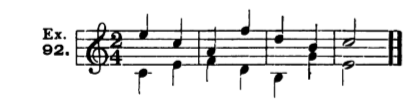
117. Applied to a faultless series of good essential intervals:
Ex.92
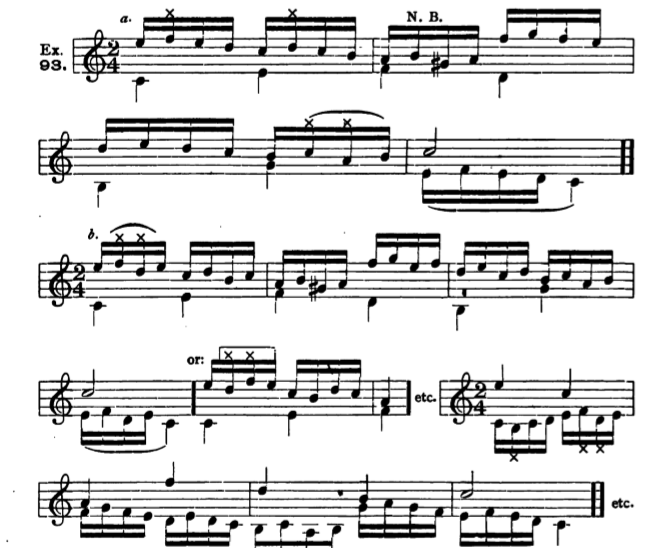
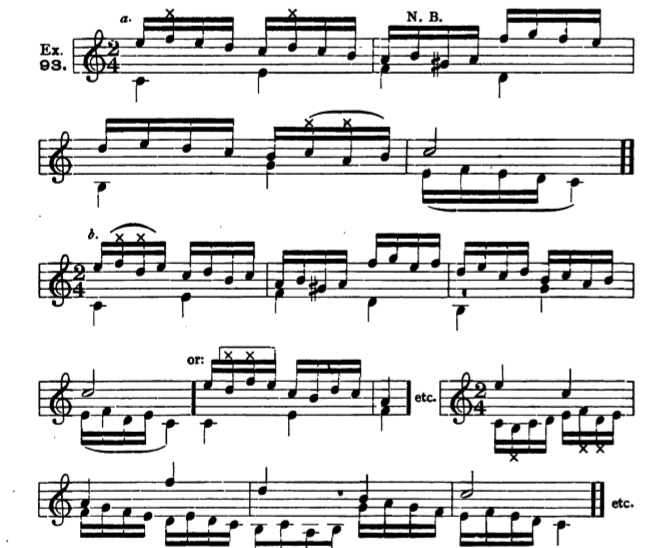
The results may be, — using only the above figures:
Ex.93a
Ex.93b
Ex.93c
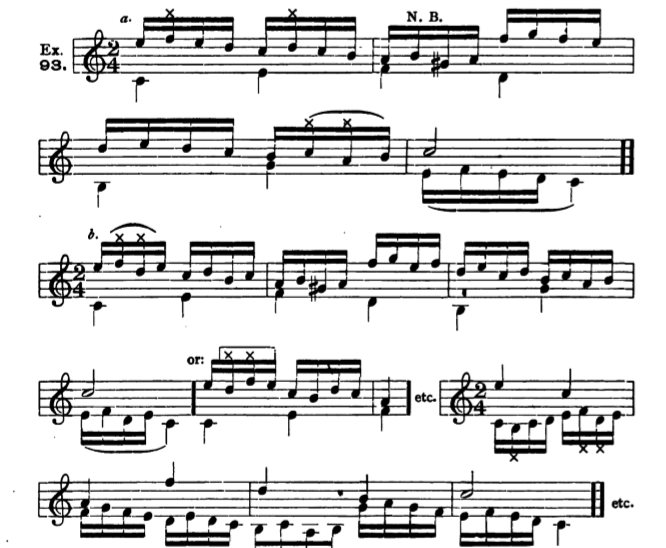
Invert all of these, as usual.
At N.B., in the second measure of version a, the lower neighbor is g-sharp instead of g. In many cases, this choice of the half-step for the lower neighbor is decidedly preferable. It is left to the taste of the student, who therefore should not neglect to test the lower neighbor, and substitute the half-step (with an accidental) where it sounds better.
The upper neighbor always agrees with the scale.
118. Rule I. The direction of the figure, when a double-neighbor is used, — of which the two possibilities are indicated in version b of the above example, — depends mainly upon the location of the following essential tones, which should, as a rule, be approached in a straight line. For example:
Ex.94a
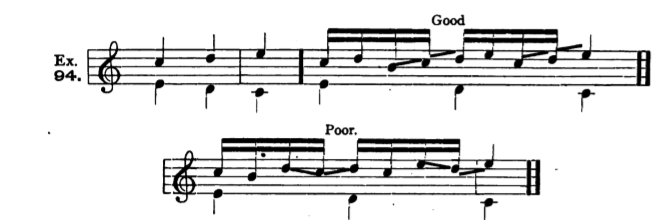
Ex.94b
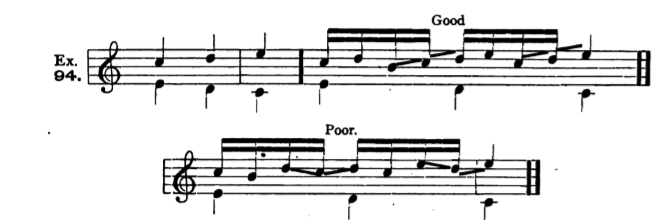
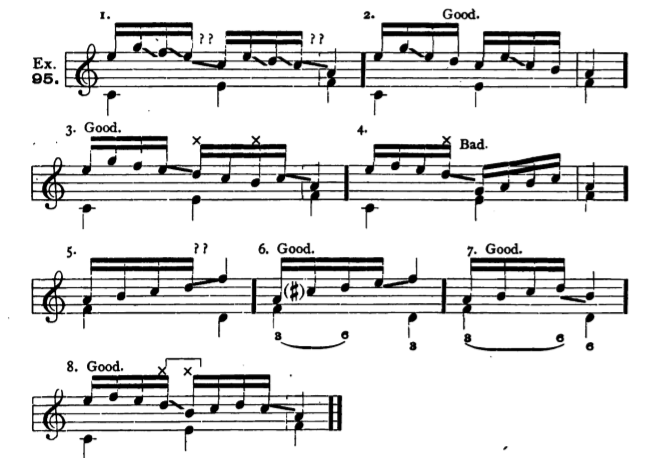
119. Rule 2. It is usually unwise to leap to the first (accented) tone of a following beat, after stepwise progression in the same direction up to that point. This is important. In other words, do not interrupt a stepwise progression (in the same direction) at the junction of one group with the next; if a skip is necessary, make it earlier in the group. For illustration:
Ex.95-1
Ex.95-2
Ex.95-3
Ex.95-4
Ex.95-5
Ex.95-6
Ex.95-7
Ex.95-8
The ear follows up a stepwise progression, and if it extends to the end of its group, the ear (mental ear) expects that it will continue stepwise into the next beat. Compare groups 1 and 3, for an illustration of this cause of mental disappointment.
Group 4 is wrong in any case, because of the rule in par. 71 (Ex. 59), which see.
In group 6, the c-sharp is preferable to c, because the essential intervals impart an impression of D minor. Further, the c is possibly the unessential lower neighbor of d, and therefore sounds best as half-step, — compare note to Ex. 93 (N. B.).
Observe that, in groups 3 and 7, there is a leap into the new group, but it is not in the same direction as the stepwise tones that precede it. Such a change of direction is generally good. Group 8 is very peculiar; but correct, because of the distinctly unessential nature of the notes that cause the irregularities. Analyze thoughtfully, and test at the piano.
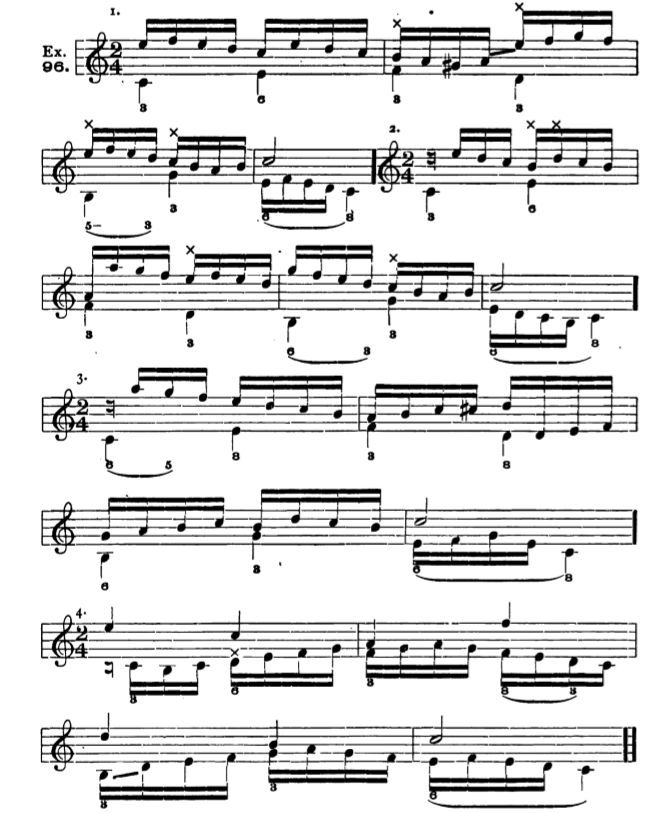
120. Other manipulations of Ex. 92:
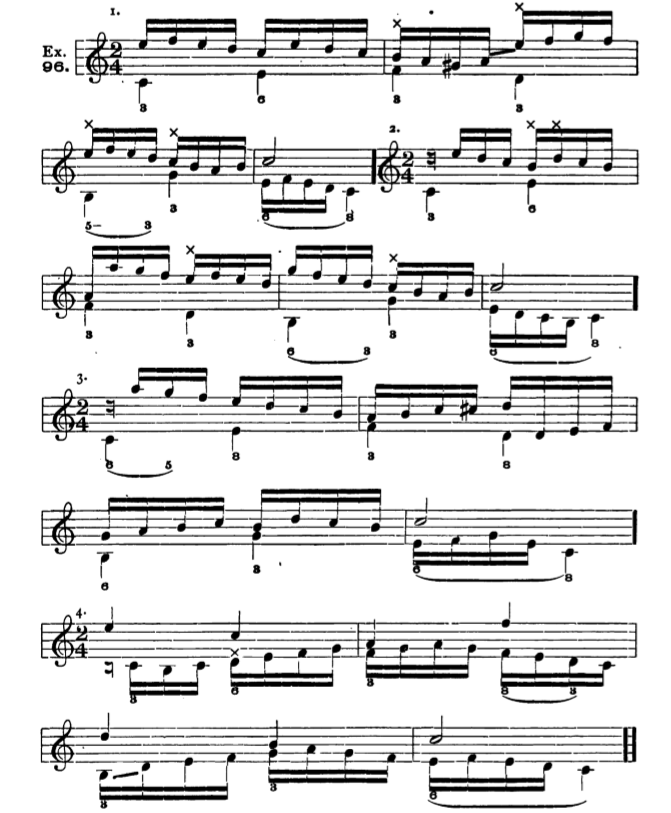
Ex.96
Ex.96-1
Ex.96-2
Ex.96-3
Ex.96-4
Study these carefully. Invert them all, as usual.
In version I, second measure, there is a wide leap at the junction of the groups. It is daring, because it is a skip to an inharmonic tone. See, again, par. 71 (Ex. 59). It is permissible, however, because (like Ex. 95, No. 8) the nature of the unessential tones is so entirely unmistakable; and, further, because of the analogy between the groups in that measure and the next (each group beginning with a " neighbor," — compare par. 107, last sentence).
Observe that in all of these versions, and in nearly all recent examples, one of the parts usually carries on the quicker rhythm for a beat or so, at the cadence.
121. Rule 3. It is permissible, and desirable, to use successive chordtones occasionally. Thus:
Ex.97
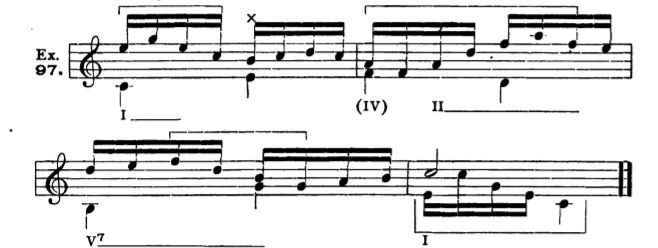
Invert, as usual.
This style, however, suggests " harmonic " figuration rather than " melodic " progression, and should therefore be used sparingly. Preference should be given to stepwise progressions, especially to such straight lines (fairly long) as are seen in many places in Ex. 96.
122. Rule 4. Besides the " straight lines " just mentioned, the most desirable and necessary trait in counterpoint is the sequence, and uniformity of figures in general. Review, carefully, par. 95 (Ex. 77, b); and reflect that this requirement is more imperative in counterpoint with four notes to a beat, than in the preceding, less active, varieties. For further illustration:
Ex.98
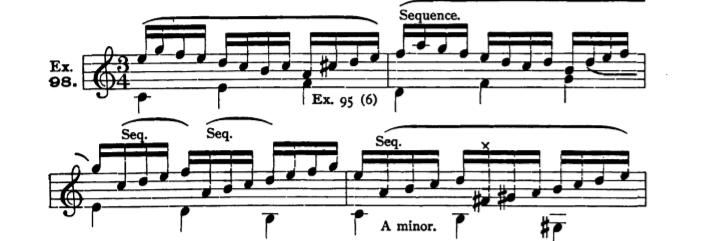
Invert this, as usual.
Exercise 12
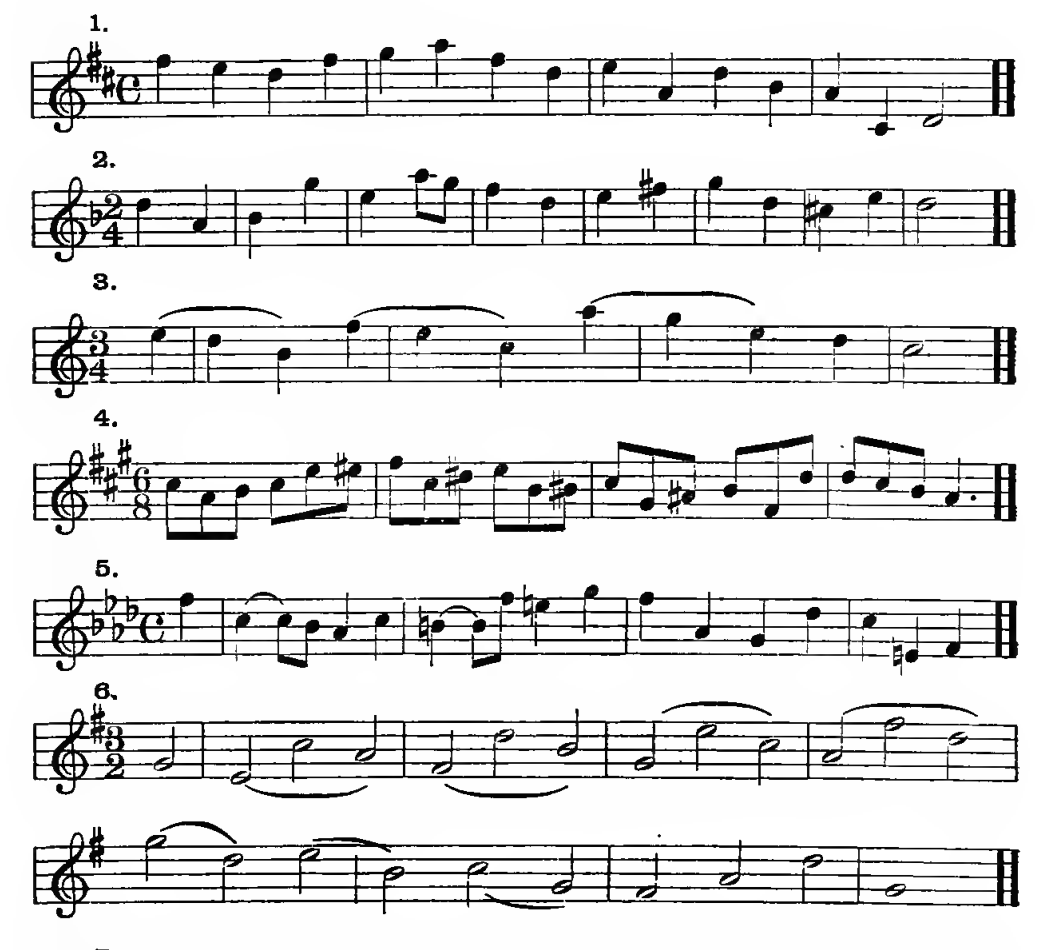
Two-Part Counterpoint. Four Notes to Each Beat.
Add a contrapuntal part to each of the following given melodies, in a rhythm of four notes to each beat, — without ties. Each melody is to be used both as upper and as lower part, as usual; and several different versions of each should be obtained. Use two staves, as a rule. 1.
Exercise 12.1

Exercise 12.2

Exercise 12.3

Exercise 12.4

Exercise 12.5

Exercise 12.6
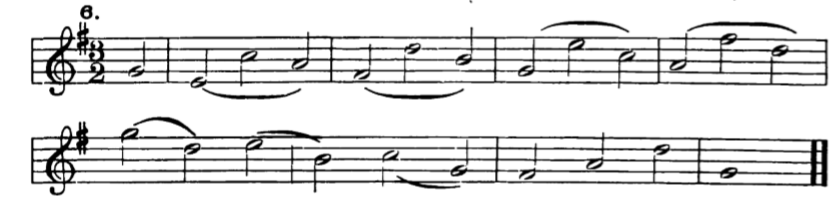
Exercise 12.7

[A solution of Melody 2 will be found in the Appendix.]
Besides these, re-counterpoint some of the melodies given in Exercises 4, 5, 6 and 7, according to this chapter.
Also write, as usual, a number of original melodies with counterpoint.