 Playable Books
Percy Goetschius · section 15 of 29
Chapter XIII. Four Notes To A Beat, As Amplified Forms
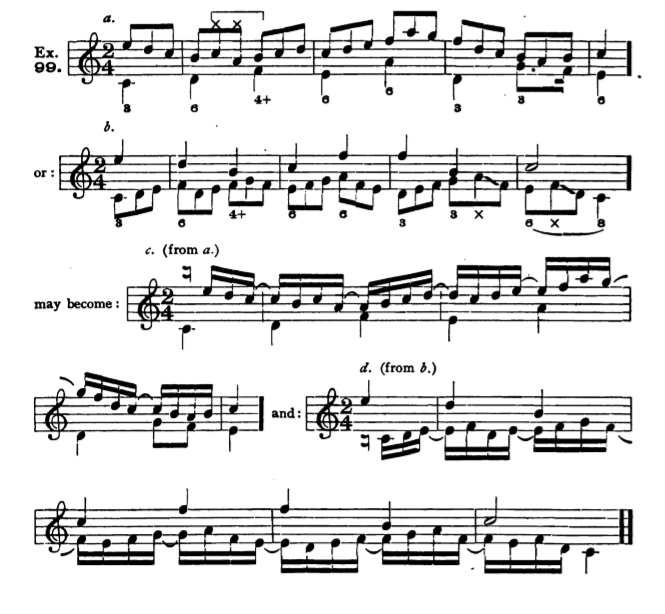
Read and hear this section in the playable edition →123. The principle of paragraphs 96 and 100 (which review) is applicable also to the contrapuntal rhythm of four tones to a beat. Namely: An original counterpoint of three notes to each beat, if smooth and faultless, may be accelerated to a rhythm of four notes, by means of the tie and shifted rhythm.
Ex.99a
Ex.99b
Ex.99c
Ex.99d
124. It will be observed that these results are not as good as those of the former chapter (pars. 96 and 100). The chief drawback is the brevity of the lying-note, which, in this quicker movement, is only a quarter of a beat. See par. 104, second sentence. Another drawback is the circumstance that the tied note is frequently a " good " interval instead of an inharmonic one. See par. 105.
The excuse for both of these unfavorable conditions is their persistency (par. 107, last sentences), but even that is a source of monotony. They are improved by inserting an occasional brief rest, as shown in Ex. 106.
Therefore, the student will probably not make extensive use of this device, in this quicker grade of movement, but depend upon other, better resources, as follows:
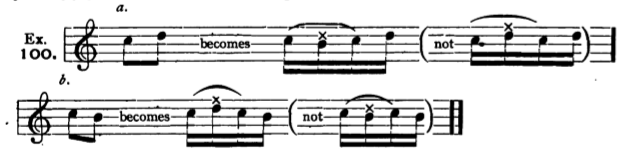
125. A counterpoint of four notes to a beat may also be derived from a faultless version of two notes to each beat, by embellishing the first note of each two-tone group with its upper or lower neighbor, — as already shown in Ex. 91.
The upper neighbor is generally chosen when the two-note group is a falling figure; and the lower neighbor, when it is a rising figure. Thus:
Ex.100a
Ex.100b
At a, the figure ascends; therefore it is better to use the lower neighbor (b) of the first note (c). At b, the opposite applies.
126. For illustration, the following faultless counterpoint of " two against one ":
Ex.101

becomes amplified to four-tone groups, by such embellishment of each accented fraction:
Ex.102
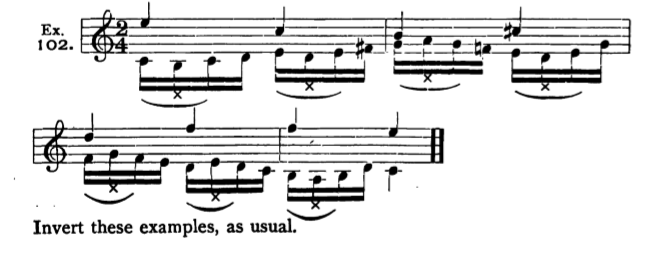
Invert these examples, as usual.
127. Further, a perfect counterpoint of " two against one " may be.accelerated to four-tone groups by inserting a chord-tone (instead of the upper or lower neighbor) between the first tone (of each group) and its repetition.
Observe the manner in which such a " repetition " always occurs when a tone is embellished by its neighbor, — as in Exs. 91 and 100. That is, the principal tone always recurs, after the neighboring note.
Thus, when applied to Ex. 101:
Ex.103
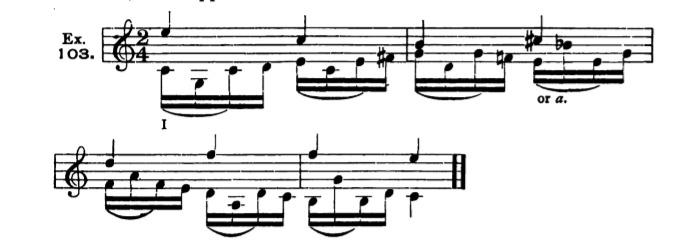
Invert this example.
In order to apply this last device correctly, the student must be able to define ' the chords. This should not be difficult, for in all good counterpoint the chord-succession is a ruling factor, and at least always present to a recognizable degree.
128. Further, two tones may become three, or four, by applying the octave-leap (par. 75) to the first tone of each group. Thus, with reference to Ex. 101:
Ex.104a
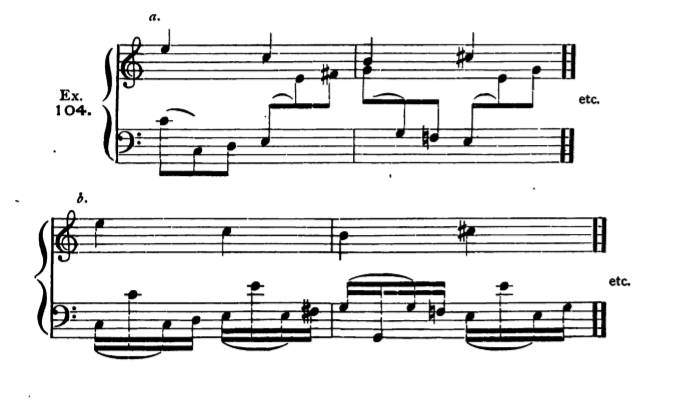
Ex.104b
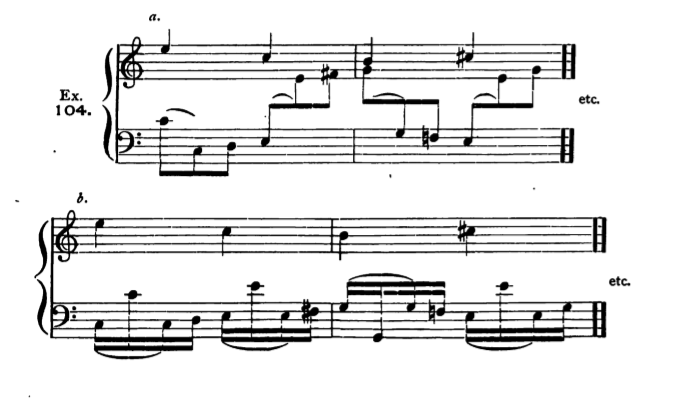
This form, though perfectly legitimate, is best limited to occasional use; its constant employment yields somewhat awkward results.
129. The best products are obtained, as usual, by employing all of these forms of enlargement, as shown in Exs. 91, 99, 102, 103 and 104, in rational alternation. For instance:
Ex.105
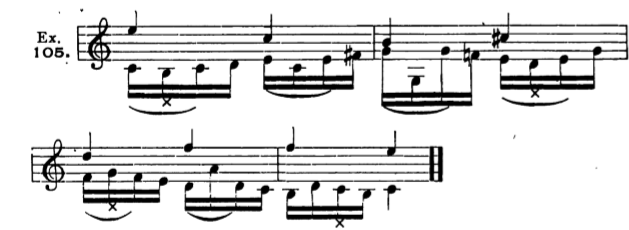
130. The brief rest may be used in connection with the tie, as shown in Ex. 89. (Review par. in and par. 112.) Applied to Ex. 99, c, the result might be:
Ex.106
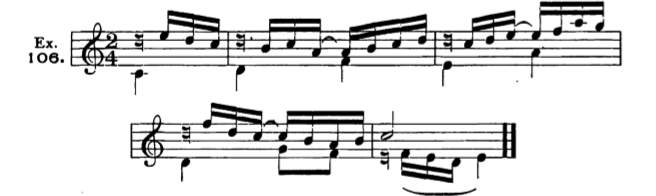
This version is considerably better than Ex. 99, c.
131. These various methods of obtaining a more animated contrapuntal part by simply expanding the simple small groups, or even the single essential tones, are as significant as they are natural and convenient; because, as the student has no doubt already observed, the most elaborate contrapuntal results are invariably reducible to a simple basis, and are, naturally, nothing more than an amplification of the latter.
All composition is, technically speaking, the development of the resources contained within the primary chord or chords, by familiar devices of rhythm, figuration, duplication, and the like. The most brilliant florid passages in the works of Liszt, Chopin, and other pianoforte writers, can always be reduced to the three or four tones of which the chord is composed, — multiplied, usually, by the addition of the grace-notes (inharmonic neighboring notes) which occupy the spaces between and around the chord-tones themselves. The most hasty analysis of any apparently elaborate piano composition will convince the student of this fact, and lead him to realize the extreme importance and correctness of all the processes of amplification,— of the development of larger groups of tone out of the simplest smaller groups.
Exercise 13
Four Notes to Each Beat.
1. Add a contrapuntal part to each of the following melodies, in a rhythm of two notes to each beat. Then accelerate each version to a rhythm of four tones to each beat, by the means shown in paragraphs 125, 127, 128; particularly par. 129. Each melody to be manipulated both as upper and as lower part. Two staves will generally be necessary.
Exercise 13.1

Exercise 13.2
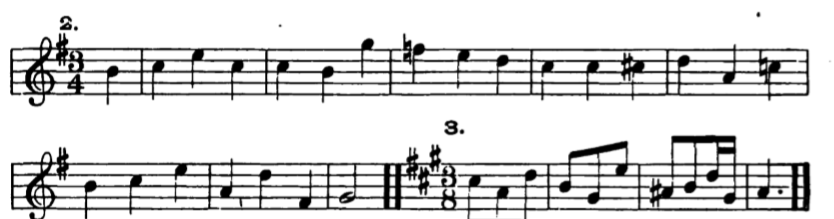
Exercise 13.3
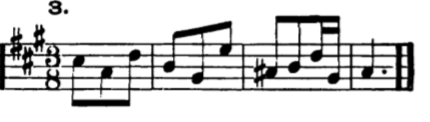
Exercise 13.4

2. Add a contrapuntal part to each, in a rhythm of //i«t notes to each beat, and quicken to a rhythm of four notes by means of the tie (and occasional rest) as shown in Exs. 99 and 106.
3. Manipulate some of the two-note counterpoints of Exercise 7 and Exercise 8, section 2; and the three-note counterpoints of Exercise 9; accelerating them to fourtone groups according to this chapter. Some of this expansion may be done at sight, at the keyboard.