 Playable Books
Percy Goetschius · section 16 of 29
Chapter XIV. Diversity Of Rhythmic Movement
Read and hear this section in the playable edition →

132. If the student who has conscientiously worked out the foregoing exercises in two-part counterpoint has at last become somewhat oppressed with their monotonous character, and has grown tired of them, it is no reflection upon his own good taste, or upon the technical correctness of this particular species of tone association. The defect lies in the absence of rhythmic interest, which must necessarily attend exercises of this kind, with their humdrum pace of two, three, or four uniform notes to each uniform beat, in one of the two melody-parts. So important is the element of rhythm, so indispensable is a certain amount of rhythmic diversity, that no musical sentence is complete and effective without it. A contrapuntal phrase may be perfect in every harmonic and melodic respect, and yet fail to excite interest or real enjoyment, because of a lack of rhythmic variety.
Consequently, no union of contrapuntal parts may be called wholly acceptable, if it does not exhibit more or less diversity of time-values in either, or both, of the parts; it must bear witness to a life within, pulsing with the varying stress of human emotion.
133. To some extent, this important requirement has already been taken into consideration, in the preceding lessons. Review par. 76 and 94, — Examples 66 and 76. It is possible, however, to develop and systematize the process of diversifying the general rhythmic effect of a musical sentence, and to define the method of its application.
134. In order to fix the bounds of such rhythmic diversity, and prevent any extravagance of rhythmic effect, it is customary to preserve a general uniformity of time-value (a certain constant fundamental movement), and to limit the diversity of rhythm to the alternating interaction of the parts. That is, instead of giving all the more rapid tones to either one of the contrapuntal parts alone (as in most of the preceding exercises), they should be distributed alternately between the parts, — not in such regular intervals as to incur again monotony of another kind, but so as to impart a more definite melodic character to each separate part, without disturbing the evenness of the whole.
135. For illustration, an example like the following, with constant uniform rhythm in the added part, —
Ex.107

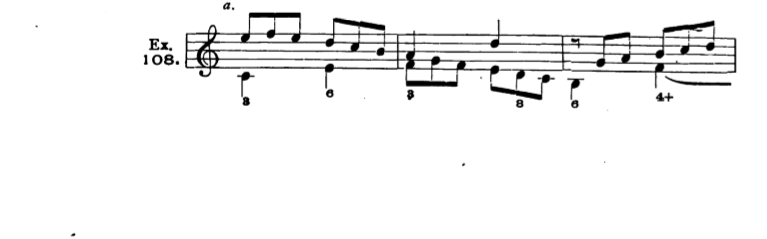
may be made far more vital and significant in both parts, by some such alternation of the fundamental movement (three notes to each beat) as this:
Ex.108a
Ex.108b
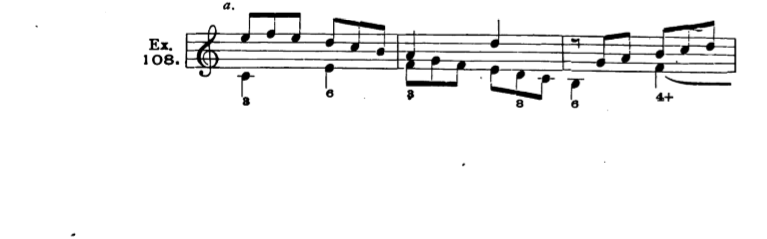
In both of these diversified versions it will be observed that the original intervals, marked in Ex. 107, are retained without essential change. At a (Ex. 108), the rapid tones are assigned first to one, and then to the other, of the two parts, in regular alternation, — from measure to measure. At b the effect is still further improved by a more irregular distribution of the shorter tones. First of all, it will be seen that they are not confined to one part at a time, but appear occasionally in both parts at once (on the second beat of the first and second measures); further, the movement in general is more animated than at a, — the upper part quickens at every second beat,' and the lower part has nearly constant rapid rhythm; interrupted just often enough to prevent monotony. A clear impression of the increased melodic vitality and beauty of these versions can be best obtained by singing each part alone. Do this thoughtfully, first with the separate parts of Ex. 107, and then with those of Ex. 108. Also invert both examples, as usual, copying them out and placing the upper part an octave lower, and the lower part an octave higher, than here written.
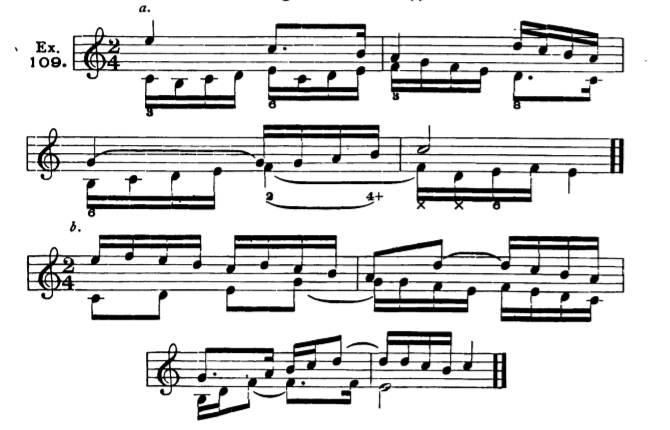
136. Further, in a rhythm of four notes to each original beat (on the basis of the essential intervals given in Ex. 107):
Ex.109a
Ex.109b
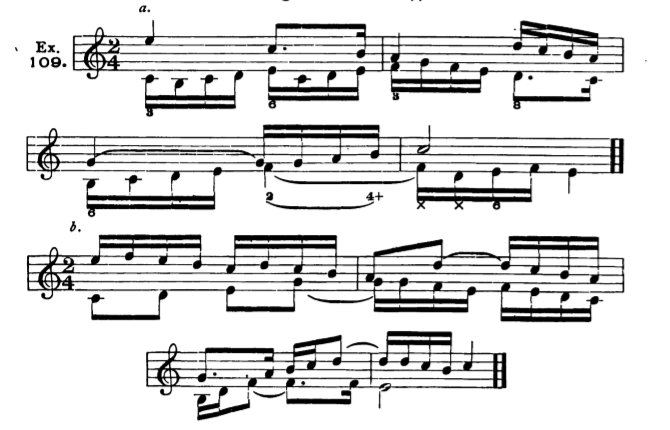
Examine these two versions carefully, and invert them, as usual. Sing each part alone.
137. Rule 1. The effect of uniform rhythmic movement should be preserved. That is, the general rhythm (two, three, or four notes to a beat, as the case may be) should be maintained in one part or the other, — occasionally in both together, as seen in the above examples.
Rare exceptions to this rule may be made, at accented points (as shown in the next example).
In Ex. 108 there is no beat which has less or more than the adopted rhythm of three tones; and in Ex. 109 every beat has its four tones, in one or the other of the parts.
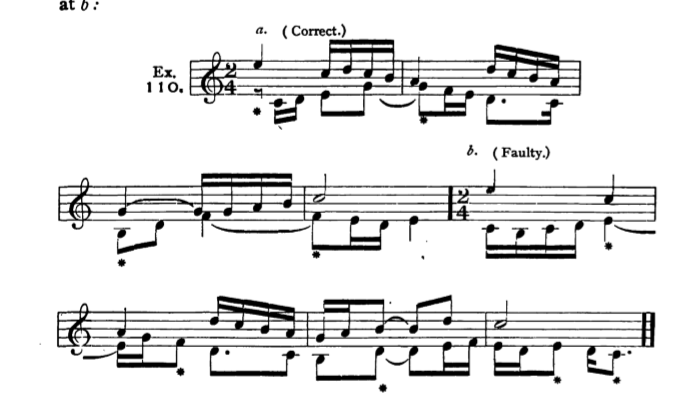
138. An occasional interruption (slackening) of the fundamental movement is shown in the following, — applied correctly at a, incorrectly at b:
Ex.110a
Ex.110b
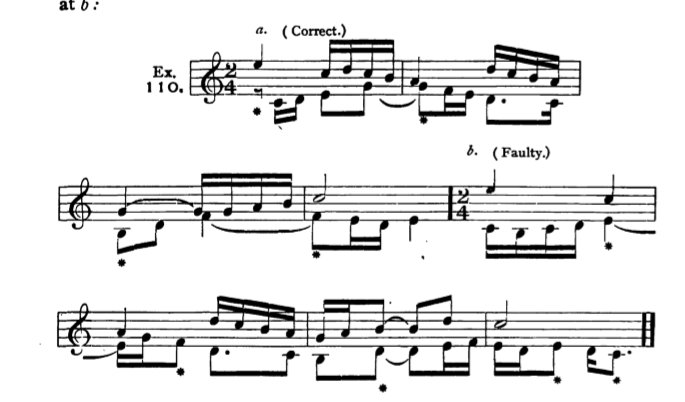
The stars indicate where the steady running movement is interrupted. In version a these interruptions all occur at accented points (at the beginning of each measure); therefore they are all correct. In version 6 they all occur at comparatively unaccented points, and are therefore irregular. Review, carefully, par. 22 and par. 23. Hence:
139. Rule 2. In case of any diversity of time-values in the collective rhythmic formation of a sentence, the heavier (longer) tones should generally occur at accented points.
The demonstration is obvious: — Longer notes are " heavier " notes, and belong properly to the comparatively " heavy " points in the measure
(or beat); shorter notes are " lighter," and belong properly to the comparatively " light" points.
Examine Ex. no very minutely with reference to this distinction.
140. It must be distinctly understood that this rule does not apply, necessarily, to each separate part, but to the combined effect of both together (that is, to the collective rhythmic formation). If either one of the two parts maintains the fundamental movement, the result will probably be good.
At the same time, it is usually necessary to avoid any striking irregularities in the upper part, because that is the more prominent one. For instance, the following version is not quite as smooth as Ex. no, a.
Ex.111
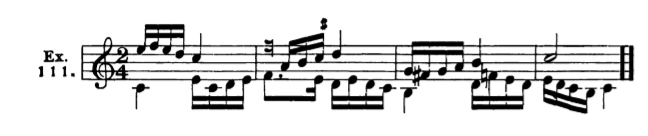
In Ex. 110, a, the lighter tones (16th-notes) in the upper part all appear on the lighter beat (second, or unaccented beat) of each measure. Here, in Ex. 111, on the contrary, the heavy (first) beat is subdivided into the light 16th-notes, while the unbroken (heavy) quarter-notes fall on the unaccented beats. Sing each of these two upper parts alone, and note the marked difference in their effect. Observe, also, that Ex. 111, when inverted, sounds perfectly well.
141. This warning applies chiefly to the quicker rhythmic movements. It is seldom necessary in rhythms of only two notes to a beat; but becomes so in a rhythm of three, and is still more imperative in one of four notes to a beat.
In slower rhythmic movement, and moderate tempo, even the fundamental rule (par. 139) may often be disregarded. For example:
Ex.112
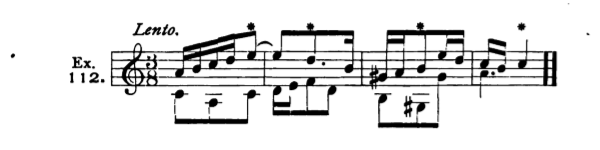
Here, the comparatively heavier notes all stand upon the lighter beats of the measure; but the effect is not bad. Observe that in measures 2, 3 and 4 they occur uniformly on the second beat. See par. 23, second sentence (Ex. 23). Invert this example.
Exercise 14
Rhythmic Movement In Alternating Parts
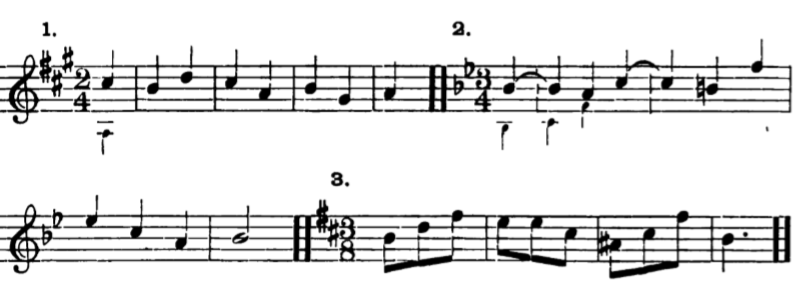
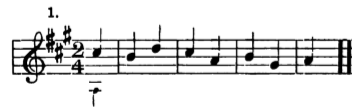
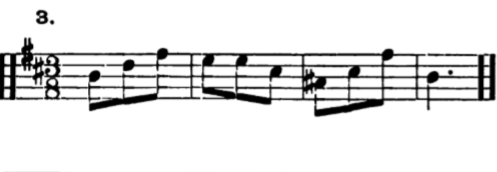
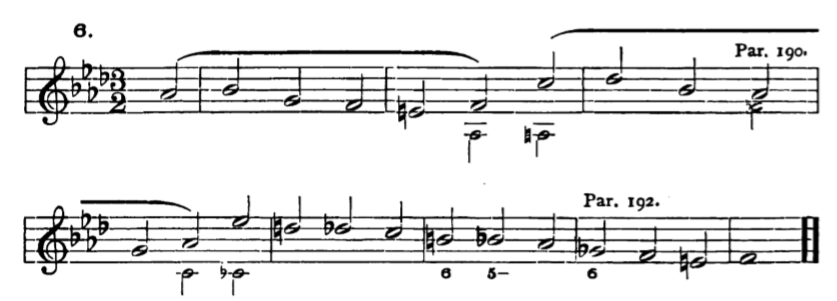
Add a contrapuntal part to each of the following melodies, in corresponding rhythm (note against note, as in Exercise 4), being careful to select good essential intervals, as required in par. 101, — which review.
Each version thus obtained is then to be amplified into a rhythm of first two, then three, and then four notes to each beat, — the rhythmic movement to appear alternately (and occasionally together) in the two parts, as shown in the above examples. Use two staves, as a rule.
Exercise 14.2
Exercise 14.1
Exercise 14.3
Exercise 14.4

Exercise 14.5

Exercise 14.6
Besides these, experiment with some former melodies.
Also invent a number of original melodies with counterpoint, as usual, imitating the style of the above, in sentences of four, six, or eight measures.