 Playable Books
Percy Goetschius · section 18 of 29
Chapter XVI. Three-Part Harmony
Read and hear this section in the playable edition →157. The next step in contrapuntal study is the simultaneous treatment of three individual melodic parts. Review par. 1.
158. " Individual" these three parts must be, each by itself, to a certain extent; for the contrapuntal principle, as has been shown, does not rest upon mere duplication of parts, or " accompaniment." It involves the association and interaction of separately correct and satisfactory melodic lines. At the same time, this individuality of each of the parts must be controlled and limited by necessary consideration for the movements of the other parts, and harmonious agreement of each with the others; their independence should consist solely in their personal melodic formation, as melodies, and must not lead to conflict of harmonic formation. In a word, to repeat the fundamental definition, the parts are to be melodically distinct, but harmonically unanimous.
159. This statement admits of but one construction, and that is, that a harmonic basis is necessary; and that, therefore, the underlying chords must first be defined, from point to point, as a general guide (at least) to the melodic course which the parts are severally to pursue.
160. Of the three parts, — coordinate though they will all be,— some one is likely to be the Leader for the time being. The reasons for this will be understood when the time comes. It may be (is almost certain to be) that the Leader is that one of the parts which has the Motive;
or it may be, rather frequently, the uppermost part, which attracts attention because of its position; or it will be the one that is engaged in carrying out some sequential design, which causes it to step into the foreground for a while. Be this as it may, the mind is inclined to give momentary preference to some single line, and to define the chords from that line (as, for instance, the upper line in Ex. 123).
161. Such " harmonizing" of a melodic phrase is subject to one sweeping rule:
A tone " may " be harmonized by any chord of which it is a component interval. That is, the tone may appear as Root, Third, Fifth, possibly as Seventh or even Ninth of some chord; as Seventh or Ninth, however, only when it moves stepwise downward, or in some other way that provides for its resolution.
162. Thus, the tone C may indicate, in C major, the following chords:
Ex.119
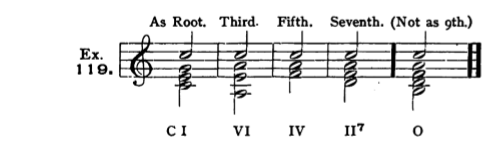
As Root. Third. Fifth. Seventh. (Not as 9th.)
And, besides these, in its fuller significance, in any key.
Ex.120
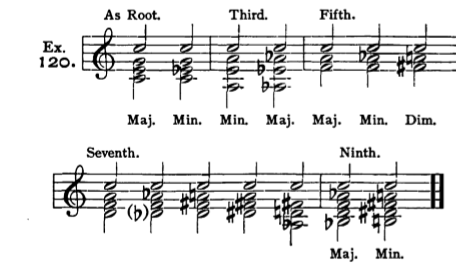
163. This list is not exhaustive. The given tone may also appear as root, third, or fifth in several other chords of the seventh (as root, for instance, in the Dom.-7th chord of F major and minor, etc.).
The task of selecting the proper chord would be formidable, if this entire list of possibilities were always valid at every point. But the choice is very greatly reduced by the ruling key, or tonality; whether, for example, the C in Ex. 120 would be treated as a major third, or as a minor third, must depend upon whether it occurs in the neighborhood of A minor, or of At> major. And, consequently, the number of available chords for the harmonizing of the tone C, in C major or its vicinity, would dwindle down to the brief list given in Ex. 119.
Hence, further, while Ex. 120 discloses an inspiring outlook for the intelligent student, and clearly exhibits the infinitude of the composer's resources, it also suggests the necessity of rational limitation, and vindicates the truly vital principle of tonality and key, as temporary centralizing influences.
164. The same restrictions apply to every tone; as in the case of C, so with D, and the rest; among all the possible harmonizations.there are a very few probable ones, to which preference must be given, and which are to be singled out as first choice.
Thus, the tone D suggests only the following chords, in C major:
Ex.121
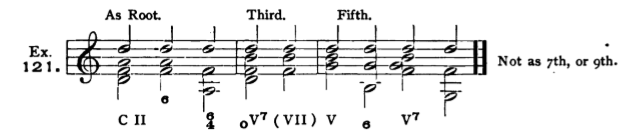
As Root. Third. Fifth.
Not as 7th, or 9th.
The name ₀V⁷ means “Dominant-7th, Incomplete.” The term “Incomplete” refers to the omission of the root. The name VII is not used in this book.
165. This more narrow, but more rational, choice of chords for each individual step of a scale, may be tabulated as follows, — for C major (or minor):
Ex.122
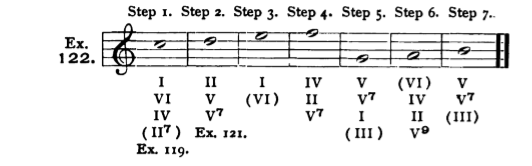
Explanation. The first scale-step, of any key, may be harmonized either with the I, or VI, or IV (possibly the II⁷) of that key. The second step may be harmonized either with the II, or V, or V⁷ of that key. And so on.
Further, not only the fundamental form, but also the inverted forms of the chords may be used.
166. The application of this table to a given melodic succession, is made by simply defining, first, the scale-step which each melody-tone represents in the given key, and then selecting one from the group of chords that are valid for that scale-step. For example: Given the melodic figure e-d-c, in C major; these tones are steps 3-2-1, and may therefore be harmonized in the following ways (— as upper part, with a lower and one inner part):
Ex.123
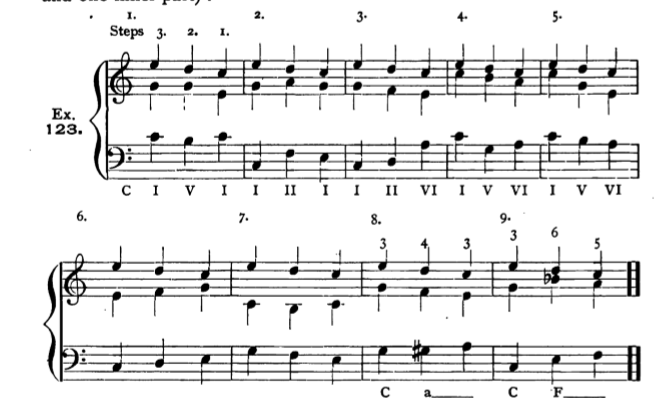
The above are all good. Examine them carefully. Many others are possible, especially by substituting other (inverted) forms of the same harmonic succession, — compare Nos. 4 and 5; or by modulating into related keys, as in Nos. 8 and 9.
The following are faulty:
Ex.124
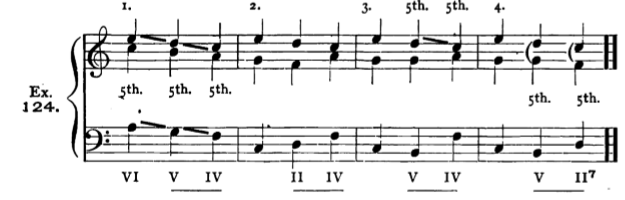
In the first group, the successive 5ths (in the outer parts) result from two causes: first, from harmonizing step 3 with the VI (which is possible, but rare, according to the table in Ex. 122); and second, from the unnatural chord-succession, V into IV (see Ex. 125). The latter succession is also responsible for the faults in the third and fourth groups. In the second group there is an awkward chord-succession (II into IV,—Ex. 125).
167. From this it appears, that the choice of chords from the lists in Ex. 122 is somewhat limited by the rules of natural chord-succession.
Of these rules the student may be already aware. If so, he might omit the next few paragraphs (up to and including par. 176).
168. It is true, ultimately, that any chord-succession may be employed, — when the student shall have learned to overcome awkward conditions by perfectly correct contrapuntal movements (correct melodic movement in every part). But the beginner must respect the following distinctions.
Some chord-successions are natural, corroborating the conditions created by the relations of the chords to each other, and to their Tonic centre. Others are more or less unnatural and awkward.
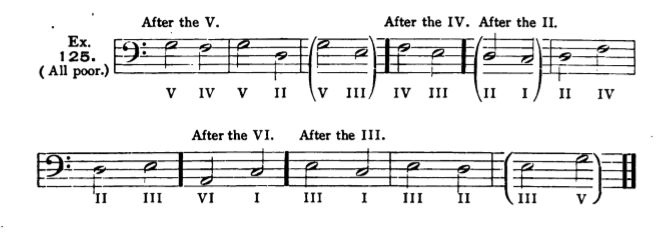
169. The following table shows how each one of the six triads may progress; that is, which chords may come after each:
After the I, — any chord of the same key or of any other key.
After the V, — either the I, or the VI (which is the " parallel" triad of the I). Possibly the III.
After the IV, any chord excepting the III.
After the II, — either the V (a perfect 5th below), or the VI (a perfect 5th above).
After the VI, — any chord excepting the I (which is its own " parallel chord" and therefore should not follow, but precede, the inferior one).
After the III, — either the IV, or the VI.
For every one of these movements (and prohibitions) there are satisfactory scientific reasons. This, however, is not the place for their demonstration. The student must know the facts, and must therefore memorize the tables, and embrace every opportunity of putting them into practice, until they become a second nature to him. If his musical instinct is quick, his mind will all the more readily assent to them. If not, he will have to work a little harder.
170. Stated inversely, the following are the chord-progressions which should be avoided:
Ex.125
After the IV. After the II.
V IV V II \V III/ IV III After the VI. After the III.
The succession V-III is really good; but the III is a rare chord, and should be avoided, as a rule. The succession II-I is stiff, but not bad; it is always possible when inverted forms are used, — that is, when the chord-3rd, or 5th, appears in the lowermost part, instead of the Root.
171. Every one of the above unnatural chord-progressions can be used, when the second one of the two chords is inverted. For example, the V may be followed by an inversion of the IV, or of the II.
172. This refers principally to the first inversion, — the chord of the 6th, which is almost invariably good.
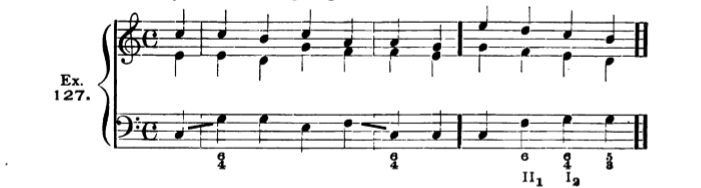
The second inversion of any triad-form (the 6/4 chord) is rare and hazardous. It would be wise for the student to avoid all 6/4 chords, excepting the second inversion of the I, and of the IV. These are good.
In other words, avoid the chord-fifth in the lower part, excepting in the I and IV.
173. For I chords, the following rules must be observed:
Leaps are not good, either to or from a £ chord (in the lower part);
excepting, as usual, during chord-repetition. Six-four chords should not occur in direct succession. For illustration, this lower part is faulty:
Ex.126
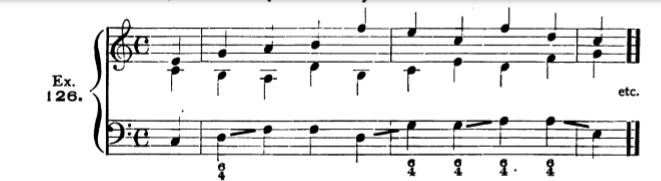
On the contrary, the following is good:
Ex.127
174. The rules given for the V apply also to the V⁷ and V⁹ (and to their Incomplete forms, ₀V⁷ and ₀V⁹); but more strictly, and with certain limitations, on account of the resolution of the chord-7th and 9th, — stepwise downward. (See par. 58, second clause, — Ex. 49.) For illustration:
Ex.128
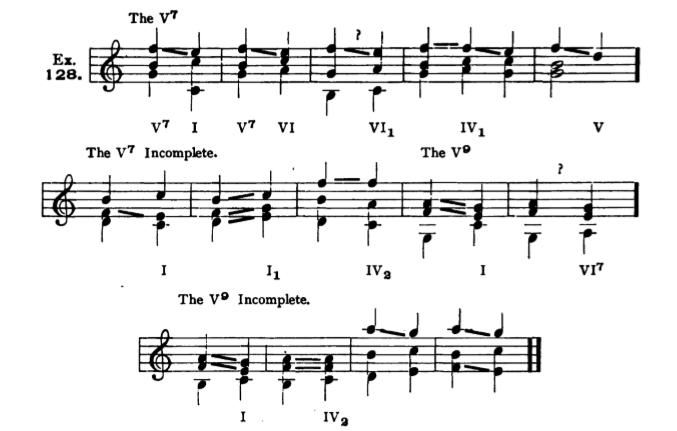
Group 3 is doubtful, because of the inverted form of the VI. That triad is very rarely inverted. In group 4, the seventh of the chord (f in the upper part) remains where it is; this is always good, if the proper resolution follows. As already stated, the term " Incomplete " signifies that the Root is omitted.
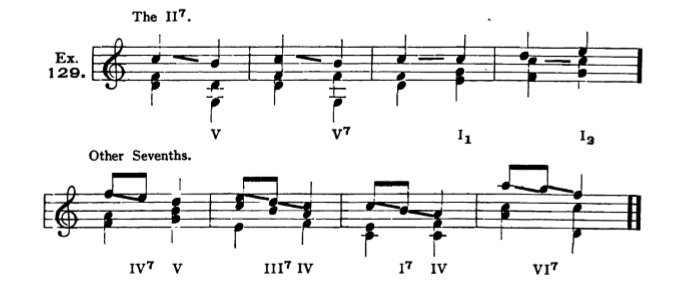
175. The II⁷ is treated like the V⁷. Like the II, it passes into the V, or into inverted forms of the I.
The other chords of the Seventh seldom occur as essential bodies, but often as descending passing-notes. Thus:
Ex.129
176. All of these rules apply, as usual, to the minor mode, precisely as to major. The only modification is the occasional lowering of the 7th scalestep, and raising of the 6th step, according to par. 32 (Ex. 30), which review thoroughly. See also par. 184.
Transpose Exs. 123 to 130 to C minor, — at the keyboard, — with particular reference to these paragraphs (32 and 184).
177. In this lesson, the student will confine his exercises to the " good " chords (review par. 12, Ex. 12), and to one key at a time. This will simplify the use of Ex. 122, and of par. 169.
For illustration, a melodic sentence in C major as upper part; each tone an essential chord-tone (that is, no passing-notes or neighboring notes, in these lessons):
Ex.130
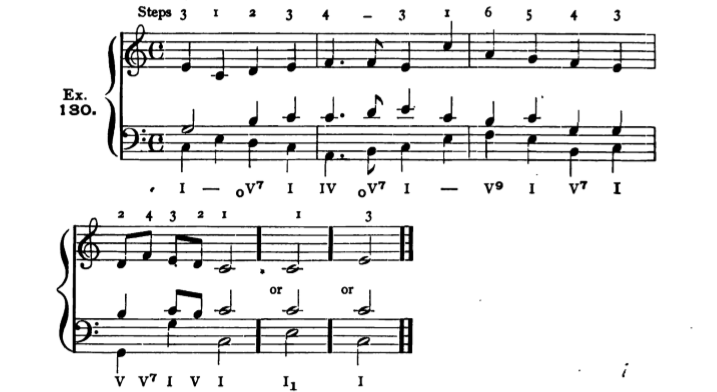
N. B. In measure 1, beat 3, the d is doubled and f is omitted. On the next beat, the chord-5th g is omitted. In measure 2, beat 3, e is doubled and g omitted. On the next beat, g is again omitted. In measure 3, beat 1, d is omitted.
In all of these cases, enough of the chord is present to define it beyond doubt; the object of the omissions is, simply, to obtain the best melodic progressions.
Either of the three endings is good.
178. This is, to be sure, a purely harmonic task; merely the defining of the chords that are required or suggested by the successive melody-tones. But it acquires a certain contrapuntal flavor through the effort to give each separate part a good melodic form. This can be done by judicious choice of duplication, and of omission, in the spelling of the chords, as seen in Ex. 130. Sing, or play, or write out, each of the above three parts alone by itself, and it will be seen that something more is accomplished than the mere harmonic accompaniment of the given melody. Such practice is so beneficial, so instructive and so stimulating, that the student should make extremely thorough use of it, before undertaking the genuine contrapuntal treatment of three parts.
Exercise 16
Three Harmonic Parts, as Melodic Harmonization. Primary Chords.
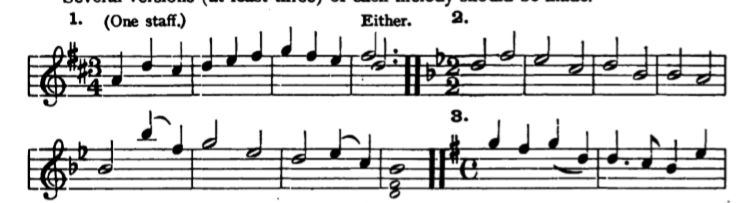
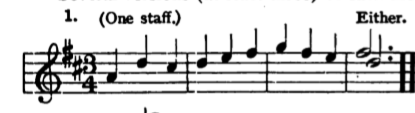
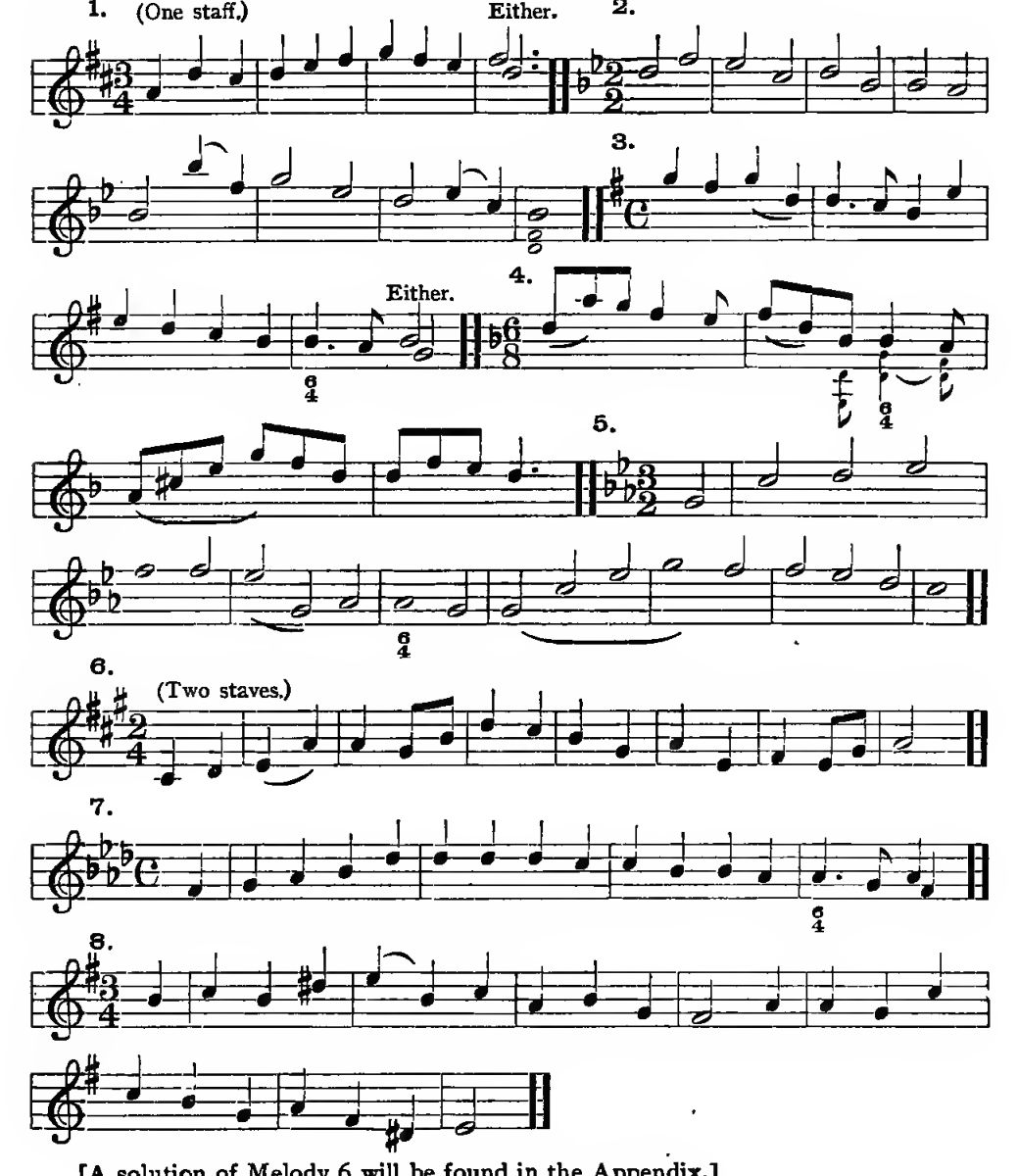
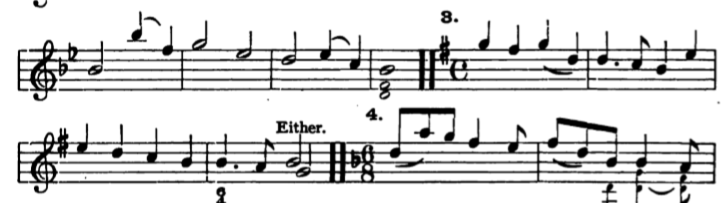
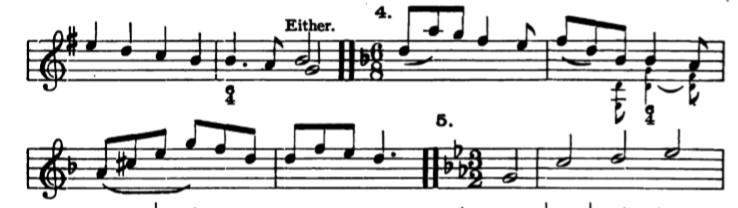
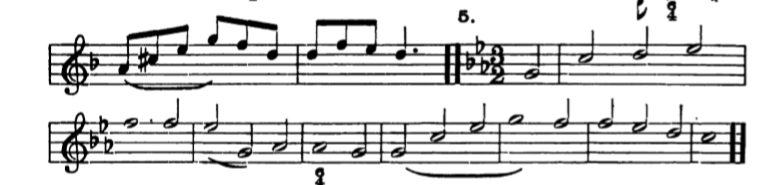
Harmonize each of the following melodies, as upper part, with "good" chords only, —the I, V, IV, V and V, — as s.iown in Ex. 130.
Each melody in the same key throughout.
Endeavor to make each part, separately, as melodious as possible.
If the melody is high, one staff will suffice (as in Ex. 128); if low, two staves will be more convenient. Or, in any case, the student may use two staves, if he so desires.
Several versions (at least three) of each melody should be made. 1. (One staff.) Either. 2.
Exercise 16.2
Exercise 16.1
Exercise 16.3
Exercise 16.4
Exercise 16.5
Exercise 16.6

Exercise 16.7

Exercise 16.8
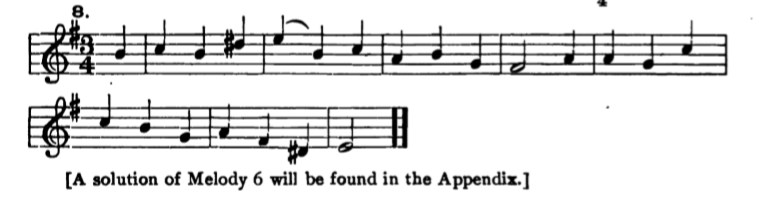
[A solution of Melody 6 will be found in the Appendix.]