 Playable Books
Percy Goetschius · section 17 of 29
Chapter XV. Motive-Development. Imitation
Read and hear this section in the playable edition →




142. The student may now venture to make more specific practical application of the contrapuntal facility he has gained; for the beginner, this is most easily and safely effected in the manipulation and development of a brief Motive.
143. The general aim of counterpoint, as stated, is the association of melodies, or the multiplication of melodic lines by harmonious cooperation. But the mere increase of the number of melodic parts is, in itself, no guaranty of artistic structure; on the contrary, such profusion of lines may easily tend to render the structure complex and obscure, and defeat the artistic purpose by diffusion instead of concentration. Multiplicity of tone-lines may so divide the hearer's attention as to destroy his sense of the principal line or lines of the musical picture.
The necessary concentration is gained by the adoption of some striking motive., or leading figure, which is held more or less constantly before the hearer's mind, as the ruling idea, in the development of which all the parts engage alternately.
Very many devices are employed in this process of development; for the explanation of these, the student is referred to the author's " Applied Counterpoint," Chap. IV; or any standard text-book. Only the most natural and fundamental method can be considered here.
144. A Motive is a brief melodic sentence, usually no more than one or two measures in length; of simple, regular, but somewhat striking character. It may begin at any point in the measure, and with any tone which indicates or suggests the tonic chord of the key; it generally ends upon an accented beat, with some tone of the tonic (or, more rarely, the dominant) chord. It is chiefly necessary to provide for a clear tonic impression, at, or near, the beginning, so as to establish the key, and obviate any awkward or obscure conditions further on.
For illustrations of Motive construction, the student is referred to the Two-part and Three-part Inventions of Bach, almost all of which begin with the " Motive " (contained in the first measure or two). Sometimes the motive appears alone, as in Nos. 1, 2, 3 and 4 of the Two-part Inventions. Sometimes it is accompanied at once by a lower contrapuntal part, as"in Nos. 1, 1, 3 and 4 of the Three-part Inventions. Examine all of these motives very carefully; and also the following two, which will be employed in this lesson:
Ex.113-1

Ex.113-2
145. The first and most natural act in the development of a Motive, is its recurrence, — not in the same part, but in the other part. Such a reproduction of the Motive in another part is called its Imitation (not " repetition "). See Ex. 114, second measure. The term Imitation may be applied to each successive occurrence of the Motive, throughout the sentence; though the proper name " Motive " is everywhere quite sufficient.
146. The design of a sentence that is devoted to the manipulation of a Motive, in two-part counterpoint, is as follows:
1. The adopted Motive is first announced, generally alone, in either the upper or lower of the two parts of which the contrapuntal sentence is to consist. Then it is taken up, — or " imitated," — by the other part; usually upon the same beats of the measure as at first; and upon the same steps of the scale, either an octave higher, or an octave lower, than before (according to the location of the leading part).
2. A recurrence of that kind, upon the same steps of the higher or lower octave, is called the " Imitation in the octave." See Ex. 114, second measure, upper part.
3. Meanwhile, the first part continues its melodic movement, as contrapuntal " added part " to the Motive which is being imitated in the other part. This continuation is called the " Contrapuntal associate."
4. This counterpoint is made according to the principles and rules of the preceding chapters, particularly chapter XIV, with reference to the free rhythmic treatment of the two parts.
5. But it is subject to one other significant rule; namely: The contrapuntal associate must be a perfectly natural continuation of the preceding tones, so adjusted and conducted that the entire group appears to be one uninterrupted melodic sentence.
147. These details are all exhibited in the following examples (with the Motives of Ex. 113):
Ex.114
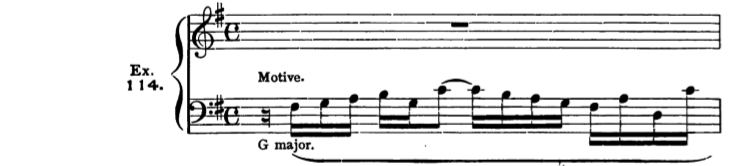
This is analyzed as follows: First, the " announcement" of Motive 1 (Ex. 113) in the lower part; followed by its " Imitation " an octave higher, in the upper part; and, below, the " contrapuntal associate " of this Imitation of the Motive.
Play, or sing, the lower part alone, in order to test the above rule (146—5), and prove that these two measures (in the lower part) are an entirely complete and satisfactory melodic phrase, by themselves, without regard to the Motive in the other part.
Further (with Motive 2 of Ex. 113):
Ex.115
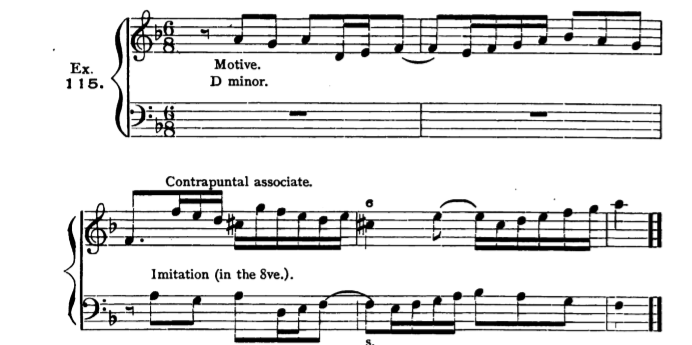
Here the Motive is announced in the upper part, and imitated an octave below in the lower part. Again, play or sing the upper part alone, throughout, and test these two measures with reference to the rule in par. 146-5.
148. In order to obtain a better grasp of these important preliminary details, the student may re-write these two examples, reversing the order of the parts. Namely: Begin Ex. 114 with the Motive in the upper part; imitate it in the lower (in the octave), but invent a new contrapuntal associate, adopting a different melodic and rhythmic form from the one given above.
Then begin Ex. 115 with the Motive in the lower part, imitation in the upper, and new contrapuntal associate.
Also examine the first few measures of the Two-part Inventions of Bach, Nos. i> z, 3, 4, 7, and 8; observe the manner of imitation (in every case in the lower part), and carefully analyze the formation of the contrapuntal associate.
In No. 10 of these Inventions, the imitation of the motive (second measure, lower part), is not in the octave, but a fourth below the original tones. From this it will be inferred that the motive may recur upon any steps of the scale which may prove to be convenient for the purpose. The imitation in the octave (upon the same steps) is, however, by far the most common at the beginning; while other steps of the scale are likely to be chosen for the reappearances of the motive from time to time in the later course of the sentence.
149. In continuing the manipulation of a Motive beyond the first Imitation (the point at which the above examples were interrupted), the possibilities are very numerous, and the greatest scope may be given to the freedom of the writer's imagination and to his facility. Among these, however, the following design is the most natural, and is commended to the beginner: After the first Imitation is finished, devote one measure to a modulation into the Dominant key (or the relative key), using lines which proceed as naturally as possible out of the preceding measure, — giving decided preference to sequential figures (par. 95); then make two announcements of the Motive in the new key. Thus, with the first Motive (beginning in the middle of the second measure of Ex. 114):
Ex.116
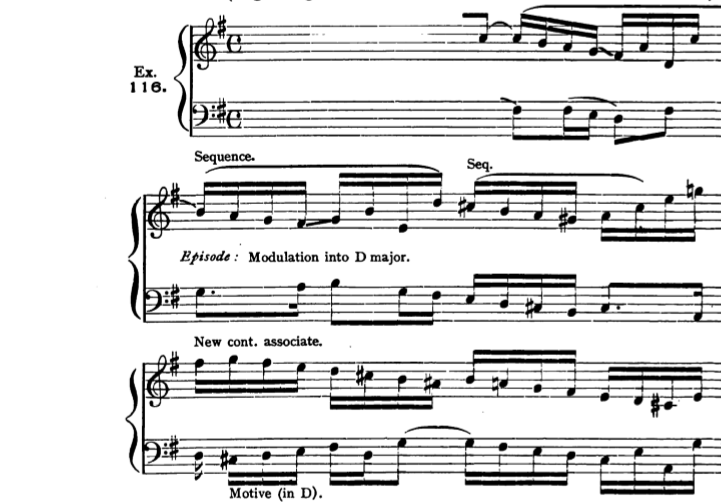
Observe that the and of these measures, devoted to the modulation, does not contain the entire Motive, but only figures from it, derived by sequence. Such a passage is called an Episode. Observe, further, that the sequences are not exact, and remember that such freedom is not only permissible, but necessary.
Notice how completely " new " the contrapuntal associate is, in the following measure, as compared with the first one; and notice how, for variety, this contrapuntal associate is not re-constructed, in the next measure, but corresponds to the preceding one.
Finally, observe how d-sharp is substituted for d at the beginning of the last measure, in order to introduce another modulation (this time into the relative key, E minor).
150. The formation, and the length, of an Episode are entirely optional, excepting that it must be in close keeping with what has gone before. It must, - like the contrapuntal associate, — be a perfectly natural continuation of the foregoing lines (par. 146-5); and this may refer to the line of either the upper or the lower part. For this reason, sequential formation is the most desirable.
151. Further, the continuation of Motive 2 (beginning with the 3rd measure of Ex. 115) might be about as follows:
Ex.117
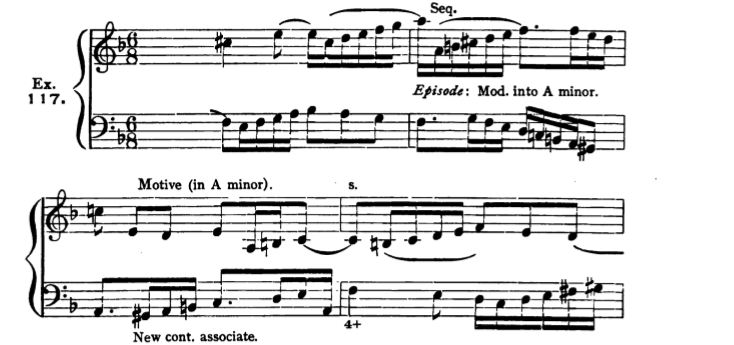
Episode: Mod. into A minor.
ELEMENTARY COUNTERPOINT. Seq. Sequences.
Analyze carefully, and observe the agreement of this design with the suggestion given in par. 149.
152. The observant student will probably realize that a great part of the object and the labor of this method of composition centres in the formation of the contrapuntal associates, or of the " counterpoint" in general; and this is a task for which the past lessons in counterpoint must have prepared him. The difference between the preceding Exercises and the counterpoints shown in this lesson appears much greater than it actually is; it is merely a difference in rhythmic appearance, and is not at all of an essential character. Close comparison with the rules and illustrations given in Chap. XIV will prove this. If any additional directions are necessary, they are comprised in the following general rule: Be sure that some good interval appears (or is understood) at the accents, and at strong beats in general; lead the two parts smoothly to these points, maintaining a uniform rhythmic effect, and alternating (or combining) the shorter note-values so as to obtain a good rhythmic form in each separate part. To test this rule, analyze the contrapuntal treatment of every measure in all of the Two-part Inventions of Bach.
153. In pursuing the development of the Motive still further, it will be necessary (before rounding off the complete sentence with a perfect cadence in the original key) to introduce a few more episodic passages, modulations, and imitations of the Motive. Some of these are necessary, and determinable; though, in general, the details may be chosen with considerable freedom, and will depend upon the fancy of the writer, or upon the specific nature of the Motive.
154. For the beginner, a schedule like the following (embracing the entire sentence) will prove most natural and effective:
1. The announcement of the Motive (in either part).
2. The imitation of the Motive in the octave, in the other part.
3. An episode of one or two measures, modulating to the Domi-
4. Two announcements of the Motive in this key (one in each
5. An episode of one or two measures, modulating into the Relative (major or minor) key.
6. One or two announcements of the Motive in that key (either
7. An episode, modulating into the Subdominant key (or its Rel-
8. One announcement of the Motive in that key (either part).
9. An episode, modulating back to the original key.
10. One or two announcements of the Motive in that key.
11. Episode, and perfect cadence.
Note. Either 3 and 6, or 7 and 8, or all of these, may be omitted.
For example, the development of Motive 1, given in Examples 114 and 116, may be continued thus, — recommencing with No. 5 of the above details (end of Ex. 116):
Ex.118
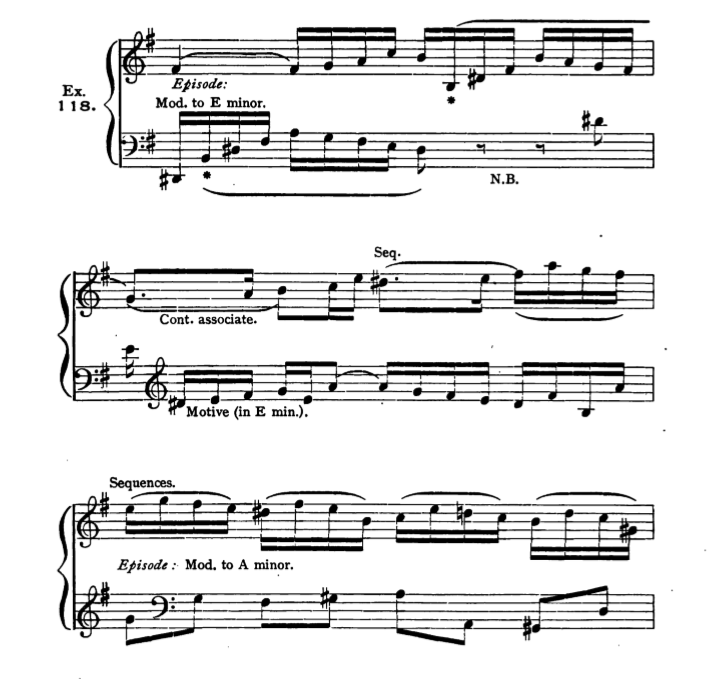
The student will do wisely to copy out Exs. 114, 116 and 118, consecutively, so that he can analyze the whole sentence without interruption.
Observe, at * in the first measure of Ex. 118, the imitating of a figure that is not in the Motive. Such episodic imitations are as valuable as those of the motive itself.
Observe, at N. B. in the same measure, the brief rests. Also in measure 6, before the entrance of the Motive.
Observe, at N. B. in the 5th measure (of Ex. 118), the alteration 0/ one of the intervals in the given Motive. The upward leap of a 4th is changed to a leap of the 6th. Such little changes are not only permissible, but desirable, from time to time.
Observe, at N. B. in the 6th measure, that the Motive enters in the third beat, instead of at the beginning of the measure. This is called Imitation in Shifted Rh7thm, and is permissible and effective, if carefully tested.
Observe, further, the addition of extra parts, and the duplication of the lower part in octaves, at the approach to the perfect cadence.
Analyze every detail, most minutely; especially the-formation of the various contrapuntal associates, and the Episodes.
155. A sentence of this kind is generally known as an Invention.
Exercise 15
Motive-Development in Two-Part Counterpoint.
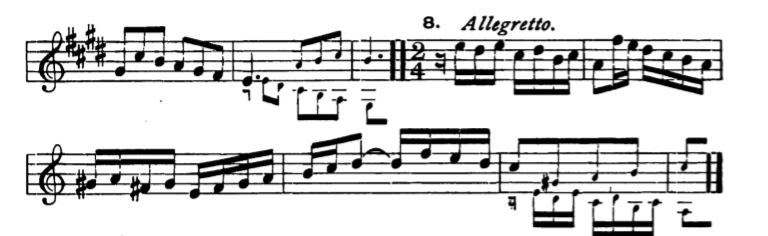
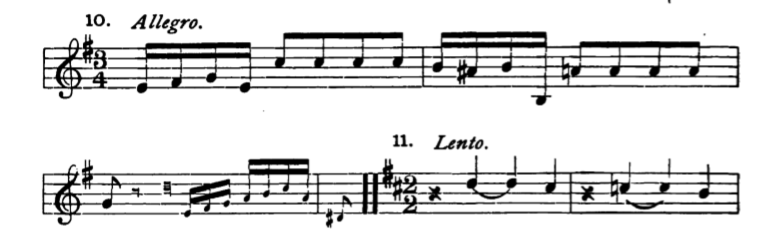
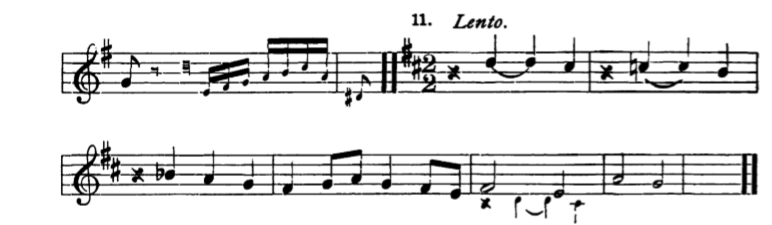
Manipulate each of the following Motives, in the manner explained above, according to the schedule given in par. 154, as small INVENTION.
Each Motive should be developed twice, completely; beginning with the upper part for the first solution, and with the lower for the second solution:
Exercise 15.1

Exercise 15.2

Exercise 15.3

Exercise 15.4

Exercise 15.5
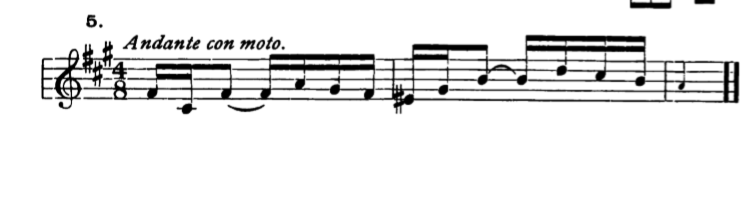
Exercise 15.7
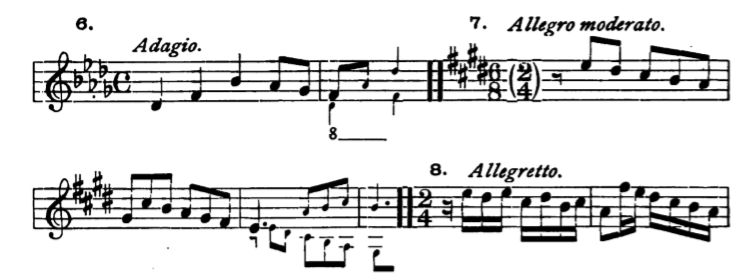
Exercise 15.6
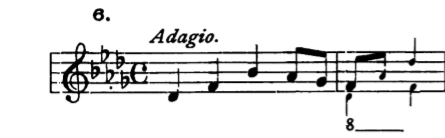
Exercise 15.8
Exercise 15.9

Exercise 15.10
Exercise 15.11
[A solution of No. 5 will £e found in the Appendix, to which the student may refer, after having made his own version.]
Besides these, invent a number of original Motives, similar in character and length to the above (and to those of Bach in his " Inventions"), and manipulate them in the indicated manner.
156. Nothing remains to be said about two-part counterpoint. The fundamental conditions which govern the association of two contrapuntal parts have been amply explained and illustrated in the foregoing lessons. All the essential rules, and all the important methods of treatment, have been thoroughly rehearsed.
It rests now with the student to continue the exercise of these methods in his own way, inventing thematic melodies and motives, and supplying them with contrapuntal associates, in order to gain more complete technical facility. This he should not fail to do. For if it be true that technical facility is the first and really indispensable condition of fluent and effective expression (whether reproductive or productive), it is also true that two-part counterpoint constitutes the groundwork of all tone-association; and, therefore, its command is the fundamental preparation for every task in the fuller styles of harmonic and contrapuntal writing. To the student who has learned to think and feel the simultaneous progression of two parts, who can carry two melodies side by side with perfect ease and consciousness, all combinations are possible; and their complete mastery is to him only a question of time and, of course, earnest effort.
For further details of the Invention, the student is referred to the Author's " Applied Counterpoint," Chapter V.