 Playable Books
Percy Goetschius · section 19 of 29
Chapter XVII. Secondary Chords
Read and hear this section in the playable edition →179. For the employment of the other, comparatively inferior (but decidedly useful and effective) chords, the tables in Ex. 122, and par. 169, must be applied in their fullest significance.
180. The best of these chords are the II and its first inversion, and the II7 and its inversions. They harmonize steps 4 and 2.
The VI is used chiefly as substitute for the I, after the V or V7. It is not inverted; that is, the Root always appears in the lower part, — excepting in the succession of 6ths, shown in Ex. 132. It harmonizes step 1, — rarely step 3.
The III is very rare. It harmonizes step 7 when it descends, stepwise, to step 6.
181. The following groups illustrate certain specific applications:
Ex.131
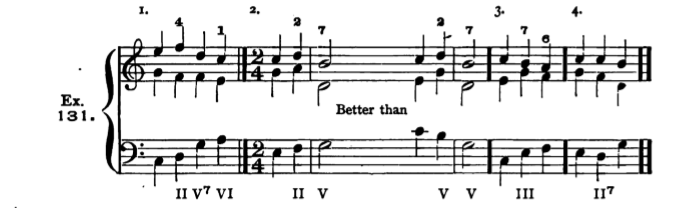
To these, add Ex. 129, which was not used in the preceding lesson.
In group 1, the VI appears after the V. In group 2, the first version is better than the second one, because it is always better to change the chord at the bar, if possible. In group 3, the III appears as harmonization of the descending ph scale-step (in the line 8-7-6). The treatment of the Sevenths is shown in Ex. 129, which review.
182. Successive first inversions (chords of the 6th) are always good; especially when used in stepwise progression. Thus:
Ex.132
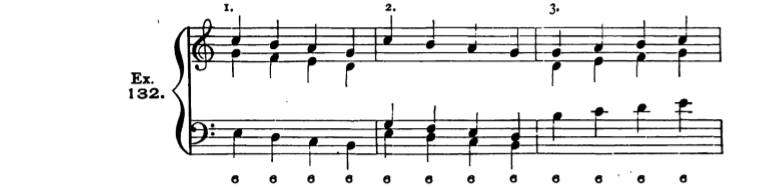
Group 1 is better than group 2; the effect is more compact when the inner part lies closer to the upper one. Group 3 is also good. Group 5 exhibits an unusually long line of sixths; it is good, because of the uniform parallelism of the outer parts ■ compare par. 107, last sentence. But observe the conduct of the inner part, which redeems its independence by occasional contrary motion, and wide skips.
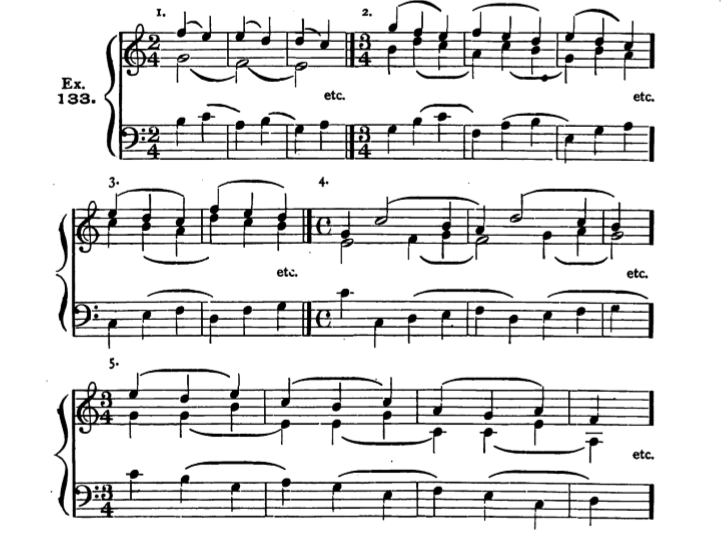
183. In sequential successions, almost any irregularity is excused, as usual. See par. 29. For example, in the following, many of the conditions of par. 169 are set aside. It is mainly necessary that the first figure is regular (normal), and that it interlocks readily with the first tone of its sequence, in each part.
For illustration:
Ex.133-1
Ex.133-2
Ex.133-3
Ex.133-4
Ex.133-5
Ex.133-6
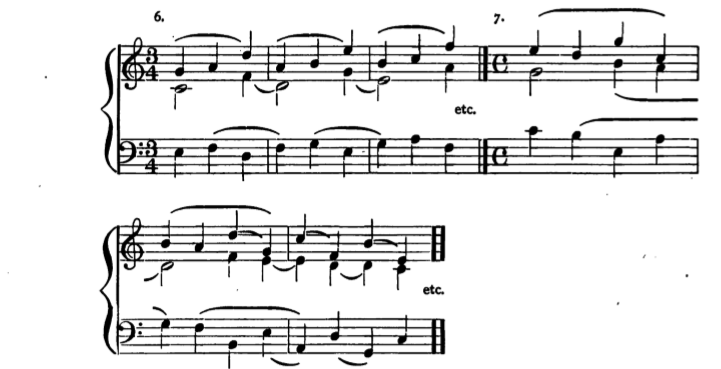
Ex.133-7
N. B. The uppermost slurs indicate the actual figure and its sequences. The inner and lower slurs are merely noted to show how the sequence interlocks with its (preceding) figure. Examine every group very carefully, observing exactly the effect of each system of slurs.
Any good figure will yield a number of sequences, but the points at which the sequence may begin must be those into which the figure itself runs smoothly.
184. In Minor, the difficulties of good melodic movement are increased, especially in sequences. The notes of the major versions need never be changed, but the notation of steps 6 and 7 may need to be modified by accidentals. As a rule, whenever step 7 descends, it must be written b-flat (in C minor). And where step 6 ascends, it must be a-natural (in C minor).
Transpose all of the above examples (131, 132, 133) to C minor,— both as written exercise, and at the keyboard; and closely observe the application of this rule. Do this without fail. First review, thoroughly, Ex. 30, and observe that the present rule is more sweeping than that of the melodic minor scale.
Exercise 17
Three Harmonic Parts. Primary and Secondary Chords. Sequences.
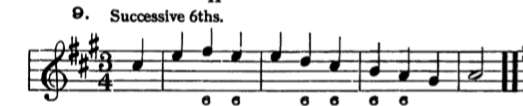
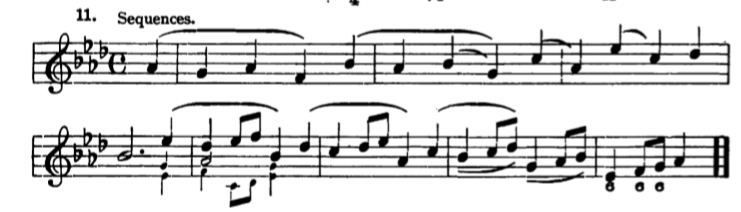
Harmonize the following melodies, with the material of this chapter. Review the directions given in Exercise 16. Use two staves. 1.
Exercise 17.1

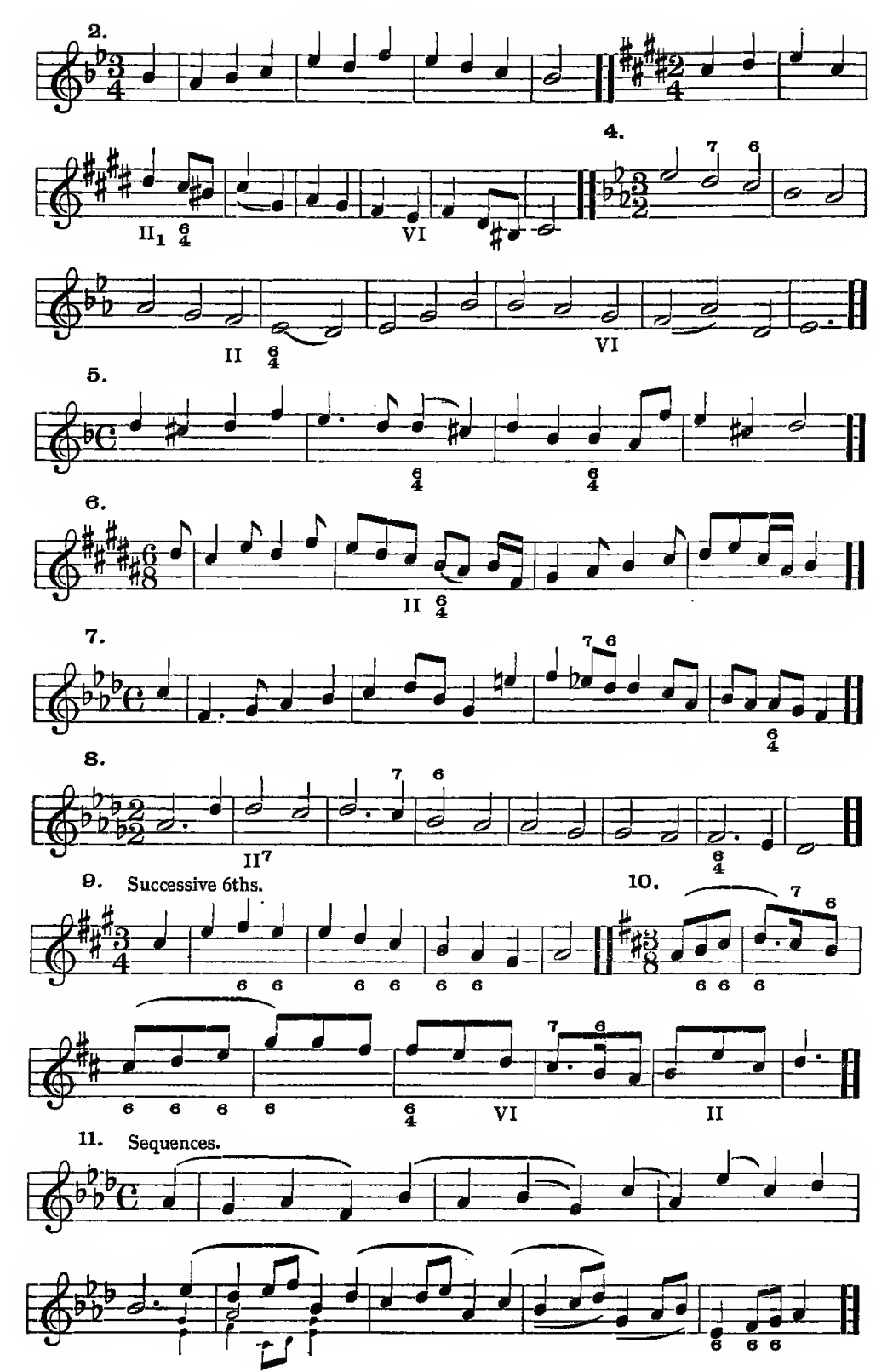
Exercise 17.3
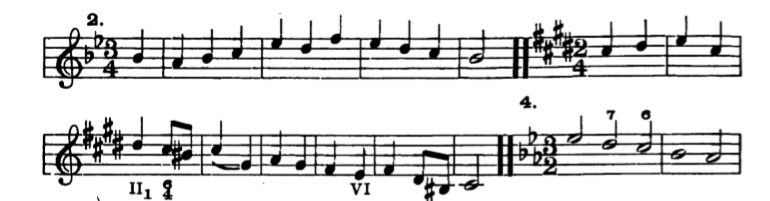
Exercise 17.2

Exercise 17.4
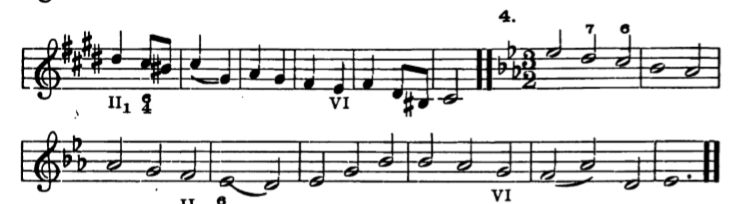
Exercise 17.5

Exercise 17.6

Exercise 17.7

Exercise 17.8

Exercise 17.10
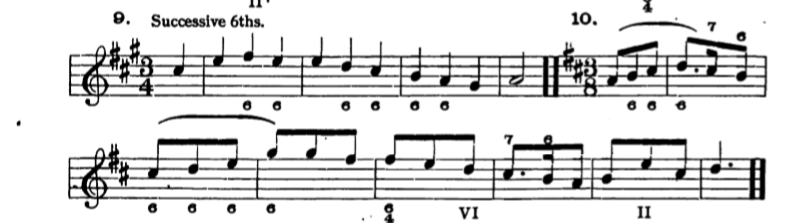
Exercise 17.9
Exercise 17.11
Exercise 17.12

[A solution of Melody 8 will be found in the Appendix.]
Besides these, the student may re-harmonize the melodies of Exercise 16, introducing Secondary chords where possible.
Also write a number of original three-part sentences, like the above, with Sequences, and with Successive 6ths.