 Playable Books
Percy Goetschius · section 20 of 29
Chapter XVIII. With Modulations
Read and hear this section in the playable edition →185. The rules for changing the key are all given in par. 81, par. 86, par. 88 and par. 90. Review the whole of Chapter VIII, but very particularly the paragraphs mentioned.
1. The keys which occur transiently in a sentence should be nextrelated to the principal key.
2. The key may always be changed easily, after some form of the
Tonic harmony has completed the momentary key.
3. But chromatic modulations may be made at any point, — if the chromatic succession itself is properly prepared. And the presence of the chromatic progression excuses almost any irregularity.
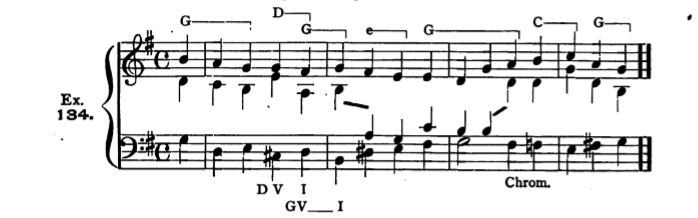
187. The first melody of Exercise 17 may also be harmonized as follows, with transient changes of key:
Ex.134
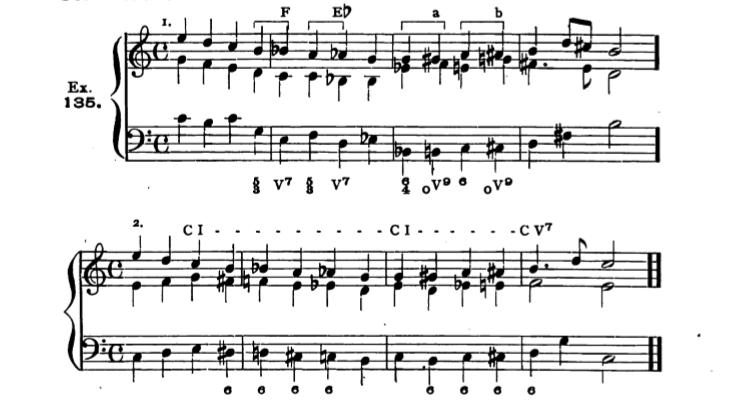
188. When the chromatic progression occurs in the given melody itself, it may generally be treated in one of these two ways:
1. The first of the two chromatic tones may be harmonized with a triad, and the second tone with a Dom.-7th chord, or diminished-7th chord. Or,
2. Each tone may be harmonized with some chord of the 6th (confirming par. 182). For illustration:
Ex.135
Ex.135-1
Ex.135-2
In the first version, the transient keys are not all next-related to the original key; nor does the melody end in the latter. The chromatic character of the harmony accounts for all this. See pars. 88 and 89. Also glance at the Notes to Ex. 158, a.
In the second version, the lines of chromatic 6ths are so indefinite that it is scarcely possible to prove the keys. They are, properly speaking, no more than passing chords, and do not actually change the key, which remains C major throughout. At the same time, any of the intimated keys might be confirmed at once, by resolving the chord in some legitimate manner; this would, of course, change the melody at that point. For instance, version 2 may end like version 1, by simply resolving the last chord of the third measure as Incomplete Dom.-7th of B minor.
189. Closely allied to this principle of very transient modulations (shown in version 2 of Ex. 135), is the common practice of momentarily altering certain Scale-steps by accidentals. This gives the chord a so-called " altered " form; but does not change the key.
190. Of many possible Altered scale-steps, the following are the most frequent and effective:
1. The lowered 6th Scale-step, in major.
2. The raised 4th Scale-step, both in major and in minor.
Ex.136
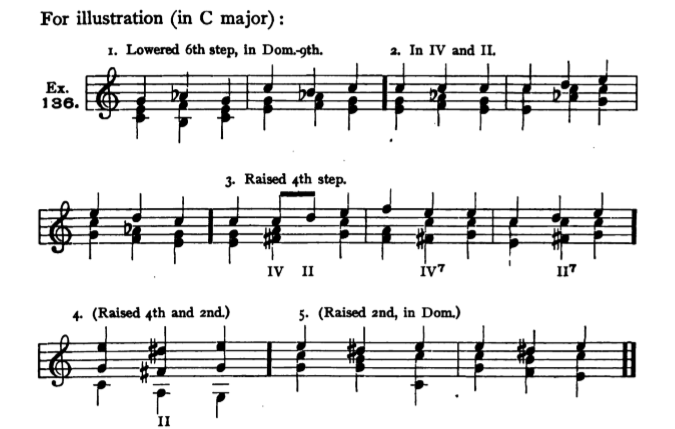
For illustration (in C major):
Observe that a Tonic chord always follows the altered one, as resolution, and in confirmation of the principal key.
Observe that by lowering the 6th scale-step the chord of the diminished-7th becomes valid for major (as well as minor).
Observe that the raised 4th step occurs only in the II, IV, II⁷, IV⁷ (Subdominant chords). Also that it may be accompanied by the raised 2nd step,—in the II. And that the raised 2nd step may occur alone,—in the V or V⁷.
Further, the raised 4th scale-step in minor:
Ex.137

Observe that, here again, the raised 4th step occurs only in Subdominant chords (II–IV–II⁷–IV⁷).
Observe also, that the Tonic chord usually follows, as resolution, — though it is perfectly proper to pass from these altered chords into a Dominant chord (measure 2), because the latter naturally moves at once into the desired Tonic.
191. The lowering of the 7 th scale-step, and raising of the 6th, in minor, — of which such extended use has been made in all the minor Exercises, — is nothing more than an application of the same principle of "Altered " scale-steps. See, again, par. 32 (Ex. 30), par. 184, and the following:
Ex.138

192. In minor, it is also possible to lower the and Scale-step, but only in the II (usually in its chord of the 6th). Thus:
Ex.139

Exercise 18
Modulations, and Altered Steps.
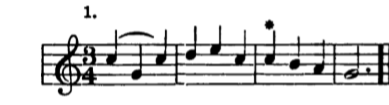
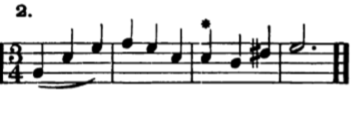
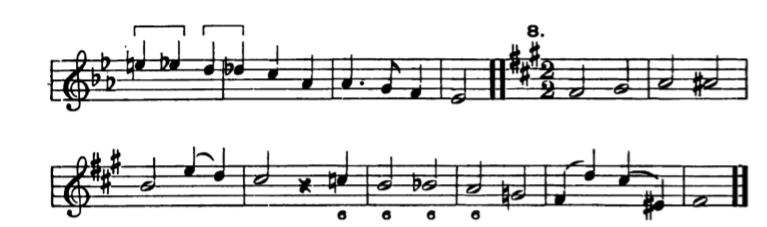
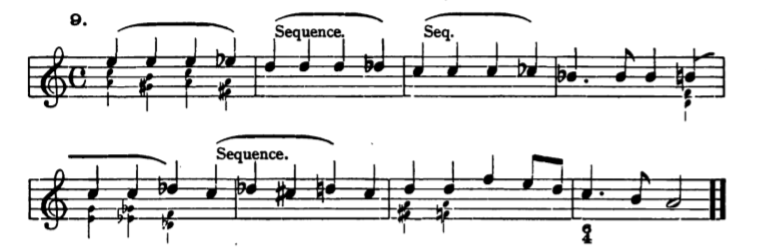
Harmonize the following melodies, introducing changes of key wherever possible or desirable, according to the above rales. Use two staves, as a rule. In the first six melodies, the * indicates where modulations are to be made. 1. 2.
Exercise 18.1
Exercise 18.2
Exercise 18.3

Exercise 18.4

Exercise 18.5
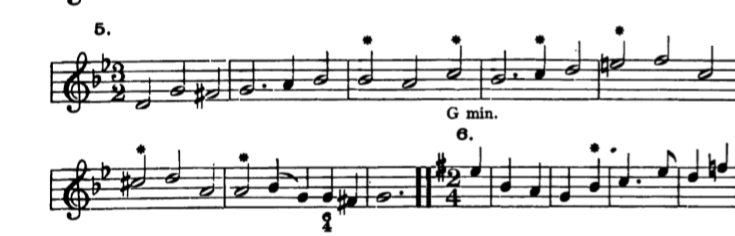
Exercise 18.6
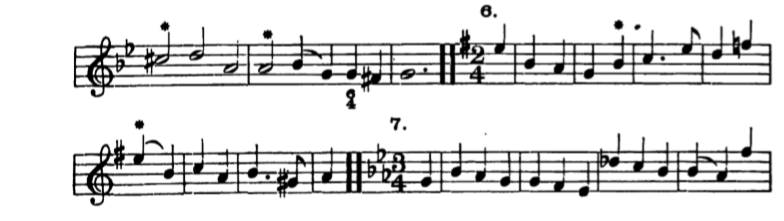
Exercise 18.7

Exercise 18.8
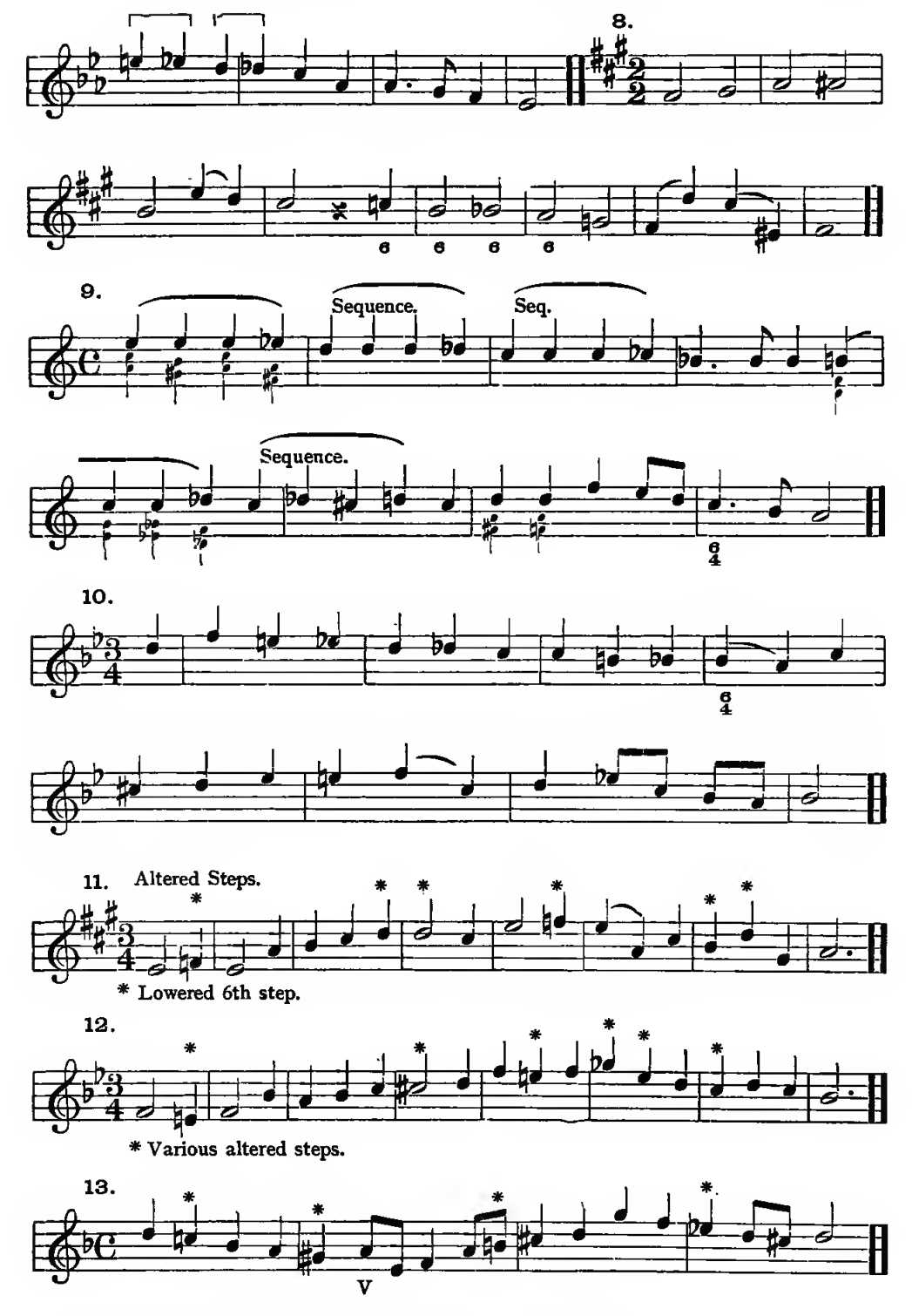
Exercise 18.9
Exercise 18.10
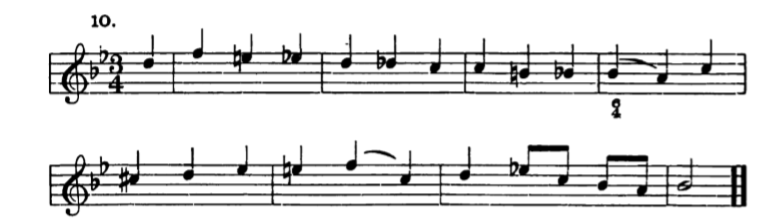
Exercise 18.11

Exercise 18.12

Exercise 18.13

[A solution of Melody 7 will be found in the Appendix.]
Besides these, write a number of original three-part sentences, like the above, with modulations and altered chords.