 Playable Books
Percy Goetschius · section 21 of 29
Chapter XIX. Contrapuntal Harmony
Read and hear this section in the playable edition →193. The consideration of melodic independence in the several parts becomes more emphatic when the same given melody is adopted, alternately, as inner and as lower part.
The task differs but little from that of the preceding chapters. It is still the act of harmonization, and subject to almost exactly the same rules as before. But the attention is necessarily more evenly divided between the parts, and the melodic nature of the exercise is sufficiently emphasized to justify the designation " contrapuntal harmony."
194. In the following, the given melody is placed in the upper part, and harmonized as before; possibly with somewhat greater concern for the melodic movements of the other parts:
Ex.140
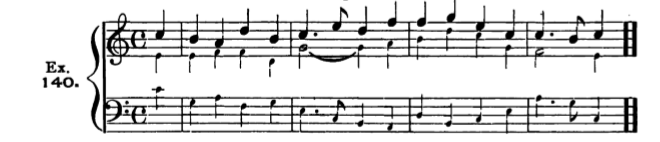
It is significant, that the two outer parts alone, without the inner, form a perfectly satisfactory counterpoint in this example.
195. When the given melody is placed in the inner part, the chords are defined according to former tables (Ex. 122, and par. 169), — though there may be greater freedom in the choice.
The tones required to complete the chosen chords are so divided between the outer parts as to give good melodic results in both. This is especially necessary in the upper part. The lower part is, of course, subject to the rules of chord-inversion. Review, carefully, par. 173, and Ex. 126 (in which the above given melody appears in the inner part).
Ex.141
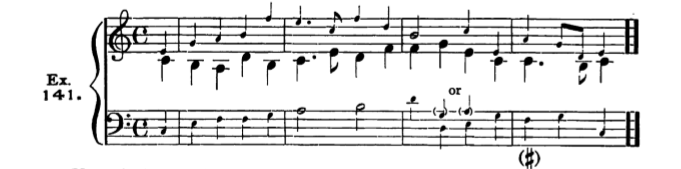
Here, the inner and upper parts yield good counterpoint, without the lower.
196. When the given melody is placed in the lower part, the chords, again, are defined according to the tables, — but somewhat more strictly. For the lower part, the table of Ex. 122 should be thus modified:
Ex.142
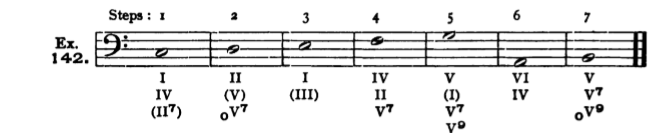
Applied to the above given melody, the result might be:
Ex.143-1
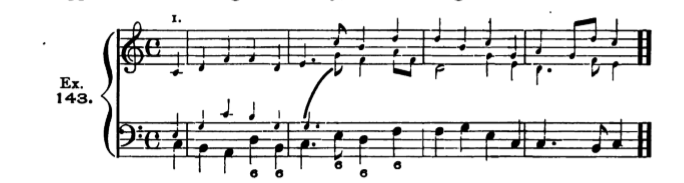
Ex.143-2
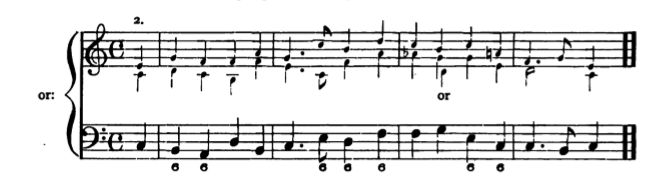
In the first of these versions, the two outer parts give a good counterpoint, without the inner.
In the second version, the inner and lower might stand alone, without the upper.
These facts are significant, in each of the above examples, and almost suggest the feasibility of counterpointing first one part alone against the given part, and then add. ing the third part. It is left to the student to experiment in his own way.
Transpose Examples 140, 141 and 143 to C minor, at the keyboard, — with reference to par. 184.
197. After the simple harmonic outline has been fixed in this manner, it may be amplified and embellished by accelerating the rhythmic move ment to two, three, or four notes to each beat.
The process is the same as defined in par. 74, par. 92, par. 105, par. in, par. 113, par. 117, par. 119 and par. 121, all of which must first be thoroughly reviewed.
198. But the quicker rhythmic movement is not to be maintained (constantly) in any single part. It must appear in alternating parts, as shown in Examples 66, 76, 108, 109, — which must also be reviewed. See also Ex. 111.
199. This manipulation of the original essential tones is not only desirable, but absolutely necessary; and the student must not consider the task of 3-part contra. puntal harmony fulfilled until he has so accustomed himself to the addition of unessential (embellishing) tones, that they will naturally suggest themselves at once, and even assist, or influence, the choice of the essential tones.
200. For illustration, Ex. 140 may be accelerated to a rhythm of two notes to each beat in alternating parts, about as follows:
Ex.144
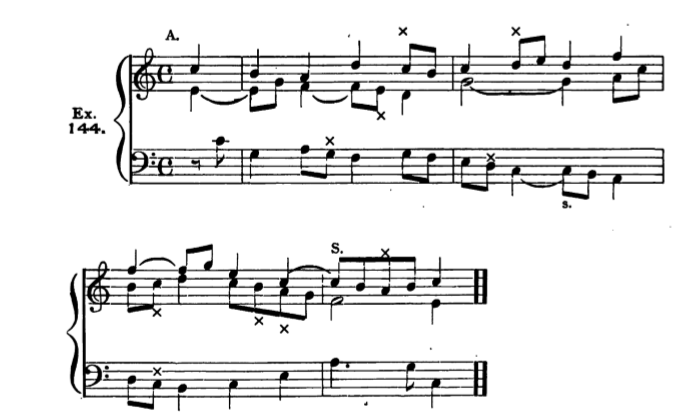
Compare this very carefully with the original form (Ex. 140); and endeavor to obtain other solutions.
N. B. Observe that the rhythm of the upper part is always regular; that is, the quicker tones are applied in the upper part at the unaccented beats. This is desirable in the upper part only, because of its melodic prominence; it does not apply at all to the inner, or lower, part.
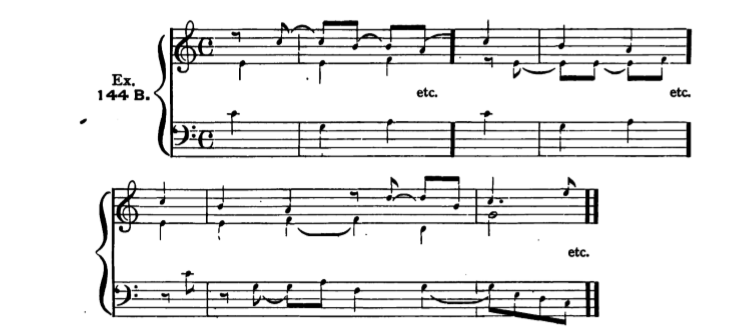
It is, of course, also possible to quicken the rhythm of a simple three-part harmonic sentence to two notes to each beat, by shifting either one of the three parts forward, — as shown in Chap. X. See Exs. 78, 79, 80. This should not be considered as a valuable or effective resource, and its use, unless very moderate, is not commended. Still, when applied in alternating parts, as in Ex. 81; or with occasional rests, as in Ex. 89; — it may be permissible, especially at single points, where no other form of amplification seems convenient. Thus, with Ex. 140:
Ex.144b
Further, the same model (Ex. 140) accelerated to three notes to each, beat in alternating parts: 3
Ex.145
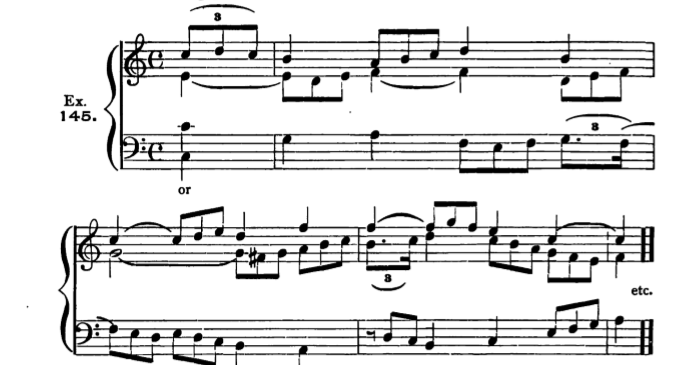
Manipulate this in other ways. Observe, again, the regular rhythmic treatment of the upper part.
Further, with four notes to each beat:
Ex.146

Compare this carefully with Ex. 140, and observe the degree of liberty that is taken with the original. Again, note the rhythm of the upper part. Also, make a number of other versions. Also, review par. 184, and transpose all the above to C minor.
Exercise 19
Contrapuntal Three-Part Harmony
1. Manipulate Examples 141 and 143 in amplified rhythms of two, then three, and then four notes to each beat, — as shown in Exs. 144, 145, and 146.
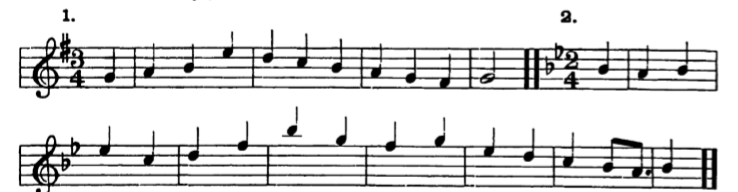
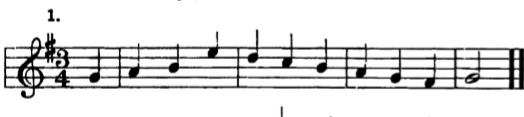
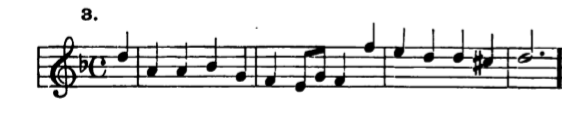
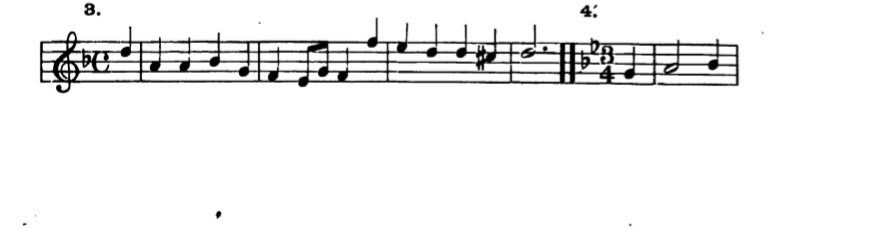
2. Harmonize each of the following given melodies in the three ways illustrated in Exs. 140, 141 and 143; — first as upper part, where it is written; then as innet part, one octave lower than written; and then as lower part, two octaves lower than written (possibly a little less than two octaves, transposed to another key). An occasional eighth-note may be used, as broken beat, even in these original essential harmonic versions, in any part, to facilitate the melodic movements.
Exercise 19.2
Exercise 19.1
Exercise 19.3
Exercise 19.4
3. Each of these simple harmonic versions is then to be manipulated in rhythms of 2, 3 and 4 notes to each beat, as indicated above.
[A partial solution of Melody 3 will be found in the Appendix.]
4. Select a large number of finished sentences from Exercises 16, 17 and 18, and amplify them, similarly, to the quicker rhythmic forms shown in Exs. 144,145 and 146.