 Playable Books
Percy Goetschius · section 22 of 29
Chapter XX. Three-Part Counterpoint
Read and hear this section in the playable edition →


201. In the four preceding lessons, the association of three melodic parts was explained and conducted on the basis of the chords which the individual tones of one given melodic line suggested or required.
202. This is, strictly speaking, the only correct manner, at least for the determination of all the fundamental conditions; because it is the Chords which constitute the proper basis of all harmonious music. The inharmonious effects which are more or less plentifully interspersed, in an effective and interesting musical sentence, are merely modifications or embellishments of the chords, and neither can nor should be accounted for in any other way. No matter how freely the dissonant particles are intermingled, the general impression must be an harmonious one; for no music may be called good, or may be expected to produce an agreeable and acceptable impression, unless it is harmonious as a whole. Inharmonious music is really not music at all, in in the sense in which our reason, our instincts, and the judgment of the whole civilized world, compel us to regard it. The chords are the " accordant" tone-bodies, which guarantee this necessary prevalence of harmonious effect. And therefore the association of parts, even when individual and melodically independent of each other (as is the case in genuine counterpoint) must be determined, fundamentally, by reference to the chords.
203. But there are other modes of arriving at a good harmonious result, more distinctively contrapuntal in character than the simple harmonization of the given melody. When the student has cultivated his sense of chord-succession sufficiently, and has reached that stage of progress at which the chords have become a part of his nature, and perform their functions automatically, he will find it possible and natural to centre his attention upon the melodic movements of the parts, and will achieve a good result more quickly and surely from this point of view.
204. In genuine counterpoint it is not the movements of the chords, but the movements of the separate tones, that create the required impression. The influence of the chords is felt rather than heard. In the above examples there are too many chord-changes, at regular intervals; as a rule, there is a different chord for each beat, and therefore the chordmovements are too frequent and obtrusive. This is probably the most obvious defect in such harmonic sentences; under such conditions a genuine contrapuntal effect cannot easily be gained, — not even when copious inharmonic embellishing tones are added (as in Exs. 144, 145 and 146).
205. The most effectual method of diminishing such persistent chordimpressions, and increasing the significance of the tone-lines as such, is to dwell longer upon each single chord, or, at least, upon certain (strong) chords; and, in general, to vary the length of the chords. While the chord is stationary (or passive), the separate parts are unhampered, and can move about with greater freedom. (This is shown in Ex. 148.)
206. In these unrestrained melodic movements, the parts hold each other in check, to some extent, not only by mutual agreement with the underlying chord, but by harmony of movement among themselves. This latter element is of extreme importance, especially in elementary counterpoint, and manifests itself most frequently in the following two forms:
1. Parallel 3rds, or parallel 6ths, between any two of the parts.
2. Duplication of any 3-tone stepwise figure, in the opposite direction. For example:
Ex.147
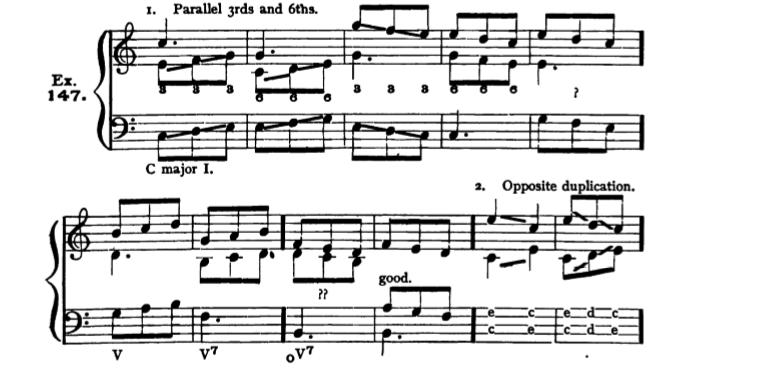
In the first measure, the inner and lower parts run parallel in 3rds; in the next measure, in 6ths. The chord remains unchanged. In the third measure, it is the outer parts; in the fourth measure, the upper and inner. The fifth measure is harsh, because both parts clash with the chord-3rd (e), which is a poor interval to double. Measure eight is still worse, because of the collision with the leading-tone (i).
In the second example, the tones e-c, or e-d-c, are counterpointed in " opposite duplication " by c-e, c-d-e. Occasional evidences of these almost inevitable cooperations will be found in Exs. 144, 145 and 146.
207. The employment of these two convenient (and almost invariably acceptable and effective) figures, in the prolongation of good chords, yields a great variety of forms, with genuine contrapuntal result. For illustration:
Ex.148-1
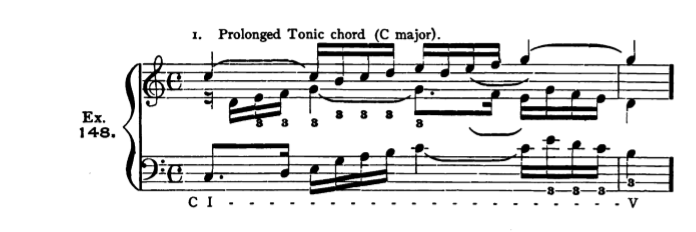
1. Prolonged Tonic chord (C major).
Ex.148-2
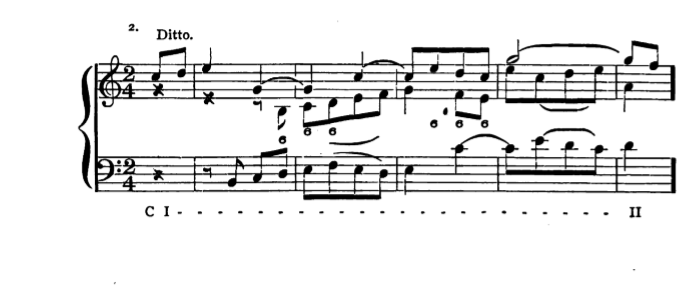
Ex.148-3
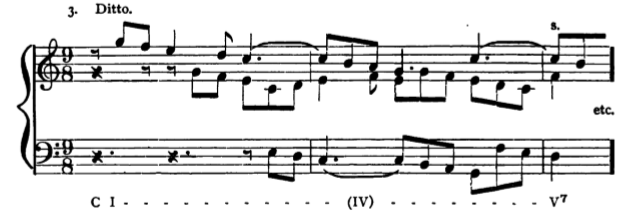
Ex.148-4
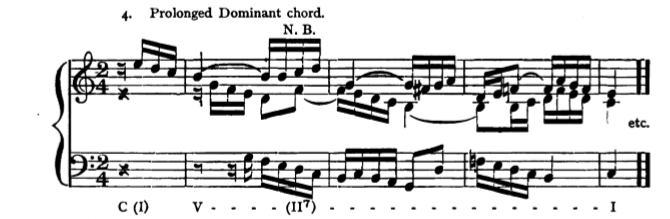
Observe that the prolongation of the chord extends exactly to the end of some measure, so that the change of harmony occurs at an accent, and thus confirms the rhythm. This is important.
Observe, also, that in a. few cases the current of the moving parts seems to denote, transiently, some other (related) chord, — indicated in parenthesis.
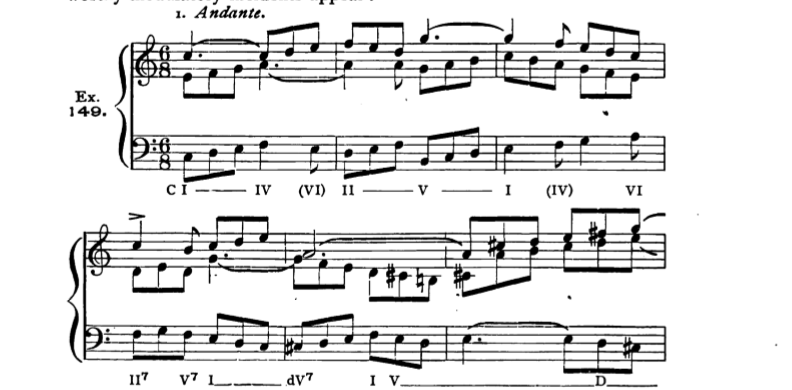
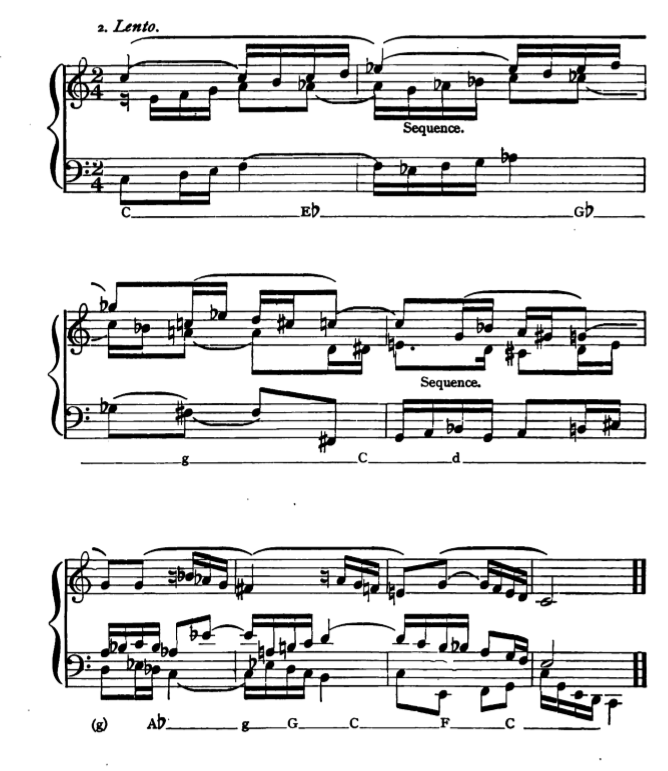
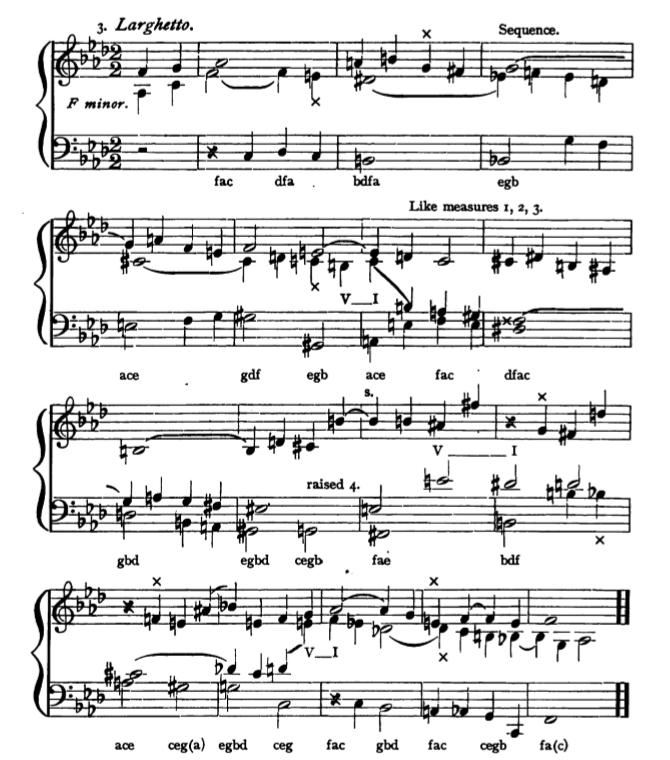
208. In the following three complete sentences, a number of noteworthy modulatory incidents appear: 1. Andante.
Ex.149-1
Ex.149-2
Ex.149-3
Explanation. No. i contains the so-called "Exchange of Mode "; — in measure 6, fifth beat, the f-sharp in the upper part changes the mode from d minor to D major; in the next measure, the b-flat changes the expected G major to g minor; and in the following measure the a-flat changes the expected F major to f minor. The same exchange occurs in No. 2, measure 6 (from the expected g minor to G major).
Such u substitution of major for minor, or of minor for major, is possible at almost any point, — particularly after any dominant chord, which resolves into either the major or minor tonic.
In No. i, with this exception, the keys are all properly interrelated. On the last beat of the 8th measure, the a-flat (lower part) becomes the lowered 6th scale-step of C major.
In No. 2, on the other hand, the successive keys are quite foreign to each other (excepting near the end, where, as is rational, the modulatory movements concentrate toward the principal keynote). These irregular modulations are chiefly accounted for by the chromatic progressions; in measure three, by the enharmonic agreement of g-flat -mth./-sharp. But the factor most actively engaged in these changes is the socalled " Pivotal tone," — that is, a tone which, being common to two keys (sometimes in a widely different capacity), is used as a point of contact, or pivot, upon which to swing the melodic movements from the one key over into the other. Thus, in measure three (of No. 2) the g-flat (lower part), as keynote of G-flat, is made identical with /-sharp, as leading-tone of g minor. At the end of the measure, this same/-sharp becomes the raised 4th scale-step of C. In measure five, the g (upper part), which was the 4th step of d minor, is held as keynote of G, and then becomes the leading-tone of -4-flat major. The same operation may be claimed for several other changes of key, — as for instance, in measure one, the c (as keynote of C) becoming the 6th scale-step of E-BaX major; in measure six, the b (lower part), as 3rd step of G, becoming the leading-tone of C j in measure four, the e (inner part), as 3rd step of C, becoming the 2nd step of d minor, — and so on.
This principle of pivotal (or common) tones is very prevalent, and very effective, in modulation, — but it must be applied with caution, under the smoothest possible melodic conditions.
Number 3 is not to be taken too seriously. It represents the utmost extreme to which free chromatic movements maybe carried, and reflects an attitude towards Tonerelationships that, despite its popularity in modern music, is decidedly hazardous for the student. In moderation, such hazy delineations are surely permissible, but the beginner has no motive whatever for their employment. At the same time, he should devote some little attention to this style, and may experiment with it.
There are four qualities whose presence, and careful consideration, make No. 3 justifiable: First, very smooth melodic movements, almost constantly, — relieved here and there by a skip along some good chord-line; second, there is some good chord/orm at almost every accent, some harmonic tone-cluster towards which the parts unanimously lead (as shown by the letters beneath the staff, the chord-names being left to the student's analysis); third, there are sufficient sequences and other evidences of consistent formation, and agreement among the melodic figures used, to prevent the sentence from being senseless and purposeless; fourth, from time to time there is a regular resolution 0/ a Dom.-chord into its Tonic. The more of these the better, as they effectually prevent eccentricity.
Observe, in all three examples, the frequent application of the devices given in par. 206 (Ex. 147).
Observe, also, how flexible and smooth the melodic movements constantly are,— especially at the bars.
Analyze every tone, most thoroughly.
209. Sentences of such free modulatory character may be somewhat beyond the reach of the elementary student. But this freedom may be attained by earnest and thorough practice. Not at once. The student must exercise the simpler forms at first, so long and so exhaustively that the voices begin to acquire life and freedom from within, and seem to move of their own volition. That facility once gained, the more ample and excursive movements will naturally follow. Hand in hand with this long course of faithful practice must go the exhaustive analysis of contrapuntal masterworks, — at present, passages with two, and with three, individual melodic lines.
Exercise 20
Three-Part Counterpoint.
Exercise 20.1
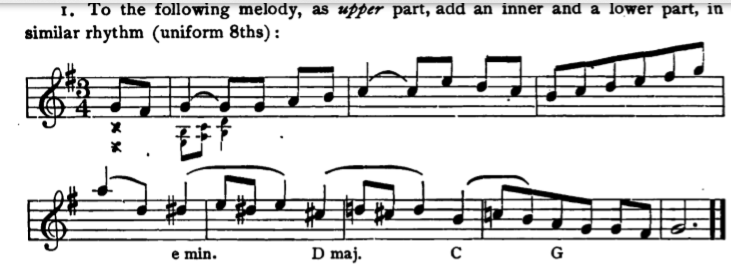
1. To the following melody, as upper part, add an inner and a lower part, in similar rhythm (uniform 8ths):
Exercise 20.2
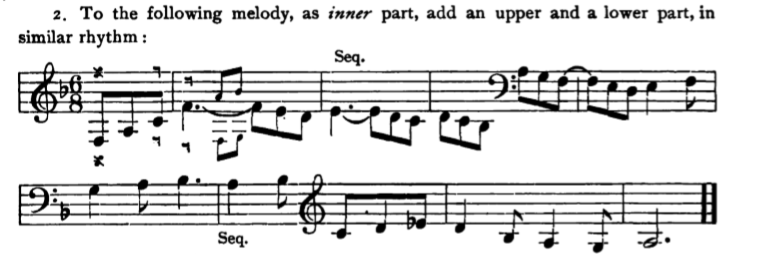
2. To the following melody, as inner part, add an upper and a lower part, in similar rhythm:
Exercise 20.3
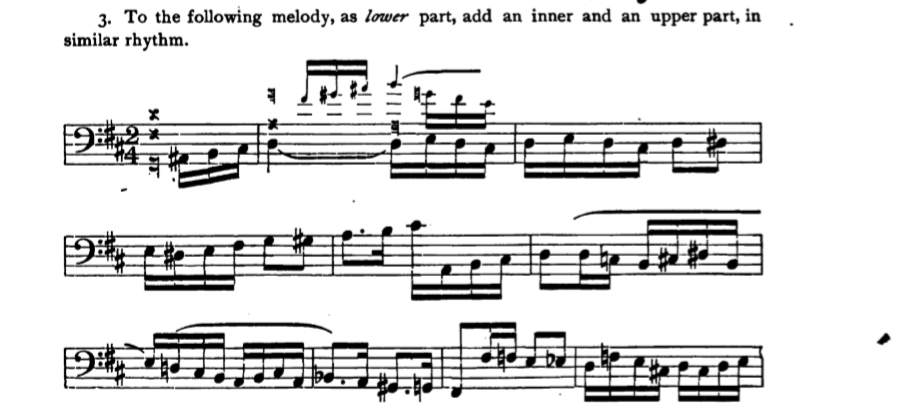
3. To the following melody, as lower part, add an inner and an upper part, in similar rhythm.
[The solution of these three sentences will be found in the Appendix, to which reference may be made after the student has exhausted his ingenuity in solving them himself.]
4. "Write a number of brief exercises, applying the devices of par. 206, as shown in Ex. 148.
5. Write a number of original sentences in the style of Ex. 149,— especially No. I.