 Playable Books
Percy Goetschius · section 23 of 29
Chapter XXI. Motive-Development
Read and hear this section in the playable edition →210. The application of the elements of three-part counterpoint to the manipulation of a Motive, is conducted in practically the same manner as was shown in Chapter XV, with reference to two-part counterpoint. That chapter should first be thoroughly reviewed.
211. The character of the motive is not materially affected by the number of contrapuntal parts employed, excepting that it may be a trifle more serious and rhythmically subdued for three parts than for two. Consequently, almost any of the motives given in Exercise 15 may be utilized here, in slightly moderated tempo, for illustrating the methods of manipulation in a contrapuntal association of three parts.
212. The motive may be first announced in either the upper, inner, or lower part; but its first imitation should follow in the next higher or lower one.
The most effective and most frequent practice is to place the first imitation of the motive in the Dominant key (that is, each tone a perfect fifth higher, or a perfect fourth lower, than in the preceding announcement).
The next imitation (the third announcement) is then made again in the original key, usually an octave higher or lower than at first.
During these imitations of the motive, the other part, or parts, continue their melodic movements, as usual, according to the rules of counterpoint with which the student is familiar. For example, with the first motive given in Chapter XV (Ex. 113), beginning in the lower part:
Ex.150
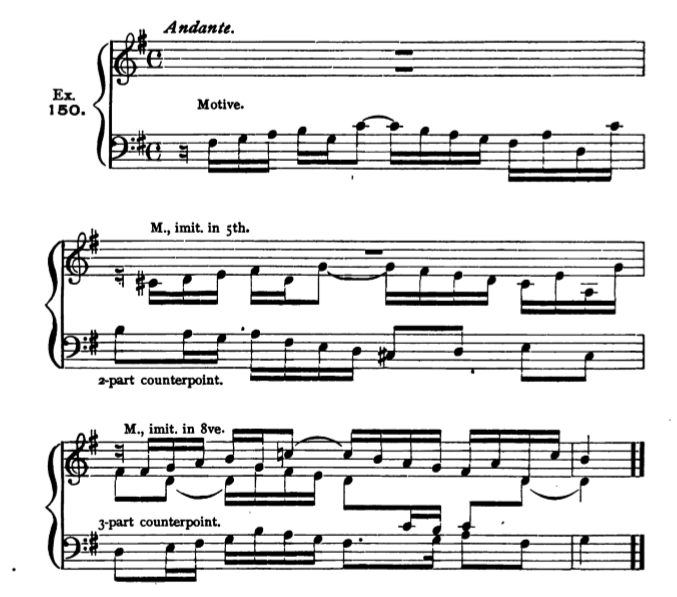
The motive is first announced in the lower part, and ends upon the first (accented) beat of the second measure. The imitation, assigned to the next higher (inner) part, enters somewhat abruptly, inasmuch as it instantly denotes the change of key — to the Dominant. (There are various ways of avoiding such an abrupt entrance of a new part, when sufficiently rude to require modification; the best of these is illustrated in Ex. 151.)
During this second announcement of the motive, the lower part continues, of course, as ordinary contrapuntal associate.
The third announcement of the motive occurs in the remaining (upper) part, an octave higher than at first; the two other parts meanwhile run on without interruption, forming an association of three contrapuntal melodies.
213. Any such abrupt entrance of the first imitation of the Motive as was seen in the inner part (Ex. 150), may be mollified by adding a beat or two to the first part (the Motive itself). In the above case, it is best to add two beats, so that the final tone in that part is merely shifted to the next accent. These beats are so employed as to effect the modulation into the new key. See Ex. 151, second measure.
214. Such additional (or " intermediate ") tones may be affixed to the first announcement of the Motive, without injuring or obscuring the latter, if they are chosen in strict conformity with its general melodic and rhythmic character; and if they are carried to the next accent only, so that nothing more than an exchange of accents takes place.
In small measures (|, f, f, etc.), the intermediate tones will equal a full measure; in larger ones (as J, f, etc.), they will equal a half-measure.
Such interlined, or added, beats come under the head of episodic tones. See the explanatory Notes to Ex. 1 r6.
215. In the following manipulation of the same motive, intermediate tones are added to the Motive itself, as a brief episode, or interlude; and a similar episode is added to the Imitation. Both of these serve as modulations, to prepare for the transposed imitations: —
Ex.151
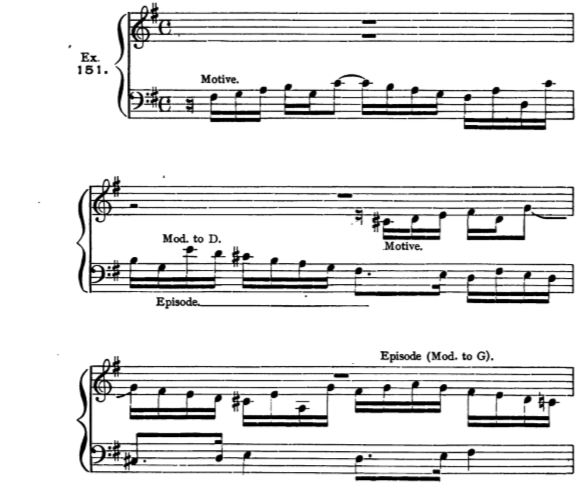
Compare the last measure, here, with that of Ex. 150. See par. 207 (Ex. 148).
216. The three-part counterpoint, which results from adding the third announcement of the Motive to the two preceding parts, and which is to continue more or less constantly to the end of the sentence, does not differ in any essential respect from the exercises of the foregoing chapter. Here, as there, the vital requirement is to secure some good chord-form at the accents or principal beats, and to lead each one of the three parts smoothly and melodiously from one of these chord-nodes to the next.
This does not mean that the chord-form must actually appear, at each accent. It is quite necessary to disguise it somewhat, by ties (suspensions) or passing-tones, — as seen in many places in Ex. 149 (for instance, in No. 1, measures 7 and 10). But the harmonious cluster must be perfectly evident.
217. To this fundamental rule, one other may be added: It is absolutely necessary to restrain the rhythmic movements of one and another of the three parts (alternately), in order to avoid rhythmic confusion, and too much commotion. Very rarely indeed should all three parts at once run in rapid rhythm (for instance, four notes to a beat); at least one of the parts should move at a quieter pace than the others; — this may be any part, and should frequently interchange with the others.
For the same reason, rests should occasionally be used; and from time to time one or another of the parts should be silent for a measure or more. Further: Free use should be made of the two devices indicated in par. 206.
218. The validity of these essential rules may be tested by careful analysis of the three-part Inventions of Bach. For example, the first ten measures of Invention No. 10; the first six measures of No. 14; the first six measures of No. 12; the first seven measures of No. 8; the first seven measures of No. 3; the first five measures of No. 1.
In analyzing these passages from the beginning of the three-part Inventions, the student will observe that the design suggested in the above examples (with reference to the treatment of the Motive) is followed in a general way, but with considerable freedom. He will notice that Bach usually announces his Motive first in the upper or inner part, and that the lower part accompanies it from the start, in somewhat free contrapuntal association; further, that his Motives are often longer than the above; and that frequent episodic " interludes" are introduced between the announcements of the Motive. The more carefully and extensively the student prosecutes the important study of analysis, the more he will see and learn.
219. The development of a Motive into a complete sentence is conducted with three contrapuntal parts in the same general manner as with two. The complete schedule is given in par. 154, which the student is advised to adopt, with such modifications (omissions or additions) as the increased number of parts, or his own purpose, may dictate.
Applied to the first Motive of Exercise 15, the result might be about as follows:
Ex.152
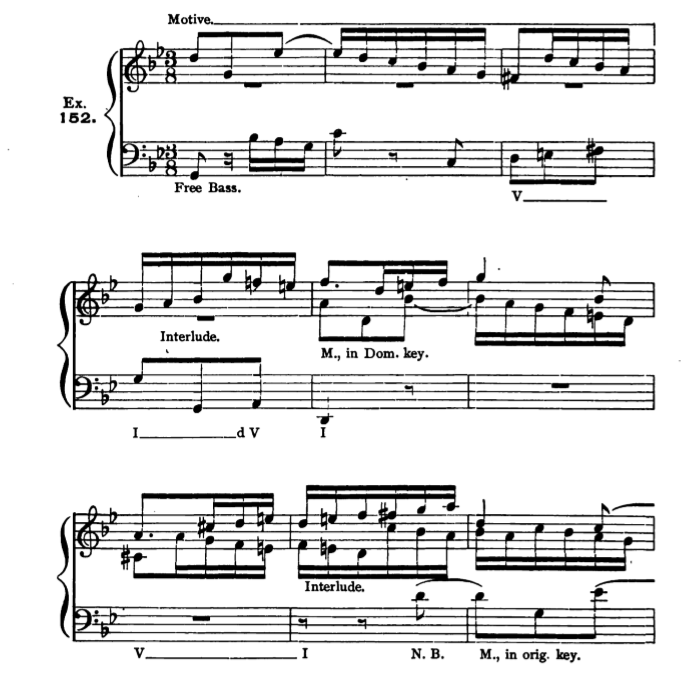
Analyze this (first without, and then with, the keyboard) most thoroughly, and observe the following noteworthy traits:
The free (or auxiliary) bass at the beginning, as associate of the first presentation of the Motive.
In measures 8 and 9 (lower part), the prolongation of the first tone of the Motive. This occurs frequently, and is owing to the fact that the Motive begins with the 5th scale-step (5th of the tonic harmony), which requires caution when in the lower part (par. 173).
In measure 17, the slight alteration of the Motive (upper part); also in measure 19; and in measure 22 (lower part).
In measures 19, 20 and 21, the episode, based upon the peculiar rhythmic treatment of the repeated figure in the inner part. At the same time, the silence of the lower part for a whole measure; a few measures later again, and longer.
The brief rest in measure 22 (inner part), and later, in each part.
In measure 20, the distinct perfect cadence (in D minor). This is important
In measures 34 and 35, the crossing of the upper and inner parts. This is permissible, if the lines are not too long (or too completely) obscured.
In the final measure, the cadence in G major. See explanatory Notes to Ex. 149, first clauses.
The frequent slurs, which everywhere indicate some linear purpose, — usually the closer interaction of the several parts, by fragmentary imitation.
Exercise 21
Motive-Development, with Three Contrapuntal Parts.
Continue Ex. 151 and develop the given Motive to a complete Invention (similar to the general design and method of Ex. 152).
2. Make another complete solution of the Motive manipulated in Ex. 152, beginning with the lower (or inner) part.
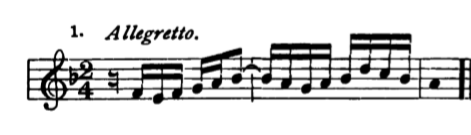
3. Manipulate each of the following Motives, in the manner above shown. Each Motive may (and should) be developed in three wholly different ways, beginning respectively with the upper part (for the first announcement of the Motive), then beginning with the inner part, — and then with the lower. The key may be altered, if necessary, to secure the proper register, and invite a different train of thought for each solution.
N. B. The student should make free use of all the devices and licenses suggested in Ex. 152, and of any others that his ingenuity may prompt; avoiding too close adherence to any of the given " rules," but always assuring himself, conscientiously, that he is obtaining a perfectly natural and harmonious product, and guarding scrupulously against eccentricity, or extravagance of any kind.
Exercise 21.1
Exercise 21.2
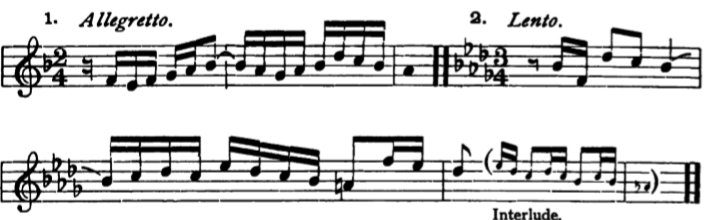
Exercise 21.3

Exercise 21.4
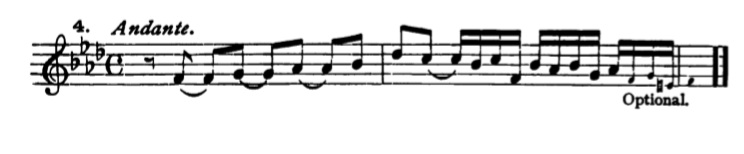
Exercise 21.5

Exercise 21.6
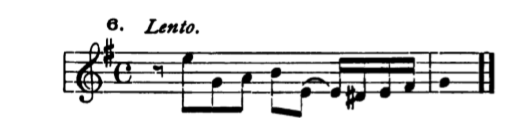
[A solution of Motive 6 will be found in the Appendix, to which the student may refer after completing his own version.]
4. Manipulate, with three contrapuntal parts, some (or all) of the Motives given in Exercise 15: numbers 2, 3, 5, 6,10 and 11 are recommended for this purpose.
5. Besides these, the student may invent a number of original Motives, similar in character and length to the above, and develop them as usual. In that case, the music is all his own.
For further details of the Invention with three parts, the student is referred to the author's " Applied Counterpoint," Chapters VI and VII.