 Playable Books
Percy Goetschius · section 25 of 29
Chapter XXIII. Modulations
Read and hear this section in the playable edition →227. All former rules for the changes of key are here again applied, without modification.
Review par. 185 and par. 186.
Melody No. 2 of Exercise 18 may be harmonized as follows in four-voice texture:
Ex.157-1
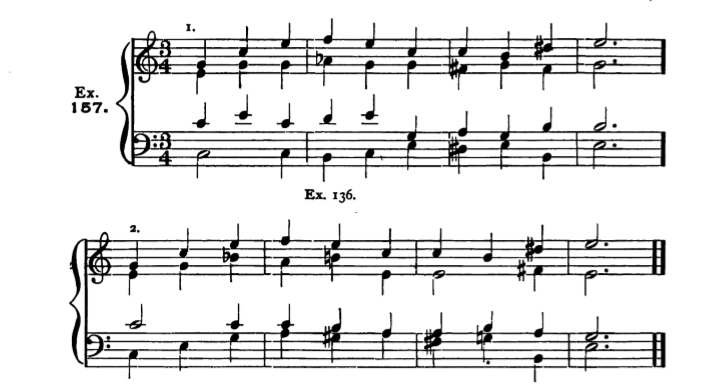
Ex.157-2
228. Review par. 188, and pars. 88, 89 and 90. Besides the chromatic progressions there shown; — from a triad into a Dom.-7th or diminished-7th chord; and the chromatic succession of 6ths; — it is quite common, in four-part harmony, to use a chromatic succession of diminished- Jth chords. These movements are all exhibited in the following:
Ex.158a
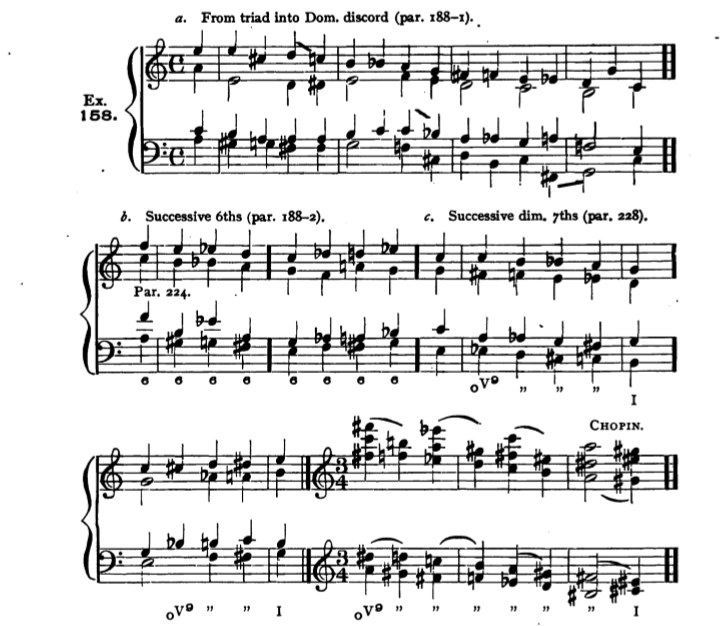
Ex.158b
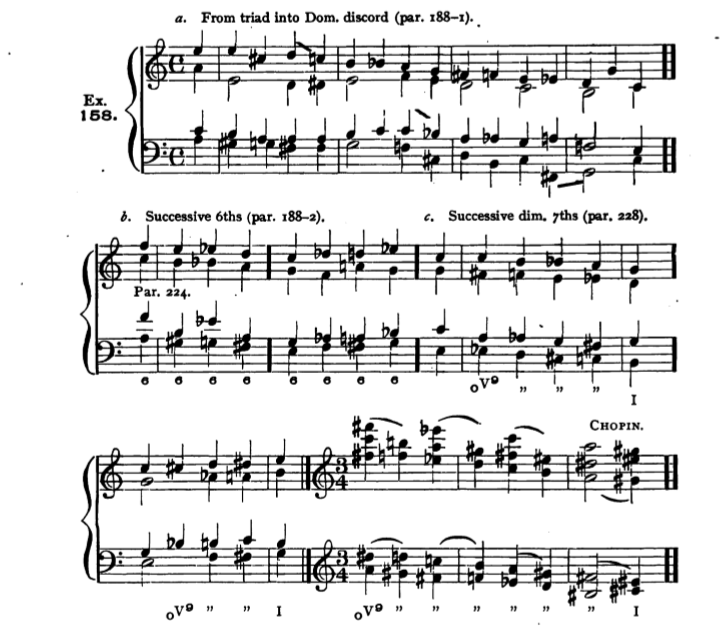
Ex.158c
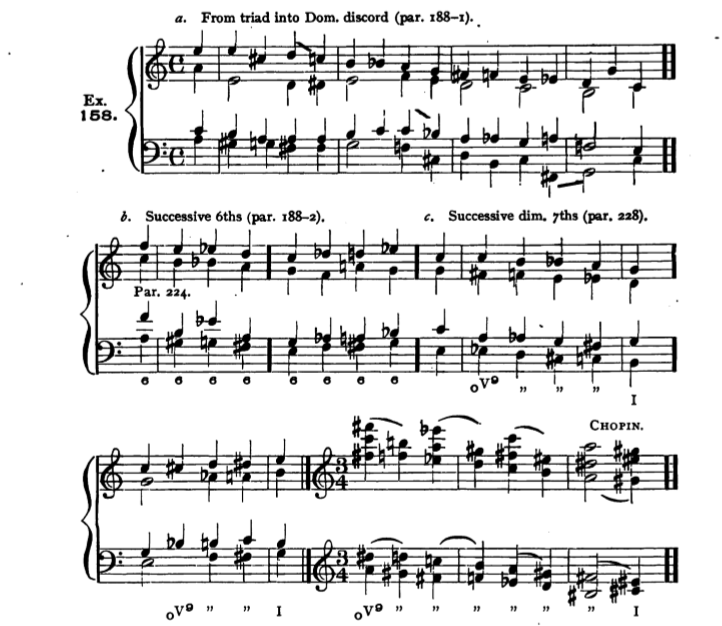
a. From triad into Dom. discord (par. 188-1).
In example a there are three irregular chromatic conditions, known as the Crossrelation. In measure i, beats 3 and 4, the d in Soprano is followed by d-sharp in Alto; in measure 2, beats 3 and 4, c in Tenor is followed by c-sharp in Bass; in measure 3, last beat, the Bass has f-sharp, followed by f in Tenor. When the chromatic succession is thus divided between two different parts, it is simply necessary that the Jlrst of the two chromatic tones should move stepwise, — not with a leap.
Observe that in example c the line of diminished 7ths is always ultimately checked by a resolution into the I. Such a return to the normal condition of chordrelationship is absolutely necessary, and should not be deferred too long.
229. The pianoforte music of Chopin abounds in beautiful and effective chromatic chord-successions, often extending through a complete sentence. The last phrase in Ex. 158 illustrates this. The student is urged to analyze Chopin's pages very comprehensively and thoughtfully, for such experience as he may desire to gain with reference to this particular kind of flexible harmonic movement. At the same time, he must not neglect the equally faithful analysis of Beethoven, Schubert, Mendelssohn, Schumann, — and Wagner.
Further, — a few random extracts from Chopin:
Ex.159-1
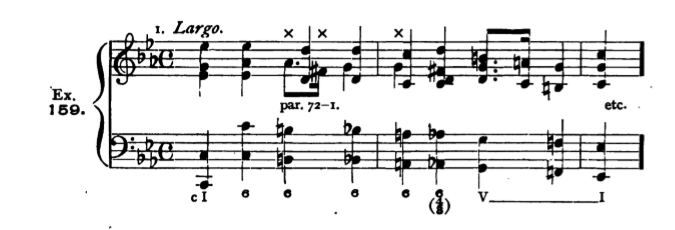
Ex.159-2
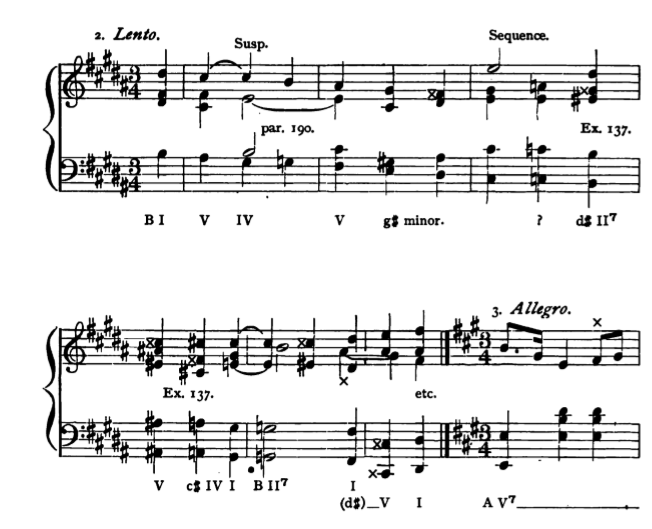
Ex.159-3
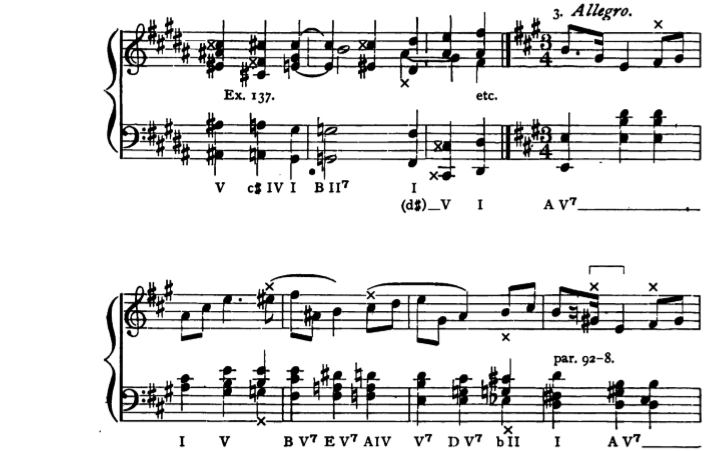
Ex.159-4
Number 1. The whole passage is in C minor; nowhere is there evidence of an actual change of key, because the tones involved create the impression of unessential passing-notes only. In measure 2, beat 2, the f-sharp is a raised 4th step.
Number 2. This passage is so " contrapuntal" in character, that the individual melody-lines cannot in every case be referred to a legitimate chord j only the chord-forms are present, — their names are not always definable. This is obvious in measure 3, beat 2. In measure 5, beat 3, the purpose is a I of B major; the a-sharp in Alto is a passing-note. Similar conditions prevail in Ex. 149, No. 3, the Notes to which should here be reviewed.
Number 3. In measure 2, beat 3, the g-natural in Bass is merely a passing-note, which does no more than change the mode of the chord from major to minor (compare Notes to Ex. 149, No. 1). Measure 6 is similar, though here the c in Bass is a legitimate lowered 6th step of E major. In measure 4, beat 3, — again similar, the e-flat in Bass is a passing-note only.
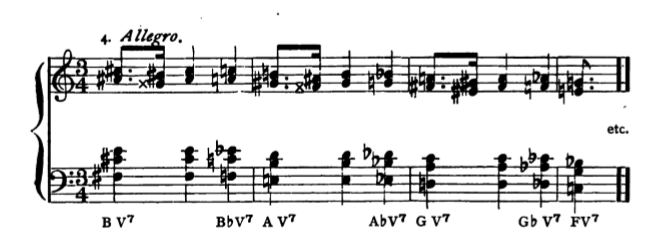
Number 4. A succession of Dom.-7th chords, in fundamental form, and, consequently, with persistent parallel 5ths. See par. 107, especially the last clause.
N. B. This paragraph (229), and the above examples, belong properly to the next chapter. It is not the purpose of the present lesson to use any other than essential tones (chord-intervals).
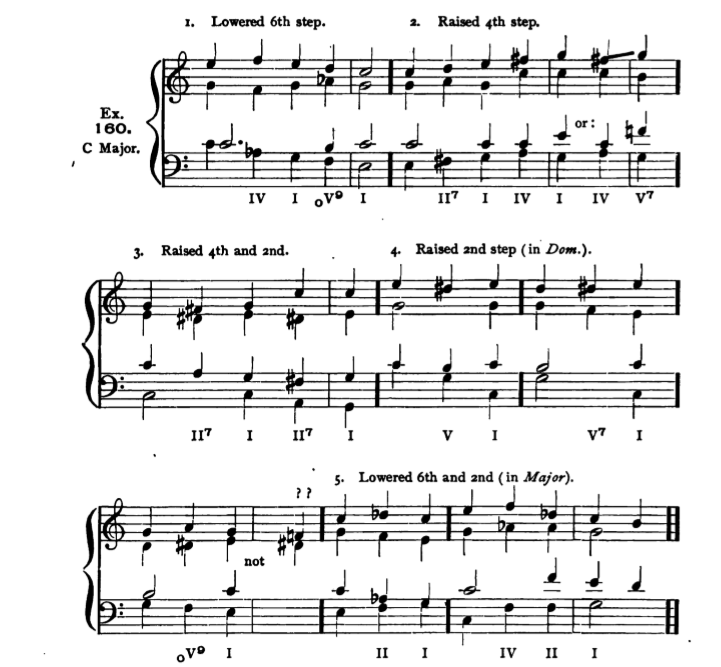
230. For the rules of altered scale-steps; review pars. 190, 191, and
In four-voice harmony their application is as follows, in major:
Ex.160-1
Ex.160-2
Ex.160-3
Ex.160-4
Ex.160-5
3. Raised 4th and and. 4. Raised and step (in Dom.).
5. Lowered 6th and and (in Major).
When the and step is raised in the Dom. discords, it should lie above, not below, the chord-7th.
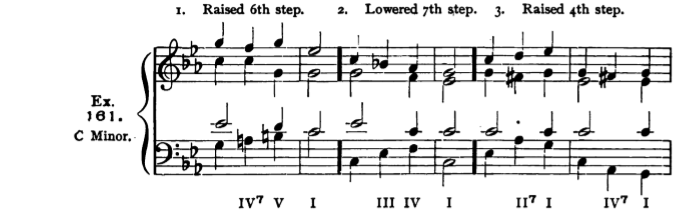
Further, in minor:
Ex.161-1
Ex.161-2
Ex.161-3
Ex.161-4
Ex.161-5
Probably the most common of these are groups 3 and 4.
Observe that here, unlike major, the altered chords do not always progress into the I.
Exercise 23
1. Harmonize, again, all the melodies given in Ex. 18, in four-part harmony, according to the above directions. Do this without fail, and thoroughly.
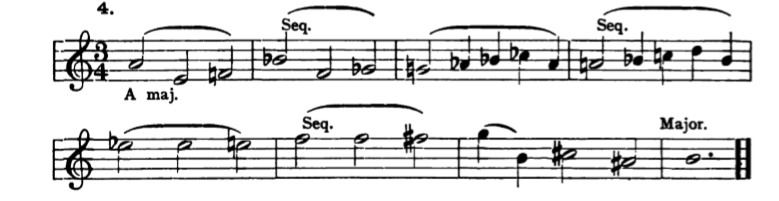
2. Harmonize the following melodies:
Exercise 23.1

Exercise 23.2

Exercise 23.3

Exercise 23.4
Exercise 23.5

Exercise 23.6

[A solution of Melody 5 will be found in the Appendix.]
3. Besides these, write a number of original four-voice sentences, with the material of this chapter.