 Playable Books
Percy Goetschius · section 26 of 29
Chapter XXIV. Contrapuntal Harmony
Read and hear this section in the playable edition →231. Review par. 193, the principle of which is applied to the fourth voiced texture also, and in the same manner.
232. In the following example, the given melody is placed in the Soprano. Review par. 194.
Ex.162
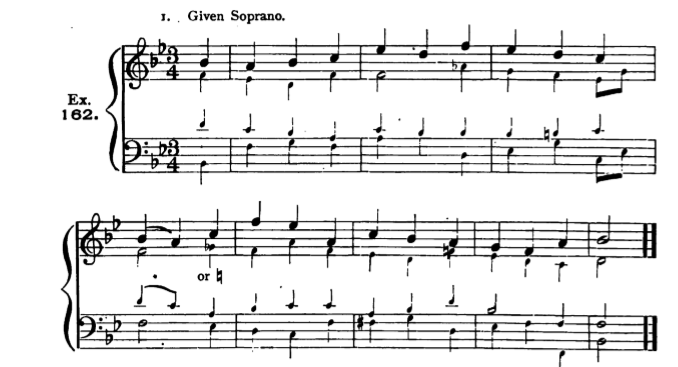
Here again, as in Ex. 140, there is significant evidence of fundamental agreement between the two outer parts, —as if, unconsciously, the Bass were counterpointed to the Soprano alone, with more reference to general melodic agreement than to the chords. It is probable that this is always preponderantly the case, in music of every kind; for both outer parts, because of their prominence, are melodic leaders; and their good contrapuntal association guarantees the complete harmonious result, into which the two inner parts necessarily fall.
This attaches a degree of importance to the Bass (or lowermost part), which the student is warned not to underrate, or overlook.
Observe the movements of the lowermost part in many sentences in Beethoven, Mendelssohn and others. See the 5th Waltz of Chopin (A-flat, op. 42), measures 29-41 from the end.
233. Review, very thoroughly, pars. 197, 198 and 199. The above simple harmonic version may be amplified to a constant rhythm of two notes to a beat, in alternating parts, about as follows:
Ex.163
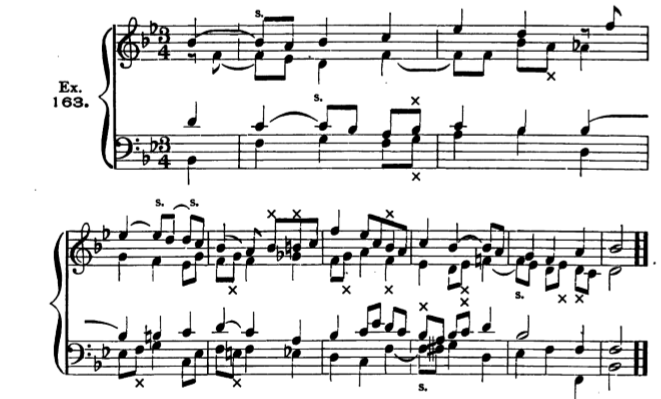
Compare this very carefully with the original form (Ex. 162). Observe, here again, that the quicker rhythm is applied, in the upper part, to the unaccented beats,—with one exception, in the first measure.
234. Review par. 195. — In four-voice harmony, the given melody cannot conveniently be used in the same key for each of the four parts.
A given Soprano is placed one octave lower for the Tenor; and a given Bass, one octave higher for the Alto. The given Soprano is transposed either a 4th or 5th downward for the Alto; and the given Bass a 4th or 5th upward for the Tenor. For example, if the given Melody is in C, the keys will be as follows:
Alto — G or F
Bass —G or F.
The above given Soprano (Ex. 162, B-flat major) may therefore be placed in F major for the Alto. Thus:
Ex.164
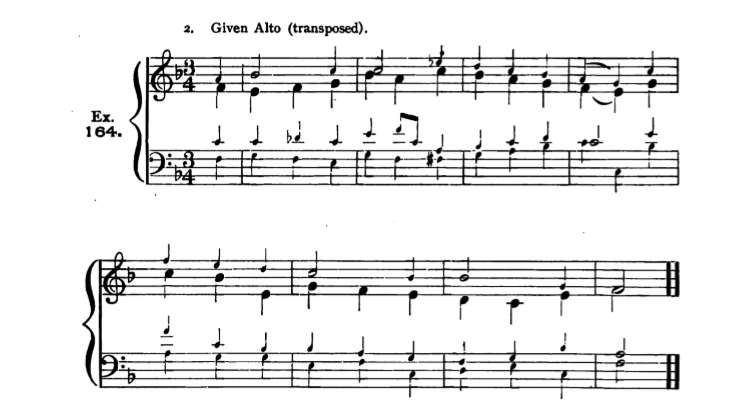
Here, the Bass agrees contrapuntally with the given Alto, as if these two parts were unconsciously conceived together. Note the parallel 3<ls in meas. 3.
235. This may be amplified to a constant rhythm of three notes to each beat, in alternating parts, about as follows:
Ex.165
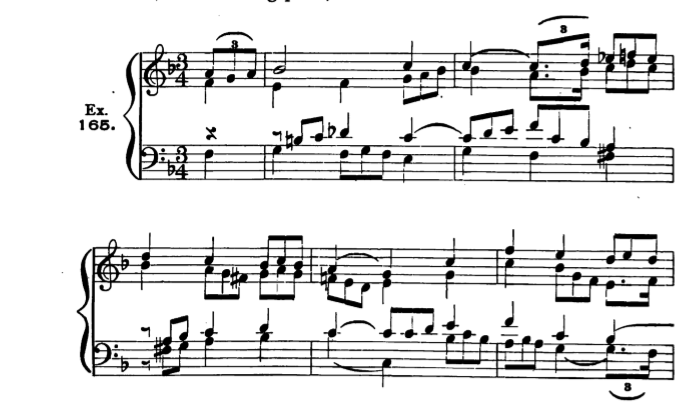
Compare minutely ■with the original model, Ex. 164. Observe, again, the treatment of the rhythm in the upper part.
236. Review par. 196. — For the Bass voice, a new Melody is here chosen, for greater variety of illustration:
Ex.166
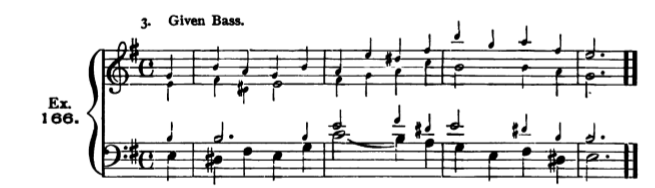
Here the agreement of the Soprano with the given Bass is conspicuous. Compare the Notes to Ex. 162. As to the monotony and meagre melodic contents of the Tenor, review the Notes to Ex. 153, version 4; — and observe how, in the amplified form (Ex. 167), this Tenor becomes as melodious as the other parts.
237. This simple harmonic sentence may be amplified, about as follows, to a rhythm of four notes to each beat:
Ex.167
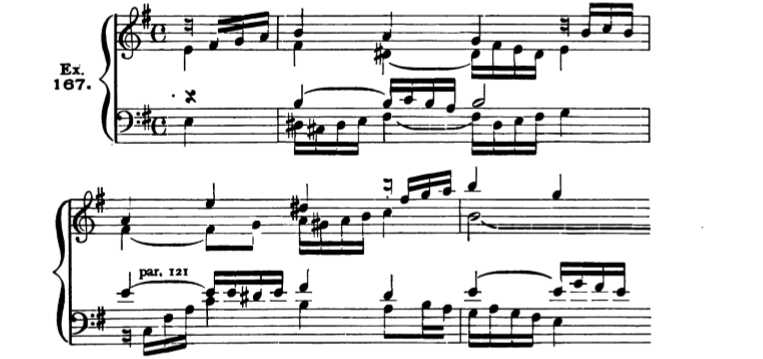
Compare carefully with Ex. 166.
238. The above given Bass (Ex. 166, E minor) may be placed in B minor for the Tenor:
Ex.168
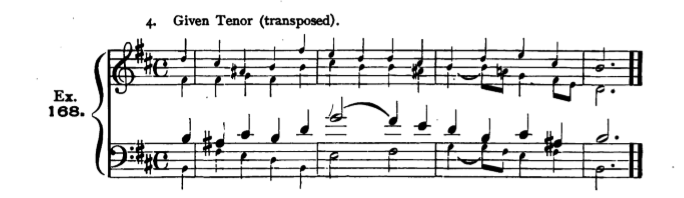
Here, both the Soprano and the Bass, — separately, — harmonize admirably with the given Tenor.
It is probably unwise to lay too much stress upon these harmonious results, with reference to any particular part or parts, because they are no doubt nothing more than the natural consequences of choosing the correct chords. At the same time, if the student finds that the intentional adoption of such a process facilitates the task of harmonization, he may be sure that it is a perfectly legitimate mode of procedure. And, at all events, he must carefully guard the principle dictated in the Notes to Ex. 162, and always provide for a good, melodious lowermost part.
239. The above harmonic phrase (Ex. 168) may be amplified to a constant rhythm of four notes to each group, as follows:
Ex.169
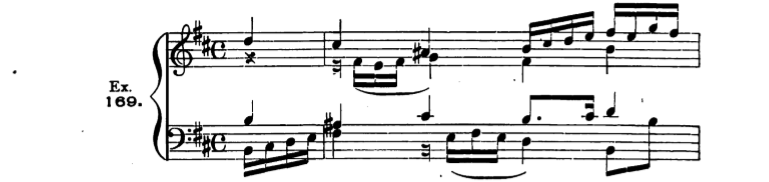
Compare minutely with Ex. 168, — not only as a whole, but each part separately.
In the second version of measures 3 and 4, the c-natural in Tenor is used as lowered and scale-step (of b minor); in anticipation of this legitimate "alteration," the whole harmonic current sets into C major. The f-sharp in Soprano is a little harsh, but inevitable, as it is the very means of establishing b minor, and proving the identity of c as lowered and step.
Exercise 24
Contrapuntal Four-part Harmony.
1. Amplify Ex. 162 also to a constant rhythm of 3 notes to each beat, in alternating parts; and then to 4-note groups. Amplify Ex. 164, similarly, to 2-note groups; and to 4-note groups. Amplify Ex. 166 to 2-note groups; and to 3-note groups. Amplify Ex. 168 to 2-note groups; and to 3-note groups.
2. Place the given melody of Ex. 162 also in the Tenor, in A major. And also in the Bass, in E major. Each version thus obtained is to be amplified as usual to 2-note groups, 3-note groups, and 4-note groups.
Place the given melody of Ex. 166 also in the Soprano, in a minor; and also in the Alto, in d minor. Each version thus obtained is to be amplified to
2-note, 3-note, and 4-note groups.
3. Harmonize each of the following given melodies in the four ways exhibited above; first as Soprano; then as Tenor (in the same key, an octave lower); then as
Alto, a 4th or 5th lower than where it is written; and then as Bass, in the same key as the Alto version, one octave lower:
Exercise 24.1
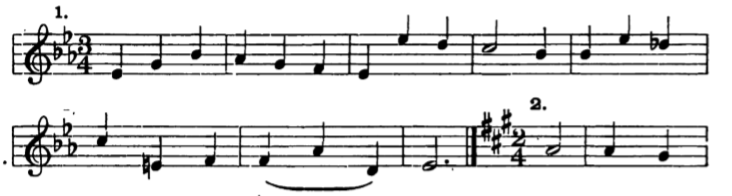
Exercise 24.2
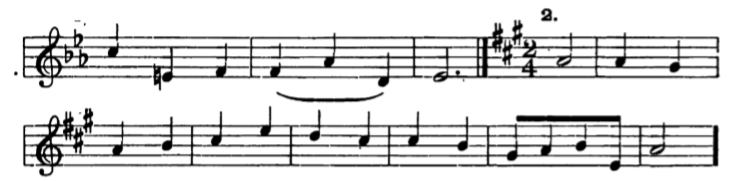
Exercise 24.3
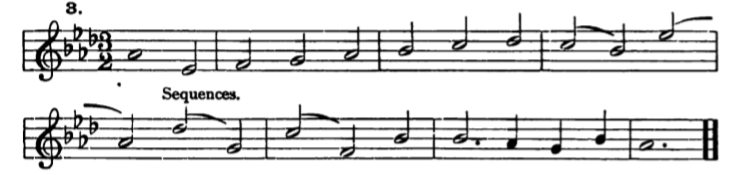
Each version thus obtained is to be amplified as usual to 2-note, 3-note, and 4-note groups; — each melody must yield 16 different solutions.
This task presents peculiar difficulties, and the student must undertake it with patience and faithful persistence. A partial solution of each will be found in the Appendix, to which he may refer after having exhausted his own ingenuity upon them. Those given versions, also, are to be amplified as usual.
4. Manipulate, at the keyboard, each one of the above simple harmonic versions (including Exs. 162, 164,166 and 168) in a rhythm of two notes to each beat, with shifted parts (syncopation), as shown in Ex. 144, B.