 Playable Books
Percy Goetschius · section 27 of 29
Chapter XXV. Four-Part Counterpoint
Read and hear this section in the playable edition →

240. Review, very thoroughly, par. 204. Also par. 205; and par. 206; and par. 207.
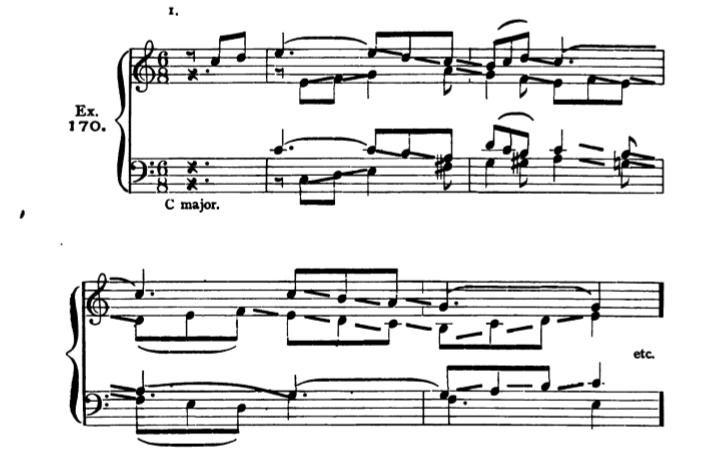
241. The devices explained in par. 206, — parallel 3rds and 6ths, and "opposite duplication," — are here again, in four-part counterpoint, convenient and valuable; especially in what must still be regarded as elementary contrapuntal exercises.
Review Exs. 147 and 148; and see the following: 1.
Ex.170-1
Ex.170-2
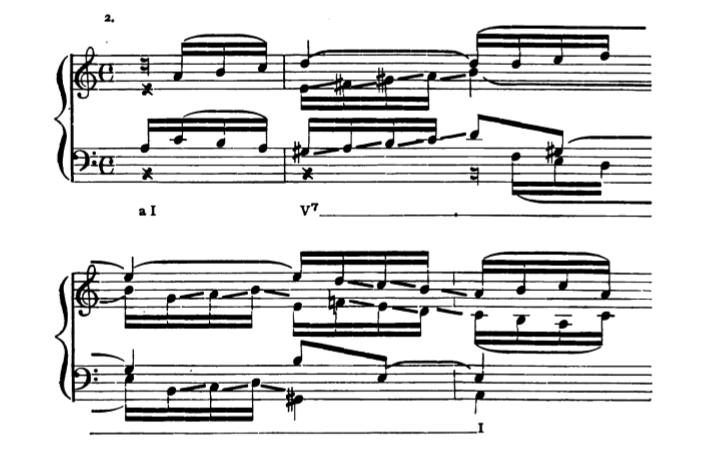
The " parallel 3rds and 6ths " are indicated by dashes; the " opposite duplications," by slurs.
Again the student is reminded that these devices are useful and legitimate in elementary counterpoint, but by no means characteristic of the higher grades of polyphonic writing. They serve, sometimes admirably, to sustain the rhythmic momentum of the parts, — especially, as has been seen, during the necessary prolongation of a chord; and often tend to overcome easily and smoothly some harmonic embarrassment.
242. As for the more serious details of four-part counterpoint, the student can find no surer means of increasing his knowledge and experience than the careful study and analysis of good contrapuntal models.
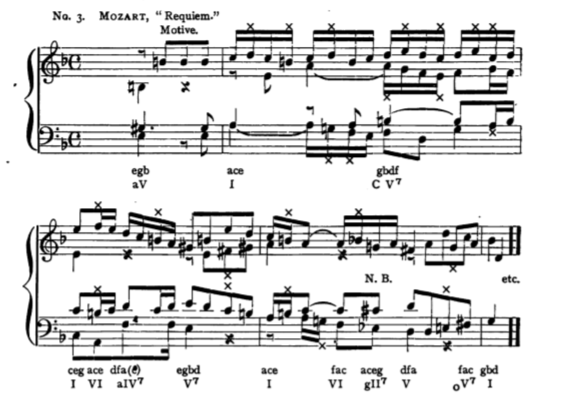
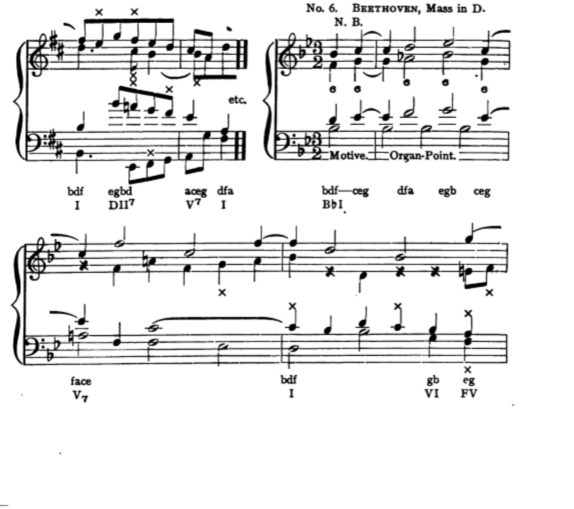
In pursuing this method of training, he should adopt the method indicated in the following analytical exercises. Thus: First define the chords, by the letters which they contain, and also, as far as possible, by name in their key; then define the unessential (passing and neighboring) tones; and carefully note all the linear details, — sequences, imitations, and other evidences of purpose and agreement in the formation and arrangement of the melodic figures. For illustration:
Ex.171-1
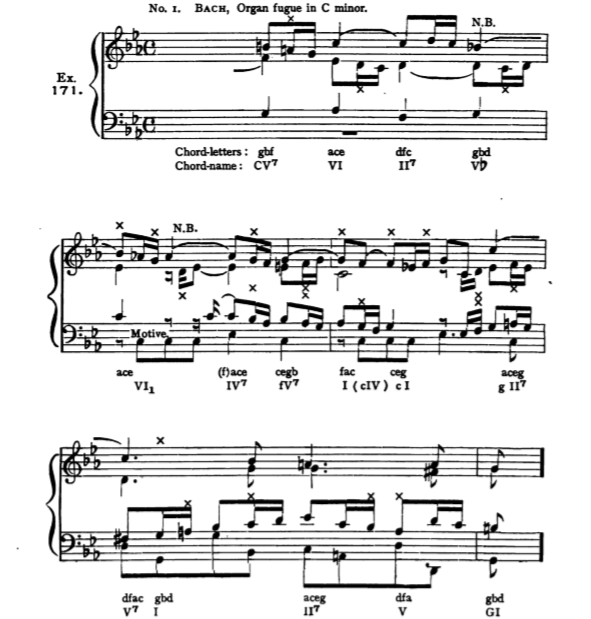
No. 1. Bach, Organ fugue in C minor.
Ex.171-2
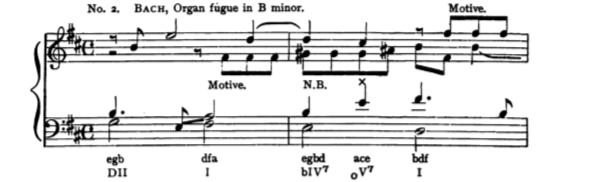
No. *. Bach, Organ fugue in B minor.
Ex.171-3
Ex.171-4
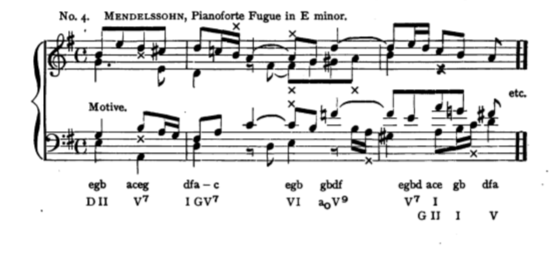
No. 4. Mendelssohn, Pianoforte Fugue in E minor. x
Ex.171-5
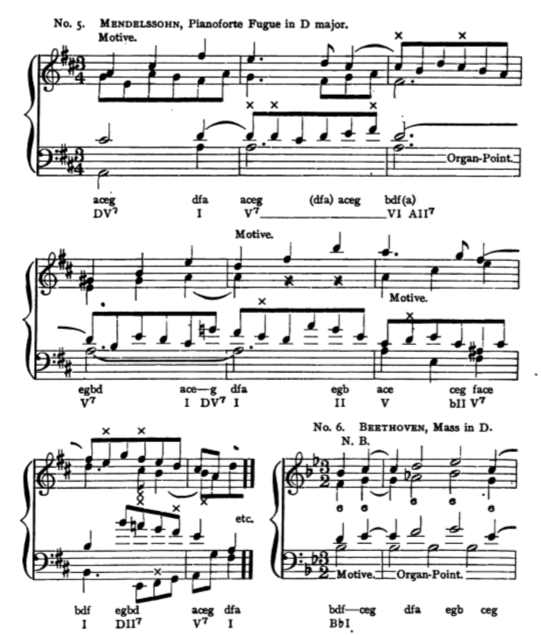
No. 5. Mendelssohn, Pianoforte Fugue in D major. Motive. 1
Ex.171-6
Ex.171-7
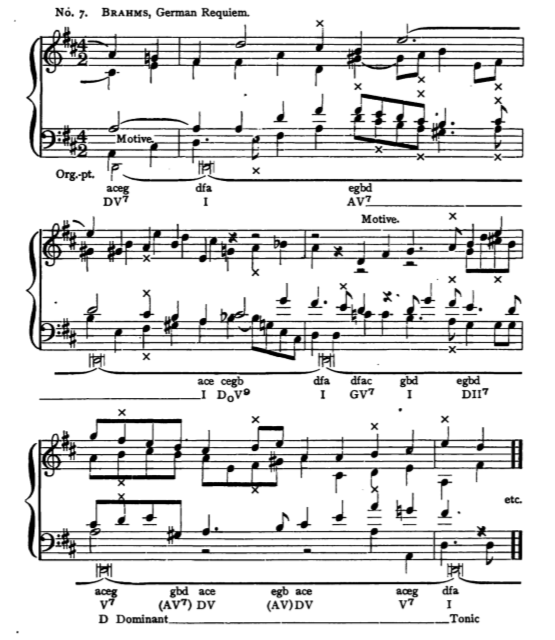
Every inharmonic tone is marked x, throughout all these numbers. The tones not thus marked form the chord, whose letters (and name) are given beneath.
Observe, throughout, that the chords represent either tonic, dominant or subdominant harmony; that the dominant almost invariably moves into the I (or VI) of its key; and that the subdominant (IV or II) usually moves into the dominant. In other words, observe the prevalence of the progression II-V7-I, and compare par. 169, — also pars. 174 and 175.
Besides these general traits, observe the following details:
In No. I: Measure I, beat 4, the b-flat in Soprano is the lowered 7th scale-step, on the way down. In measure 2, beat 2, the manner in which the three upper voices cooperate to carry on the four 16ths of the beat.
In No. 2: Measure 2, beat 1, the g-sharp in the Alto is the raised 6th step, on the way up. Notice, particularly, the descending scale in Bass (in half-notes), and how this line is later imitated in Alto, and, syncopated, in Soprano and Tenor. In measure 4, the a in Soprano is the lowered 7th step of B minor, used on the way down, in preparation (also) of E major.
In No. 3: Measure 3½, beat 2, the c-sharp in Tenor is the raised 4th step.
In No. S: Measure 2 is, strictly speaking, all dominant harmony, although the fourth 8th-note sounds like a brief tonic. Similar long dominant chords are found in No. 7, near beginning and end. Compare paragraph 207 (Ex. 148, No. 4).
In No. 6: At the beginning there is a succession of Sixth-chords, over the tonic organ-point. Compare paragraph 182 (Ex. 132).
Exercise 25
Analyze, similarly, each of the following extracts, in the given order. Determine the chord-letters, as shown in the above example; and mark all inharmonic tones. This is the most important detail of the analysis. The chord-names may be added, wherever they appear definable. Also note, particularly, all the linear details, and the relation of the figures and tone-lines to each other, — with reference, for instance, to par. 206 (Ex. 147).
[The student may need to be cautioned against being over-scrupulous. It is not necessary to define every tone. He should leam to analyze, at first, somewhat superficially; first defining those chord-forms (and chord-names) that are quite evident, and adding minuter definitions as the passage assumes a clearer general character in his mind. Above all things, he should recollect that, in counterpoint, the TONE-LINES are of paramount importance.]
Bach, " Well-tempered Clavichord ": — Volume I, Fugue No. 5 (D major), measure 5, to the end.
" " Prelude No. 12 (F minor), measure 11, to the end.
" " Fugue No. 16 (G minor), measure 15 to 18.
« " Prelude No. 7 (Eb major), measure 1 to 4; 10 to 25; 32 to 41: 58, to the end.
a " Fugue No. 12 (F minor), last 6 measures.
*' " Fugue No. 14 (F# minor), last 9 measures.
" " Fugue No. 18 (G# minor), measure 7 to n.
" " Fugue No. 20 (A minor), measure 11 to 15.
" " Fugue No. 23 (B major), measure 12 to 18.
" " Fugue No. 1 (C major), measure 5 to 7; 16 to 19; 22, to the end. Volume II, Prelude No. 1 (C major), measure 11 to 20.
" " Fugue No. 7 (Eb major), measure 21 to 30; 58, to the end. •• Fugue No. 9 (E major), measure 5, to the end.
" " Fugue No. 16 (G minor), measure 51 to 67.
" " Fugue No. 2 (C minor), measure 19, to the end.
" " Fugue No. 23 (B major), measure 19 to 27; last 12 measures.
" " Fugue No. 22 (B> minor), measure 17 to 25; 42 to 46.
“ ” Fugue No. 8 (D♯ minor), last 6 measures.
" " Fugue No. 5 (D major), measures 10 to 16; 24, to the end.
After finishing these, the student may analyze any example of 4-part counterpoint that he may find, in the works of Bach, Händel, Mendelssohn, Rheinberger and other modern writers.