 Playable Books
Percy Goetschius · section 28 of 29
Chapter XXVI. Motive-Development
Read and hear this section in the playable edition →243. Review pars. 142 to 145. Also pars. 212, 213, 214, 215 and 216. These all have bearing upon four-part counterpoint, also.
244. The rule given in par. 217 should be applied with still greater emphasis to a contrapuntal sentence with four parts. At least one of the parts should be restrained in its movements, — that is, heavier (longer) tones should occur frequently in one and another of the parts, in contrast with the prevailing quicker rhythm. This may be seen, to some extent, in Ex. 170.
Further, rests should be frequently introduced; not only brief ones; whole groups of beats should be silent now and then in one, and then another, of the parts, — so that while four parts are unquestionably rep resented, they are not always active together. In this manner, the student's task is reduced for a part of the time to three-part counterpoint, and the result is all the more effective.
245. The development of a Motive with four contrapuntal parts, while subject to all the general conditions of foregoing chapters, requires a somewhat more definite system of announcement and imitation, at the beginning. The following schedule must be adopted:
1. The Motive may first appear in any one of the four parts. And, if need be, a few intermediate tones may be added, with strict regard to pars. 213 and 214.
2. The second announcement (first Imitation) must appear in the next higher or next lower part, — in the Dominant key (compare par. 212).
3. The third announcement must be in the original key, one octave lower or higher than the first announcement, and therefore in a " parallel " part of the latter.
4. The fourth announcement must be one octave lower or higher than the second one, —again in the Dominant key. This will always be the last one of the four parts, the one which has remained unused.
Between each of these announcements brief episodes may be introduced, if necessary.
For example, with the first Motive of Exercise 21:
Ex.172
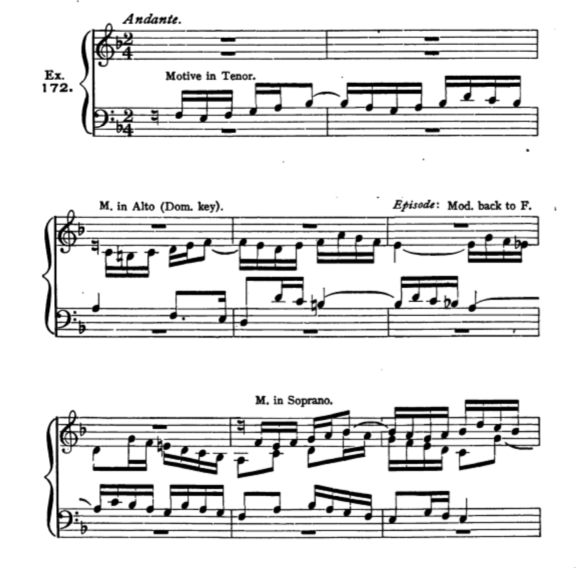
Episode: Mod, to Subdom, and to orig. key.
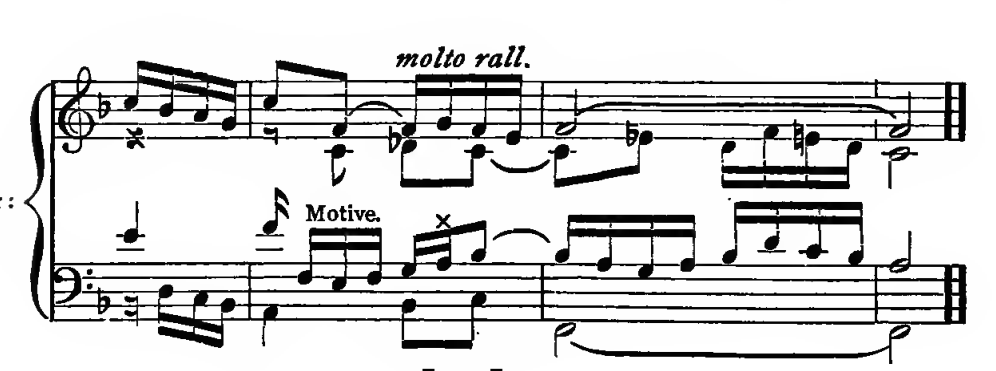
Analyze this (first without, and then with, the keyboard) most thoroughly. Observe that the counterpoint does not become " four-part" until the last part announces the Motive (measure 10). The four parts are then retained steadily to the end, excepting one measure rest in the Alto. This is somewhat contrary to the spirit of paragraph 244, but cannot be wrong, of course.
In the second version of the ending, one additional announcement of the Motive is made, in the Tenor. The d-flat (in Alto) is, in both cases, practically the lowered 6th scale-step of F major.
246. The above sentence is much shorter than any of the Inventions with two voices, or with three voices, made in Exercises 15 and 21. Should a more extended form be desirable, the schedule given in par. 154 may be consulted, but will probably be utilized more as a general guide, than literally, Compare par. 219.
Exercise 26
Motive-Development, with Four Contrapuntal Parts.
1. Make three more complete solutions of the Motive manipulated in Ex. 172, beginning with Soprano (in same key); then beginning with Bass (C or B major); and then with Alto (C or B major).
2. Manipulate each of the following Motives, in the manner above suggested. Each Motive may be developed in four wholly different ways, by placing the first announcement respectively in each of the four parts (in different keys, — as indicated above, and according to the suggestions given in par. 234). Review all the directions in Exercise 21, No. 3.
Exercise 26.1
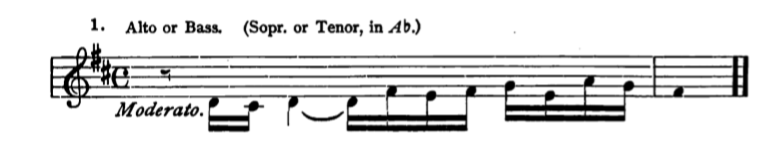
1. Alto or Bass. (Sopr. or Tenor, in Ab.)
Exercise 26.2
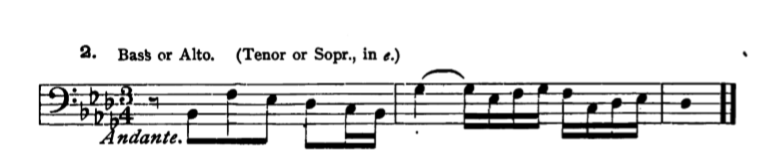
2. Bass or Alto. (Tenor or Sopr., in e.)
Exercise 26.3
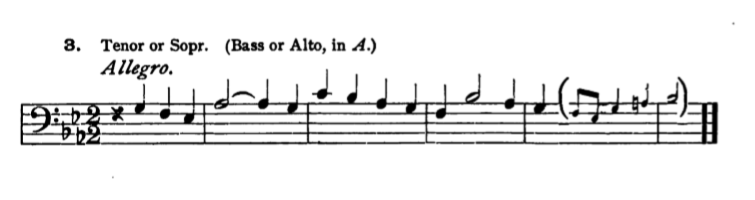
3. Tenor or Sopr. (Bass or Alto, in A.)
Exercise 26.4

4. Sopr. or Tenor. (Alto or Bass, in c%.) Allegretto.
Exercise 26.5
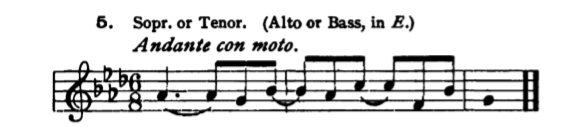
5. Sopr. or Tenor. (Alto or Bass, in E.) Andante con moto.
[A concise solution of Motive 5 will be found in the Appendix.]
3. Besides these, manipulate again (with four parts) some of the Motives given in Exercise 15 and in Exercise 21,— subject to pars. 213 and 214, if needed.
4. Further, the student may invent a number of original Motives, similar to the above, and manipulate them in the usual manner.
This is as far as the study of Elementary Counterpoint need extend. For the continuation of his contrapuntal discipline, the student may take up the author's Applied Counterpoint, beginning with Chapter IV.
But before doing so, or in systematic alternation with the latter, he is urgently advised to pursue a thorough course in free composition, as detailed in the author's Homophonic Forms.