 Playable Books
Cecil Forsyth · section 51 of 60
No. 47. The Viola (or Tenor)
Read and hear this section in the playable edition →

Fr. Alto, It. Viola, Ger. Bratsche.
The Viola is not merely "a big Violin." It is a Viola. If it were called a bi fobut noga it bir songs elin" that would be a better
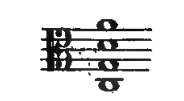
a perfect fifth below those of the Violin, its size by no means corresponds to the increased depth of pitch. A similar remark holds true of the Cello, but in that instrument the deficiency in size is compensated by extreme depth of ribs and height of bridge. On the Viola, however, these compensations are impracticable. Nor can the general size of the instrument be increased so as to be in correct proportion to its pitch. In either case we should get an instrument too small to be played satisfactorily in the Cello-position and far too large to be properly played in the Violin-position. The result of

and somewhat uneven in tone-quality,' and undeniably clumsy to manage
In actual size the instrument shows a much greater percentage of difierence than any other member of the String-group. The corresponding differences in ease-ot-management between, let us say, a huge sixteenth-century Gaspar and a modern French Viola are so great that it is dificult to class the two, except in pitch, as the same instrument. There is, therefore, considerable latitude for the player in the choice of an instrument. opinions, but on the whole it may be said that the first necessity of the Viola above all other stringed-instruments is warmth and depth of tone-colour. Without size this appears to be an impossibility. resulting ditticulty in handling the instrument has to be laced by players, but the ditticulty of this position can easily be "turned" if composers would steadily refuse to treat the instrument as a Violon manqué, and if players would as steadily refrain from practising Fiddle-studies on the Viola in public.
In fitting and general appearance the Viola differs from the Violin in only one particular. The two bottom strings—the C and G-are both covered; that is to say, they are "spun" with metal filament in order to secure the necessary weight without undue thickness.
The Viola-technique is, in theory, precisely the same as that of the Violin. All that was said above with regard to the Violin fingering, positions, shakes, tremolos, Natura. and Artiticial Harmonies, double-, triple-, and quadruple-stopping, bow-strokes, lists of keys, and so on, applies equally to the Viola when transposed down * Porter slight It is therefore unnecessary to repeat these details. differences, however, due to the pitch, the greater size, and the consequent more clumsy build of the instrument, may be mentioned
Chromatic technique.
This is precisely the same as on the Violin. In each case a single finger is used to play both the natural and the chromatic note. Chromatic passages, however, are somewhat easier in execution and clearer in etect when played on the Viola. This is due to the greater length of its strings as compared with those of the Violin. The finger has more room in which to move. The intonation of the semitones is more easily precise, and enharmonic differences are more apparent to the ear. The greater chromatic freedom of the Viola, however, must be taken in a comparative sense only. The instrument is no more purely chromatic in its technique than the Violin.
Short chromatic passages in the middle and bottom registers are always orchestrally effective. Care should be taken that each of these
1 The Viola more than any other stringed-instrument is liable to have some one or two wolf notes in its compass. In tact very few Violas are wholly free from this defect. The opposite disease, commonly known as sleep, seems to affect it less. Perhaps its constitution, inured for centuries to sleepy passages, has by now become immune to the microbe of sleeping-sickness.
passages is not too long. Furthermore, they are much more effective slurred than bowed. I'his may be taken in a general sense for both fast and slow passages. In particular, very fast bowed chromatic scales are almost impossible. This is not due to any defect in the lefthand technique, but to the constitutional unreadiness of the instrument
to sphe alto or Eclet (13) on the third line is used normally for
ali Viola-music. For the highest notes the G-or Violin-clet S)
on the second line is employed. As a rule the former clef would be written for all passages up to about
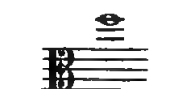
The & is scarcely worth using, except in those rare cases where a complete passage lies in the top octave, say from
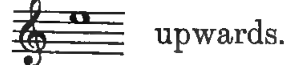
Continual change of clef is worrying to the player. Even in the case of a passage which is mainly in the highest register and must
therefore be written in the it is as well not to interpolate the
I simply because the passage happens to descend for a moment. For instance, in the extract given below from Strauss's Ein Helden- Leben, the use of the 'I at bar 4 would certainly save a leger line. The notation, however, is clearer as it stands.
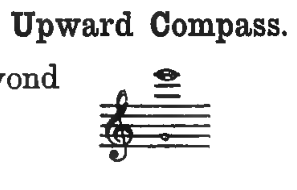
It is unwise to go beyond
in the orchestra? Indeed the last three or four semitones of this compass can, in the ordinary orchestral routine, be dispensed with. This leaves the instrument with a three-octave compass, sufficient for most purposes, one would think. In dealing with the top-register it must not be forgotten that, owing to the size of his instrument, the Viola-player has much more ditticulty in fingering his notes than the violinist. The upper curves of his instrument are large. They therefore offer a much greater obstacle to his left hand. He has however
1 See Ex. 245.
2 With of course the Natural Harmonic A a fourth higher. See below, page 389, for its Harmonio compass.
no "thumb position" 1 like the Cellist. He has to rely solely on the Violin-technique, and has to apply it in disadvantageous circumstances. So long as he is not called upon to rise beyond the 5th position on the Lst string, the technique sullices; but, beyond that, the tundamental deficiencies of a "too large and too small themselves, and the technique, except with the most brilliant players, "peters out."
It does not follow, then, that the Viola can be regarded in its top register as merely a Violin tuned a fifth lower. Any good violinist Is much more at his ease between
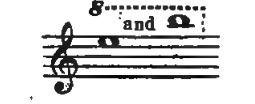
than the correspondingly good Viola-player between
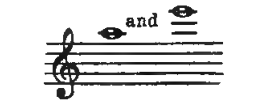
Indeed it might almost be said that, in judging the relative difficulty of Viola-passages in alt, it is safer to class them with similar Violinpassages an octave higher.
Another reason for using the upper Viola-register with some caution is to be found in the fact that Viola-players are not continually playing in that register. Attention has been already drawn to this point in the section devoted to the Horn. It applies less to a stringed-instrument, but, even here, if a composer allots 99 per cent. of his Viola-music to its two lower octaves he must be prepared to find that the player inevitably loses a certain portion of freedom in the extreme top-register.
A Viola-passage like the following, the last tive bars of which are included not as an example but as a warning, can only be made orchestrally tolerable in very special circumstances. Here it forms part of a tremendous melodie String-unison supported by the whole The circumorchestra. The Violins really pull the passage through. stances may justify this special case, but one would not. like to be asked to name the orchestra whose Violas could play these bars neatly with only a light pizzicato accompaniment.
Example 245
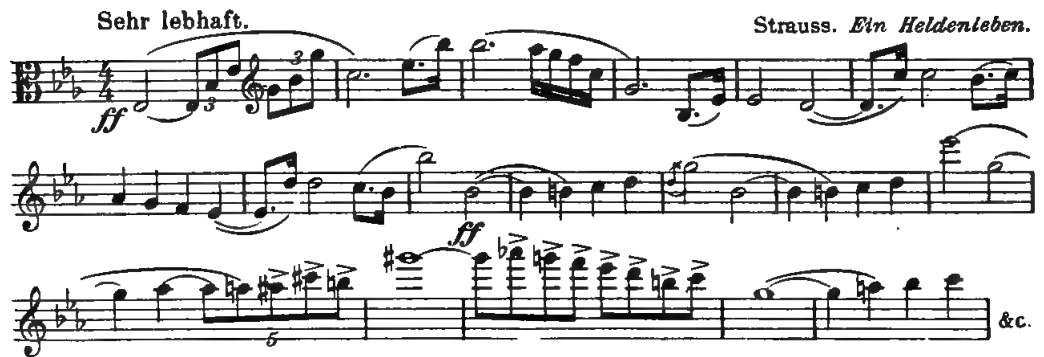
' See page 411.
The above remarks must not be taken as pointing backwards to the bad old days when Viola players were selected merely because they were too wicked or too senile to play the Violin. Those days are haning for the nevement with all treen possible in tring of study and specialization, but with a knowledge of the instrument's limitations.
Like all the middle-compass instruments, the Viola has to take its share of "flling-up" This is not a drawback. In a way it is a peculiar felicity for the orchestral composer. With perhaps a single

medium-such as the pianoforte—acquire, on the orchestral instruments, a beauty of sound second only to that of human voices. This point is worth keeping in mind when the temptation arises to write wild, crooked, pianistic passages for the Viola.
Chords.
The available double-, triple-, and quadruple-stops may be taken in a body trom the list of Violin chords given on pages 315 to 328. tor the Viola they must, of course, be all transposed down a pertect fifth. In general it is the lower parts of the Violin-chords (transposed) which are most serviceable on the Viola. The nasal twang of the top string gives a certain unevenness and emptiness to big spread chords.
In laying out chords for the Viola it must be remembered that there is an added heaviness in the triple- and quadruple-stops. They should only be used in fairly simple keys where there are opportunities for the employment of the open strings. As a rule, the triple-stops are of greatest orchestral service when written for the three bottom strings.
It is necessary to mention these reservations explicitly, but the student must not forget that the principal object of orchestration is the enforcing of musical ideas by means of suitable tone-colour. should not be too ready to throw away the more striking tone-colours of the Strings on any musical passage; nor to risk spoiling his musical idea by so doing. He should reserve the right quality for the right The peculiar "hulking" quality of the Viola chords is a strong weapon in his hand, but a weapon that should only be used at the right moment. When associated with the chords of the Cellos and with the notes of the Basses its effect varies, according to the character of the music, from a rich, organ-like placidity to a sombre and sometimes almost painful savagery.
Simple double-stops are more continually used and more smoothly eftective on the Viola than on any other stringed-instrument. Indeed, in many modern works the Violas are constantly playing in two parts. This must not be taken to mean two parts each of which has a clear contrapuntal outline, but merely two "filling-up" parts. Naturally the three lower strings are more often employed for this sort of work than the top string
In'such unobtrusive passages cases often occur where an isolated chord or two cannot be performed by each separate player. Both notes, for instance, may lie on the bottom string. it is unnecessary always to mark these chords div. The players will instinctively divide at such places. An example can be seen in the extract printed below, page 413, from the 3rd Movement of the Choral Symphony. In the last bar but one of the Viola part the first two chords are quite easy and natural to play. The third chord-low D and FF-is an impossibility, as both notes lie on the bottom string. The players, therefore, divide for that chord only, and resume the unison on the See also Bar 2 of the Freischütz Example printed next quahere the same thing occurs. below,
On the other hand, it the composer wishes the whole passage it clearly in his score. See, for instance, the divided he must mark Example quoted below? from Strauss's Don Juan. The last bar, both in the 1st and 2nd Violin parts, could quite easily be played in double-stopping, but it is specially marked div in both cases. The result is, of course, an actual halving of the amount of tone on each
A consideration arises here which is of general application. All two-part writing for single stringed-instruments is less pure and flexible than the same two-part writing when played divisi. This has been matter of general observation, though the reason has, one physis, noth ordere to oneduce the manatio resine, whether in thinks, not been mentioned. used. or the f, a certain speed and pressure of bow-stroke has to be • This speed and pressure differ materially as between any two of the four strings. When, therefore, the bow is setting any two neighbouring strings in vibration, a certain compromise speed-andpressure has to be adopted. This accommodation of the bow, while satistactory tor most practica, purposes, suits neither of the strings pertectly. the tone, and this loss is orchestrally less noticeable in the p than in the f.
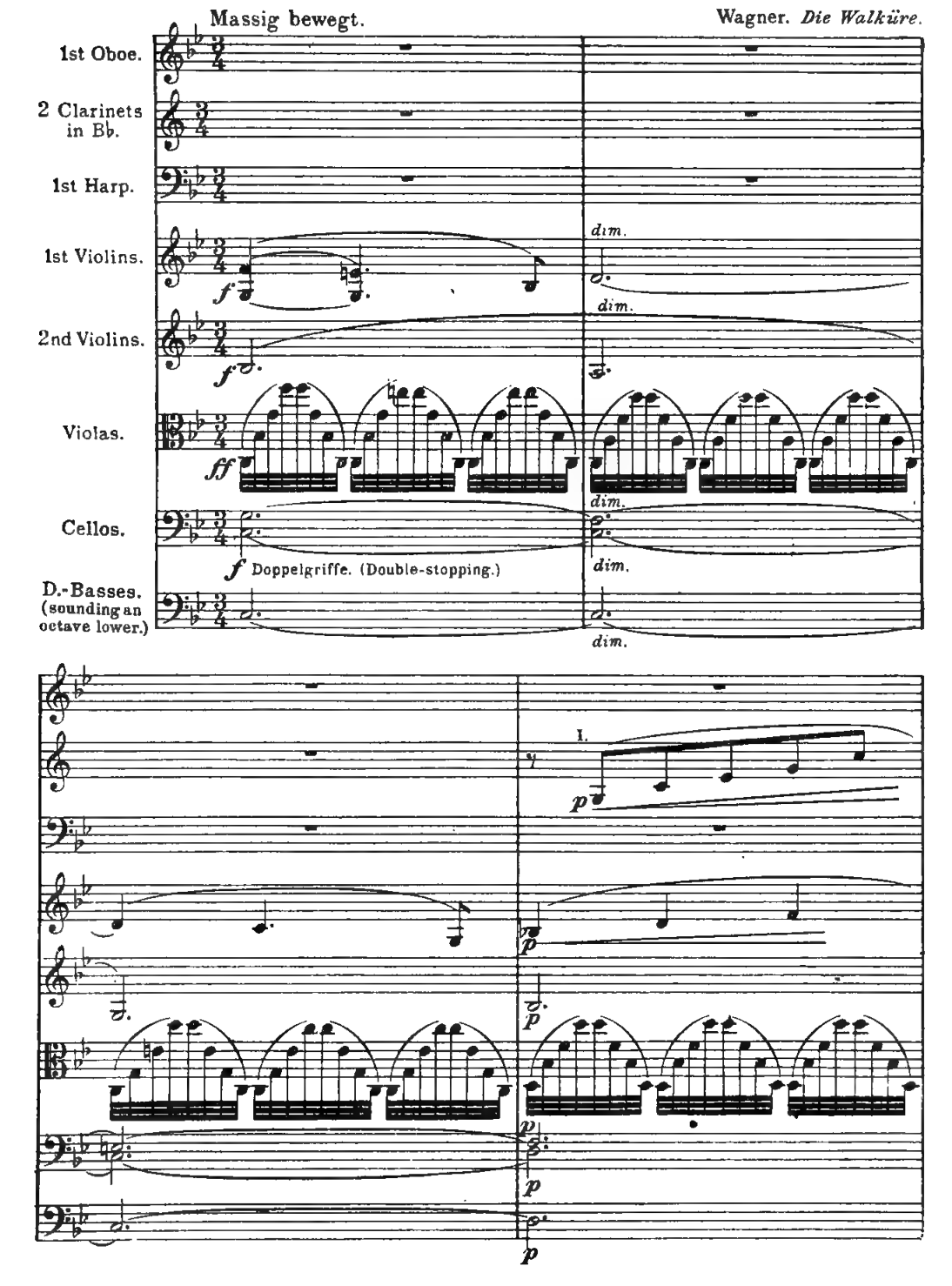
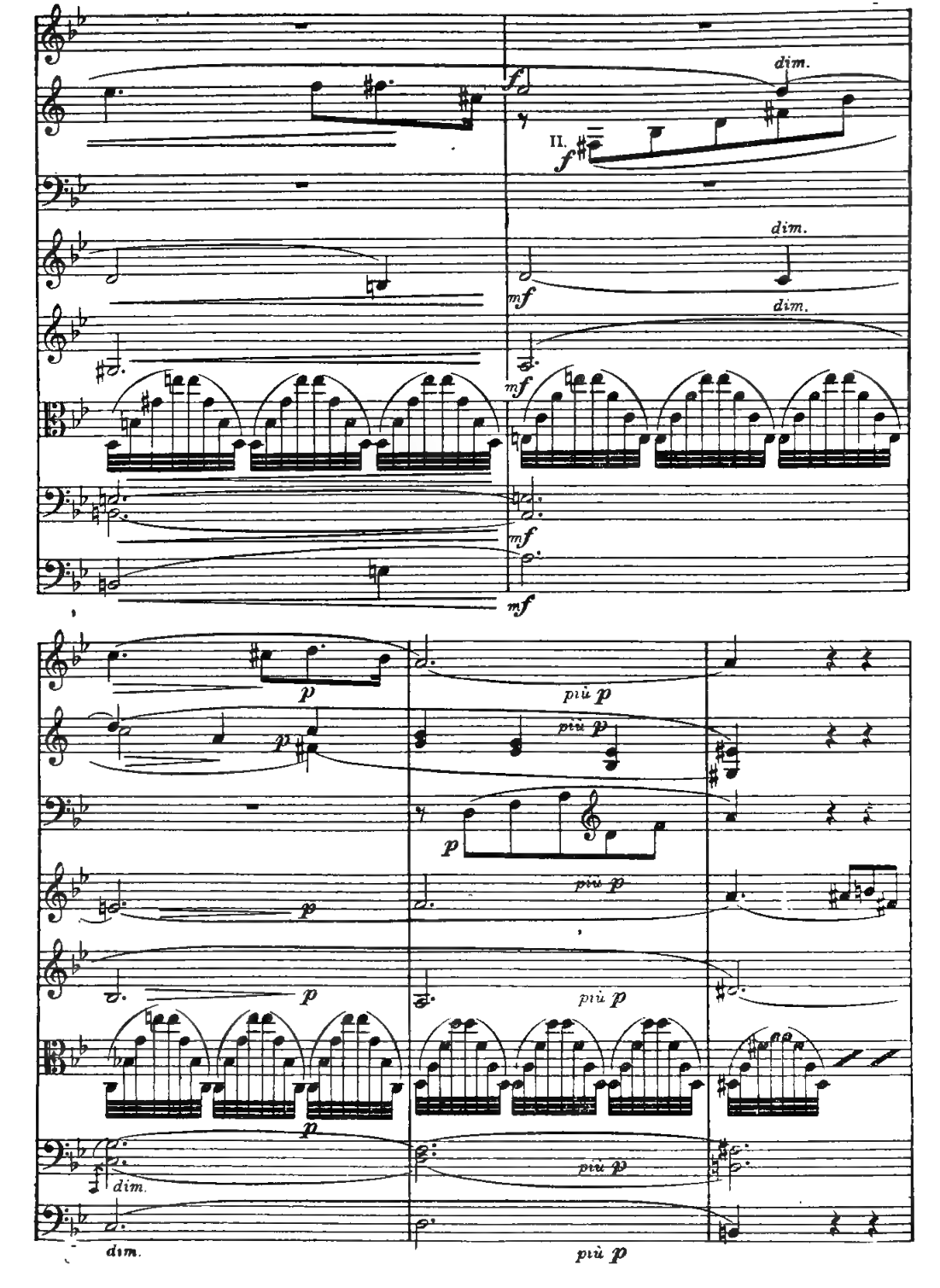
As on the Violin, chords can be arranged in any form of arpeggio, and either slurred or bowed. For purposes of quiet accompaniment the former method is usually the more convenient. Such passages are perhaps more common on the Viola than on the other stringed-instruments, as its pitch and tone-quality tends to throw them into the required shadow. This style of quiet arpeggio may be illustrated by an excerpt from Act I. Scene 3 of Die Walküre. The student should notice that, except for the first arpeggio, which has to be played in the 2nd position, all the chords lie easily under the hand in the Ist position, and, where possible, make use oi at least one open string in each chord. The last bar is a little awkward, as in it the fingers cannot be laid on the strings in their natural position, viz., in the & Example 247. 1 Example 278.
order Ist finger, 2nd finger, 3rd finger, at increasing distances from the nut. The substitution of a Bt for A the second note of the arpeggio, would simplify the passage from the player's point of view.
Example 246
Natural Harmonics.
The technique, notation, and available list of Natural Harmonies is exactly the same for the Viola as for the Violin. The list given above, pp. 328-9, has therefore only to be transposed down a perfect fifth.

A similar remark applies here. However, owing to the imperfections of the instrument, it cannot be said that the Artificial Harmonies come out as well on the Viola as on the Violin. This is more particularly the case with those Artificial Harmonics which must be taken on the C-string. Nevertheless they are practicable, and as the great orchestral difficulty in writing Artificial-Harmonic-chords is to keep the vitch this notech o are noi toilbe the cokedass and resources of

An example of these Artificial Harmonies (for Violas divided into three parts) has already been quoted above- from Strauss's Also sprach Zarathustra. If the student wishes to see a more elaborate example he should examine the Viola parts at "No. 18" in the same work. this passage the composer, beginning with a single high Gi,
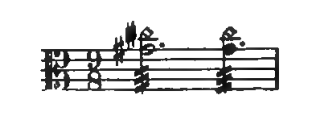
gradually adds parts till he has a complete five-part Harmonic-chord played by six groups of Violas. The bottom part is doubled, and the whole series of notes is played tremolo.
The following is the complete compass of the Viola in both Naturaland Artificial-Harmonics:

Of these notes the first three can only be played in Natural Harmonics. The rest can all be played in Artificial Harmonies, and those notes which are marked with a + can be taken both ways.
The Viola Bow
is precisely similar in shape to the Violin bow, but it is a good deal heavier and rather less elastic. All the coups d'archet which are practicable on the Violin are also practicable on the Viola. The lighter less effective on the latter instrument. greater weight of the Viola bow, but principally to the fact that not one Viola in a hundred will "speak" with the readiness of an ordinary Violin. The instrument needs a certain continual nursing and coaxing with the bow-arm. Consequently the heavier strokes, such as the f detache, the storzando, and the legato slur are much more in its character. The last point is worthy of particular attention, for a good dea of the "chippiness" of effect with which the Viola has been charged is really due to want of proper phrasing.
1 Example 235.
It should be remembered that the Viola bow has to be kept moving at a fair pace in order to produce a good steady tone. Consequently the number of notes that may be included in a single li or y is somewhat curtailed. Even in the p and mp this point must be borne in mind. In the fand ff two or three crotchets in moderato time are about the dimir This applies equally toe melly for Violas and passage is trom strauss's Don Juan. Cellos is marked f molto appass., and contains three nuance crescendos in the first three bars.
Example 247
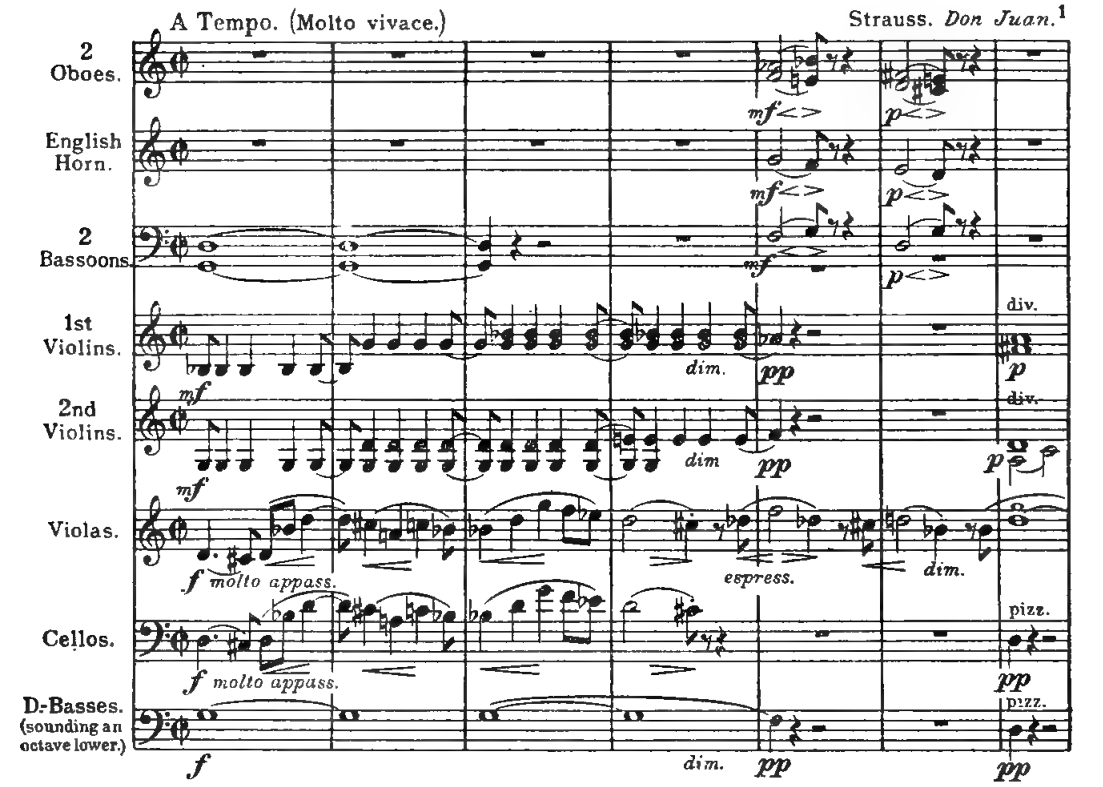
Phrased as written there is an inevitable hardness and tightness of the tone in bars 2 and 3. If bar 2 is taken détaché throughout, or at most with the last two notes under one slur, and if bar 3 is split up into two slurs over the Ist and 2nd halves of the bar respectively, a very much better and more vigorous result is obtained. It is always depressing to watch the Cellists and Viola-players in an orchestra straining to get tone, and yet not daring to adopt the only means by which it can be got,—plenty of bow. As a rule in this country conductors pay far too little attention to the necessary refinements of String-phrasing. They rely on the infallibility of the composer, and play his parts as printed or copied. More often they save time by putting the whole matter aside and leaving it to chance. In a recent
1 The entrance of the Flute, 3rd and 4th Horns, and Timpani is omitted from the last bar of the example.
performance of the passage printed above each one of the Cellists and Viola-players adopted a phrasing to suit his own individual taste. The result to the ears of the audience is of course no phrasing at all,— mud instead of rhythm.

The only difference to be noted here occurs in the case of the Fingered-Tremolo. It was stated that in the Fingered-Tremolo of the Violin the utmost stretch possible between the Ist and 4th fingers on the same string was an augmented fourth, while, with the Ist finger on one string and the 4th finger on the next higher string, the maximum stretch was a minor ninth.
Owing to its greater length of string these limits, in the case of the Viola, have to be reduced respectively to a perfect fourth and an octave.
The caution to keep the notes of the fingered-Tremolo as close as possible applies with even greater force to the larger instrument.
Nothing more need be said here with regard to the different "fancy" methods of tone-variation. The Ponticello, the Sul Tasto, and the Col Legno have already been sufficiently described in the section devoted to the Violin. It is to be noted, however, as a general statement that the Pizzicato becomes more resonant as it descends through the String-groups from the Violins to the Basses.
Mutes are regularly used nowadays on the Violas when that quality of tone is required. As we have already seen, the ancient composers' reluctance to use muted Violas, and the ancient theorists' explanation of that reluctance on the ground that their tone was already "sutliciently veiled by nature," have their common origin in the tact that the then existing mutes did not adequately damp the vibrations. No stringedinstrument answers so well to the mute as the Viola. Its strings, already struggling against the difficulties of a too-small sound-box, reduce their utterance, under the mastery of a heavy close-fitting mute, to a weird mystical thinness. In especial the two outer strings undergo a transformation that has the curious effect of at once attenuating their tone and intensifying their characteristics. Under these conditions the top-string becomes over-nasalized to the quanty ot a far-oti double-reed instrument, while the bottom-string sutters a U-change which muffles and, at the same time, accentuates its tragic quality.

This is an important feature of the Viola. The discrepancies between the size and the pitch of the instrument have already been referred to. It is these discrepancies which produce its characteristic flavour of sombre antiquity.
The top-string is perhaps the most affected. Its quality has something nasal and piercing; something suttering, even unpleasant. A prominent melody on this string becomes unbearable atter a short
It appears to great disadvantage it contrasted with the lovely Violin-tone of the same register. On the other hand a tearing forte subject, if not too much prolonged, is immensely effective. Such a passage has already been quoted above 2 from Strauss's Don Juan. The student should notice, in the last bars of that extract, the curiously good and telling effect of the Violas with the Wood-Wind. This peculiarity of the instrument has been well known almost since orchestral composition began. Indeed it is one of the strong characteristics of the Viola that, while its melodic etiects with string accompaniment leave something to be desired, each of its strings exhibits an affinity with some one or other of the Wind-groups. The top-string in particular not only combines well with the Wood-Wind, but shows in a degree remarkable for a stringed-instrument certain likenesses to the heavy Brass. In this register it can be quite well combined with beto, am i hate men pratide drip his this was known to
The two middle strings are at once the least characteristic and the most sympathetic. Lacking the piercing unhappy quality of the topstring, they combine well with almost anything in the orchestra,— with the other Strings, with high or low Wood-Wind, and with Horns. It is on these two strings that the Viola does most of the accompanying and filling-up work, to which a great part of its existence is devoted.

with melodie passages in this middle register, and no better example could be given than the beautiful subject already quoted from Tschaikowsky's Romeo and Juliet.
A remark may be interpolated here with regard to the striking emphasis which the Viola quality lends to the minor-mode. This may be merely associative. It may be a half-conscious mental linking of its antique tone-colour with the dark hues of the ancient Dorian mode. Whether this be so or not, it is a fact that a large number of effective melodic_passages in the minor-mode have been assigned to the instrument. In place of quoting any of the well-known classical eem Les, la tradesert as en had been reded 5 - an example of cleverly contrived bowing. The sixteen bars of which it consists give both an excellent example of the Viola used melodically chietly on its two upper strings, and of the peculiar lamenting quality with which it can invest the minor-mode. It must be said that in the Score the 3rd Horn (the 2nd highest of the four Horn-parts) occupies a line to itself. These three Horn-parts are here compressed on to one
1 Berlioz commends this string for use in "scenes of religious and antique character," and instances Spontini's La Vestale as the first work in which it was so employed. Since his day this type oi characterization has become common. See, for instance, the Andante con Moto-the so-called "Pilgrims' March"—in Mendelssohn's Italian sympliony. Wagner has employed the instrument with the game object both in l'annhäuser and

stave for reasons of space. The 4th Horn-part in the bass-clet transposes downwards in the way usual in modern Scores. The vertical arrangement of the Wood-Wind parts,' the momentary introduction of the Oboes on the two climax-bars of the tune (bars 8 and 16), and the phrasing of the String cantabile are all worth attention.
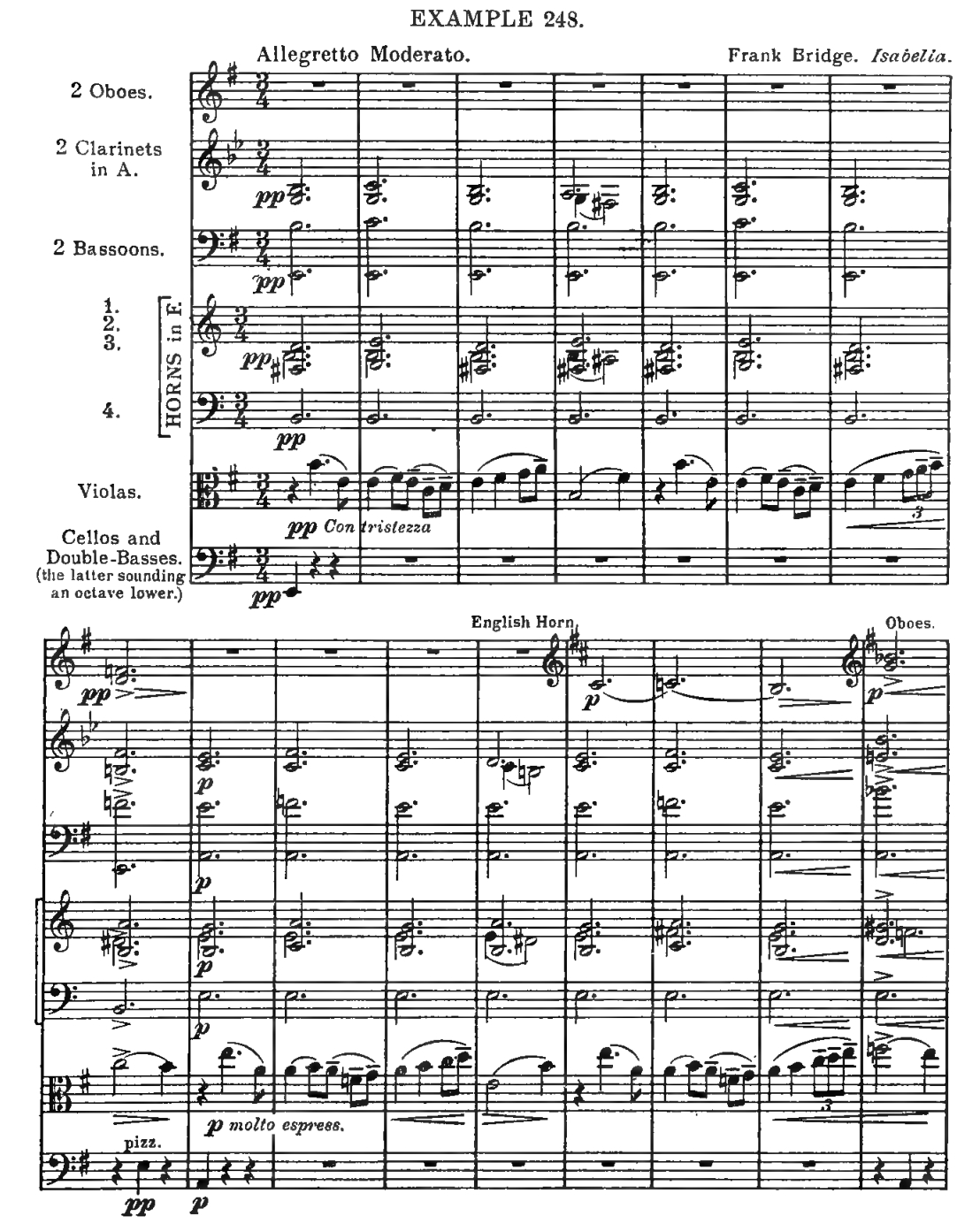
' See also the arrangement of the Wood-Wind in the short extract from Wagner' Lohengrin given under «Bass-Clarinet," Example 192
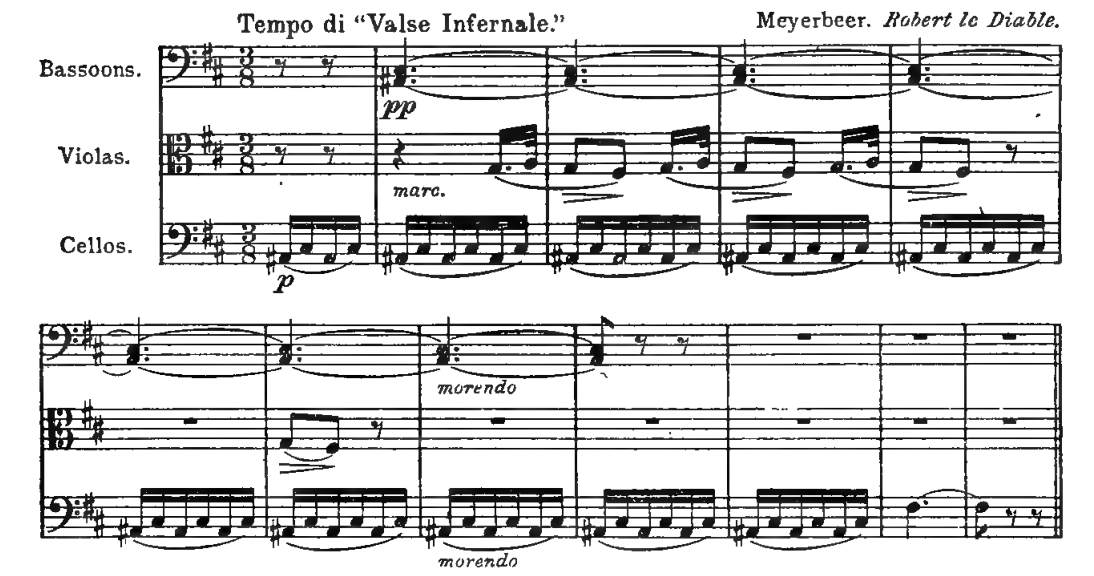
In The bottom-string' of the Viola is the most characteristic of all. fact, to the average concert-goer the Viola is only a Viola when it 1s on its bottom-string. "Sombre, austere, sometimes even forbidding," its mere of , rage in the died, est phiraste, is su for to coate up , the simpler and more persistent the phrase the greater its effect when played on the Viola. mentions the impressive effect produced in Act III. of Robert le Drable by these few Viola notes:
Example 249
They could be played either in the Ist position on the 3rd and Even simpler is the thy omically complex reiterated note assigned to the Violas in Rebecca's song, "Lord of our chosen race" (Sullivan's Ivanhoe, Act II., Scene III.).
EXAMPLE 250. Andante Moderato.
Sullivan. Ivanhoe.
Violas.
In the Full Score these notes combine with a string przzicato, Harp-chords, and a tenuto for English-Horn in supporting the Vocal-
1 It need scarcely be said that, in every stringed-instrument, the bottom (open) string is regularly used for its enharmonic equivalent. Thus the notes:
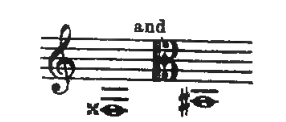
are continually written in Violin- and Viola-parts respectively. 2 Gevaert. See also the reiterated Viola "D " in Ex. 154.
Melody. They give a curiously restless and tragic colour to the song. This type of expression so characteristic of the instrument is as old as the time of Gluck. Berlioz quotes with eloquent admiration from that master's Iphigénie en Tauride the air of Orestes, in which the Violas play a continual throbbing syncopated middle-part. The whole Viola part has only a compass of a minor third-G to Bb-and out of sixty bars fifty contain merely repetitions of the note A. Berlioz claims this "fearful and persevering mutter of the violas" as an "unspeakably fine piece of inspiration.
The student should accustom himself to listen carefully to the quality of the Viola bottom-octave, and especially to differentiate between its mental effect and the effect of the same notes when played mainly on the 2nd string of the Cello. On this point it is impossible to give any rule. Probably any passage will be as playable on the one instrument as on the other. A little experience is needed here in order to ensure a correct decision between Viola, Cello, and Viola-and-Cello unison.
The Viola has perhaps suffered the ups and downs of musical treatment more than any other stringed-instrument. In the late sixteenth and early seventeenth century it held much the same position in the orchestra that the Ist and 2nd Violins occupy to-day. We have only to remember that fact in order to realize how sombre, melancholy, and unbending must have been the quality of the String-ensemble in those times.' The Violin, however, with its higher pitch and its more exquisite tone-colour, was continually "knocking at the door," and the Viola found itself servant where once it had been master.
So long as Music was developing along the polyphonic lines, which we now associate with the name of Bach, this meant little decrease in its dignity. The instrumental family which joined its voices in the elaboration of fugues and fugatos was a happy family, the members of which differed among themselves only in the matter of pitch, not of importance. With the downfall of the old polyphony, however, all was changed. The family had now got one master-the top-line melodyand it is easy to understand the feeling of relief with which men's minds turned to this new and agreeable species of music. The bustle and confusion of four or five real parts was now replaced, except for the most special occasions, by a straightforward tune, supported by a modest tinkle ot accompaniment.
If we turn now to the Scores that represent this period-that is to say the Haydn-, Mozart-, and even early Beethoven-Scores—we feel that the Viola is often merely a source of anxiety to the composer. We feel that he must have regarded its existence as something in the nature of a prehistoric survival. The instrument was there and had to be written for. Interesting but subordinate contrapunta. middle-parts were, however, still a thing of the tuture. The Viola, theretore, either did nothing or something which by the ingenuity of the composer was
1 See, for instance, the extract quoted above from Monteverde's Il Combattimento di Tancredi The three top parts, viola da vrazzo , l", and Illa, are for the Tenor-Viol or Viola-da-Braccio mentioned on page 300.
made to appear as much like nothing as possible. It all else talled it could always play the bass, and, though this otten resulted in an unnecessary and uncomfortable three-octave-bass, it was better than filling the part with rests.

Then Beethoven began to develop his style. sympnonies he soon began to tind out ways in which the Viola might be more individualized from the rest of the Strings. Occasional melodie unisons with the Cellos—such as those in Symphonies No. 5 (Andante con Moto), No. 6 (Andante molto mosso and Allegretto), No. 7 (Allegretto), and No. 91 (Allegro assai): Solo passages such as that in the Eb Quartet (Op. 127)—and new groupings, such as that solemn association of Viola- and Cello-harmonies in the Finale of the Choral Symphony are to be met with in the works of his middle and third periods.
On the whole, however, it cannot be said that Beethoven exalted the Viola in the same way that he exalted some of the other orchestral instruments. His main contribution consisted of this, that he found a way in which he could always give the Violas a wholly independent yet subordinate middle part. In his music they are always "doing something," perhaps not very interesting, but still something which materially adds to the general orchestral prosperity.
of the Viola from the composer's point of view. His researches on this point are embodied in his elaborate work, Harold in Italy. _Unfortunately a good deal of this work is monumentally dull, while in many places the composer shows only an impertect acquaintance with the instruments possibilities. The result usually is that one hearing of Harold in Italy is quite enough to put the listener off the Viola for the rest of his life.
With the advent of Wagner the Viola began to be written for as it deserved. Its patience was no longer tried, and the edge of its qualities blunted by a continual subservience to the caprices of the other Strings. Wagnes did. the attir cops did hot he tale a in the ata in t Violas in the way that a Symphonic work in which the top String-line throughout was assigned to the Violas. In his other works too one continually "feels" the presence of the Viola-tone as something rather too prominent and sometimes even unpleasant. Occasionally there is an apparent disregard of the peculiar tone-quality with which they are sure to endow their phrases. Hence comes a certain sombre effect, a somewhat unnatural air of lumbering solemnity. Wagner never did this. He had
1 See also the forceful unison of Violas, Cellos, and two Bassoons at the end of the Egmont Overture, beginning at Bar 4, page 71 (Peters's Ed.).
2 Under the influence of the early nineteenth century Ossianic movement Mehul wrote a complete Upera— Uthal-with this instrumentation (Violas in place of Violins). According to Berlioz Grétry's criticism on this procedure was conveyed in the remark, "I'd give a guinea to hear a fust string." Other composers, such as Cherubini in his C minor Requiem, have omitted the Violins from a complete movement in order to gecure a special tone-colour throughout. out Violins are rarely heard nowadays in our concert-rooms.
the true orchestral "sense" that is content to subordinate or omit colour till its prominence is called for in order to enforce the musical His Violas have to play acres of "filling-up" stuff, but their prominence when it comes, is a prominence urgently demanded by the special character of the music.
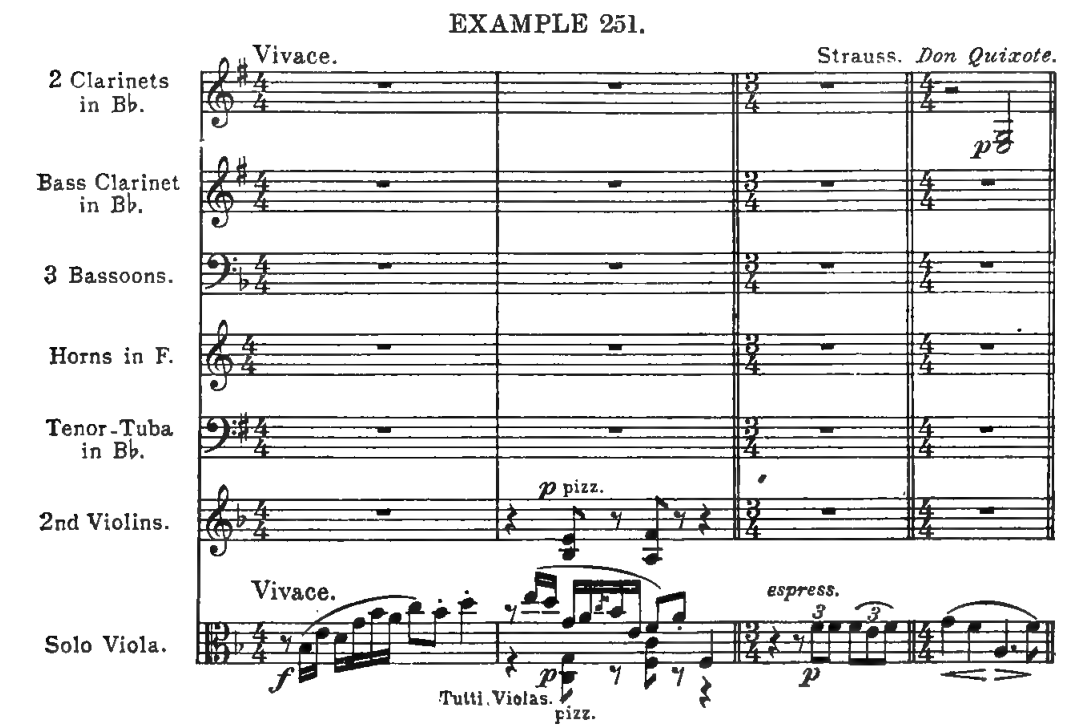
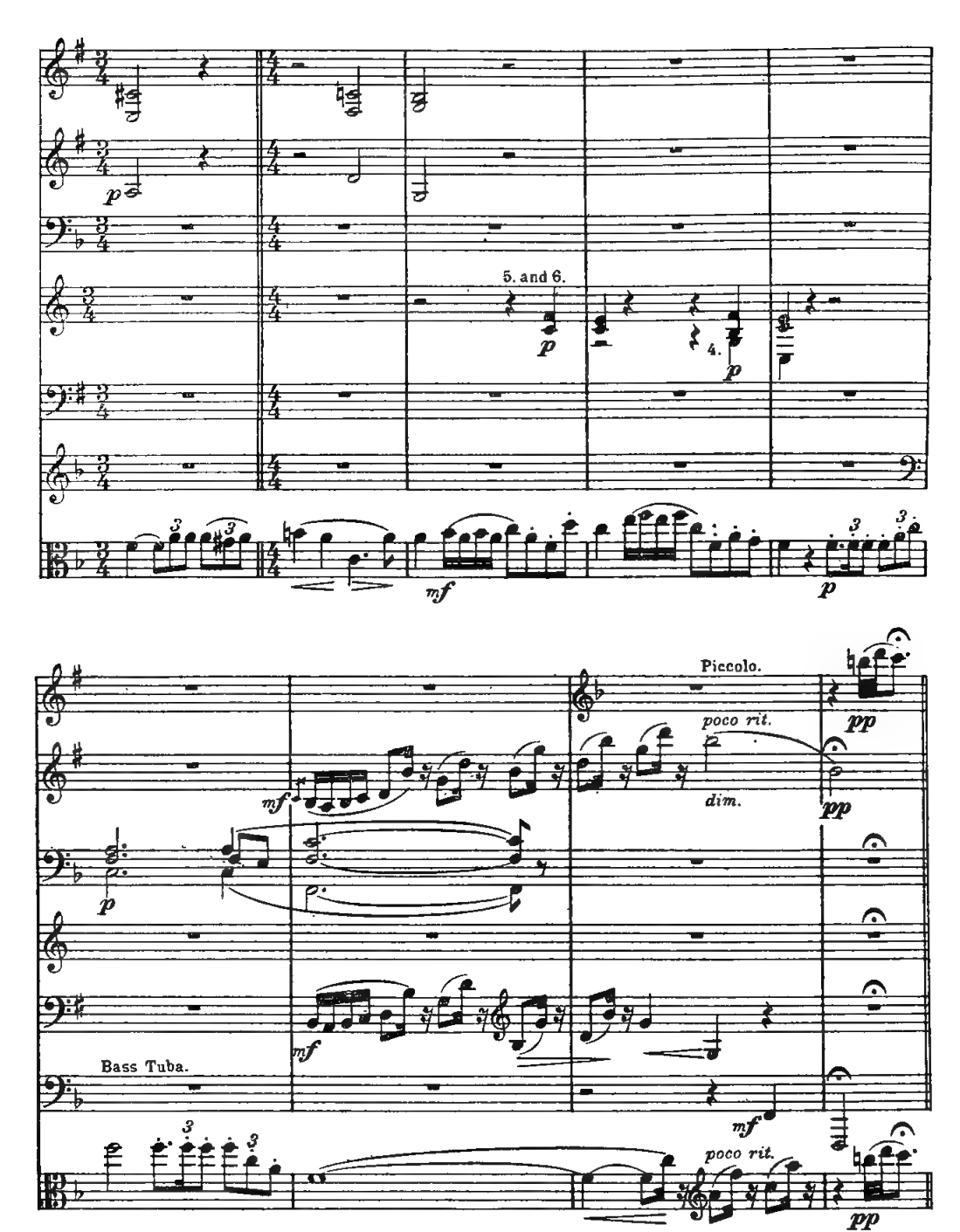
In more modern times still the composer has begun to ask of the Viola-player much the same extension and perfection of technique as he asks of the Cellist or the Violinist. Strauss in particular treats the instrument with a freedom and plasticity quite unknown before his day. It cannot perhaps be said that the elaborate Viola obbligato in the Don Quixote Variations—however cleverly characteristic ot its subject, Sancho Panza--adds much to the dignity or technique of the instrument. Example 251, taken from the Sancho Panza section of the Introduction, gives a fair idea both of Strauss's whimsical treatment of the Viola and of his typical style of orchestral accompaniment. The Bass-Clarinet is of course to be read as sounding a major ninth lower, and the Tenor-Tuba a major second lower. Their phrase in the 11th Bar is therefore a unison, whose first note is a major third above the ord Bassoon part.
It has already been mentioned that the Violas are more often divided than either of the groups of Violins. This remark should, however, be qualified by the statement that, whereas the simple twopart divis which makes up the hack-work of harmony is common on the Viola, the elaborate Violin-subdivisions which are perhaps too common in modern Scores are less often found in the Viola-parts. Such an elaboration as the twelve-part-divisi (eight-part shakes and four-part Bowed-Tremolos) in Variation II. of Strauss's Don Quixote is only of the rarest occurrence.
Another point which cannot fail to be noticed in the perusal of modern Scores is that the Viola, being a midway instrument as far as pitch is concerned, is associated (1) as a middle-part with the general orchestral ensemble, (2) as a lower-part with the upper strings and Wood-wind, and (3) as an upper-part with the lower portions of the orchestra. The result of this is that the Viola-part of any modern orchestral work is as a rule longer than even the Ist Fiddlepart.
With regard to (1) nothing need be added to what has already been said.
With regard to (2) it is obvious that where the compass permits and only a very light String-bass is wanted the Violas can be used for that purpose. A well-known example of this method is to be found in the opening Adagio of the air Softly sighs (Act II. Scene II. of Weber's Opera Der Freischütz). This has been quoted so often that the student will probably prefer to see a more modern instance, the fascinating String-passage in Ischaikowsky's Romeo and Juliet that follows the Viola-melody already quoted above.' In this example the muted Violas repeat the tonic and dominant pedal, while the muted Violins in four-parts play the curiously wavering and attractive harmonies in their soft middle register.
Example 252
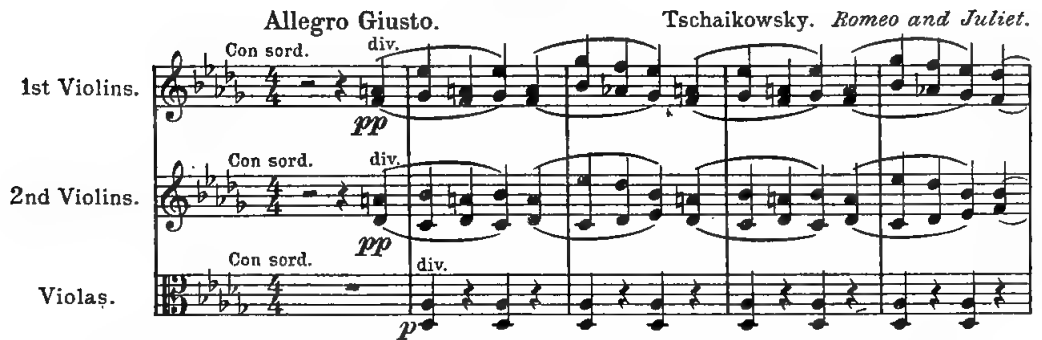
The two pedal parts in the above extract could of course be played by Cellos divisi or by Cellos and Violas. It is just on this point that the student should try to cultivate his orchestral cunning so as to distinguish the subtle differences of the three methods.
With regard to (3) the first thing to notice is the constant use of the Viola-and-Cello-unison for melodie purposes. This method of reinforcing the String tone in the tenor-octave was first practised as a part of his ordinary orchestral routine by Beethoven. A reference has already been made to a number of his works in which this procedure is adopted. Mozart also occasionally uses this unison, but he generally does so, not for a full-dress melody, but in order to give momentary prominence to a short isolated phrase. See for instance the 3rd and 4th bars of the Introduction to Zerlina's song Vedrai carino in Act II. of Don Giovanni.
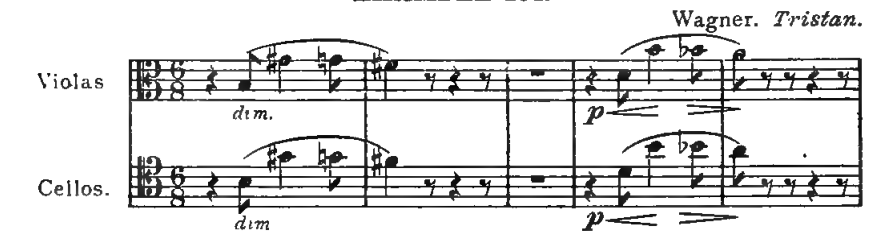
I'he important point for the student to notice is that while the Violas add a good deal to the power and weight oi a subject sc arranged, they rob the Cello top-string of a good deal of its clarity and "bite, and substitute a certain velvety thickness and richness. The sing on can be rapta pammas played by ta canoul to
* Example 141.
Example 253
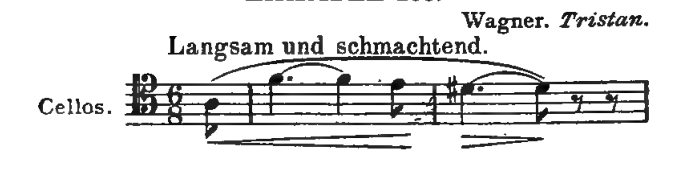
and then contrasting the effect with the similar passage towards the end of the prelude:
Example 254
The Schumann Pianoforte Concerto in A minor is another work in which these differences can be observed with ease. In the Intermezzo of that work the Cellos alone play the subject:
Example 255
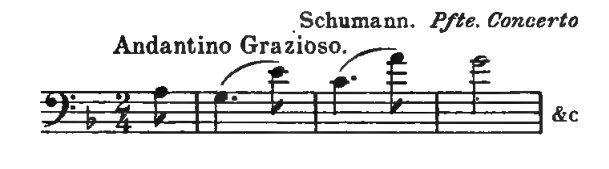
Later on the Violas are added thus:
Example 256
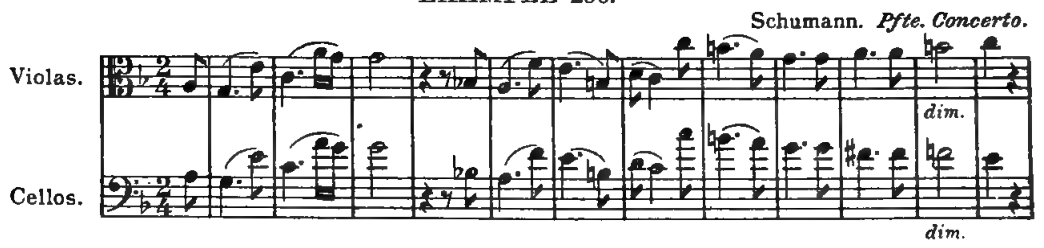
This instance, though less in the modern style than the Wagner excerpt, is perhaps more instructive, as the compass is so much greater. The student should especially note, at a performance of this work, the tone-quality on the top C, B, and A. Here the Violas themselves are on their top-string, and, so far from dulling and smoothing the Cellotone, they add enormously to its pungency. Indeed, within the very narrow available limits of pitch there is nothing in the orchestra so poignant and irresistible as the unison of Cellos and Violas, both playing on their top-strings.
Attention must however be principally directed towards the harmonic- not the melodie-union of Violas with Cellos. With this union Iccasionally too the aspecs, Horns, and patron bones ass added ~ Irombones are added Whatever the arrangement of this sonorous ensemble, its basis is almost invariably a divis harmony of Violas and Cellos. The quality of tone so produced is, when legato, rich and somewhat organ-like: when detached and forte, impressively crude and sometimes almost savage. In most cases of this sort the top line, or even the two upper parts, can be arranged for Violins. The substitution of the divisi Violas, however, gives a quite different character to the music, a character perhaps not often desirable, but, when desired, strikingly effective.
So many examples of this type of orchestration are familiar to all that it is scarcely necessary to give any quotations. Among the bestknown are
(1) 'The accompaniment to Wolfram's address at the beginning of the Sängerkrieg in Tannhäuser. The key is Eb, and the whole passage is over a hundred bars long. The accompaniment consists of nothing but Violas and Cellos (divisi, according to circumstances), and a Harp playing in simple arpeggios and chords. This is a good example of the long continuance of one tone-colour, quite appropriate effective in Opera, but lacking variety when transterred to the Concert-room.
(2) The short passage in Lohengrin's Narration, in which the Viola and Cello harmonies are supported and reintorced by the Trumpet, Trombones, and Tuba, (Full Score, bottom of page 357)
(3) The far-off organ effect in Act III. of Die Meistersinger. Here both the Violas and Cellos are divided into two-parts, each of which plays in double-stopping, that is to say, eight notes in all. (Full Score, page 355, beginning at Bar 7.)
(4) Act I., Scene II., of Tristan, just after Kurwenal's words "Darf ich die Antwort sagen." (Passage begins in the Full Score at the bottom of page 34 and continues as far as page 37, bar 5.) This is a locus classicus. The student should by no means omit to examine
the the above list might very easily be added to, and other composers —German, French, Russian, and English--might be drawn upon for purposes ot quotation. Wagner, however, exhibits such a certain and subtle "touch" in this matter that it is quite satisfactory to confine the illustrations to his works.
In this country Elgar' continually shows a keen appreciation of the instrument's capabilities and limitations. In particular he has the faculty of writing passages and melodie subjects which are not only orchestrally etfective, but which must be played on the instrument for reas wai cog for the Viola think in climaxes that are far too high This is an important point. So many composers
1 E.g. the Allegro non troppo at the beginning of Tschaikowsky's Pathetic Symphony.
"See for instance his variations Dorabella (con sord.), Ysobel, and Troyte (Violas in octaves), and the unexpected high unison of Violas and 2nd Violins in Pomp and Circumstance, No. I. (Full Score, page 4).
for the instrument. They are also apt to neglect the bottom string entirely. The instrument labours under the disadvantage of not being sufficiently individualized in composers' minds. There is, however, no getting : beyond a phrase like this. It must be either Violas or nothing.
Example 257
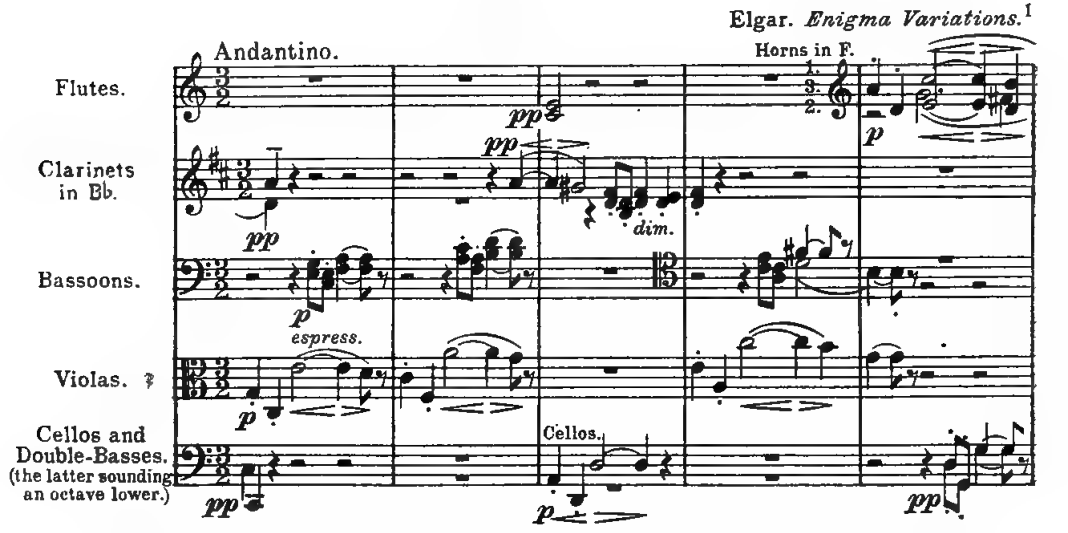
The neglect of the bottom string seems to be otten due to the tear that its use will make the music thick and heavy. But this fear is groundless. The orchestral sound of the instrument on that string, especially in the p and mp, has nothing of the tubby effect of the same notes on the Pianoforte. Owing to the relative shortness of its string and the consequent ditterence in its harmonics, the Viola is much less likely than the Cello to overweight a passage in that register
Occasionally a single Viola is employed as a solo instrument. In the old school of opera this usually meant a full-dress Obbligato made up of little scale-passages and arpeggios, both of which the Viola does in a nicely sympathetie and not too obtrusive manner? Nowadays this sort of thing is scarcely à la mode. The interest of adding a fussy nothing to something is questioned. Also it takes a Mozart to save such a musical situation. The Viola Soloist has, therefore, less space nowadays in which to move about. On the other hand, he generally has something much better to do. It is usually melodic, and the melody may vary from the hali-dozen effective unaccompanied A-string notes in Max Bruch's Ave Maria to the beautiful tune which
1 From No. VII. of the set (Ysobel). A crotchet, O-G-E for Ist Violins and 2nd and 3rd Trombones, is omitted from the first beat of the example.
3 resor insanel he Viola obliged to An etes the Act aust nee much Der Freischütz. more direct and satisfactory in every way. The obbligato in Meyerbeer's Plus banche the VioLat do Sonor but the laying rue que la blanche hermine is undoubtedly designed for the Vrola d' Amore. that the part is merely marked in the printed score, of the double-stopping and the Harmonic writing are quite conclusive on the point.
Elgar assigns to the instrument in his overture, In the South. The expressive soaring passage which proclaims the might of the Lovepotion in Iristan (Act l., Scene III.) gives a happy example in a single phrase, both of the Viola used as a solo instrument, and of the accompanying harmonies of Violas and Cellos. The long slur in the Solo Viola part is, of course, only an advertisement to the player that the passage is one phrase. It could not be played in a single bow.
Example 258
Wagner. Tristan.
Molto rallent.
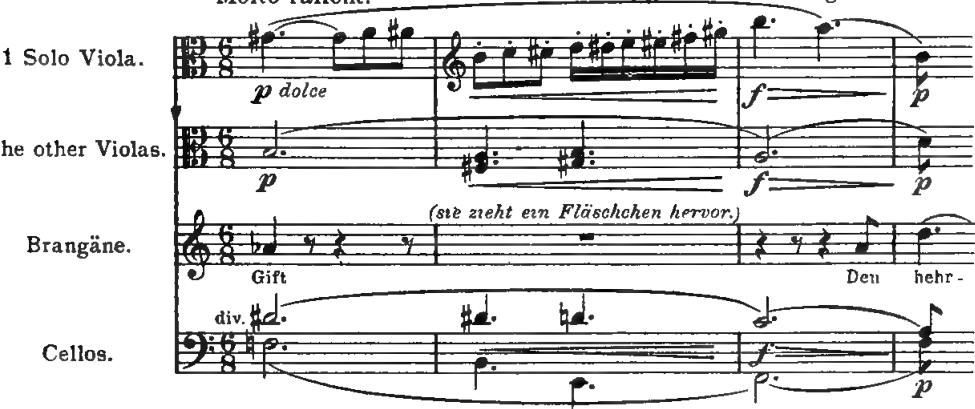
(ste zieht ern Fläschchen hervor.
Berlioz, in his Treatise on Modern Instrumentation, gives it as his opinion that in cases where great energy is required, and the 2nd Violins are to play the same melody as the Ist Violins, they should play in the unison and not in the octave below. In such cases he says "it is preferable, if the Viola part cannot be made prominent, to employ it in augmenting the sound of the Violoncellos, taking care to put them together (as much as the low compass ot the instrument will permit) in the unison and not in the octave." In support of this, he quotes the well-known peroration in Beethoven's C minor Symphony. The following tabloid-version of the first five bars will enable the student to see the force of Berlioz's remarks:
Example 259
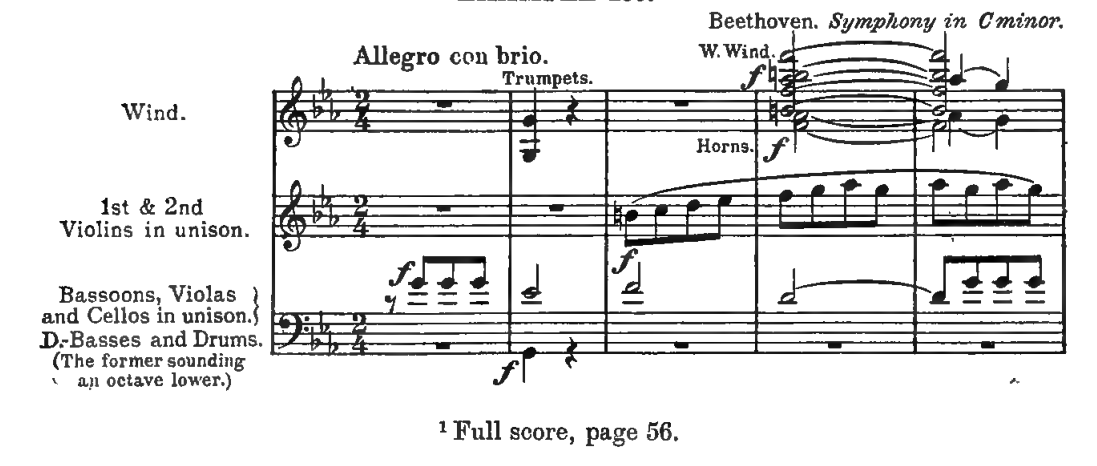
They amount to this, that when the passage is meant to sound clear and strong, the addition of the Violas Sva below the Violins, merely darkens the tone-colour without adding anything material to the force and vigour of the passage. This is very true and, as Strauss observes, it is no less applicable to the similar case of the Trumpets and Horns. Circumstances, however, alter cases. To soft melancholy melodies of a precisely opposite character, this curious shadowy darkening may be highly appropriate! A few notes sung by a Soprano or Contralto often gain enormously in pathetic appeal by the judicious addition of the Violas on octave lower.
In this connection it may be mentioned that nothing needs such gingerly handling as the orchestral use of Violas and Cellos in octaves There is sometimes a temptation to fall back on this when "nothing better can be found for the Violas to do." As a rule rests are better. For special subjects of a vigorous type,? or for deep quiet p effects when the harmony is simple and very clearly defined by the other instruments, the combination may be effective. But its haphazard interpolation into a musical ensemble where the other parts are merely in single notes, not octaves, produces a feeling of emptiness in the alto-and tenor-registers. Nine times out of ten the passage will gain strength if "8va" is written above the Cello line. If this is impossible from the nature of the music the Violas can be omitted.
An attempt has been made by Professor Ritter to regularize the qualities and to extend the upward compass of the Viola; the instrument which has been produced under his direction is known as the Ritter Viola-alta.
His two main objects were (1) to enlarge the instrument up to a size that should be theoretically in proper proportion to its pitch, and (2) to ease the technical difficulties in the top register by the addition of a 5th string tuned to Violin-E.
Theoretically, the instrument is a success. Top-string shifting is— save on the rarest occasions-done away with; the tone is big, fine, and free. Yet the Viola-alta, at any rate in this country, is scarcely ever used. The reason is not far to seek. While the Viola can be easily increased in length, depth, and girth, the human trame cannot The management of the ordinary Viola was already something of a puzzle to human arms and fingers: in its new plethoric form, one fears that it must remain a forbidden joy to all but musical Jack Johnsons. Other experimental Violas, such as the Violotta manufactured by Stelzner of Dresden, have been designed with the object of extending the downward compass of the instrument. There seems, however, to be very little orchestral necessity for this type of "improvement."
*A few bars in which the Violin axump agplay in octaves abore a moving bass for cellos and Basses is quoted below.
2 See Exs. 134, 247. For a p quotation see Ex. 287.