 Playable Books
Johann Joseph Fux · section 15 of 32
Fourth species in four voices
Read and hear this section in the playable edition →Fourth lesson
From the lessons in two and three voices it is known that ligatures follow the completed species of semiminims, and I likewise assume that their nature is already understood. It remains now to explain which accompanying concordances ligatures require in four voices. Something was said about this in three-voice composition: namely, that they require the concordances they would call for if the ligature were removed, for the reason stated there, that a ligature is nothing other than a delay of the following note, which changes nothing as regards concordances. Examples will make the matter plain.
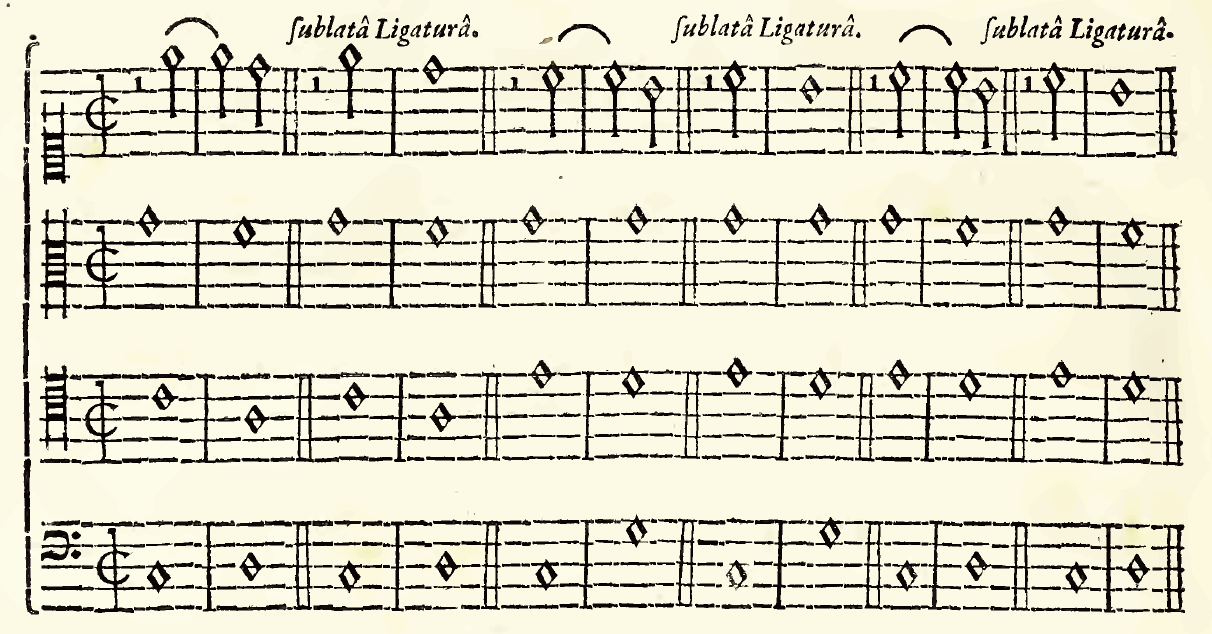
These examples clearly demonstrate that the concordances are the same with tied and untied notes.
Joseph. Does that rule never admit an exception, revered Master?
Aloysius. There are exceptions in certain cases of this lesson, where one is obliged to combine ligatures with three semibreves throughout the full measure. First, this cannot be done in the case where a fifth is associated with a seventh in ligature. For example:
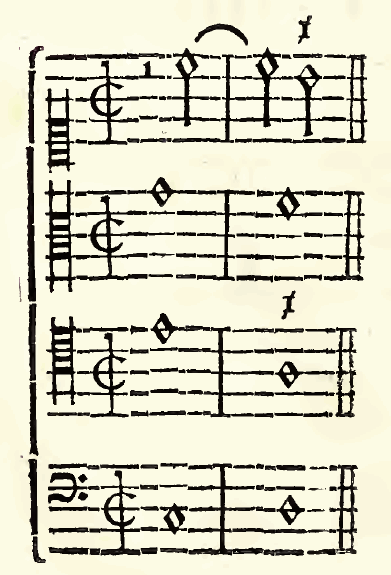
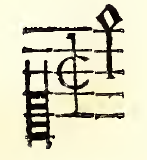
Here the resolution of the ligature produces with the tenor part a faulty dissonance, which must above all be avoided.
Joseph. What remedy is there in this case?
Aloysius. The semibreve in the tenor part must be divided in this way.
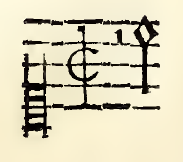
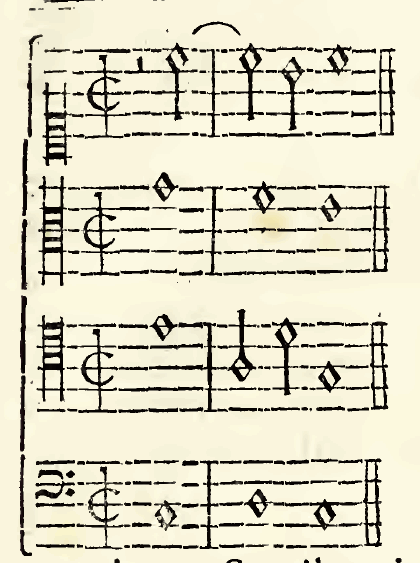
Joseph. But this species does not admit the division of a semibreve.
Aloysius. That is so—where it is possible. But several cases will occur, as you will be taught by the examples shortly to follow, in which necessity will make it quite impossible to dispense with division. Therefore the strict requirement of three semibreves cannot be held very rigidly in this species.
Joseph. A seventh accompanied by an octave would not be subject to the division of a semibreve, as may be seen in your preceding example, in this way:
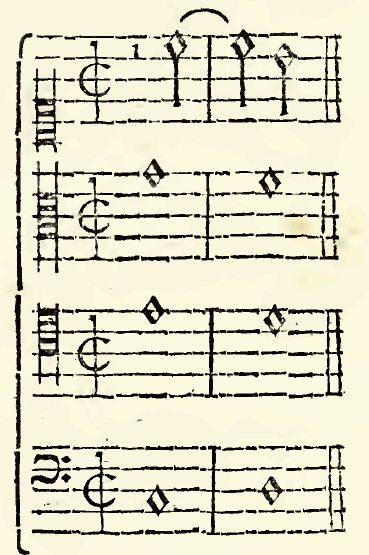
Aloysius. That is true in this case, where nothing prevents an octave from being given instead of the fifth. But in cases, of which there are very many, where there is no room for an octave because of the sequence of preceding and following notes, a fifth must necessarily be used. Then the semibreve must be divided, as in many other circumstances, as the following examples teach.
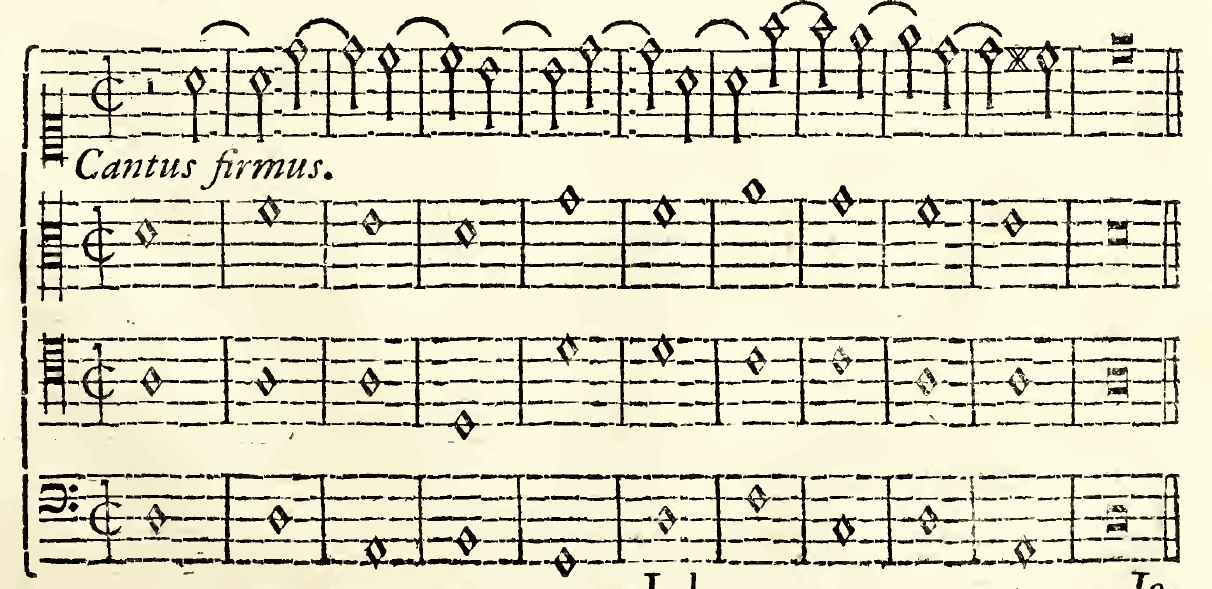
Joseph. I find nothing doubtful in this example except the progression from the fourth measure to the fifth between the tenor and alto parts.
Aloysius. So that this progression may cause you no scruple, you must know that a fourth between the middle parts is either regarded as of no consequence or performs the function of an imperfect consonance. Hence that progression must be treated just as if you were proceeding by similar motion from a perfect to an imperfect consonance. This must be carefully noted. Now to the remaining examples.
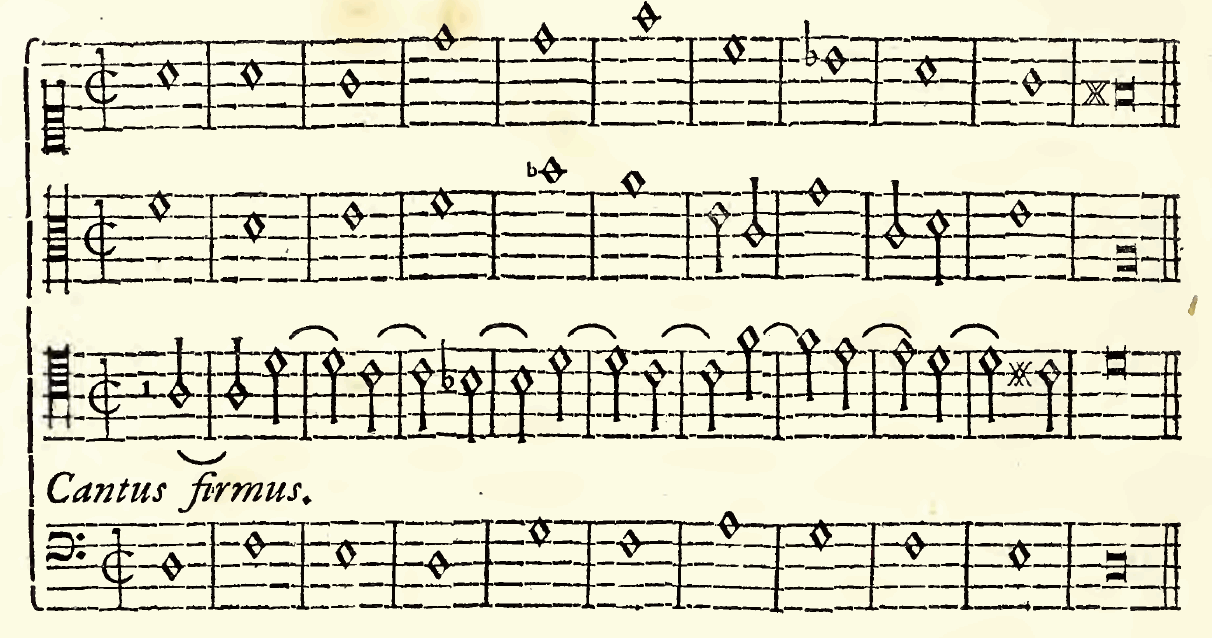
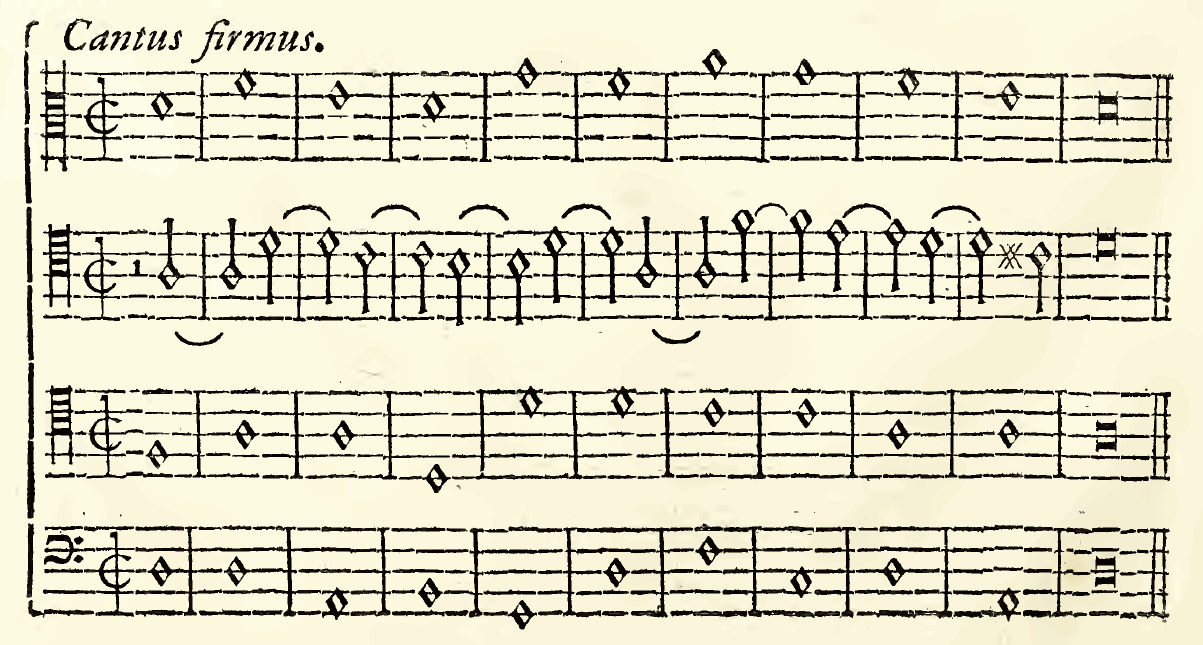
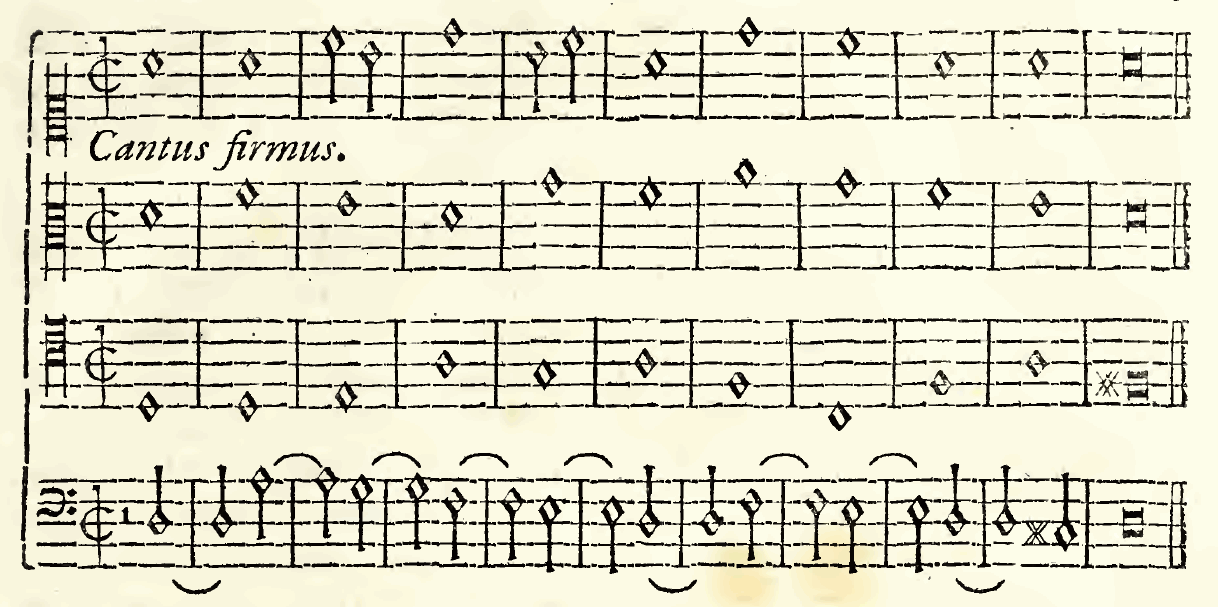
These examples make it clear that ligatures in four voices either cannot everywhere be accompanied by three whole semibreves, as this species requires, or, where they can, cannot be furnished with harmony complete according to all the rules.
Joseph. I see in which examples one or another of the semibreves has been divided, and for what reason, but I do not see where you say anything is lacking in the harmony.
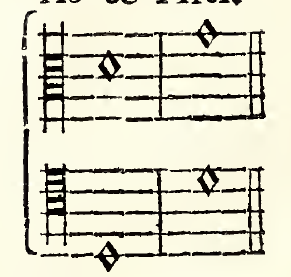
Aloysius. Do you not observe that the fifth is missing on the thesis of the sixth measure of the first example? Yet it is most necessary for complete harmony. Then, in the fifth measure of the last example, the second is doubled, while the sixth needed for complete harmony is missing, as the following example demonstrates.
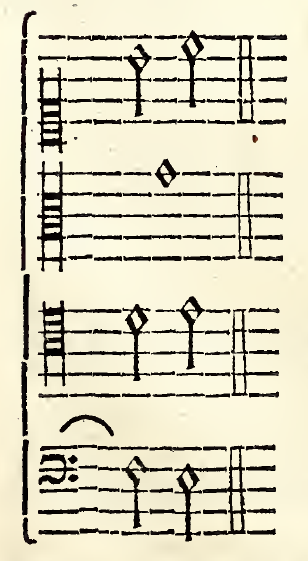
Finally, in the fifth measure of the same example the fourth is doubled, whereas strictly speaking the second rather than the fourth should be doubled.
Joseph. What is the reason for doubling the second rather than the fourth?
Aloysius. It matters not so much on account of the second or fourth as on account of complete harmony. For since fullness of harmony consists in the placing of a third, fifth, and octave, whereas in the example mentioned a doubled fifth is found instead of the octave, it is clear that the harmony there will not be complete in every respect. Here, however, I am not speaking of the first part of the measure, where the second is present and does not admit an octave as its companion, but of the second part of the measure, where the octave is wanted. For example:
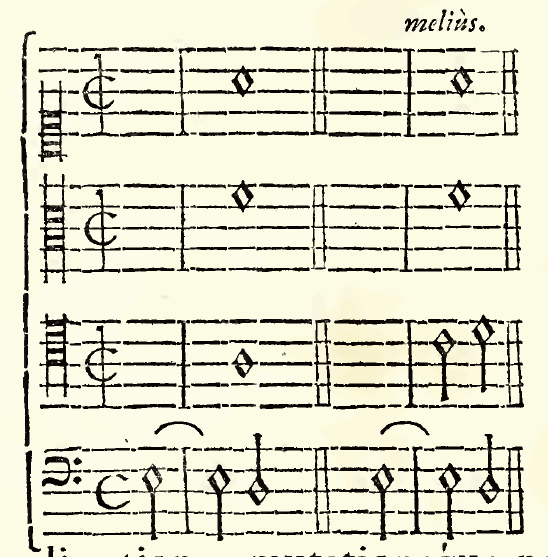
Similar defects of no great consequence must be conceded to the strictness of this species because of the exceptional benefit this exercise brings to students. For it teaches not only the correct manner of composing, but also how far one may at times depart from the strictness of the rules when necessity requires. I have placed a model before your eyes, and leave you to imitate it in working through the remaining five modes with the same method and changes of position. Now let us proceed to the fifth species of this study.