 Playable Books
Johann Joseph Fux · section 16 of 32
Florid counterpoint in four voices
Read and hear this section in the playable edition →Fifth lesson
Joseph, you know that this species consists in florid counterpoint. I suppose that its nature and manner of construction are known to you from the preceding examples and explanations, especially from the exercise in this species for three voices. Thus nothing new needs to be added here except a fourth part, consisting of semibreves, to be woven in according to the rules of four-voice composition. To the examples.
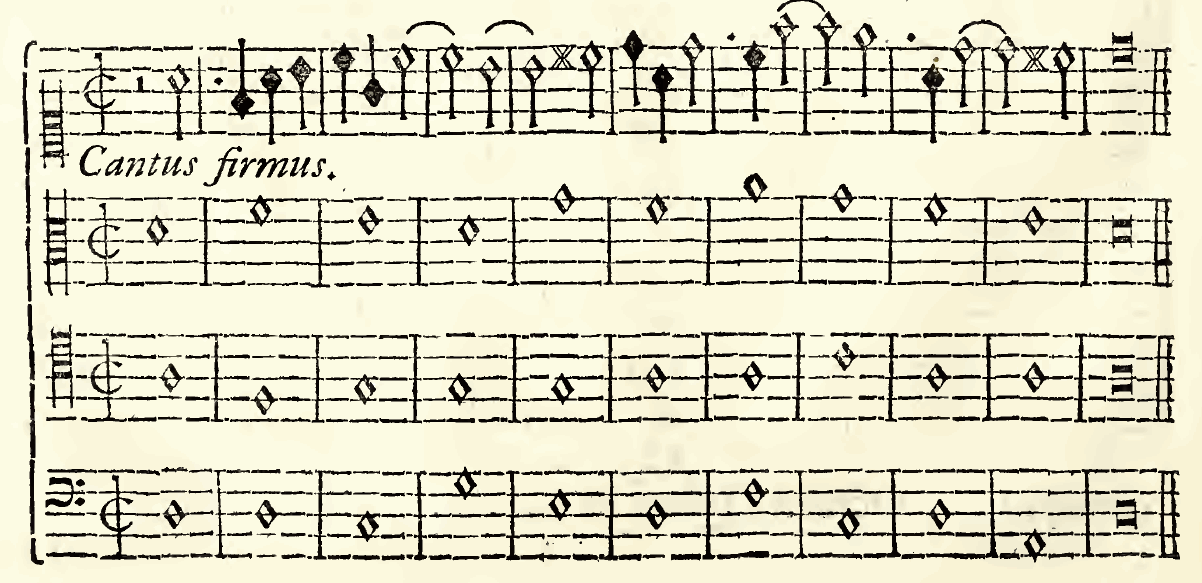
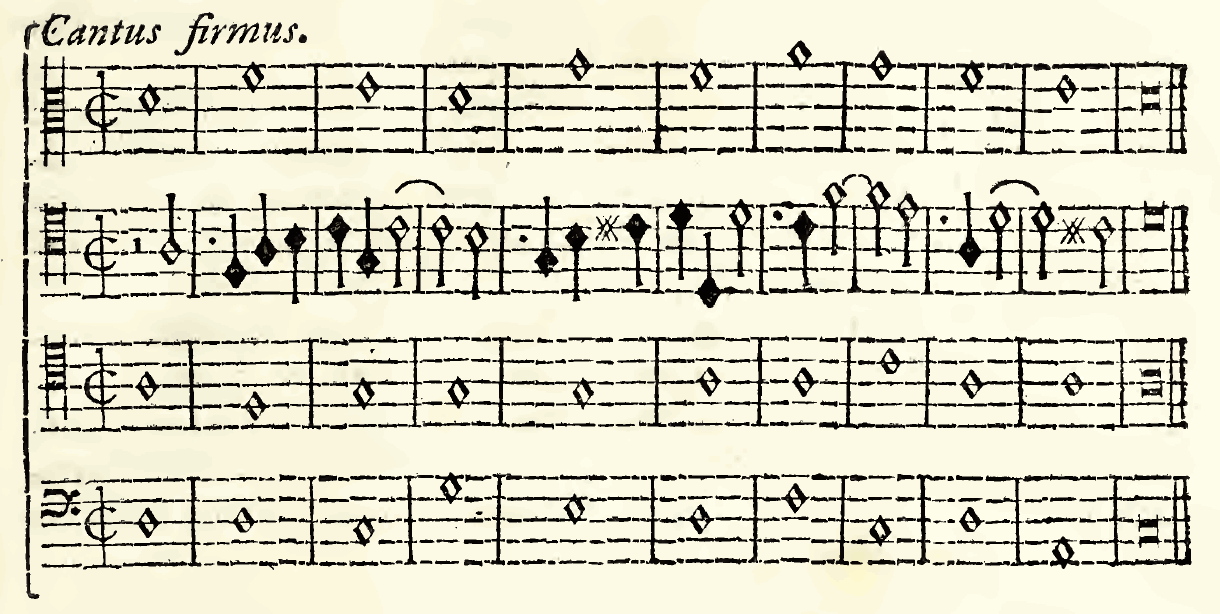
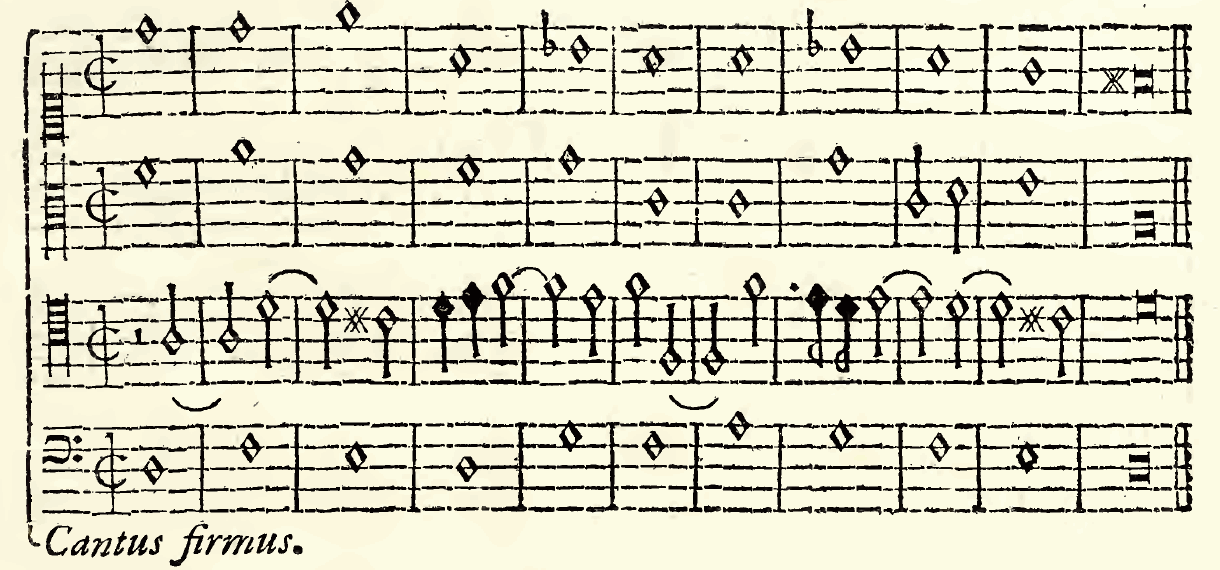
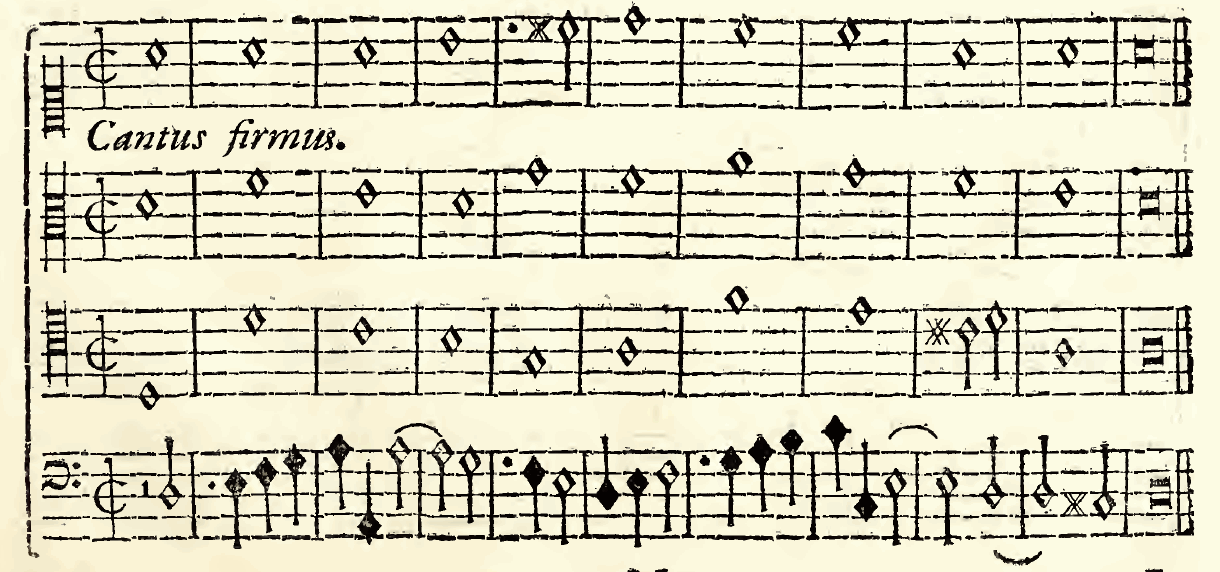
Joseph. I see that here too, as in the species of ligatures, one or another of the semibreves has been divided.
Aloysius. When I said that the semibreves must remain whole, I wish this to be understood in terms of what is possible. Nevertheless, observe that wherever the opportunity was given, this was everywhere observed exactly. I entrust the remaining exercises in the five modes to you, to be pursued with equal application.
Having now completed the five species and practiced each separately, I most strongly encourage you to practice them together. Keeping the same cantus firmus, combine, for example, minims, semiminims, and ligatures. By doing this, each part acquiring its own particular motion, a wonderful variety will be added to the composition. As in the example.
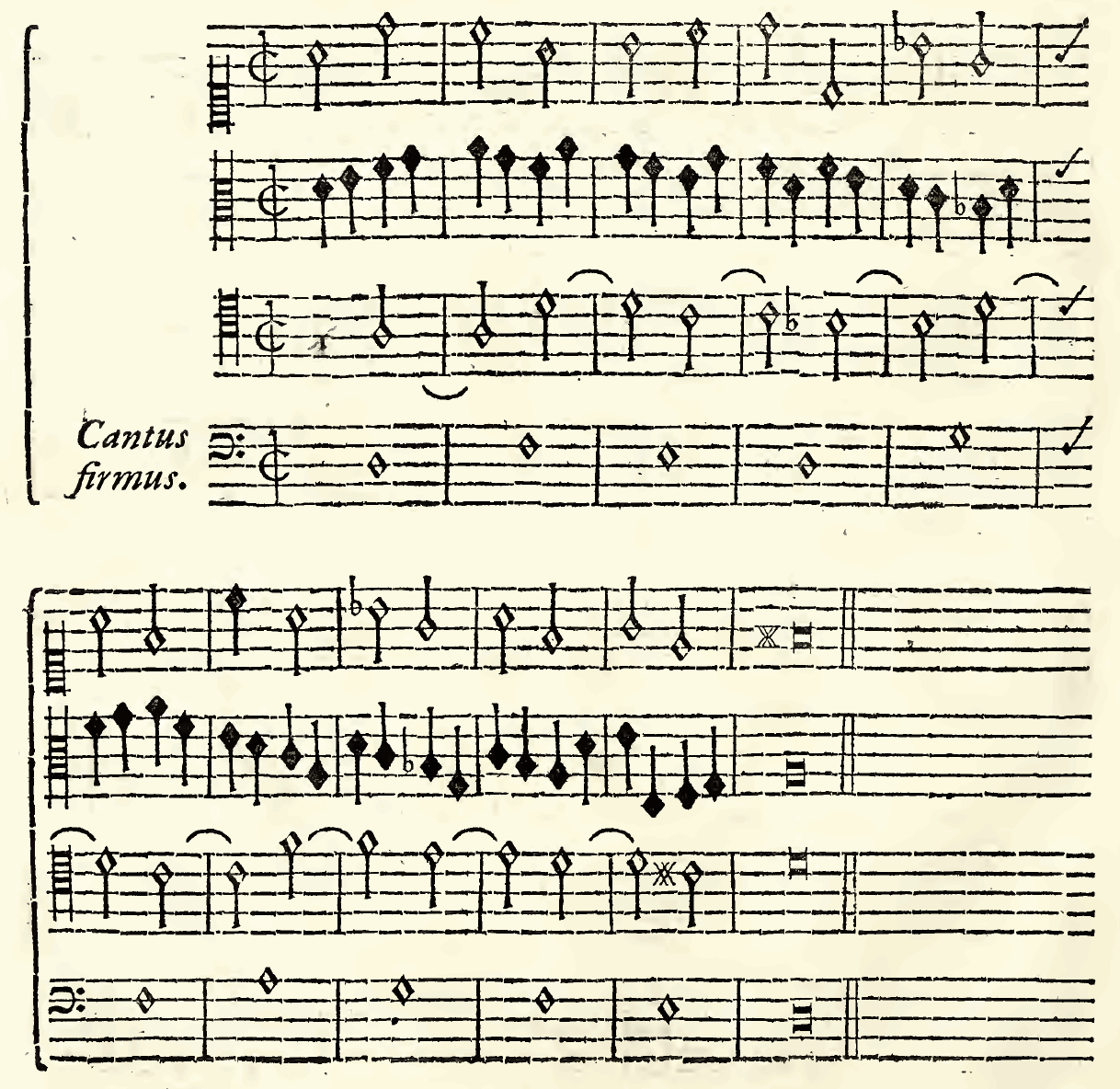
With equal application I assign you to complete both this mode and the other five, varying the cantus firmus through all four positions so that it occurs in every part. You will take care now to grasp together what has been said separately about each species, and to observe exactly the function of the parts in relation to one another, which I think is no longer unknown to you. It is not easy to express how much benefit these properly conducted exercises bring to students, since scarcely any difficulty will arise that will not be familiar to you after working through these species. Therefore, if you wish to progress in this discipline, I urge you with the greatest earnestness to devote no small amount of time to practicing these five species, continually choosing new cantus firmi at your discretion and spending at least a year or two persevering in this exercise. Do not allow yourself to be carried away by a premature eagerness to proceed to imaginative and freely invented composition. Enticed by its sweetness, wasting time wandering here and there, you will never attain a true foundation.
Joseph. You bid me walk a rough and very thorny path, revered Master. For it can scarcely be possible to devote so much time to this wearisome work without becoming bored.
Aloysius. Joseph, I forgive your complaint and sympathize with you. But the Muses are said to dwell on a mountain that can be reached only by a steep path. There is no apprentice to any mechanical art, however humble, who is not bound to an apprenticeship of at least three years. What shall I say of music? It far surpasses not only those unlearned and manual arts in ingenuity, difficulty, and abundance of material, but is second to none of the liberal arts. Let the future benefit of your toil spur you on. Let the hope of glory attract you. Let the resulting ease in writing encourage you, together with sure confidence that what you write will be correct. Once this is done, setting aside the cantus firmus for a time, I shall lead you to the knowledge of imitations and fugues. First, however, it must be stated that, outside the restriction of the cantus firmus, some dissonances may also be resolved in another way: for example, a ninth to a sixth and a tenth to a third; a fourth to a sixth and to a third, in the manner written below. For example:
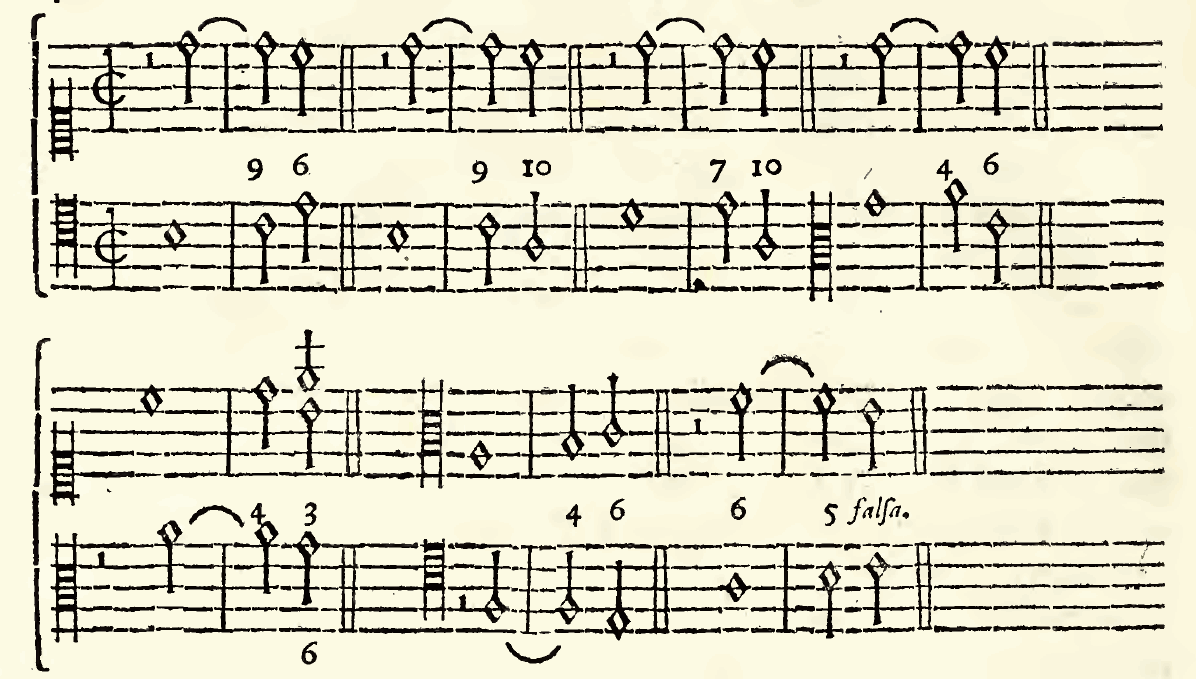
Joseph. Why do these resolutions occur outside a cantus firmus, and not also with a cantus firmus?
Aloysius. Do you not see that both parts move in the resolution, and that this cannot happen with a cantus firmus, which is immovable? There is therefore a difference, and it is clear that these resolutions have no place where oblique motion is indispensable. Now I shall lead you back to composition in two voices, unrestricted by any bond of a cantus firmus.