 Playable Books
Johann Joseph Fux · section 18 of 32
Fugue in general
Read and hear this section in the playable edition →


First lesson
On fugues in general
Several authors of no mean standing affirm that fugue takes its name from fugere, to flee, and fugare, to put to flight, as though the preceding part fled, pursued by the following one. This would be true, were it not that imitation does the same, as was said. Therefore another definition must be established to distinguish fugue from imitation. I say, then: fugue is the repetition by a following part of certain notes placed in a preceding part, with regard to the mode and, for the most part, to whole tones and semitones. To understand this definition it is clearly necessary to know what a mode is. By mode I mean what is commonly called a tone. Thus, when one says first tone, second tone, and so forth, it would be better to say first mode, second mode, and so forth, to remove ambiguity with the intervals in the ratios 9:8 and 10:9, which are also included under the name tone. Since the subject of modes is among the most intricate of all and not easy for a beginner to grasp, we shall be content here and now to explain only as much as suffices for our present purpose, deferring its full explanation to the end of the work. A mode, then, is a series of intervals contained within the bounds of an octave, with the semitones placed in various and differing positions. To this applies the saying of Horace:
There is a measure in things; there are, after all, fixed bounds,
Beyond or short of which right cannot stand.
Since the variety in the position of the semitones is found to be sixfold, six modes must also be established. These are shown in the following octave systems, namely D, E, F, G, A, C.
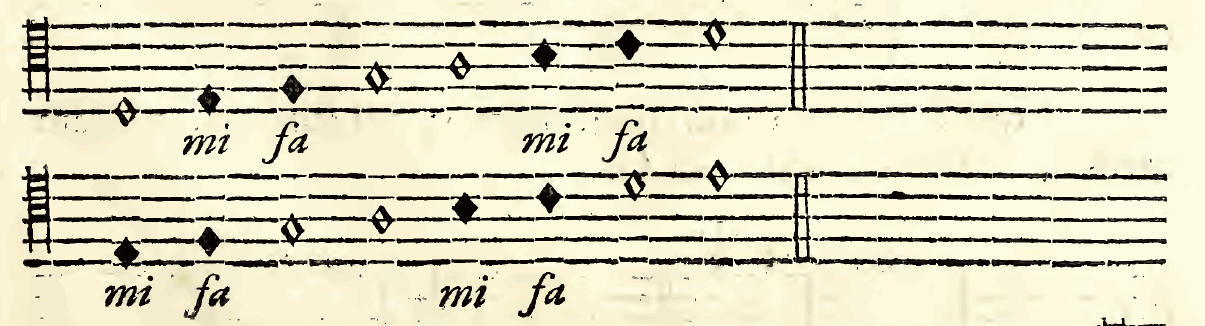
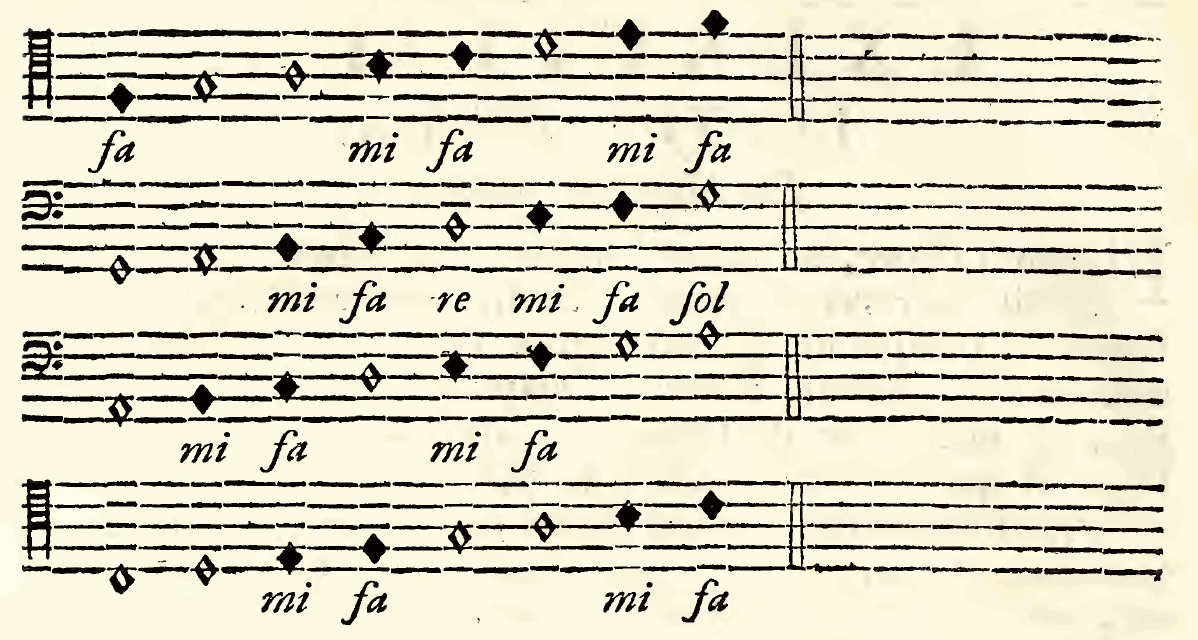
You see the semitones in six different positions, counting from the first note of each mode. This difference is indicated by the blackened notes. Which of these is first, second, third, and so forth we shall pass over for the present, numbering them meanwhile in the order in which they are placed here. Furthermore, a mode is bounded by the limits of the fourth and fifth contained within the octave; fugue subjects must be regulated according to these limits. For example:

Thus, if the beginning part makes the leap of a fifth, the following part must make the leap of a fourth, lest it exceed the limit of the mode or octave, and conversely. For example:

Imitation is not bound to this; it is enough for it to follow the same steps and leaps. For example:

Finally, fugue cannot be established outside the intervals constituting the mode, namely outside the unison, octave, and fifth; imitation, however, as has been said, can be at all intervals.
Joseph. I think I have understood what has been said thus far about modes, imitation, and fugue. Now please teach me what must be considered in choosing subjects and how fugues are to be established and conducted; for I have very often heard that the matter of fugues is not known to all who profess this discipline.
Aloysius. That is so; talk of them is heard more frequently than knowledge of them. So that nothing about them may remain unknown to you, I shall explain what you have asked. The preceding demonstration establishes that there are six different modes, and therefore each mode must have its own appropriate subject. It follows that a theme proper to the first mode is by no means suited to the second, third, fourth, fifth, or sixth, because of the differing position of whole tones and semitones found in each mode, as the examples will show.
A subject proper to the first mode
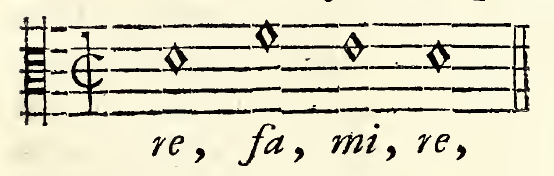
This theme, taken up by the following part at the fifth, preserves the same whole tones and semitones. For example:
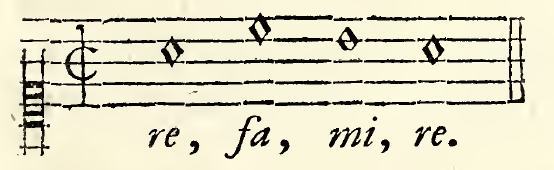
This cannot occur for this subject in any of the other modes. Let us examine the mode A, la, mi, re, which alone comes closest in similarity to the mode D, la, sol, re:

Here, in the penultimate note of the following part, fa comes instead of mi, and the position of whole tone and semitone is reversed. The arrangement of the subject proposed in the first part cannot otherwise be obtained except with the aid of a sharp placed before the penultimate note. For example:
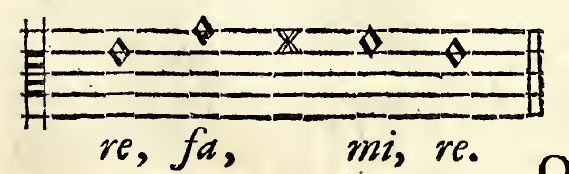
This is not admitted by the diatonic genus in which we are now working; rather, it must abstain from every sharp and flat in subjects, for otherwise we should never come to know the true nature of the modes.