 Playable Books
Johann Joseph Fux · section 26 of 32
On modes
Read and hear this section in the playable edition →To undertake the treatment of modes is much like bringing the ancient chaos into order. For so great a diversity of opinions is found among both ancient and more recent authors that there seem almost to have been as many opinions as heads. Nor am I so greatly held by admiration for the Greek authors, for it is beyond dispute that their music was at first very poor in intervals, as Plato testifies in the Timaeus. It is therefore not surprising that, as time passed and more species of tetrachords and octaves were acquired, the number of modes also increased. Yet the Greek modes took their names and number not so much from the species of octaves as from the diversity, character, and style of peoples: thus Dorian, Hypodorian, Phrygian, Lydian, and so forth. By these names they indicated the differing character and style of nations, which each people used according to its native custom, just as today we say Italian, French, or English aria, and so forth. But now that scarcely a shadow of Greek music remains to us, I cannot sufficiently marvel that there are still some who dare assign these foreign words to the modes of our modern music and obscure a matter already intricate enough with empty names. Leaving aside what is now obsolete or belongs more to musical history, we must examine the opinion of more recent authors, particularly those who establish twelve modes: six authentic or principal, and six plagal or collateral.
Joseph. Do all modern practitioners hold this opinion of twelve modes?
Aloysius. By no means. For there are some, perhaps led by chant, who recognize eight modes, and others who recognize more or fewer.
How much these opinions are to be valued will become clear from what is now to be said and from our own view, which will be presented shortly.
Here we must recall what we asserted above about simple fugues: namely, that six different species of octave are found according to the varying position of the semitone, and consequently there are as many principal modes, namely D, E, F, G, A, and C; although their diagram has already been given in the cited place, I do not consider it superfluous to repeat it here, as the order of the discussion requires.
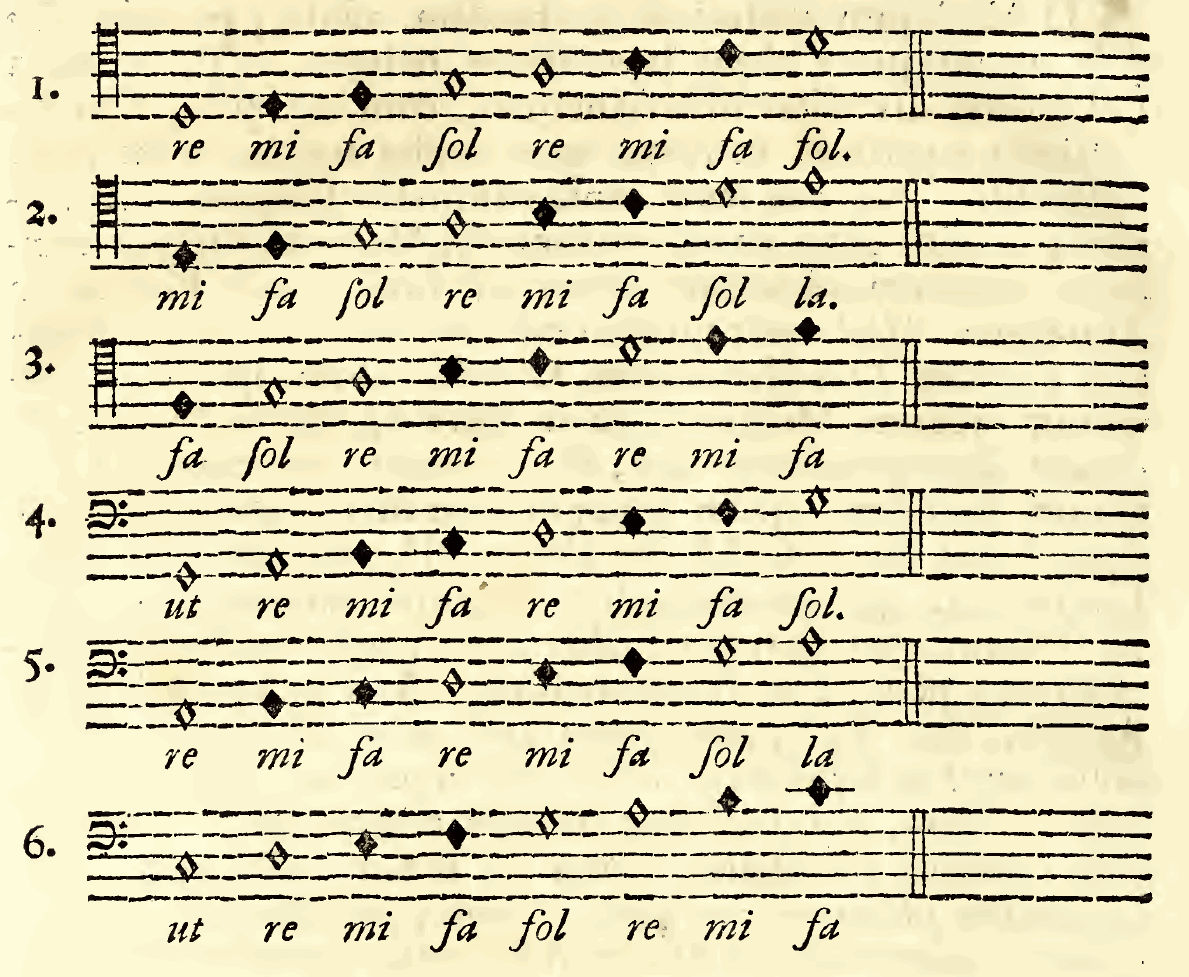
So many octaves differing in species are found because the semitones occur in that many different positions when counted from the first note of each system. Therefore exactly that many principal modes, and no more, must necessarily be established. For all other conceivable octave systems must be referred to one of these species as transposed modes.
Transposed modes belonging to the first mode, D
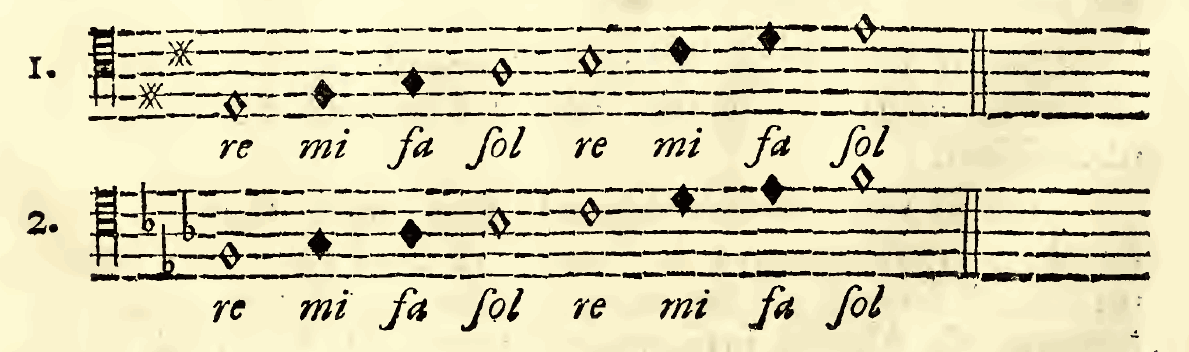
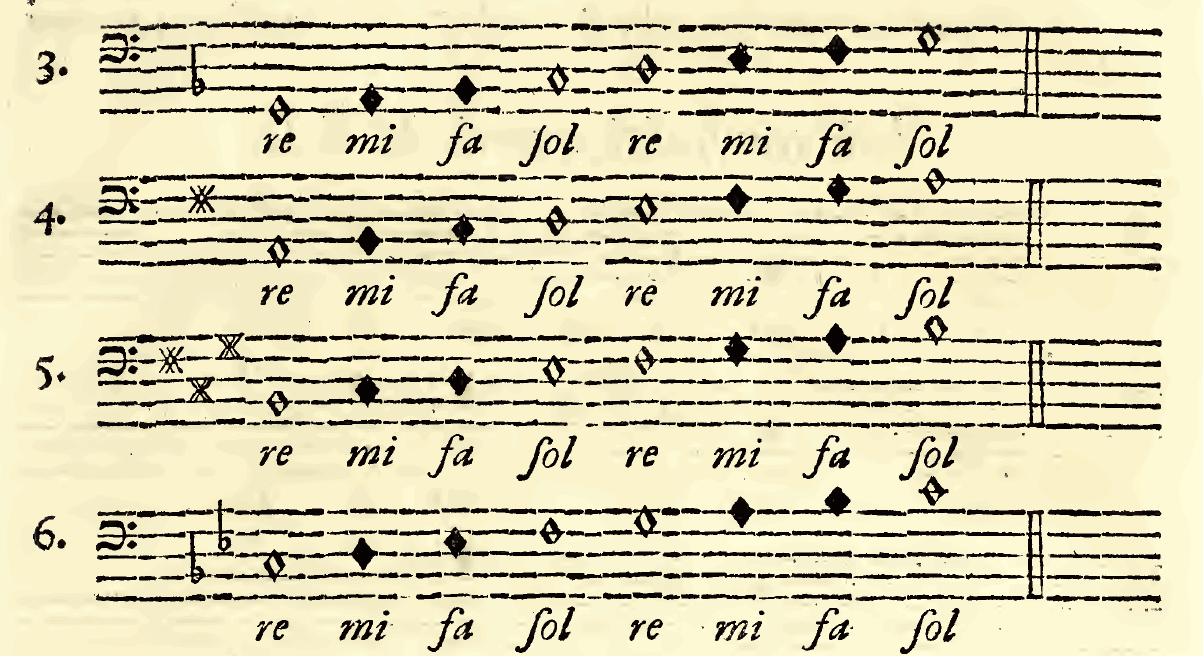
These, then, are the transposed forms of the first mode, D, because their semitones fall in precisely the same positions as its semitones. Consequently, preserving the same solmization, they differ in position but not at all in species.
Transposed forms of the second mode, E
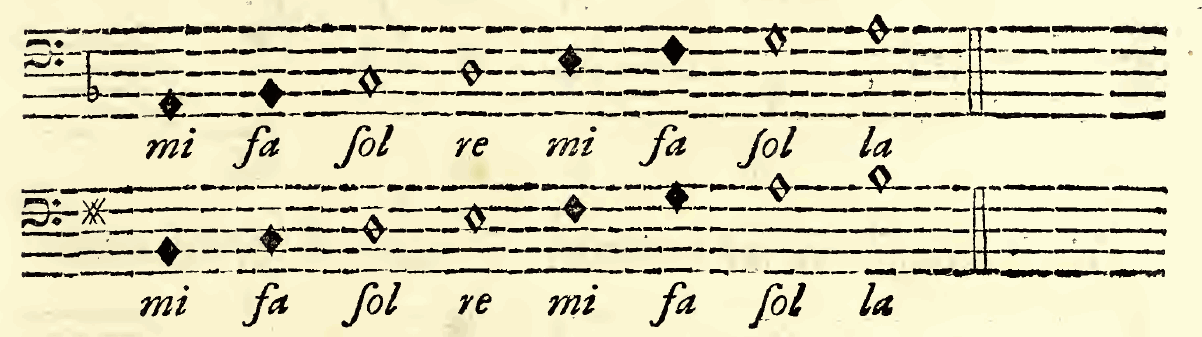
And some others of no great use.
Transposed forms of the third mode, F
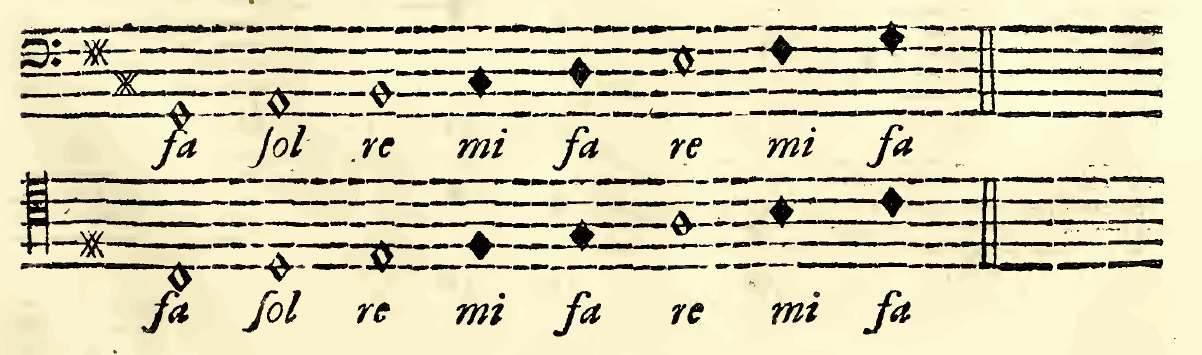
And any others that can be produced with the aid of a flat or sharp are little used.

Transposed forms of the fourth mode, G
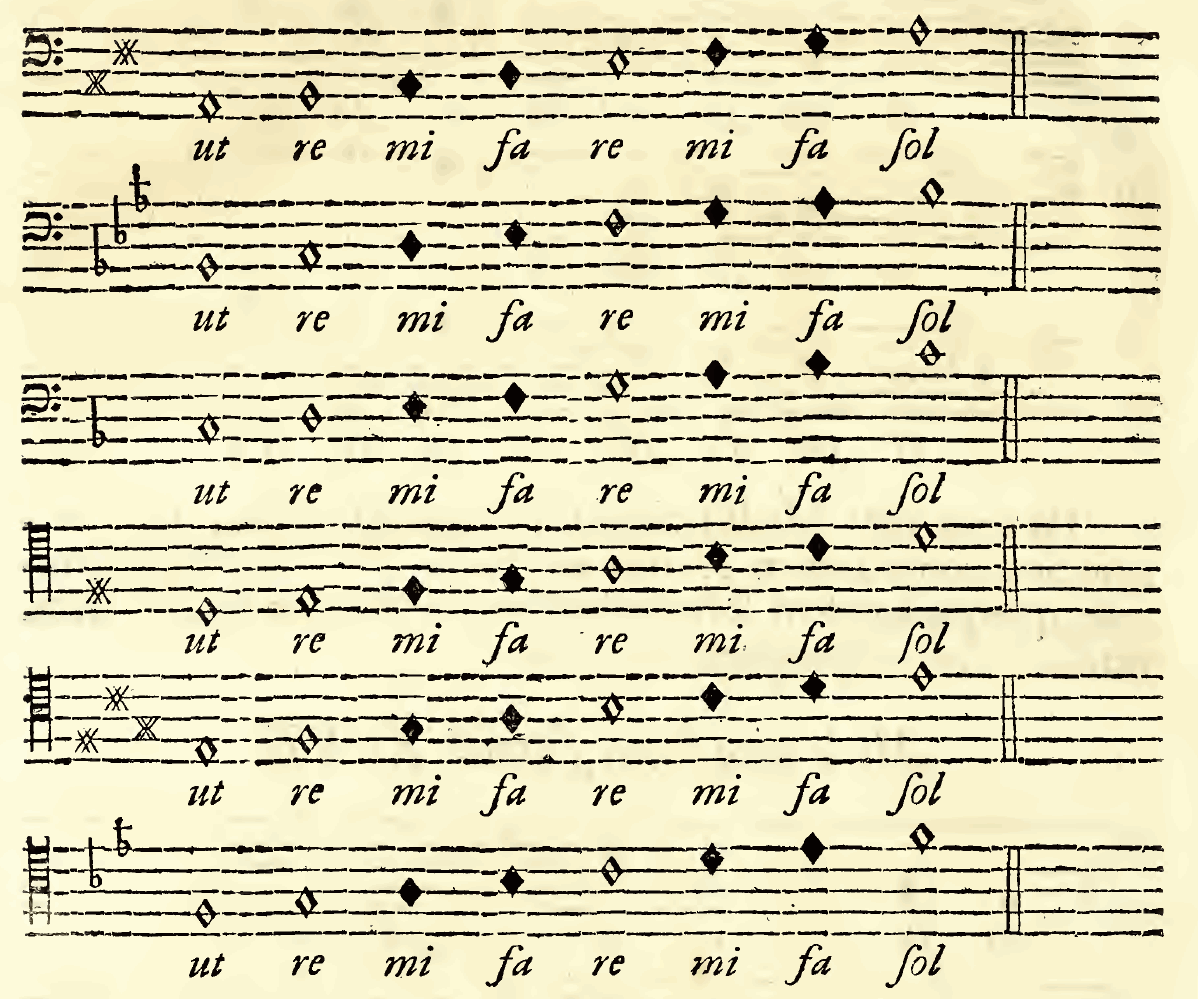
Transposed modes belonging to the fifth mode, A
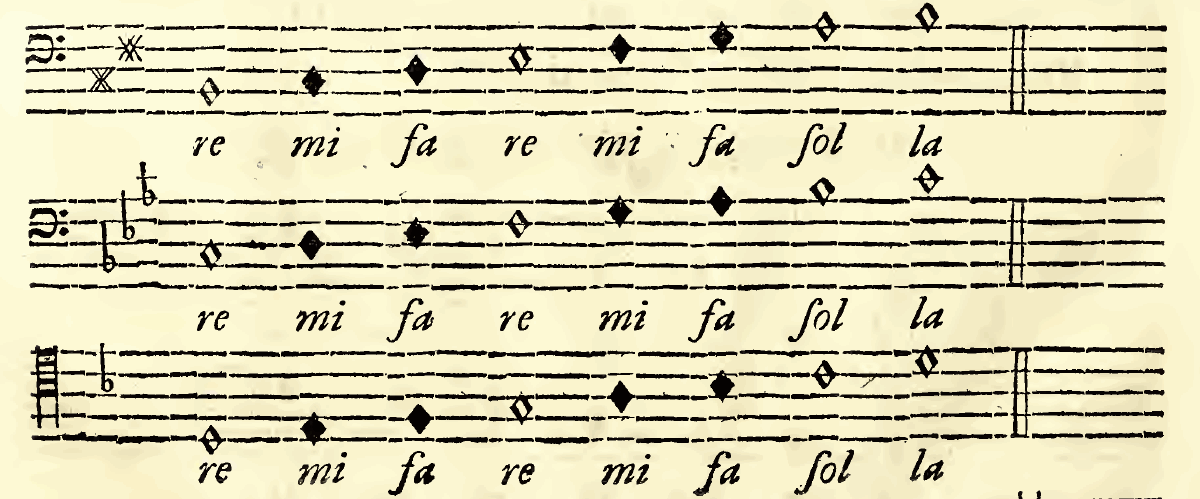
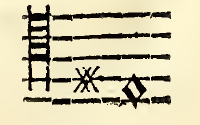
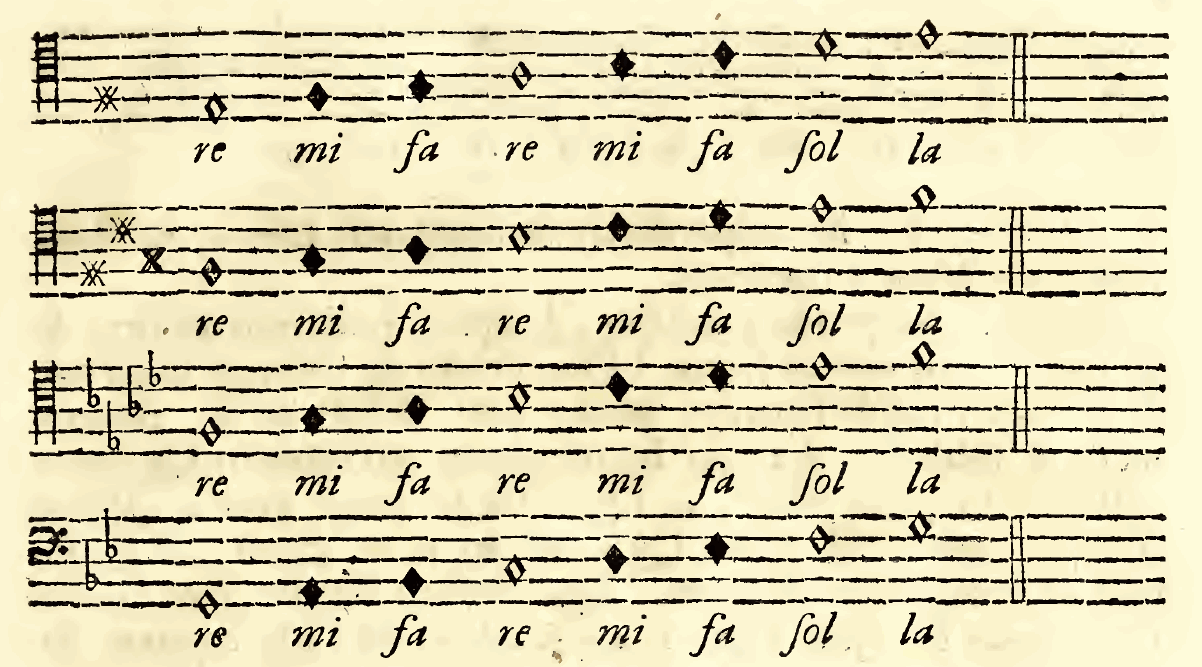
Transposed modes belonging to the sixth mode, C
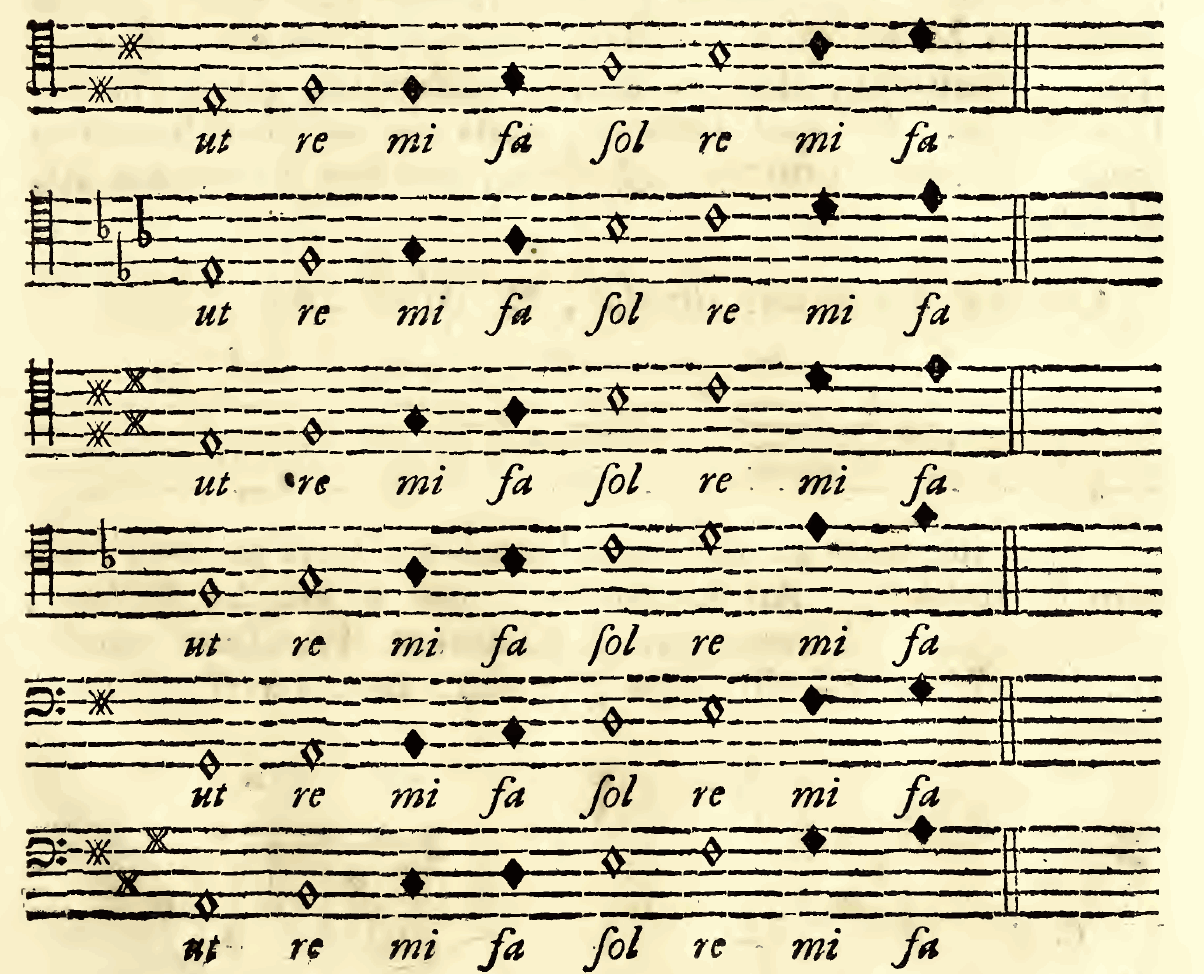
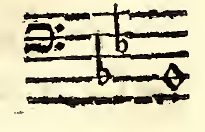

Joseph. From what has been said and demonstrated thus far, I infer that there are only six natural modes.
Aloysius. Suspend your judgment for a little while, Joseph, and recall what was said in Book One about the division of the octave: it may be divided in two ways, harmonically and arithmetically. By harmonic division the fifth is placed in the lower portion and the fourth in the upper; by arithmetic division the fourth is obtained in the lower portion and the fifth in the upper. Since the manner of making this twofold division was explained in Book One, I refrain from repeating it here.
Now from this twofold division of the octave arise two octave systems differing in species, and therefore also two modes differing in species: harmonic division produces one, called authentic, and arithmetic division the other, called plagal. From this it is inferred that, because twelve octave systems differing in species arise, as many modes must be established.
Octaves divided harmonically, and the modes arising from them

There is no doubt that these systems are produced by harmonic division. But whether the following systems, presented by Joseph Zarlino and many others for the formation of plagal modes, arise from arithmetic division is a matter of the greatest controversy.

For Zarlino himself, in Part Four, Chapter Nine, on modes, sets out the following system from the octave C.
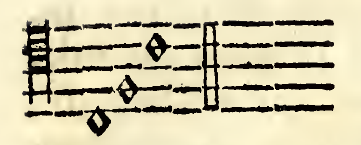
Here the lowest pitch remains, which is the true product of arithmetic division. If, therefore, plagal modes arise from arithmetic division, as indeed they do, their formation must be expressed by the following systems.

Joseph. In this way there would be only five plagal modes.
Aloysius. Indeed. For the octave F–f cannot be divided arithmetically because of the tritone arising from it, as I have already said elsewhere.
Joseph. What, then, is to be accepted in such perplexity?
Aloysius. I shall tell you after we have examined the use and distinction of modes, both authentic and plagal.
According to Zarlino’s opinion, it must be assumed that the beginning, ending, and cadences are common to both modes, so that there is no difference except that the melodic course of the authentic mode must occupy the higher range, and that of the plagal the lower. Nor does this author require that subjects of the authentic mode always proceed upward and those of the plagal downward, as his examples demonstrate.
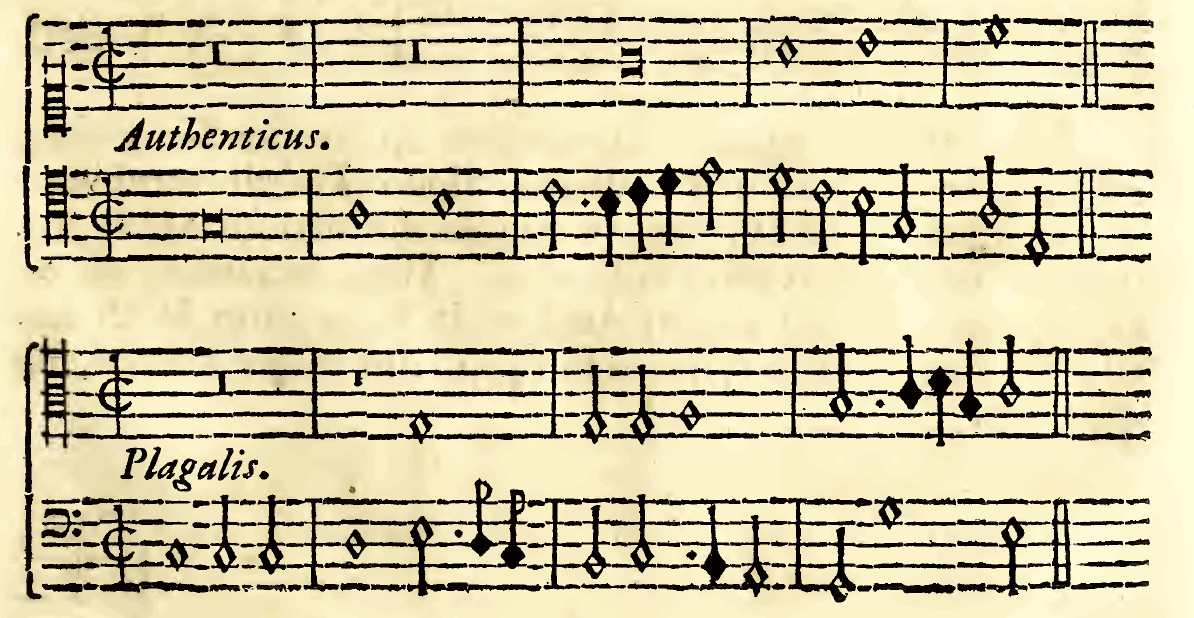
From these examples it is clear that there is no other distinction between these two modes than that the plagal melodic course is lower and its subject ends on a collateral interval, namely E and B natural. Besides a low melodic course and, for that reason, a change of clefs, Giovanni Maria Bononcini requires subjects to descend a fourth according to the nature of the plagal mode.
Angelo Berardi, otherwise an author of no mean standing, seems to distinguish the authentic mode from the plagal only by name, without regard to subjects ascending or descending or to a high or low melodic range. Indeed, he places the melodic course lower in the authentic mode than in the plagal, as his examples show.
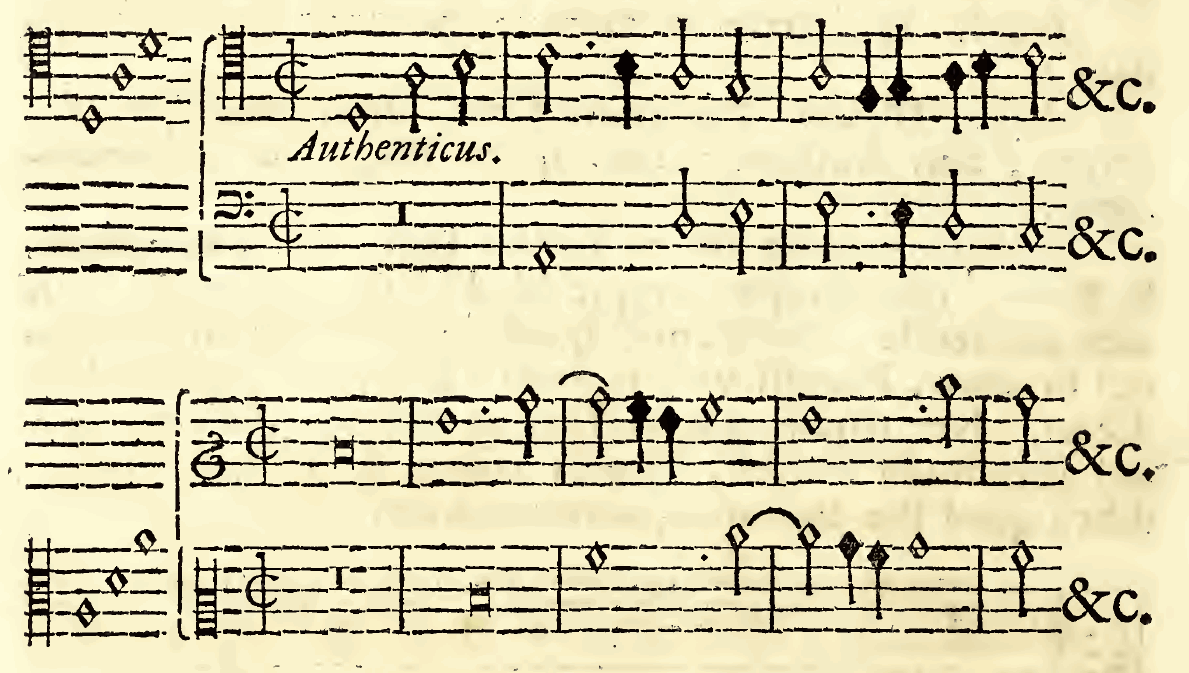
Who, knowledgeable in music and acquainted with the opinions of other authors, would assign this last example to the plagal mode, when the nature of its subject and its melodic course seem more suited to the formation of the authentic mode? Still more remarkable is the following composition, given by the same author as an example of the third mode, or E–e, which I shall set out here in full so that you may marvel all the more.
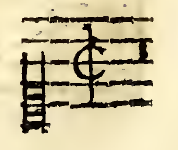
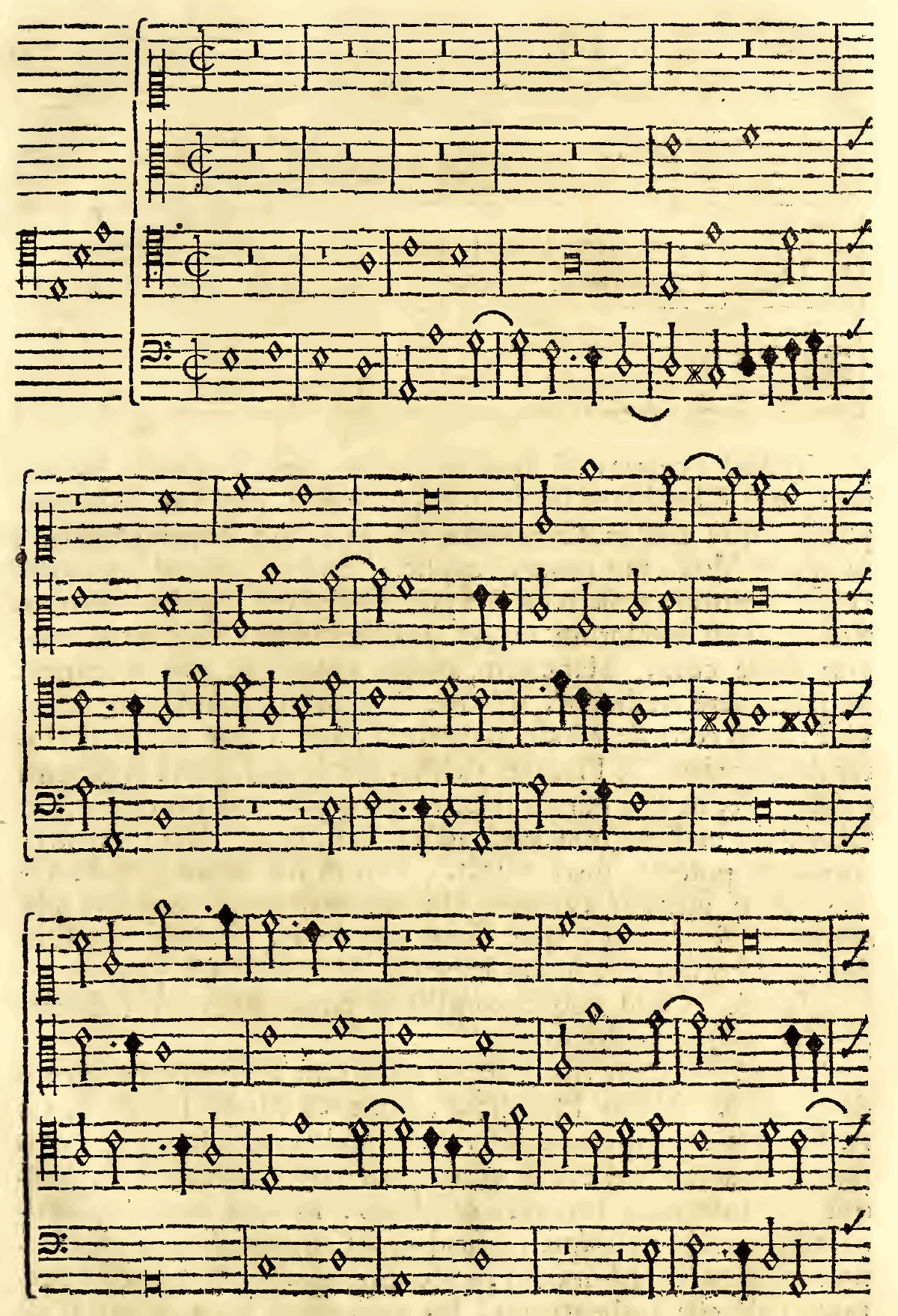
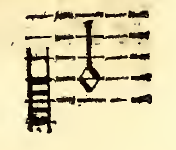
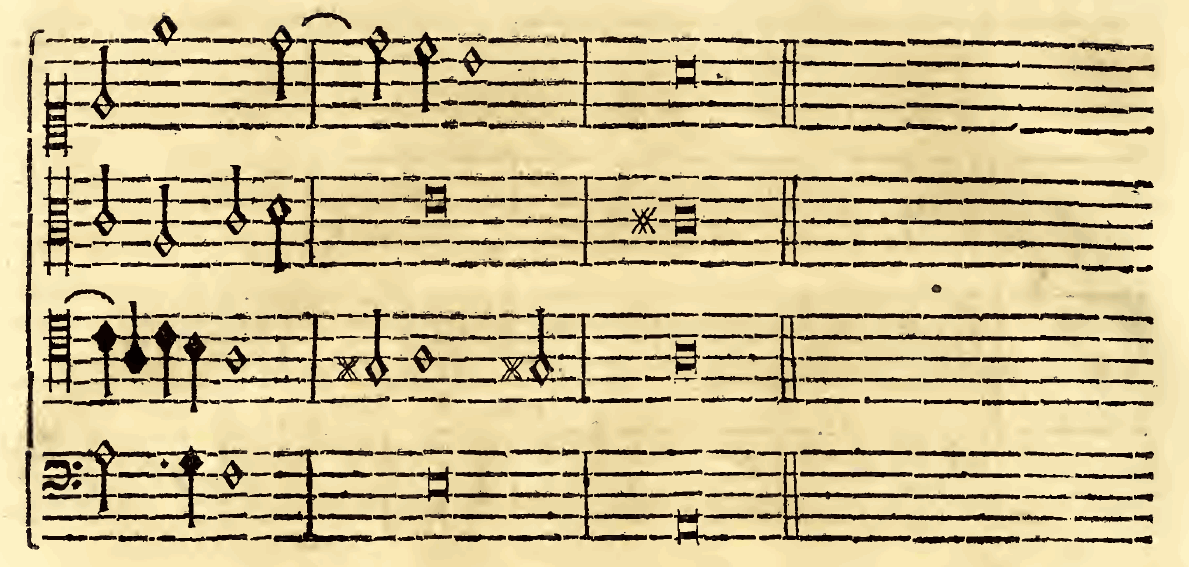
Do you see that neither the entering tenor nor the final cadence corresponds to the arrangement prefixed here? Thus nothing prevents this composition from being assigned to A, or Hyperphrygian, as its proper mode. I could bring forward not a few examples from Aloysius of Palestrina showing that the matter of modes was not of great concern even to this most excellent man. Reflecting on this matter, were authority not an obstacle, I should almost believe that these otherwise distinguished authors themselves did not know what definite conclusion to establish about modes; or, if there is any distinction between authentic and plagal, they certainly thought it so insignificant that they did not consider it worthwhile to attend to it. Perhaps it had force formerly, when hearing was not yet so delicate and could be contained within those same narrow bounds. But in our age, when the insatiable appetite of the ears scarcely allows itself to be confined within reasonable limits, it is easy to judge what value should today be placed on this opinion that restricts the breadth of music.

Joseph. What course should be taken, then, amid such disagreement among authors and ambiguity in the matter?
Aloysius. I shall tell you, Joseph, not so much as a precept as by way of advice. Leaving aside plagal modes, use the six modes D, E, F, G, A, C with their transpositions, in the manner you were taught above concerning simple fugues and will be taught further, ranging far and wide melodically through intervals proper and congenial to the mode in which you are working. Be persuaded that a composition worked out according to the rules of harmony, otherwise freely ranging and full of charm, is sufficiently authentic, whereas one devoid of these things is all too plagal.
Joseph. Perhaps plagal modes will be needed in composition upon a chant melody?
Aloysius. Not at all. It is enough to take account of the intonations and ecclesiastical modes—knowledge of which you should seek from chant specialists—and in melodic writing to follow the advice just given without the restriction of a plagal mode. You will complete a work you need not regret.
Joseph. Since I have understood from you that you are concerned with only six modes for figured music, it would be useful to know what order you follow, and which you establish as first, second, third, and so forth.
Aloysius. Joseph Zarlino and most others of that age regarded C, or Dorian, as the first mode. Later, almost all more recent practitioners assigned the first place to D, formerly called Phrygian. It is enough for us to have demonstrated that only six modes differing in species exist; it matters very little what order anyone follows. If, however, Joseph, you prefer to follow established custom, I do not prevent you from calling them by the names received in use.