Nikolai Rimsky-Korsakov · section 28 of 96
The Sixth Chord of the Diminished-Fifth Chord of the Seventh Degree (*)
Read and hear this section in the playable edition →
§ 28. 1) It is used as a dominant harmony.
2) It is prepared by the triad of the fourth degree and resolved onto the tonic triad.
3) Only the fifth or the third of the root is doubled.
4) The leading note must rise to the tonic, and it must not be placed in the tenor, so as to avoid parallel fifths:
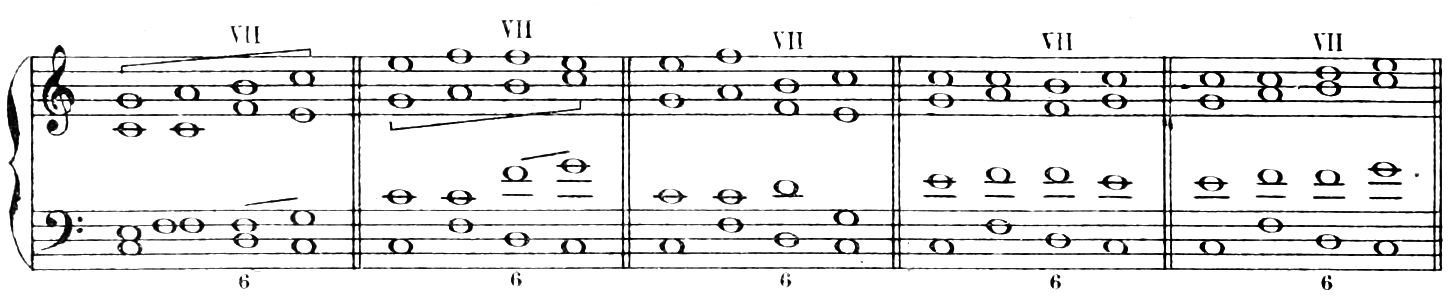 Fig. 99 · See it in the reader
5) Use it to harmonize the upper, ascending tetrachord of the major scale.
6) Use it to harmonize the upper, ascending tetrachord of the melodic minor scale.
The triad of the fourth degree is artificially turned into a major triad as a result of the alteration of the sixth degree of the melodic minor scale.
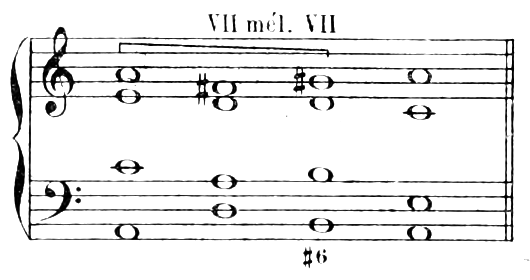 Fig. 100 · See it in the reader
7) When the complete tetrachord of the melodic minor mode is used, the succession of two major thirds is to be avoided:
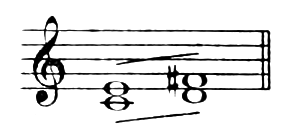 Fig. 101 · See it in the reader
to do so, the bass of the sixth chord of the first degree is held back, thus forming a second chord:
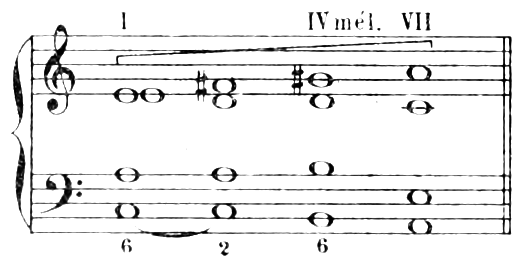 Fig. 102 · See it in the reader
 Playable Books