 Playable Books
Arnold Schoenberg · section 11 of 66
Degree VII
Read and hear this section in the playable edition →

The triad on degree VII, the diminished triad, requires special consideration. Its construction differs from that of the triads considered so far, which share at least one feature: the perfect fifth. The triad on degree VII has a diminished fifth; such a fifth does not occur among the nearer overtones, and the triad is therefore perceived as a dissonance. I have already discussed the fact that dissonance requires special treatment, and the reasons for this, in the case where it appeared only successively, melodically (two leaps of a fifth or fourth in the same direction). Clearly, dissonance has an even more conspicuous effect when its notes appear together, sounding simultaneously. In succession it might escape notice if, for example, one forgot the preceding note involved. In simultaneous combination it cannot escape notice.
We can only speculate about how people came to use dissonances at all. It presumably happened only gradually; at first, attempts to mix the more remote overtones—the dissonances—with consonances were probably made only occasionally and with great caution. I imagine that they were initially allowed, as it were, merely to flit past: above a sustained C–E–G triad, for example, a melodic voice might slide from a long-held G to a long-held E through an extremely fleeting F. Something like a more or less fully executed portamento or glissando (called “smearing” in the dialect*)), whose individual notes can scarcely be distinguished. Later, one of these notes may have been fixed as a step of the scale. I therefore believe that dissonance first appeared as a passing tone, and that the passing tone arose from portamento, from the need to connect interval leaps smoothly or melodically—which in this case means by scale steps. That this need coincides with another, the need to put the more remote overtones to use as well, may be only a fortunate coincidence of the kind that development so often presents. Perhaps, however, it is the very same principle, and portamento is one form in which its effect is realized. But portamento might also, like the scale, be a laying-out of the overtone series horizontally. If the ear stopped halfway in this process and chose, not the dissonant overtones that are actual constituents of a sounding tone, but stylized and tempered average tones, this can be explained in the same way as a compromise between the goal and what is attainable, as I have already suggested for the origin of the scale.
*) It should be noted here that music too has a dialect that could serve as a source for illuminating historical development, much as the vernacular does for the written language: folk music. For besides the results of its own development, it also contains old things that were once in common use. And one should reconsider the banalities and trivialities as well. Most will prove to be not truly ignoble, but worn out and outdated. “Hackneyed,” as amateurs like to say.
The use of ornaments of this kind, which touched upon dissonant tones, was permitted in the form of the so-called “Manieren,” and indeed was almost demanded by taste. These “Manieren” could not be notated, since written notation could not have represented them; the figures concerned—appoggiaturas, trills, portamenti, and so forth—could therefore be transmitted only through tradition. But through practice, a sense that the dissonances touched upon belonged together with the fundamental may gradually have seeped into the awareness of the analysing ear, creating the need to fix at least some of the more frequently occurring notes in writing as well.
The passing note, then, is nothing other than the written fixation of a manner of ornamenting. Just as notation always falls short of sound—not only in melody, but perhaps still more in rhythm, where the constraint of barlines often scarcely permits even approximately correct representations—this notation, too, is of course imperfect when measured against what the imagination envisaged. Yet it is understandable as one of those simplifications the human mind must devise if it is to master its material. Here too, one may suspect that the system for simplifying the thing has been mistaken for the system of the thing itself; and one may safely assume that, although a correct feeling underlay it, our treatment of dissonance subsequently pursued the development of the simplifying system more than it truly engaged with the nature of dissonance. I may fall into the same error by adhering to this manner of treating dissonance, but I can cite two points in my favour. First, as I have often stressed, I give the instructions needed to fulfil the system neither as rules nor as aesthetics. Second, one must also consider that our ear today has been educated not only by the conditions nature imposed upon it, but also by those produced by the system, which has meanwhile grown into a second nature. Today we can scarcely escape the effect of this culture, this artificial product, or can do so only gradually; and reflecting anew on nature may have value for the theory of knowledge without thereby being able to bear immediate artistic fruit. Certainly this path, which listens for new secrets from nature, will one day be taken again. Certainly these too will then be diluted into a system; but first the old system must be cleared out of the way. Perhaps the insight I have presented here can help bring that about.
Notating the dissonance that occurs as a passing tone presumably led to recognition of the phenomenon of dissonance in general. Two drives contend within human beings: the desire to repeat pleasant stimuli, and its opposite, the need for variety, for change, for new stimuli. They often unite in a relatively coarse predatory drive: the drive to take possession. The question of whether repetition or change will then follow is postponed for the time being. The more robust satisfaction afforded by the awareness of possession, with its possibilities of deciding in either direction, can suppress subtler considerations and lead to the conservative repose that always characterizes those who possess. Confronted with the dilemma of whether repetition or renewal of the stimuli was preferable, the human mind here too chose to take possession and founded a system.
Thus one can also imagine that the accidental occurrence of a dissonant passing note, once set down in writing and once its appeal had been felt, provoked a desire for a less accidental, deliberately produced repetition; that the desire to experience this appeal more often led to taking possession of the methods that evoke it. Yet if the attraction of the forbidden was to yield undiminished pleasure, that fundamentally contemptible compromise between morality and desire had to be struck: here it consists in a more relaxed understanding both of the prohibition and of the forbidden thing. Dissonance was accepted, but the door through which it was admitted was bolted when excess threatened.
In this way the treatment of dissonance may have arisen, governed equally by psychological and practical considerations. The caution of the listener, who wants to enjoy the attraction without being too frightened by the danger, agrees with the caution of the singer. And the composer, who must not alienate either, devises methods that serve the purpose: how can I hold the listener in suspense and frighten him, yet not go so far that I can no longer say, “It was only play”? Or: how can I introduce slowly and cautiously what must come if I am not to bore him; how can I persuade the listener to accept the sour grape too, so that the sweet one—the resolution of the dissonance—will then refresh him all the more pleasantly? How can I induce the singer to sing a dissonant note whose intonation may give him difficulty? By keeping him from noticing its entrance and whispering to him at the moment of catastrophe: “Easy, it will pass.” Introduce cautiously and resolve agreeably: that is the system!
Preparation and resolution, then, are the names of the two protective coverings in which dissonance is carefully wrapped, so that it neither suffers nor causes harm.
Applied to our case, the diminished triad, this means that the dissonant diminished fifth must be prepared and resolved. That no note other than the fifth can be the dissonance in the diminished triad follows not only from comparison with the overtones, among which a fundamental always has a perfect fifth, but also from comparison with the other triads, all of which have perfect fifths. There are various ways of treating dissonance, various ways above all of resolving it, but also various ways of introducing it. The first and simplest form of introduction that we learn is preparation. In this procedure, the note that will subsequently become dissonant should already have been sung as a consonance by the same voice in the preceding chord. The purpose of this preparation is clearly to have the singer intone the note where, as a consonant member of a major or minor triad, it presents no difficulty, and then sustain it while the other voices move in such a way that it becomes a dissonance. For our first form of resolution, we provisionally choose a method whose suitability is easy to understand psychologically. If introducing the dissonance creates an obstruction in the harmonic flow, comparable to a weir in a stream, this arrest should cause an accumulation of force that carries the obstacle, so to speak, “in its stride.” The motion that surmounts it should be a strong one. The progression from degree V to degree I may be regarded as such a strong motion, or, more generally, the upward leap of a fourth in the root*). In my criticism of the concept of the dominant I have already pointed out how strongly the tonic attracts the dominant, and further mentioned that every root has a need to be overwhelmed, overcome, by a root lying a fifth below it. By following this need of the root—the need to dissolve into a higher, stronger unity as a subordinate constituent, the need to serve a cause greater than its own—we fulfil, as it were, the root’s most intense longing; we thus perform the strongest motion. It is therefore clear that the use of this strongest motion on an occasion as special as the occurrence of a dissonance in our provisional harmonic life is as appropriate as putting on festive clothing for solemn occasions in ordinary social life. There are, of course, other means of resolving dissonance; and when more frequent use has made it less exceptional for us, we shall make less fuss over it and shall not always immediately resort to the strongest means.
*) Strictly speaking, I ought rather to say a downward leap of a fifth; but for reasons discussed in the note on page 141, I prefer this designation.
If, when resolving the dissonant fifth of the diminished triad, one lets the root make this upward leap of a fourth (or downward leap of a fifth), degree III results as the chord of resolution for degree VII.
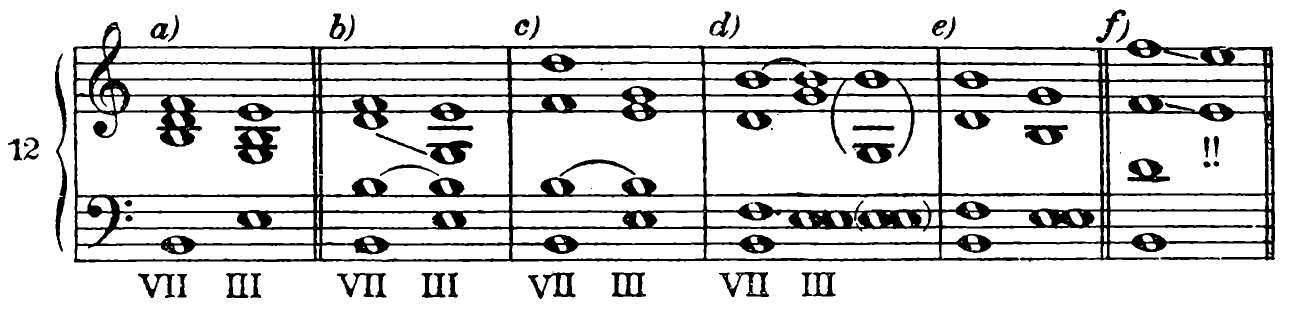
Here the dissonant note itself was resolved by the dissonance moving downward by step, from f to e. There are various ways in which the dissonance can behave in relation to the chord of resolution. It can fall, rise, or remain stationary, but it can also leap away. For our first case we choose the course of letting it fall—that is, move one scale step downward. One reason is that this voice, which has so strongly drawn our attention, then becomes the octave of that root which we found particularly suited to resolving the dissonance. It thereby confirms, so to speak, the fulfillment of the root’s need. There is also another reason, to be discussed on a later occasion.*)
*) Page 100.
Here, however, the common-tone link must sometimes be relinquished if a complete chord is to be obtained. If the link, b, were held (12b, c, d), the voice with d would have to leap up or down to g. This causes difficulties in some cases—for example, in 12b, where a downward leap would place the alto below the tenor, while an upward leap would place it above the soprano. As already stated (page 45), however, we are to avoid crossing the voices. The solution in 12c is good and usable; but since the upper voice makes a leap here, some attention will have to be paid to its melodic line. This will be done shortly. In 12d, by contrast, whether the alto leaps upward or downward, the distance between two adjacent voices would be too great: in the first case alto and tenor would be a tenth apart, in the second alto and soprano. We should, whenever possible, avoid such a spacing, since experience places it among those with a less even sonority. (When something of this kind occurs in works of art, the sonority may be intentional or may have arisen from its subordination to other purposes.) Here, then, the solution in 12e, without a common-tone link, is preferable. Depending on the needs of the setting, the pupil may readily use the common-tone link on one occasion and dispense with it on another. The considerations involved will be explained later when we discuss the melodic needs of the voices. For the present, let it merely be suggested that it is best not to depart too far from the spacing in which the little setting began; and if one has had to leave it, the first opportunity should be taken to return to it.
This case prompts a consideration of some importance. For the first exercises we selected for connection only chords that permit a common-tone link. This seemed to be a rule, but it is not one: its purpose was merely to make the voices always appear with octave doubling and to avoid certain other voice-leading difficulties that will be discussed later. Now it becomes necessary here to dispense occasionally with the common-tone link. The instruction has therefore been set aside by a higher necessity. This is not an “exception to the rule,” since we had no rule; we had an instruction that gave as much as it took away. Certain errors could be avoided because, although it also excluded some cases that might be good, it otherwise excluded those in which the errors could occur. Once the pupil has gained sufficient assurance within this restriction, he will be able to dispense with this assistance when a higher necessity demands it. In general we shall, of course, continue to let the voices move only as much or as little as is indispensable. But—and this is what needed saying here—every instruction is set aside when a higher necessity demands it. There are thus no eternal laws here, only instructions that remain valid until another wholly or partly sets them aside: when different conditions are imposed.
Concerning which note of degree VII is suitable for doubling, the following can be said. First of all, naturally, the root—even if only because we have so far always worked exclusively with doubled roots. But also for the same reason that the root was preferred in the other triads. The third and fifth, however, are a different matter. The third is more eligible here, because degree VII is neither a major nor a minor triad, but a diminished one. Here it does not determine the mode and is therefore less conspicuous. The fifth, by contrast, is the most conspicuous note of degree VII because it is a dissonance, and for that reason alone should not be doubled. Moreover, as a dissonance that we intend to resolve, it has an obligatory path: it must descend. If it were doubled, the other voice containing it would have to descend too (Example 12f). This would produce a kind of voice leading about which more will be said later. For the present, only this: two voices would perform the same motion. That is superfluous, since one suffices. The diminished fifth, then, must not be doubled.
Now for preparation. The dissonant note should have been a consonance in the preceding chord and should then remain in the same voice while becoming dissonant. Every note of the scale occurs in three degrees: in one it is the root of a chord, in another the third, in the third the fifth. Our dissonance, F, is the root of degree IV, the third of II, and the fifth of VII. The chords on degrees IV and II are therefore available to us. A new question now joins the three we asked when connecting consonant chords. The questions now read:
1. Which note is the bass note?
2. Which note is dissonant? (If there is one, prepare or resolve it, according to which is called for at that point.)
3. Harmonic link? (It stays in place if possible, thus no longer unconditionally.)
4. Which note or notes are missing?
Example 13 shows preparation and resolution in several cases. In 13a, b, and c, preparation takes place through degree IV (since the note to be prepared is the octave of the preparatory chord, this is called preparation by the octave); in 13d and e it takes place through degree II (preparation by the third).
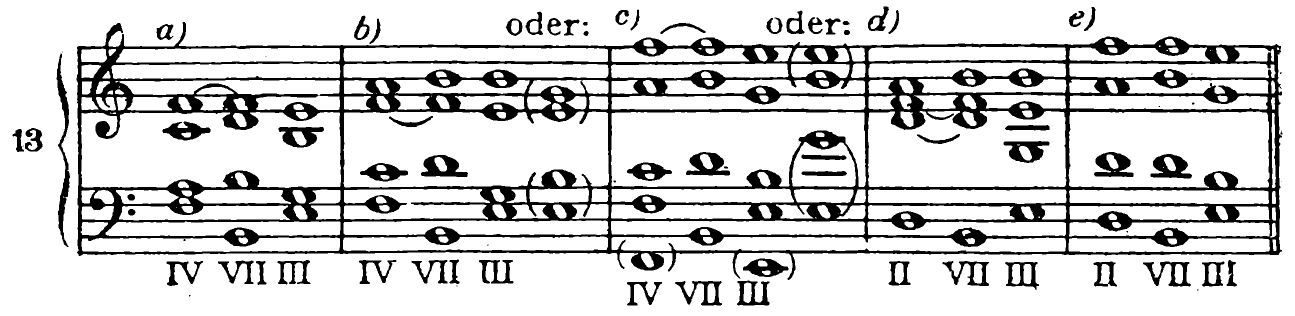
The pupil should now practise preparing and resolving degree VII in as many examples as possible, including other keys. The degree sequences will be IV, VII, III or II, VII, III. For the present, VII is always followed only by III, and preceded only by IV or II. Once the pupil is sufficiently secure in handling degree VII, he should begin using it in short passages as well. Here too, of course, VII must always be followed by III and introduced by IV or II. Otherwise, the pupil can follow the table throughout; its restrictions concerning degree VII now cease to apply.