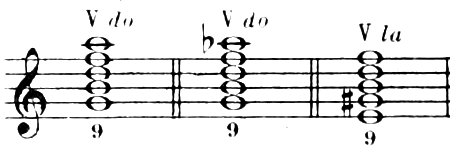
§ 42.—1) The ninth chord consists of a seventh chord with a further third added, a ninth above the bass.
2) As an independent chord it is considered only on the fifth degree; it is therefore classed among the dominant harmonies.
3) When the ninth is major it is called the major ninth chord; when the ninth is minor it is called the minor ninth chord.
4) The major ninth chord is found on the fifth degree of the natural major mode, and the minor ninth chord on the fifth degree of the harmonic major and minor modes:
5) To lay out the ninth chord in four parts, the fifth is omitted.
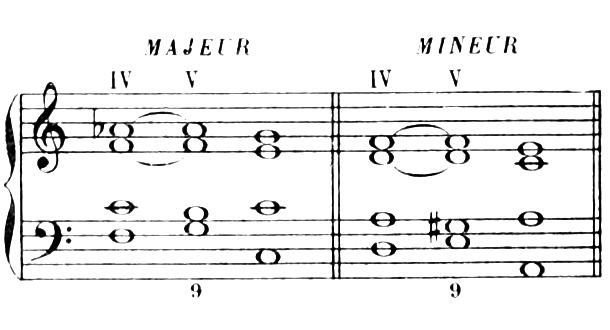
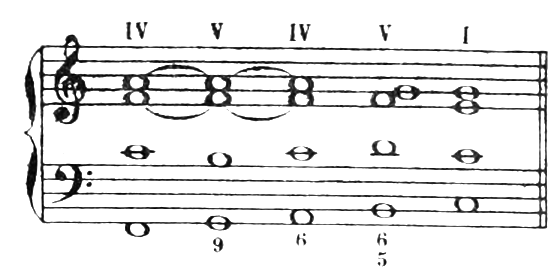
6) The ninth descends to the fifth of the tonic triad that follows it as its resolution, and the other parts move according to the rule for resolving the dominant seventh chord.
7) The ninth chord is placed after the triad of the fourth degree, the two chords being connected harmonically, preferably with the ninth in the upper part:
We give no special exercises for the use of this chord; the student will compose several examples of eight bars using the ninth chord without overusing it.
 Playable Books