 Playable Books
Arnold Schoenberg · section 54 of 66
Some Remarks on Ninth Chords
Read and hear this section in the playable edition →


The ninth chord is the stepchild of the system. Although it is at least as legitimate a result as the seventh chord, it is nevertheless called into question again and again. It is impossible to see why. The system begins to become artificial at the moment it models the minor triad on the major triad. To go on and form a seventh chord by adding the seventh is not, it is true, a necessary consequence of this first arrangement, but it is a possible one. Yet if this is possible, then ninth chords, eleventh chords and so on are possible too, which would at any rate have the advantage that the system of building in thirds could be continued. That would surely bring the further advantage that, without losing control of the root progressions, one could bring into the system much that today lies outside it, among the accidental harmonic formations. I could do this myself; why I do not, I shall say later.
As far as I know, the chief objection to ninth chords is that their inversions are supposed to be unusable, and, I suspect, also the ridiculous obstacle that the chord cannot easily be presented in four-part writing; for its sake one would need five or six voices. One could, of course, disregard the analogy with the inversions of seventh chords, or at least disregard it for the time being, and at least use what is there; but theory tends to declare bad, or at least impossible, whatever it has no example for. It is all too fond of saying: ninth chords do not occur in inversions, therefore they are bad; or: ninth chords do not occur in inversions, therefore there are no ninth chords at all. The other course would admittedly not be right either: namely, that theorists should invent the inversions of ninth chords instead of the composers doing so. Theory cannot and must not stride ahead; it should ascertain, describe, compare and order. I therefore confine myself to giving composers and future theorists a few suggestions for the further extension of the system, and refrain from combining formations, some of which certainly occur already in modern works, but in an application fundamentally different from the one that would have to take place here. Theory was on the right path when it ascertained the existence of ninth chords. It should then have mentioned that inversions of ninth chords do not occur, but could quite well have kept quiet about considering them bad or even impossible. In such cases, establishing the fact ought to suffice for the theorist. He has done enough when he supplies “data for the theory of harmony”; he need not expose himself and need not make aesthetics, for then he makes a fool of himself. What is not yet used today is not ugly on that account, for it may be used tomorrow, and then it is beautiful. In my sextet Verklärte Nacht, in the following sonority, without knowing theoretically at the time what I was doing, merely following my ear, I wrote the inversion of a ninth chord that stands at Φ in 267a.
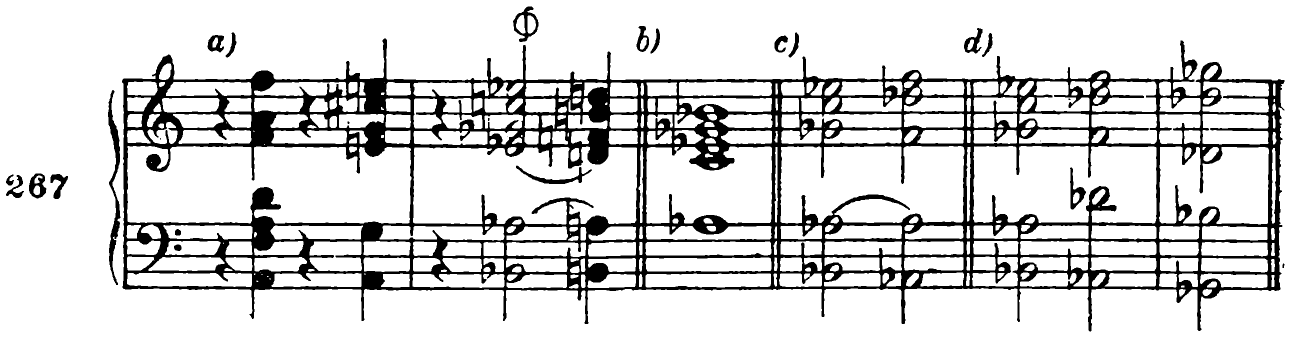
Annoyingly, I now see that it is precisely the inversion that theorists declare the most thoroughly excluded, because in it, the ninth being in the bass, the simplest resolution leads into a ⁴₆ chord, and between two voices there arises the so-called “böse Sieben” (“wicked seven”), the forbidden resolution of a seventh into the octave (267c). But the ⁴₆ chord could well have occurred in passing, or else (the old theory did not, after all, shrink from such cruelties elsewhere either) it could have been forbidden altogether; and the “wicked seven” could be avoided if (as in 267d) the tenor leaps to D-flat. Only now do I understand the agitation, incomprehensible to me at the time, of that concert society which rejected my sextet on account of this chord (that really was the reason given). Of course: there is no such thing as an inversion of a ninth chord; so there can be no performance of one either, for one surely cannot perform something that does not exist. And I had to wait a few years. However, when it was performed after all, no one any longer noticed that a ninth chord in the fourth inversion occurs there. Today, naturally, such a thing no longer disturbs anyone who deserves to be taken seriously. In Salome there are ninth chords of quite another kind. To name just one work that is not only performed but is also esteemed today by the very people who at the time could not get over my ninth chord.
So, as I said, the ninth chord and its inversions exist today, or at least can exist. The student will easily find examples of them in the literature. It is not necessary to set up special laws for its treatment. Whoever wants to be cautious will be able to apply the laws that come into consideration for seventh chords, that is: let the dissonances fall, root leaping a fourth upward.
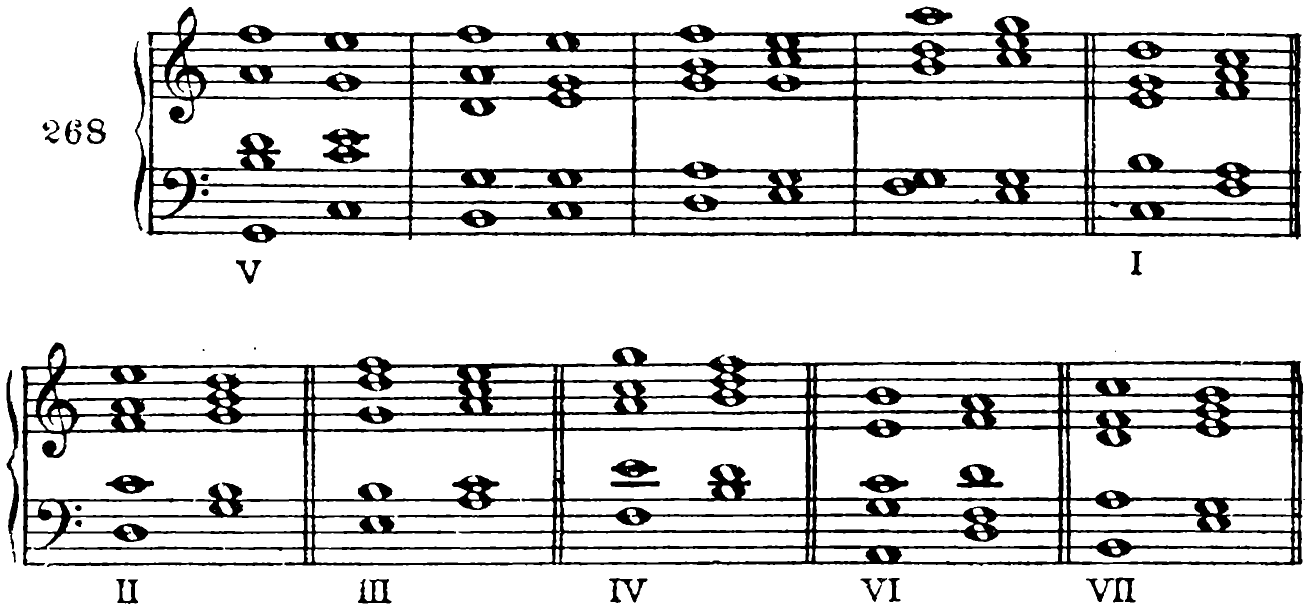
Watch out for fifths!
But the deceptive resolution, too, really ought to work just as well as with the seventh chord. For if the seventh can remain in place, the ninth will surely also be able to remain in place while the root rises.
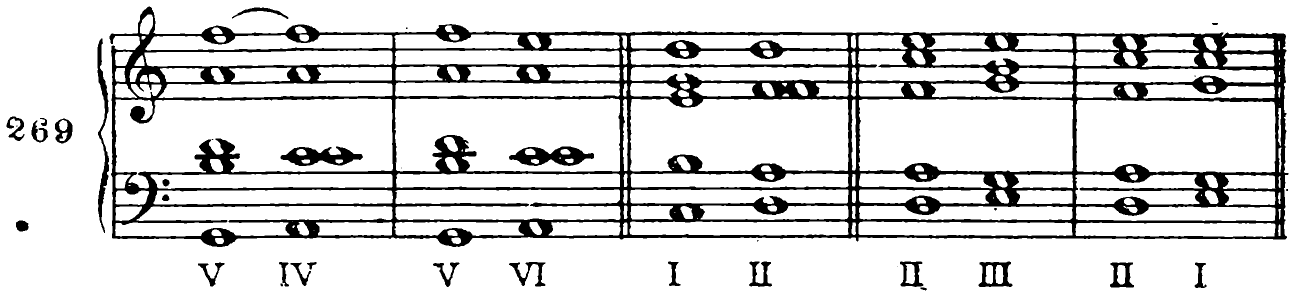
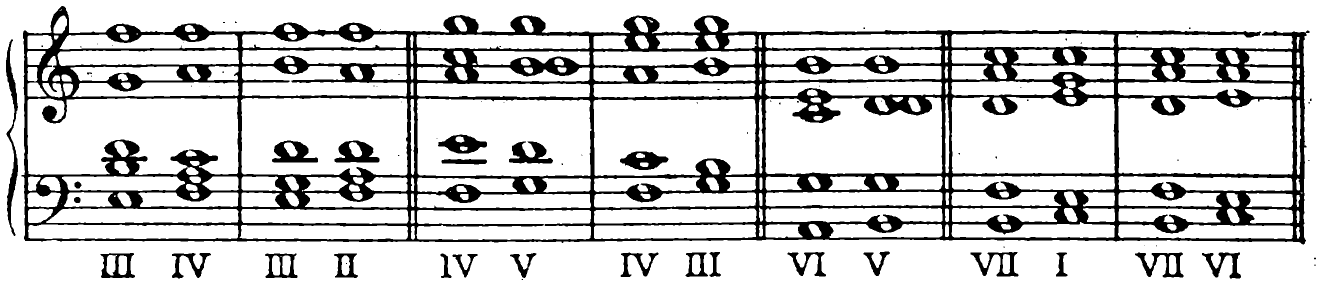
All of this does occur at least as an event of voice leading, and is therefore justified on that ground alone (for example, in passing), and
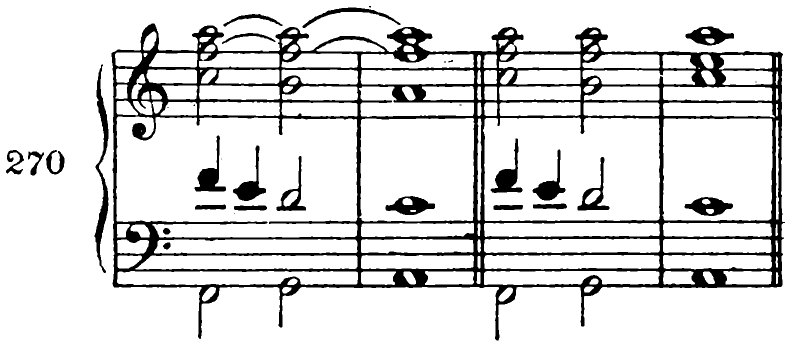
it is surely evident from my explanations that the system of dissonances fully meets its task if it accommodates the events that occur in voice leading. If one also wanted to try leaping away from the dissonance, one would get further still.
But to prove the existence of the ninth chord it would really be enough, apart from the fact that it occurs as a suspension, to mention the dominant seventh-ninth chords with major or minor ninth, which nobody disputes. Even if one will not accept the ninth chords built on the secondary triads, one must at least acknowledge that, in the sense of the secondary dominants, major and minor ninth chords can be formed on every degree, even if not all of them can be used at once and without further ado like chords native to the scale.

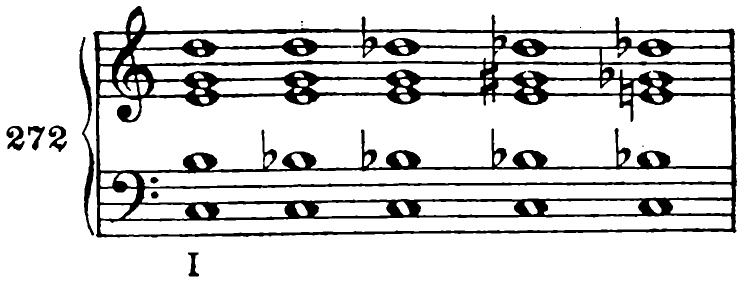
Insofar as they have minor ninths, they are no harder to relate to the key than the diminished seventh chords derived from them, and those with a major ninth certainly cause no more difficulty than the corresponding seventh chords. Naturally one could apply to them all the alterations customary with seventh chords, for example (272):
Their usability, however, is beyond doubt if one regards them as vagrant chords or connects them with vagrant chords, as for instance in the example from my sextet or as in 273a.
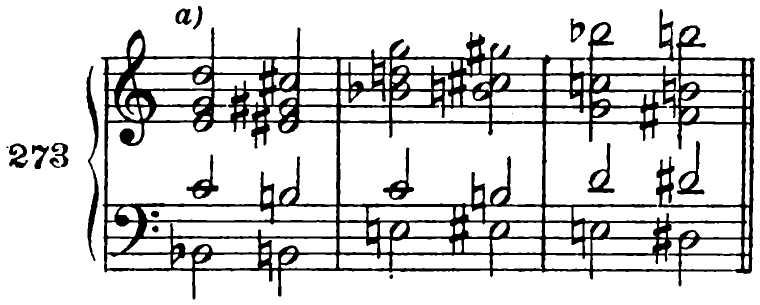
The resolutions in 273a are taken from the harmony textbook by A. Halm (Sammlung Göschen), an otherwise very fine little work. It contains a great many very pretty things; but he nevertheless calls these connections “acts of violence” and declines “to attach to them an undeserved value in principle,” for he gives them (273b) in root position, because the ninth chord (especially with authentic resolution, a fourth upward) is supposed to be incapable of inversion.
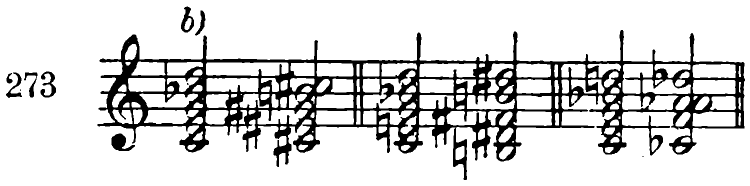
But then one could at least try to invert it with a different resolution; then no parallel fifths arise, if it is they that are violent. It is remarkable that so fine a mind does not hit on this when he had already come so close. The blinkers of the system! One rightly marvels at all that man is able to invent. But one could marvel at least as much at how much he has not invented, although he was close to it. A little more violence in thinking and a little less fear of acts of violence in aesthetics, and things would go better, far better! When using ninth chords, the student will do well at first to try, once again, what is as simple as possible. Then he can try out variants after the manner of the secondary dominants and in the spirit of the suggestions given here; later also the connection with vagrant chords. It goes without saying that here too he will do best always to let the strictest possible laws apply. The more that is admissible he finds along this path, the better. Freedom “one can manage on one’s own.”