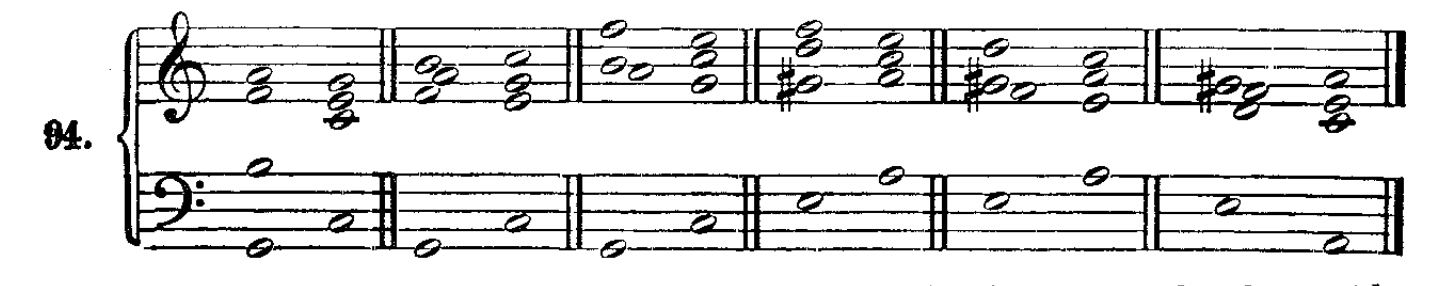
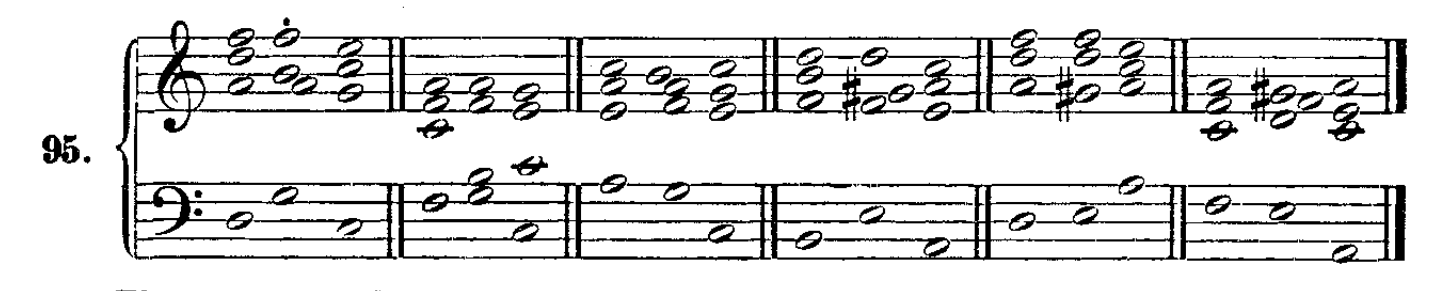
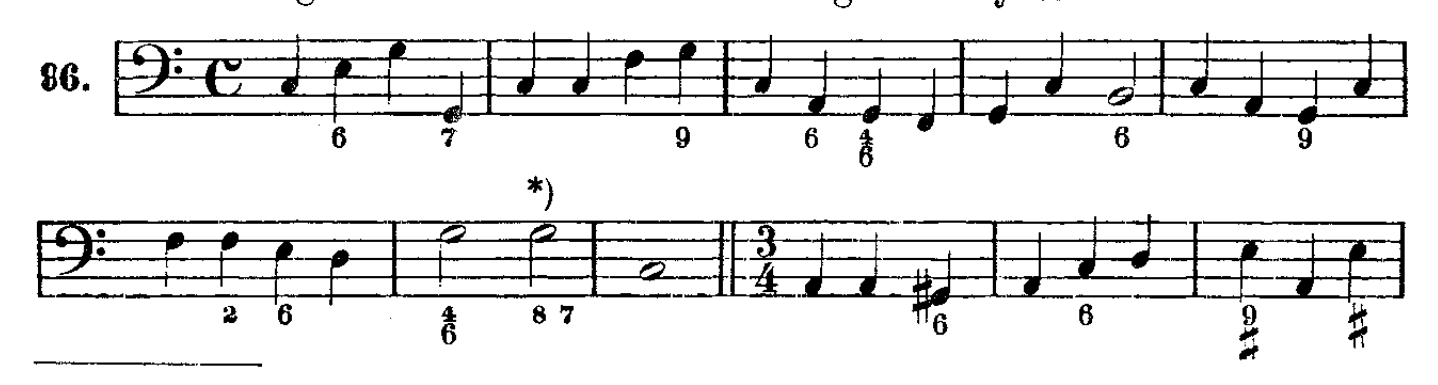
§ 34. In major, as well as in minor we find on the 5-th degree a five— voiced chord: this is called the chord of the ninth, because of the interval of a ninth formed by the lowest voice and the uppermost voice.
This doubly - dissonant chord contains, in major, a major ninth, and is therefore called the major chord of the ninth. In minor it contains a minor ninth—and is called the minor chord of the ninth. The chord of the ninth resolves into the tonic triad; the intervals already discussed in the Dominant chord, are led as before; the ninth, however, progresses one degree downward—like the seventh.
§ 35. The chord of the ninth, being a strongly dissonant chord, must be prepared; that is, the ninth must be part of the preceding chord, and must be kept in the same voice. The triads of the 2-nd, 4-th and 6-th degrees may serve as such preparing chords.
 Playable Books