Nikolai Rimsky-Korsakov · sección 46 de 100
Armonía a varias voces Lee y escucha esta sección en la edición reproducible →
Traducción automática de la lectura en inglés. Borrador; aún sin revisión por un hablante nativo.
Al escribir acordes de 5, 6, 7 y 8 voces, sean independientes o constituyan la base armónica, el estudiante debe seguir los principios del capítulo anterior sobre el movimiento de las maderas en octavas. Como las notas 5.ª, 6.ª, 7.ª y 8.ª son solo duplicaciones en octavas de notas inferiores de la armonía real (a 4 voces), deben elegirse instrumentos que se combinen entre sí para producir las mejores octavas. También pueden utilizarse el cruce y la inclusión de voces.
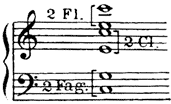
A. Maderas a dos (disposición cerrada):
Fig. 75 · Verlo en el lector En la armonía abierta deben evitarse los acordes a varias voces, pues supondrán simultáneamente escritura cerrada y abierta:
Fig. 76 · Verlo en el lector Nota. En la mayoría de los casos, esta distribución se emplea cuando las dos voces armónicas superiores tienen una función melódica especial; esta cuestión se ha tratado anteriormente.
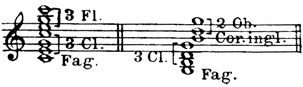
B. Maderas a tres:
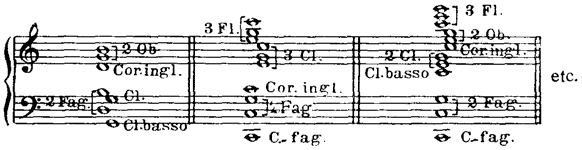
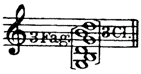
Fig. 77 · Verlo en el lector Fig. 78 · Verlo en el lector La superposición es el método más satisfactorio para la armonía cerrada a tres voces. El cruce es menos favorable, pues produce octavas contrarias al orden natural de registro:
| Aquí la disposición | | es incorrecta.
Fig. 79 · Verlo en el lector Fig. 80 · Verlo en el lector ← Armonía a cuatro y tres voces Todas las secciones Duplicación de timbres → Más Playable Books Forsyth, Orchestration A witty, thorough guide to every orchestral instrument, with the original pages. Fux, Gradus ad Parnassum Learn how independent voices work together, one species at a time. Goetschius, Exercises in Elementary Counterpoint Build independent melodies through graded exercises, with 471 recorded examples. Goetschius, Counterpoint Applied Study imitation, canon, and fugue with 393 recorded examples. Kitson, Counterpoint for Beginners Strict counterpoint in two and three parts, species by species, with every example playable. Prout, Analysis of J. S. Bach’s Forty-Eight Fugues Follow Prout through all 48 fugues of the Well-Tempered Clavier, every example playable. Rameau, Treatise on Harmony Explore the foundations of harmony, composition, and accompaniment. Rimsky-Korsakov, Practical Manual of Harmony The classic harmony course, newly translated from the 1910 French edition, with all 640 examples playable. Tchaikovsky, Guide to the Practical Study of Harmony Tchaikovsky’s Moscow Conservatory harmony course, with playable examples. Fenaroli, Partimenti Six books of partimenti, with playable basses, contrapuntal exercises, and bilingual rules. Reger, Supplement to the Theory of Modulation Explore Reger’s modulation method with 100 analyses and 102 playable examples. Cutter, Harmonic Analysis Learn to name every chord and non-harmonic tone in real music, from Bach to Wagner, with the passages playable. Schoenberg, Theory of Harmony Read all 22 chapters, with the original German beside a new English translation. Forsyth, Choral Orchestration A whole Te Deum orchestrated bar by bar, with Forsyth’s reasons, the full score and the vocal score playable. Berlioz, Treatise on Instrumentation Berlioz’s treatise on the orchestra, revised by Richard Strauss, with the original pages. McKay, Creative Orchestration Ranges, transpositions, texture and balance, taught through projects, with the supplied examples played by orchestral samples. Sanganeria, Arrival Build jazz lines that land, with 30 original playable examples. Bona, Complete Method for Rhythmical Articulation Practice rhythm through 120 graded studies, with playable notation and original scans. Hanon, The Virtuoso-Pianist Practise all 60 exercises with playable notation, original scans and supplied Mutopia playback. Mathews, Standard Graded Course of Studies, Grade I A first year of piano: 136 short pieces by many composers, every one playable, with Mathews’s teaching notes. ← Todos los Playable Books  Playable Books