Nikolai Rimsky-Korsakov · seção 52 de 100
1. Em uníssono (justaposição ou contraste de timbres) Leia e ouça esta seção na edição reproduzível →
Tradução automática da leitura em inglês. Rascunho; ainda sem revisão por um falante nativo.
Essa classe de combinação possui as mesmas características das combinações na linha melódica (cf. Cap. II). As madeiras reforçam os metais, suavizam-nos e reduzem suas qualidades características. São possíveis disposições como as seguintes:
2 Trompetes + 2 Fl.; 3 Trompetes + 3 Fl.; | 2 Trompetes + 2 Ob.; 3 Trompetes + 3 Ob.; | 2 Trompetes + 2 Cl. 3 Trompetes + 3 Cl.
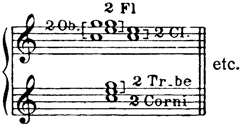
Também
Fig. 106 · Ver no leitor assim como:
2 Trompas + 2 Fag.; 3 Trompas + 3 Fag.; | 2 Trompas + 2 Cl.; 3 Trompas + 3 Cl.; e:
2 Trompas + 2 Fag. + 2 Cl. etc.
As combinações 3 Trombones + 3 Fag., ou 3 Trombones + 3 Cl. são muito raras.
Um acorde instrumentado para todos os metais, dobrado pelos mesmos acordes instrumentados para todas as madeiras (a dois), produz um som magnífico e uniforme.
Exemplos:
Snegourotchka 315—2 Trompas + 2 Cl. e 2 Trompas + 2 Ob. (cf. Ex. 236).
Nº 141. The Tsar's Bride 50—4 Trompas + 2 Cl., 2 Fag.
Nº 142."""142—Justaposição de todas as madeiras e metais.
Ivan the Terrible, Ato II 30—Justaposição e envolvimento (cf. Tabela de acordes II, Ex. 8).
Nº 143. The Christmas Night 165—4 Trompas + Fl., Cl., Fag.
* Nº 144. Sadko, antes de 79—Trompa, Trompete + madeiras dobradas.[15]
Nº 145."242—Todos os metais + Fl., Cl.
Legend of Kitesh, início—Trompa, Trombones + Cl., Fag. (cf. também 5—Ex. 249).
* Nº 146. Legend of Kitesh 10—Corne inglês, 2 Cl., Fag. legato + 4 Trompas non legato.
"""324—Todos os metais + madeiras.
* Nº 147. The Golden Cockerel 233—
Trompetes + Ob. Trompa + Cl. | ] | 8.
Os sons fechados ou com surdina em trompetes e trompas assemelham-se em timbre ao oboé e ao corne inglês; a combinação desses instrumentos produz um som magnífico.
Exemplos:
Nº 148. Russian Easter Fête, p. 11.—Trompa (+), Trompetes (registro grave) + Ob., Cl.
* The Christmas Night, antes de 154—Todos os metais com surdina + madeiras.
* Nº 149. Tsar Saltan 129—2 Ob., Corne inglês, + 3 Trompetes com surdina (3 Cl. embaixo).
* Nº 150.""131, 17º compasso.—Mesma combinação com adição de trompas.
* Nº 151. Antar 7—Ob., Corne inglês, 2 Fag. + 4 Trompas (+).
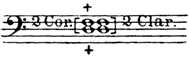
Um belo timbre escuro resulta da combinação de notas médias nas trompas com sons fechados e notas graves no clarinete:
Fig. 107 · Ver no leitor Se os fagotes substituem os clarinetes, o efeito perde parte de seu caráter.
Exemplos:
* Kashtcheï the Immortal 29, 11º compasso,—2 Ob., 2 Cl. + 4 Trompas (+).
"""107, 6º compasso.—2 Cl., Fag. + 3 Trompas (+).
* The Christmas Night, p. 249—Cl., Fag. + 3 Trompas (+).
* Mlada, Ato III 19—3 Trompas (+) + 3 Fag. e 3 Trompas (+) + 3 Ob. (cf. Ex. 259).
← Duplicação nos metais Todas as seções 2. Superposição, cruzamento e envolvimento das partes → Mais Playable Books Forsyth, Orchestration A witty, thorough guide to every orchestral instrument, with the original pages. Fux, Gradus ad Parnassum Learn how independent voices work together, one species at a time. Goetschius, Exercises in Elementary Counterpoint Build independent melodies through graded exercises, with 471 recorded examples. Goetschius, Counterpoint Applied Study imitation, canon, and fugue with 393 recorded examples. Kitson, Counterpoint for Beginners Strict counterpoint in two and three parts, species by species, with every example playable. Prout, Analysis of J. S. Bach’s Forty-Eight Fugues Follow Prout through all 48 fugues of the Well-Tempered Clavier, every example playable. Rameau, Treatise on Harmony Explore the foundations of harmony, composition, and accompaniment. Rimsky-Korsakov, Practical Manual of Harmony The classic harmony course, newly translated from the 1910 French edition, with all 640 examples playable. Tchaikovsky, Guide to the Practical Study of Harmony Tchaikovsky’s Moscow Conservatory harmony course, with playable examples. Fenaroli, Partimenti Six books of partimenti, with playable basses, contrapuntal exercises, and bilingual rules. Reger, Supplement to the Theory of Modulation Explore Reger’s modulation method with 100 analyses and 102 playable examples. Cutter, Harmonic Analysis Learn to name every chord and non-harmonic tone in real music, from Bach to Wagner, with the passages playable. Schoenberg, Theory of Harmony Read all 22 chapters, with the original German beside a new English translation. Forsyth, Choral Orchestration A whole Te Deum orchestrated bar by bar, with Forsyth’s reasons, the full score and the vocal score playable. Berlioz, Treatise on Instrumentation Berlioz’s treatise on the orchestra, revised by Richard Strauss, with the original pages. McKay, Creative Orchestration Ranges, transpositions, texture and balance, taught through projects, with the supplied examples played by orchestral samples. Sanganeria, Arrival Build jazz lines that land, with 30 original playable examples. Bona, Complete Method for Rhythmical Articulation Practice rhythm through 120 graded studies, with playable notation and original scans. Hanon, The Virtuoso-Pianist Practise all 60 exercises with playable notation, original scans and supplied Mutopia playback. Mathews, Standard Graded Course of Studies, Grade I A first year of piano: 136 short pieces by many composers, every one playable, with Mathews’s teaching notes. Goetschius, Lessons in Music Form Hear how figures become phrases, periods, rondos and sonata forms, with the printed examples beside their playable notation. ← Todos os Playable Books  Playable Books