Playable Books
Nikolai Rimsky-Korsakov · section 10 of 100
Kettle-drums
Read and hear this section in the playable edition →

Kettle-drums, indispensable to every theatre and concert orchestra occupy the most important place in the group of percussion instruments. A pair of kettle-drums (Timpani), in the tonic and dominant keys, was the necessary attribute of an orchestra up to, and including Beethoven's time, but, from the middle of the 19th century onward, in western Europe and in Russia, an ever-increasing need was felt for the presence of three or even four kettle-drums, during the whole course or part of a work. If the expensive chromatic drum, permitting instant tuning is rarely met with, still, in the majority of good orchestras, three screw drums are generally to be found. The composer can therefore take it for granted that a good timpanist, having three kettle-drums at his command, will be able to tune at least one of them during a pause of some length.
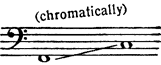
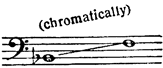
The limits of possible change in Beethoven's time was considered to be:
Big kettle-drum: | F2-C3 (chromatically) | Small kettle-drum: | B♭2-F3 (chromatically)
In these days it is difficult to define the precise extent of high compass in the kettle-drums, as this depends entirely on the size and quality of the smallest one, of which there are many kinds, but I advise the composer to select:
E2-G♯3 (chromatically)
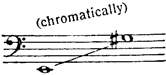
Note. A magnificent kettle-drum of very small size was made for my opera-ballet Mlada; this instrument gave the D♭ of the fourth octave.
Kettle-drums are capable of every dynamic shade of tone, from thundering fortissimo to a barely perceptible pianissimo. In tremolando they can execute the most gradual crescendo, diminuendo, the sfp and morendo.
To deaden the sound, a piece of cloth is generally placed on the skin of the drum, according to the instruction: timpani coperti (muffled drums).
Table D. Pizzicato. Table D [Enlarge] The black notes are dry and hard, without resonance, and should only be used when doubled with the wood-wind. * Table E. Glockenspiel, celesta, xylophone. Table E [Enlarge]