 Playable Books
Arnold Schoenberg · section 10 of 66
Writing Short Chord Progressions
Read and hear this section in the playable edition →The pupil’s next task is to form short passages from the six chords at his disposal. These should have some variety, as far as the available means already permit, and be as interesting as possible. They should also achieve, though still in embryonic form, an effect that we shall later pursue more vigorously with more adequate means: namely, to express the key to a certain extent. To compose passages that meet these requirements, we shall have to fulfil certain conditions (remember: once again these are not laws for all eternity—although even such laws are relatively harmless, since a few exceptions dispose of both law and eternity in an instant—but instructions that hold only as long as their purpose seems worth pursuing, and that are set aside as soon as higher purposes arise). The passages will of course have to be very short, since only six chords are available, and even their eligibility for connection remains subject to conditions (the harmonic link). Unless their surroundings give them a differently coloured meaning, or they serve some other purpose, repetitions can easily become boring, unnecessarily boring; or, since repetition usually reinforces, they can give the repeated chord overwhelming importance among the other chords. On the whole, then, repetition must be avoided unless we intend to confer such overwhelming importance on a chord. For the present we can have this intention with only one chord: degree I, which declares the key. Repetition gives this chord a prominent role in the short passage and thereby expresses the key, although for now not very compellingly. The most suitable arrangement for this repetition is to place the chord only at the beginning and the end. For the first and last impressions make the deepest mark; and some variety is also achieved by delaying the chord’s repetition as long as possible, so that something different, something contrasting, has intervened. The first condition we impose will therefore be: the short passage begins and ends with the triad on degree I. Because of the harmonic link, this means that the final chord must be preceded by one that, according to our table, permits connection with degree I: thus degree III, IV, V, or VI. To protect the examples from errors that would be unavoidable if they were too long, we shall initially be content to connect four to six chords. The first and last of these are degree I; between them, therefore, there can be at most two to four other degrees—and, since repetition is to be avoided, fewer rather than more.
Following the table, the pupil can now set his own exercise by beginning with degree I and then following it with one of the degrees that share a harmonic link with it—for instance, III first. He then selects from the table a degree that can follow III. The possibilities are I, V, and VI. But since I has already appeared, repeating it once would already close the example; the choice must therefore be between V and VI. To proceed systematically, we use V for the first example, giving us I, III, and V so far. As the table shows, V can be followed by I, II, or III; since I and III have already appeared, II ought now to follow. But that would extend the example to at least six chords. To keep the first examples as short as possible, we take I as the conclusion. The example is therefore I–III–V–I. This connection is now realized exactly in the manner already indicated for connecting chords, by answering the three questions (see Example 11a below).
In planning other short passages, the pupil will do best to proceed systematically, beginning again with I, III and continuing differently after III. For example, I, III, VI; after VI he can follow immediately with I in one case, and with IV and then I in another. When he has worked through everything beginning with I, III, he should begin with I, IV, then I, V, and finally I, VI, continuing differently each time.
A few more things must be said here about voice leading. It should be melodic. But this should not be understood to mean that it must be expressive or beautiful in the manner of a song, for example, or have varied contours, rich ornamentation, or even articulated structure. We cannot aim at that, because for now all the prerequisites are lacking. After all, we are working without rhythm, and thus without a motive; articulation and ornamentation are hardly conceivable without rhythm. What “melodic” means here for the present might best be put this way: the voice should not be unmelodic; that is, it should avoid motions and sequences of motions that attract unpleasant attention. It is difficult to find a standard for this, for much that used to be unmelodic is now felt to be melodic. Bellermann, for example, considers it necessary to mention specifically that Handel used the leap of a minor seventh in a melody. Certainly, composers of the fifteenth or sixteenth century would not yet have done this; but the sixteenth century no longer sets the standard for the seventeenth. The same holds for most other precepts that one might wish to impose on our time on the basis of Handel’s melodic practice. They would scarcely agree completely even with the melodic lines of Haydn, Mozart, and Beethoven, let alone those of Schumann, Brahms, or Wagner. But one should remember that, as already mentioned, melody does not fully enter into the working of purely harmonic exercises because the motive is absent; with it disappears not only the need for richer ornamentation, but also the occasion and the temptation. Our task can only ever be to make the motions necessary to connect the chords: on the whole, then, as little movement as possible. For the less the voices move, the fewer errors in their movement—in voice leading. Yet the conduct of the exposed voices, the two so-called outer voices, soprano and bass, does draw some attention to itself, and a certain monotony could impair the impression of the harmonic effect; later we shall therefore need to mention some remedies. For now only the bass concerns us, since it alone frequently makes larger leaps, whereas the other voices move almost exclusively by seconds. It is therefore sufficient for the present to mention errors that can occur in the bass. Some of these are, of course, progressions that nobody today would find objectionable. Nevertheless, the older teaching of harmony was right to a certain extent in demanding their avoidance. Its justification may seem invalid to us today; yet these short passages solve the simplest musical problems, problems whose musical effect is so primitive that an ear accustomed to Wagnerian harmonic freedom would almost be justified in facing it uncritically. It is therefore advisable to rely on the ear of that earlier time rather than on the ear of today: its sense of beauty undoubtedly drew from the material those fulfilments that accord with the overall effect of such simple structures. If these short passages, like everything intended to develop a sense of art and form, are already to have style—that is, to show a certain balanced relationship between the effect and the means employed—it will be appropriate to heed the instructions of the older teaching of harmony. We may confidently discard them as soon as our means become richer and our possibilities for drawing effects from the material therefore become greater. We take these instructions, too, not as a rule—that is, as something that can be set aside only by an exception—but simply as instructions. And we understand clearly that we heed them only because we can achieve a stylistically proper effect only when we use the means in a manner suited to their simple purposes.
One of these instructions reads: two melodic leaps in the same direction, of the size of a fourth or a fifth, should be avoided because the outermost notes form a dissonance. Or, stated somewhat more generally: two interval leaps in the same direction that add up to a dissonance have an unmelodic effect.
For example:
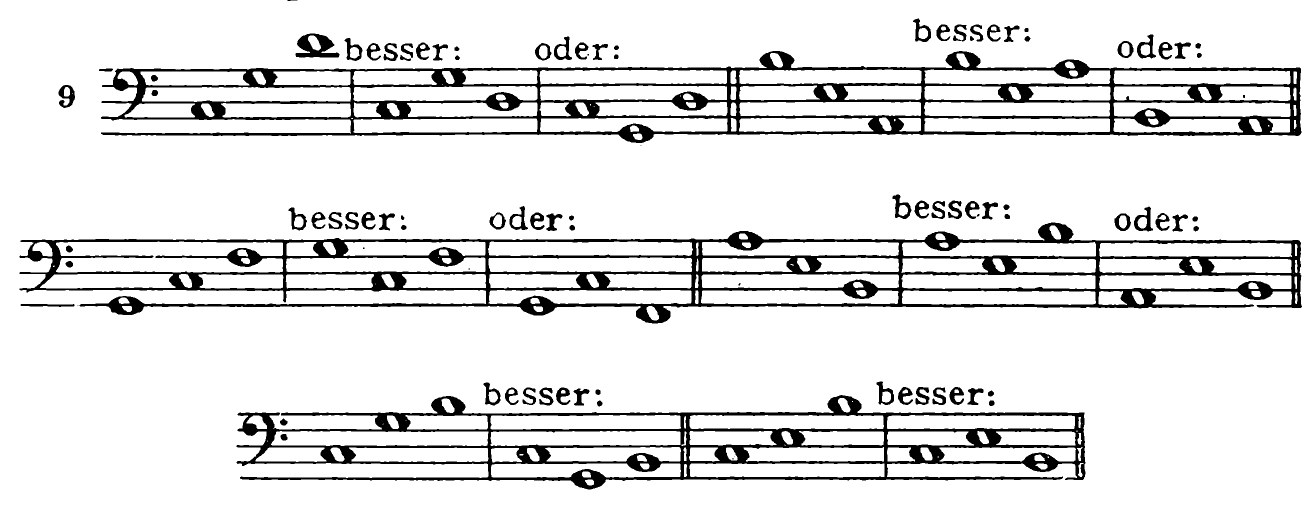
That was certainly correct from the standpoint of the older teaching of harmony. Its instructions concerned chiefly vocal music, which was often sung unaccompanied, a capella. The performers, professional singers or amateurs, generally sang their parts at sight without much rehearsal. Sight-singing was the basic condition to which everything else adapted. Writing well for voices therefore meant, above all, avoiding difficulties as far as possible. And since singers, unlike instrumentalists, have no ready-made notes, or at least tangible points of reference for them, certain intervals still present difficulties of intonation today. Although the range of what singers can perform continues to expand, development here is slower than with instruments. We can nevertheless understand that the ear resists dissonances (more remote overtones) not only when they sound together, in a chord, but also when they occur successively, in the melodic line; that it does not grasp them as quickly, experiences them as an impediment, and wishes for their removal, their resolution. It may at most admit them for the sake of their resolution, for the sense of well-being this effect produces. For the listener, the dissonance, its need for resolution, and the resolution may be a pleasure; for the singer, however, the impediment can become a difficulty.
The other of the two melodic instructions reads: no voice should make an interval leap larger than a fifth (the octave leap, which has almost the effect of repeating the same note, was of course allowed). Why one should not use a leap of a seventh is clear from what was said above about dissonant motions. It is less clear why one should not use a leap of a sixth. Bellermann reports that earlier musicians regarded the effect of this leap as effeminate. That may well be so, but it must have a cause. I believe I can find one in two circumstances that produce not effeminacy but rather its opposite, harshness, yet nevertheless explain the avoidance. Whether it is right or wrong to call a rarely used, unfamiliar motion effeminate is of less importance here. One cause may well be sought in the various difficulties of voice leading that stand in the way of introducing a leap of a sixth: there must be room for it, and certain forbidden parallels often arise (these will be discussed later).
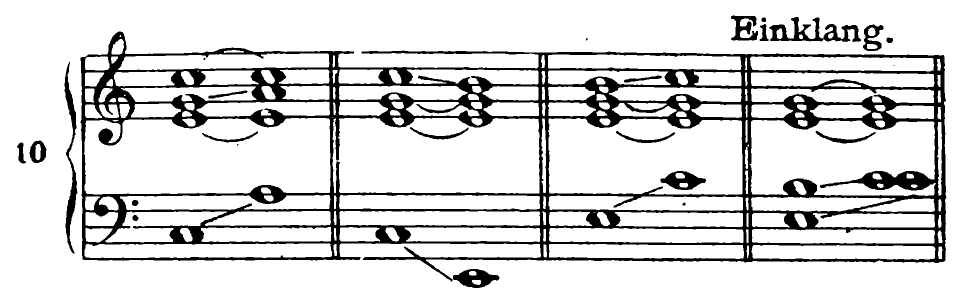
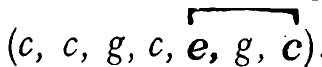
A second cause may be that the sixth is less familiar to the ear: although this interval occurs in the overtone series as a relationship to the fundamental (E–C), it does so in the opposite direction—the fundamental lies above the third (C, C, G, C, E, G, C). It therefore does sound less familiar and ought rather to be called harsh. These two causes may have led to the leap of a sixth being used rarely or not at all, making it seem foreign and unfamiliar to the ear; only a mistaken interpretation, presumably, led to its being called effeminate.
Example 11 now gives realizations of several passages of the kind we have assembled according to the table.
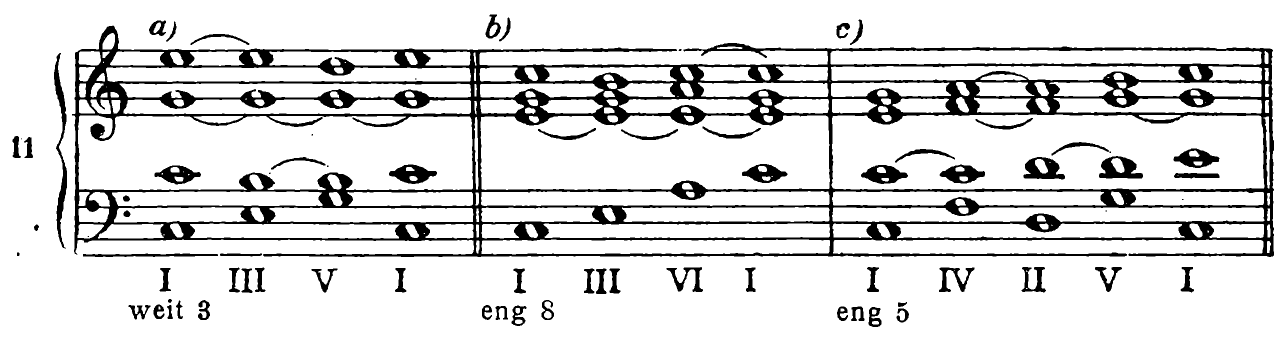
The pupil can also realize these same examples using a different spacing (close instead of open, open instead of close), or beginning in fifth or octave position instead of third position. It is absolutely necessary to practise every new exercise in other keys as well; but this should be done from an independent plan, not simply by transposition.