 Playable Books
Arnold Schoenberg · section 12 of 66
Inversions of triads
Read and hear this section in the playable edition →In the exercises we have solved so far, it was immaterial how the chord members were distributed among the upper three voices; only one condition was imposed: the bass must always take the root. Various circumstances, however, require—and permit—chord tones other than the root to occur in the bass. They require it and they permit it: a necessity and an advantage. This curious result will emerge in almost every consideration of artistic craftsmanship. It is unlikely that one would obey a necessity if it brought no advantage beyond that arising solely from its initial conditions; equally unlikely that an advantage would arise without being linked to the fulfilment of certain necessities. It looks mysterious, and surely is: that one does something because necessity compels it and unintentionally produces beauty; or that one feels one is doing something beautiful and in doing so fulfils necessity. This is one of those mysteries that make life worth living. This reward, which surprises the person searching with all his strength on a plane higher than that of his efforts, always comes of itself in true art and true morality. But the intelligent craftsman, the intelligent artistic craftsman, will include it in his considerations from the outset. He would consider it impractical to let a momentary advantage prompt a fundamental change. Even a small change in the foundations of an organism has far-reaching consequences. Though not immediately visible, they will inevitably appear later. He would therefore allow such a change only if he could anticipate at least a certain number of its probable consequences and estimate and weigh their value or lack of value. This much is certain: if such a change does not accord with the nature of the organism, most of its consequences will be harmful, and the apparent necessity that prompted the change will prove traceable to an incorrect judgment. But if the change truly accords with the organism’s nature, with its drive to develop, then such an objectively sound measure will yield not only the advantages expected, but others not sought. Conversely, if one began with the wish to obtain new achievements from an organism that are grounded in its nature, it would always become apparent that one had thereby followed a necessity of that organism and had helpfully accommodated its drive to develop.
Applied to our case, the result is this: every setting of a chord with the root in the bass imitates most perfectly the sonic relationship of a tone to its overtones. If another note is placed lowest, we have departed from the natural model. Is that good? It is both good and not good: better in one case, less good in another; stronger in one case, less strong in another. Undoubtedly, giving a sonority a bass note other than its root produces at least a different effect, if not a weaker one. Let us assume the least favourable case, that the effect is weaker: then the exact imitation of the natural tone, with the root in the bass, is the stronger. This makes it possible to present a chord with a stronger effect on one occasion and a weaker effect on another, or with greater or lesser significance. But that can become an artistic advantage! For if, during a longer passage—say, one ten chords long—we are obliged to repeat a chord, having only seven chords available, that chord would, as I have already suggested, gain preponderance over the others. If that is intended, all is well; but if it is not intended and repetition is nevertheless necessary, we must consider how to weaken the effect of the repetition sufficiently to prevent the repeated chord’s significance from becoming too prominent. If, for this purpose, a triad in its strongest form is followed by one of its weaker forms, this weaker form will not readily impair the effect of the preceding one, and will still leave enough potential effect for a later, second repetition in the stronger form. Perhaps this also explains why recitatives so frequently employ the sixth chord, the less perfect form of a triad: to express the transient, that which does not decide the future key of the principal piece. But the sixth chord’s effect is not merely weaker; it is also different. Naturally, this circumstance offers nothing but advantages—above all variety and shading.
Thus, although placing a note other than the root in the bass proves advantageous, we are hardly in a position to forgo these advantages voluntarily. For they are not merely necessities of every harmonic passage; it is not merely necessary to differentiate the effects of chords, shade their relative weight, and provide variety. This also meets the bass’s needs in two respects. On the one hand, using a sixth chord often provides the first means of giving the bass a more melodic, or even a more melodically varied, course; on the other, the conditions imposed by the voice’s range will often lead us to choose it.
Thus, if one began with the intention of leading the bass more melodically and used a sixth chord for that purpose, this would also have the unexpected advantage that the sixth chord does not overpower an earlier or later repetition of the same triad, perhaps makes these repetitions possible at all, and also brings variety among the surrounding root-position triads. Conversely, if one began with the intention of introducing a sixth chord for variety, this could have the advantage of making the bass more melodic and perhaps allowing it to remain in a comfortable register or leave an uncomfortable one. Or if one chose a sixth chord because the bass would otherwise enter an uncomfortable register, the other advantages already mentioned, though not sought, could result. Of course, further advantages arise besides those discussed here. Moreover, as will be seen repeatedly later, the use of triad inversions is sometimes almost necessary for achieving certain harmonic connections and certain harmonic effects.
The historical origin of inversions will of course not be attributable to such reflections. Probably not to reflection at all, even though these thoughts are persuasive: that the same notes, differently arranged, must also yield usable sounds; and that the overtone series, if a suitable number of its lowest tones are omitted, also provides a model for such arrangements. Probably their origin was not even harmonic at all. Rather—and this is the only convincing way to imagine it—their origin must be sought in independent voice leading, as three or more voices, following their natural course, met in these and similar sonorities, which the ear could approve because they recalled the natural model and were therefore comprehensible.
The name “inversion of a triad” derives from inverting the lowest note in the triad’s schematic representation. To invert means to place a low note of a chord or interval an octave higher, or a high note an octave lower, while the other chord tones remain in place. Thus C (14a) is placed an octave higher, above G. In this schematic arrangement the third thereby becomes the lowest note, producing first inversion. This ought properly to be called a third-sixth chord, but since it is the first in the series of sixth chords, it is called simply a sixth chord. If the lowest note of this sixth chord is in turn inverted upward, the fifth becomes the lowest note, producing second inversion (14b), the fourth-sixth, or six-four, chord. In other words, when a triad’s third is the bass note, the triad is in sixth-chord position; when its fifth is the bass note, it is in six-four-chord position.
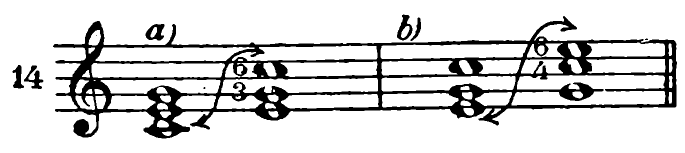
For harmonic evaluation—that is, for judging the chord succession—it is immaterial whether a triad is used in root position or inversion. The use of inversions can, however, encourage rhythmic and melodic nuances. For if root position, as the most perfect imitation of the tone, represents the strongest form of the triad, the two less similar imitations, the inversions, are weaker forms. It follows naturally that the three forms of the triad can produce different kinds of accentuation. Making use of this property is an obvious demand of economy in artistic craftsmanship. The melodic possibilities that inversions offer besides the rhythmic one have already been suggested.