 Playable Books
Arnold Schoenberg · section 13 of 66
a) THE SIXTH CHORD
Read and hear this section in the playable edition →Only one restriction has been imposed on the use of the sixth chord: it is not used as the concluding chord, and only rarely as the opening chord. Earlier musicians’ need to express the key as unambiguously as possible led them to avoid anything problematic or questionable, especially at the beginning and end. Beginning and ending were to be definite, clear, unambiguous; for this purpose an inversion, being a weaker form of the triad, is less suitable than the triad itself. The case, rare in the older literature, of a beginning deliberately blurred in its tonality—Beethoven’s First Symphony, which begins with a seventh chord on degree I leading to the subdominant—has found a counterpart only in our time in the venture of making the ending less definite as well. Although, as stated, using an inversion does not affect harmonic significance, we shall always take the opening and concluding chords of our exercises in root position. The reason is simply this: because harmonic significance is not affected. Specifically, the harmonic significance that prompted the use of degree I as the opening and concluding chord: expressing the key. Beginning and ending otherwise than in root position may produce melodic, rhythmic, atmospheric, or expressive values, but no values of harmonic construction; and only these could induce us to set differently the opening and concluding chords for which root position was chosen on harmonic grounds.
Otherwise, except in formulaic turns to be discussed later—cadences and the like—the sixth chord is freely permitted wherever the same degree is possible in root position. In fact the sixth chord presents scarcely a problem; only the fact that restrictions were imposed on the other inversion, the six-four chord, invites a more detailed discussion. Since these restrictions, as we shall see, are also harmonic in nature—that is, they influence harmonic successions—we must investigate why such restrictions do not apply to the sixth chord, which in essence, by its origin, is no different from the six-four chord.
Older theory asserts that the bass is the foundation of harmony. But this is entirely true only of the period of music in which the respective roots of the harmonies employed were placed in the bass. The foundation of harmony can of course be formed only by the roots of the chords. For in them alone are expressed the impulse of the sonority and its capacity to form successions. They alone reveal the character and direction of those successions. They alone, then, ground harmonic events. But as soon as the bass develops more independently and becomes what I should like to call the second principal voice, the second melody, it must also use notes other than the roots. The bass is then no longer the foundation of harmony, but at most the foundation of harmonic examination, and that is a great difference. If the bass note is E, for example, and above it lies the sixth chord—C and G—then the E in the bass is entirely irrelevant to the character of the connection this chord will make with the next. It is C, the root, by which the strength and significance of the harmonic progression are measured. Thus examination of harmonic events, even when its notation relies on the bass part, depends on comparing the roots. Nevertheless, assigning special importance to the bass accords with a correct feeling. As stated, its importance does not lie in its being the foundation of harmony, for its line, compared with the line of roots, is merely a kind of lowest inner voice; it lies only in its having been made the basis for examining harmony. The justification for this may be explained as follows. First, it once really was the foundation of harmony, namely as long as it contained the roots. The ear thus became accustomed to directing its attention to it. Added to this is its special prominence as the second outer voice, as the boundary of the body of sound. And another important factor: the analogy with the phenomenon of the tone, of which the chord is an imitation. In the tone too, itself a composite, the lowest tone is recognized as that which generates the whole complex and gives the total phenomenon its name. But the most important reason for the bass’s special position is this: the lowest tone of the body of sound, the bass note, has clearer, more intensely effective overtones than any higher voice, since it lies farthest from the limit of audibility. The effect of these overtones is admittedly smaller than that of the voices forming the harmony, which are actually sung and even generate overtones themselves. Yet the ear, which apprehends the tone in its totality, also unconsciously perceives the effect of the overtones. If the chord formed by the actual voices agrees with the overtones of the bass note, an effect similar to that of any single tone arises: the total phenomenon is named after the lowest tone, the bass note, and recognized as fulfilling the bass note’s needs. Here, then, the bass note is predominant and conspicuous through the reinforcement supplied by the higher voices. But if the setting does not agree with the overtones of the bass, collisions occur between the elements lying above it. These collisions may be felt as an obstruction in which the bass, having the most audible overtones, is the participant with the strongest will. Thus the bass voice is particularly conspicuous here as well.
Harmonic examination is therefore justified in choosing the bass as its basis, since the bass contributes prominently to the formation of such states of sonority. If we now compare the sixth chord and the six-four chord with the triad, the decisive question in this comparison—since the notes are the same—is the placement of the bass. Any possible difference can depend on this alone. We find that the setting contradicts the overtones of the bass notes, E and G. Consequently neither the sixth chord nor the six-four chord is consonant to the same degree as a root-position triad. Musical practice acknowledges this in the sixth chord by treating it as less suitable for establishing the key. But there must be another difference between these two chords, for the six-four chord is even regarded as a relative dissonance. Since the chord members are identical, the difference cannot be sought in them, but again only in the overtones. If we also consider the overtones of the notes in the setting and compare them, we find the following. The bass note of the six-four chord finds earlier, and therefore stronger, support in the overtones of the other chord members than does the bass note of the sixth chord. The second overtone of C is already G, supporting the fundamental; likewise the second overtone of E is B, supporting the third. In the sixth chord, by contrast, only the fourth overtone of G, B, supports the fifth of E; and likewise the octave of E appears only as the fourth overtone of C.
![Sixth chord: E E B E G♯ B / G G D G [B] D / C C G C [E]. Six-four chord: G G D G B D / C C [G] C E G / E E [B] E G♯.](/schoenberg-harmony/images/sh-012-overtones.png)
In the six-four chord, then, the arrangement of the chord tones resembles the overtones of the bass note more closely than in the sixth chord. The inherent sound of the six-four chord’s bass note finds less resistance to its will in the chord tones; or, as one might also view it, its chord tones are more inclined to acknowledge the bass note’s predominance and follow it. If we assume that the bass note strives to produce in the setting a sonority as similar as possible to its own—that its will is to assert its overtones—then the bass of the six-four chord has more chance of doing so than the bass of the sixth chord. Thus both the six-four chord and the sixth chord contain problems. Both are actually dissonances. But the problem of the six-four chord has a greater prospect of fulfilment and is therefore more intense, more conspicuous. The problem of the sixth chord is also present, to be sure, but is farther from fulfilment. The movement within it is not great enough to emerge outwardly. It may be neglected. Yet it has not been wholly overlooked, for it has been felt that the sixth chord is less suitable for establishing the key than root position. The problems shown here are admittedly very small; they take place, as it were, in the last decimal places. Yet evidently they were perceived, or no distinction would ever have been made between the two inversions of a triad. Since the ear has proved so sensitive to this problem, which takes place in the overtones of the chord tones, we may hope that it will not fail in music’s further development either—even if music should take a path that aestheticians can already confidently predict will lead to the end of art*).
*) I read this brief derivation, which, as will be seen, plays no prominent role in my book, to a young music historian. Once again I had to discover how impossible it is to anticipate every objection that may be raised—and how useful it would be to an author to learn of them in time. For it is usually much easier still to refute them than to raise them. And raising objections is certainly easy enough! Nevertheless, I was initially speechless when the following was put to me: if the six-four chord is a greater dissonance than the sixth chord because its chord tones support the overtone sound of its bass note, this would mean in general that a chord is all the more dissonant, the greater the chance, through this support, of its bass becoming the root. Conversely, the smaller this chance, the smaller the dissonance. But then a dominant seventh chord, whose bass note can never become the root, would have to be a lesser dissonance than the six-four chord.
I soon recovered and refuted this, but offered only one reason, and not the strongest, rather than all of them. Let them all be stated here. 1. I did not assert that the dissonance becomes greater or smaller; I showed why these two chords do not coincide completely with a consonance. This needed to be shown, since it is indeed puzzling that three tones can be a pure consonance in one position and a relative dissonance in another—a case with no other counterpart in harmony. 2. I showed the difference between these two chords, which is not that one is a greater dissonance than the other, but that the problem of one is closer to fulfilment than the same problem in the other. Perhaps people knew better what to do with the clearer problem merely because it was clearer, than with the less clear one whose will they did not understand. 3. The dominant seventh chord does not need support for its striving toward fulfilment as a root, because it is already a root in actuality; indeed, the root of the actually sounding voices. 4. The dominant seventh chord—and this is the reason I gave—is dissonant through the notes actually sung, and therefore does not first need to be explained as a dissonance through the overtones. It is thus already a greater dissonance than the six-four chord because the notes actually sung, the absolutely audible notes, are dissonant, whereas in the sixth and six-four chords only the barely audible tones, the overtones, are dissonant.
I include this incident only because it seems characteristic of the way objections are raised.
The sixth chord therefore has, as stated, no harmonic significance, but does have melodic significance: it can bring variety to the conduct of the bass and thus also of the other voices. Its use is unrestricted except for one small, relative limitation, grounded in the following consideration. We established earlier that the third is only the third choice for doubling: because it appears last in the overtone series, and because, as the note deciding between major and minor, it sounds relatively conspicuous, so that doubling it would emphasize still more something already conspicuous. It will therefore be clear that, in general, if we want an even sonority in a sixth chord, with nothing inessential standing out, doubling the third will be superfluous—that is, not very favourable—since the third, already particularly conspicuous in the bass, would otherwise stand out still more. Of course this applies only as long as it is not necessary, as will soon prove to be the case, to have the third in one of the upper voices as well. What is necessary, one does; what is superfluous should be avoided.
Example 15 presents the sixth chord on degree I in various positions: at a with the octave doubled, at b with the fifth doubled. The pupil should first practise these, and then settings of the other degrees in the same manner.
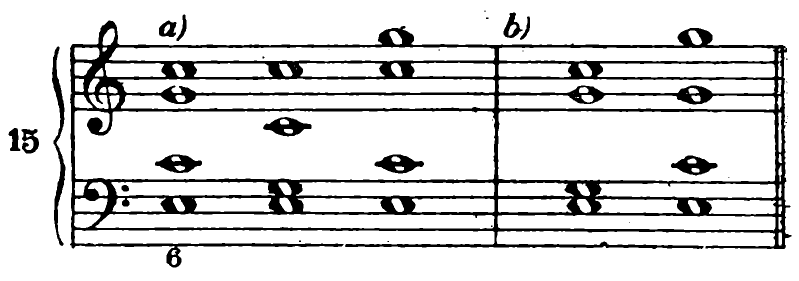
Here we also use doubling of the fifth for the first time. This makes it necessary to insert a discussion arising from the use of doubled fifths when connecting sixth chords.