 Playable Books
Arnold Schoenberg · section 14 of 66
Parallel octaves and fifths
Read and hear this section in the playable edition →


When chords are connected, three kinds of relationship arise between two moving voices:
1. While one voice moves, the other remains in place (oblique motion), 16a;
2. while one voice moves downward, the other moves upward (contrary motion), 16b;
3. both voices move in the same direction, both descending together or ascending together (parallel motion), 16c.
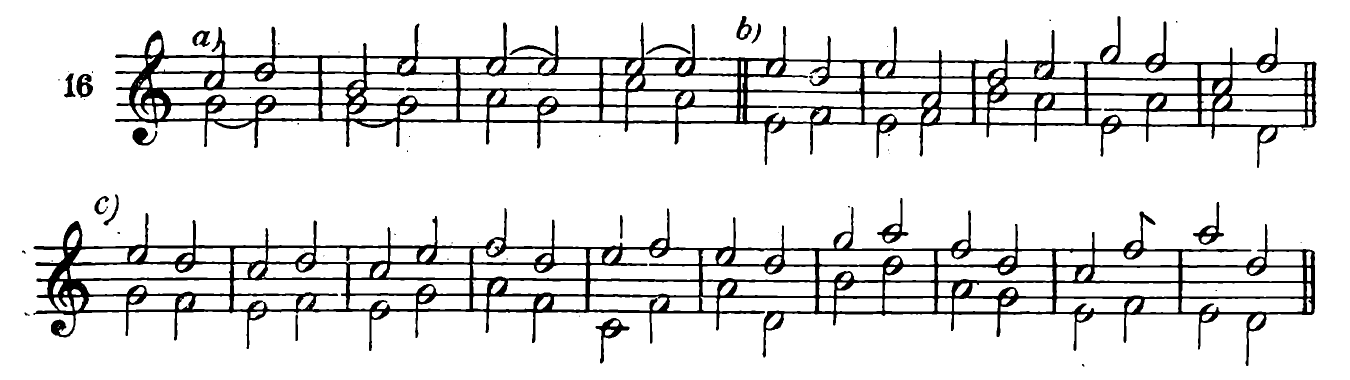
In almost every connection of chords set in four voices, two—and often all three—types occur.
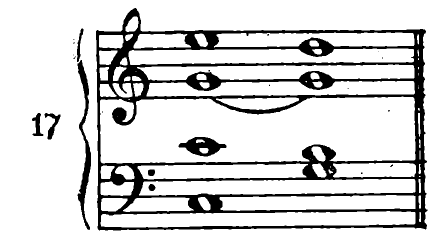
Thus, in musical example 17, oblique motion occurs between soprano and alto, or between tenor and alto, or between bass and alto; parallel motion occurs between soprano and tenor; and contrary motion between soprano and bass, or between tenor and bass.
While older theory allowed oblique and contrary motion unconditionally, it prohibited parallel motion conditionally in some cases, and absolutely in others. These are the cases known as parallel octaves and parallel fifths.
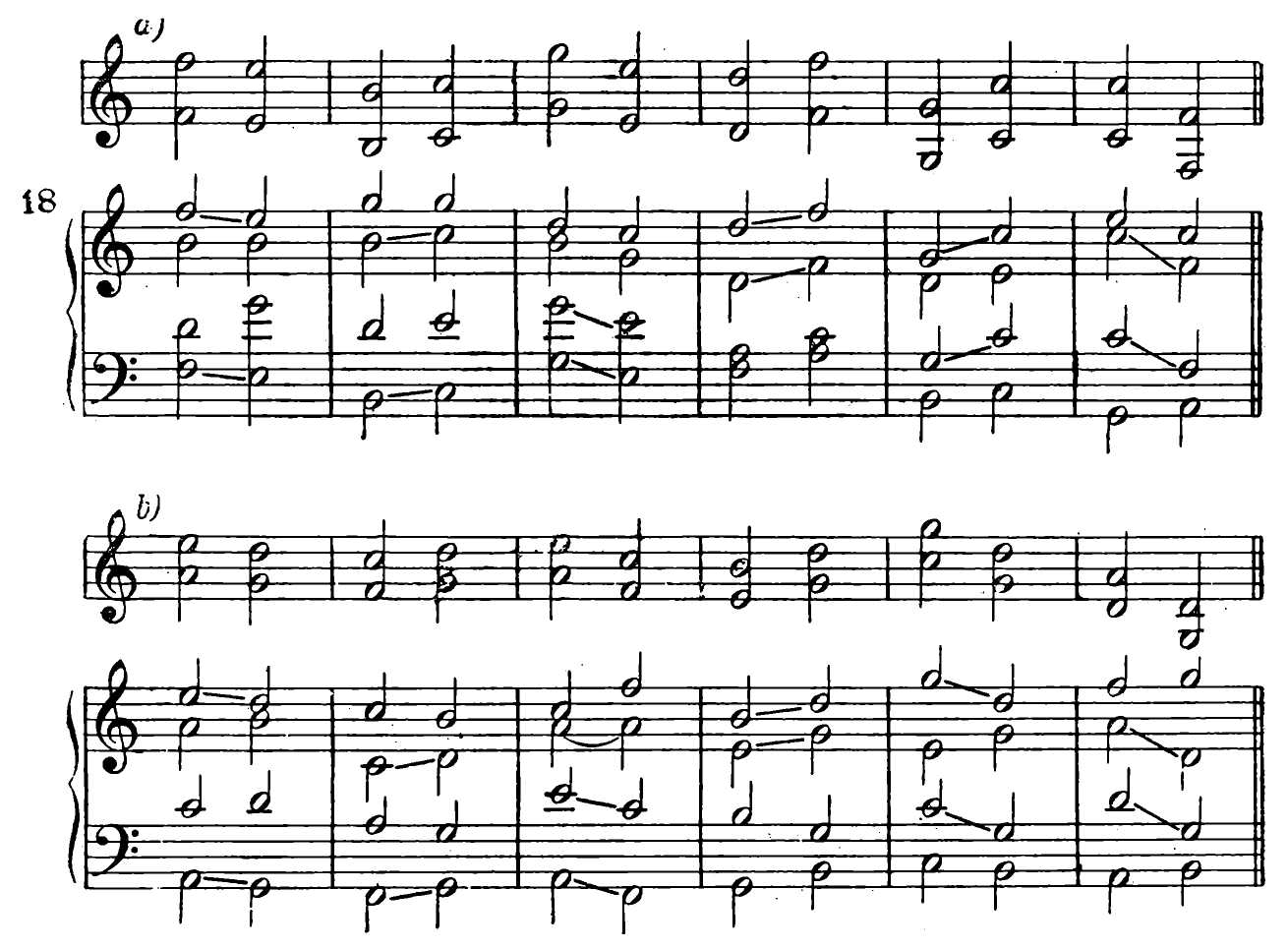
Example 18a shows parallel octaves; 18b, parallel fifths.
The relevant laws defined what was prohibited as follows: when two voices move in parallel from one octave relationship to another, or from one fifth relationship to another, parallel octaves or parallel fifths result respectively (open parallels).
The stricter version of this rule reads: parallel motion of two voices into a perfect consonance (octave and fifth) is forbidden.
This version also prohibits what are called hidden parallel octaves and hidden parallel fifths. It could also be formulated thus: when two voices, starting from any intervallic relationship—including that of a fifth or octave—meet in an octave or fifth through parallel motion, open or hidden parallel fifths or octaves arise.

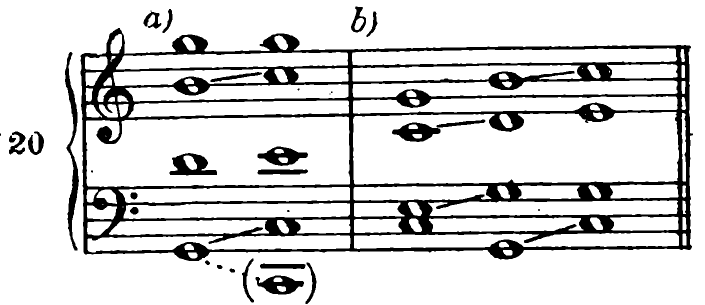
Open parallel octaves or fifths were unconditionally forbidden, but certain hidden ones were permitted under specified conditions. Above all, those that could not be avoided: necessity knows no prohibition! Among octaves*), these include those that almost always arise, for example, when degree V is connected with I (Example 20a), where hidden octaves could be avoided only by taking the bass downward to C, which is too low; or the case in Example 20b, where, given a soprano melody G–B–C, the hidden fifths between alto and tenor can scarcely be avoided.
*) The abbreviations “octaves” and “fifths” for “parallel octaves” and “parallel fifths” are admittedly very incorrect, but so customary that they may be tolerated, like everything established by usage.
Exceptions were therefore established: hidden octaves or fifths are conditionally permissible when they are less conspicuous because they occur between two inner voices, or at least between an inner and an outer voice. And: hidden octaves are better when one voice moves by a second and the other leaps a fifth or fourth. Or: they are “least objectionable” when the upper voice is the one moving by a second, for example from the seventh to the eighth note or from the third to the fourth. Also: parallel fifths are “mitigated” when a harsh dissonance diverts attention. (Thus they are less objectionable than the harsh dissonance, yet more strictly forbidden!) Then people spoke of “horn fifths,” “Mozart fifths,” and—in contrast to fifths overlooked by someone with a good ear—“intentional” fifths: those that someone without a good ear at least noticed in time. But when and why one may intend something so strictly forbidden on supposedly sound grounds was prudently left unsaid. The question whether intentional murder is more pardonable than unintentional murder would be all too close at hand!!
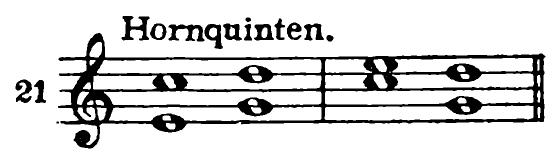
These injunctions were justified by claiming that such parallel movement abolishes the independence of the voices. That was the more intelligent version. The other simply asserted that such progressions sound bad. A third mediated between them by saying that they sound bad because the independence of the voices is abolished. It may not be incorrect that, with parallel octaves, the voices’ independence seems lost at the single moment of progression. But the assertion that they sound bad—or, worse, that they sound bad because the voice’s independence is abolished—is absolutely false. For parallel octaves are used for doubling, sometimes also for reinforcement. Naturally, because they sound good: nobody would have written parallel octaves for the sake of a worse sound. And the organ’s mixture adds to every voice not only simultaneously sounding octaves but also simultaneously sounding fifths*). This produces a stronger sound; but since we are dealing with artistic beauty, the stronger sound is also the beautiful one. Thus the claim that parallel octaves sound bad in themselves is completely untenable. The other claim remains: that they abolish the voices’ independence. Certainly, when two voices sing the same thing, they are not absolutely independent. When they sing approximately the same thing—namely octaves, which are not quite the same—they sing the same content but something different in sonority. If two voices sing continuously in unison or octaves for a considerable time—even in unison, the blending of sounds, to which each voice contributes quite independently, would still have to be considered—one could speak of a relative lack of independence in content. But if two voices sing wholly different content and meet, so to speak, on the same track only at one or a few exceptional moments, one may at most maintain that their independence is reduced to some extent at those moments. To say that they have therefore actually become dependent is surely a pedantic exaggeration. It overlooks their independence of content throughout the rest of the time, except for these few moments, which probably do not impair clear recognition of the essential difference in content; and it overlooks that they differed in sonority at every moment. Thus even here one can hardly speak of an absolute abolition of independence. More justifiably one could speak of something else: conditions whose fulfilment is a prerequisite of all good craftsmanship. Once the number of voices has been fixed after mature reflection and examination, the decision should prove correct at every moment of the piece: it should be evident that fewer voices could not present everything, while more could hardly be kept adequately occupied. Accordingly, every voice should at every moment have something to do that it alone does. If, in a thin harmonic texture, the task of moving from D to E is already fulfilled by one voice, then—if that really was the sole task, moving from D to E—it is superfluous, and therefore bad, for another voice also to move from D to E. If one can find nothing else for this voice to do, it should rest. But not knowing what else to do with it generally indicates no outstanding skill. One must therefore make an effort to find something else for it to do! If, however, the main task is not the motion D–E, for which one voice indeed suffices, but producing the octave sonority of two voices moving from D to E, the question is no longer the independence of voices but only sonority. Since parallel octaves neither sound bad nor absolutely abolish the independence of the voices, it is nonsense to expel them from art with the solemn fervour of a self-appointed apostle of beauty. They have never wholly submitted to this treatment, continually reappearing in masterpieces.
*) I published this chapter in the August 1910 issue of the journal Die Musik. It was exposed to discussion, and I learned of several “objections” raised. They concern the organ mixture, and also—see the notes—organum in fifths and parallel thirds. I welcome the opportunity to answer them. I say, “the mixture adds to every voice”—surely one could credit me with knowing, if I know about the mixture, when it is used, even if I do not expressly say: with the full organ. Surely it is clear that when used, it adds “to all the voices … etc.” Now the objection is: yes, but only with the full organ, and there they are not heard. A delightful objection. So they are added because they are not heard! Why do it, then? Why add precisely fifths and so forth rather than Bible verses or cannon shots? Answer: “They are not heard as fifths, but only as fullness, brilliance, and power of sound.” Then they are heard after all; as what should one hear them? Where should one hear the effect of a change in sound, if not in the change in sound? As voice leading? Do we hear octave doublings as voice leading?
In our exercises, devoted solely to harmonic examination, the task of doubling for reasons of sonority can naturally never arise. We shall therefore avoid parallel octaves entirely in our exercises. We shall do so also for the reason already suggested, which will answer in the same negative sense the question of whether to write parallel fifths in harmony exercises. Since parallel fifths and octaves were almost universally avoided until about the middle of the nineteenth century, and have remained relatively rare since, solutions that violate this injunction would lack stylistic propriety. And the pupil does not yet know the harmonic means that restore balance when someone capable of doing so disregards these prohibitions. He is not yet composing, but merely working harmony exercises, whose average plausibility can be maintained only by always aiming at least at average quality. Since the teacher cannot teach him absolute perfection, he must at least keep the questionable away from him as long as possible.
Theorists had somewhat greater difficulty justifying the prohibition of fifths. It is all the easier to refute. They claimed that progressions in parallel fifths sound bad; or that, since the fifth is an overtone, it is merely the root’s shadow when it moves onward parallel with it, and must move differently from the root if it is to be noticed independently; and other things of the kind. Curiously, progressions in fourths were forbidden only conditionally, although their harmonic content is exactly the same.
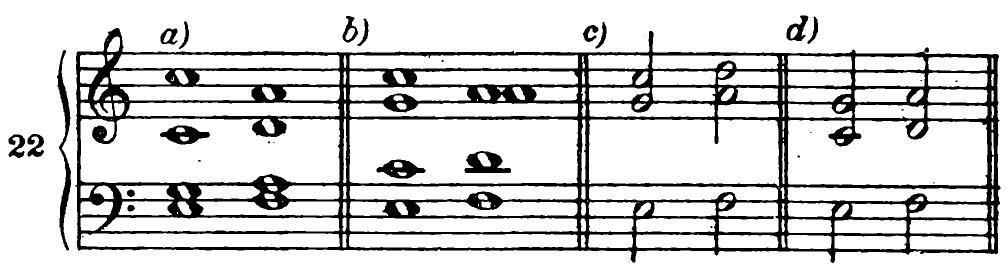
If content were at issue, parallel fourths would also have to be forbidden. Strictly speaking, connecting the degrees concerned would then have to be prohibited above all. For harshness of content—that is, harmonic harshness—can lie only in the harmony, in the degrees. Yet parallel fourths are permitted when “covered” by a third below (22c). Could parallel fifths not also be allowed when covered by such a lower third (22d)? Harmonically there is no difference. Since this parallel motion does not sound bad, and parallel thirds and sixths even sound good, is it specifically parallel motion in fifths that sounds unconditionally bad, while every other parallel motion sounds good at least under certain conditions? Parallel octaves, for example, which represent the extreme on one side—complete loss of independence of content and, in sonority, progression in the most perfect consonance—are at least conditionally admitted as doublings because they sound good. And parallel thirds and sixths, which likewise make voices dependent in content but represent progression in a consonance even less perfect than the fifth, are also permitted! Thus neither is progression allowed only in the most perfect consonance, since thirds are less perfect than fifths, nor are parallels allowed only in imperfect consonances, since octaves are more perfect consonances than fifths. And every reason advanced against progressions in fifths also applies either to progressions in octaves or to progressions in thirds. There must therefore be other reasons.
I shall try to resolve this question more simply.
The development of part-singing may be imagined as follows. The first impulse may have been the desire to participate actively in a song otherwise sung by a single person. Two or more sing the same melody. If voices of exactly the same kind sang together—for instance, only low male voices—it is fairly obvious that they could perceive as in tune only singing in unison, on the same note, in the most perfect consonance. If female voices joined and the melody lay neither very high nor very low, a second possibility arose: singing in the second perfect consonance, in octaves. But if the melody lay too low for high female and male voices, or too high for low female and male voices, something else had to be found for them. Until true part-singing had been invented—unless singing in octaves is already considered relative part-singing—there was probably no alternative but to sing the same melody starting on some other consonant tone. Since unison and octave were already used, the ear necessarily had to choose the next most perfect consonance: the fifth. Thus organum in fifths arose, or, what amounts to the same thing here, organum in fourths*). That only much later did people think of using the third for the same purpose, indeed that even much later still the third had not gained recognition as a consonance, proves the correctness of the hypothesis repeatedly mentioned in this book: dissonances differ from consonances only in degree; they are merely more remote consonances, whose analysis presents the ear with greater difficulty because of their remoteness, but which, once analysis has brought them closer, have the chance of becoming consonances just as the nearer overtones are. Incidentally, the early permission to introduce the seventh of the dominant seventh chord without preparation also supports this view. Thus, in seeking to produce imitations of natural euphony, the ear was on the right path when it followed the progression unison, octave, fifth. And people sang in fifths for the same reason as in octaves: for their pleasing sound. Another of those curious coincidences that so often give the mysteries of acoustics a cabbalistic appearance also emerges: singing in fifths or fourths fully met the needs of the human voice. For the tenor is on average a fifth above the bass, the alto approximately a fourth to a fifth above the tenor, and the soprano likewise a fifth above the alto. Thus the solution found instinctively was truly artistic: two birds with one stone.
*) Just as I prepare these pages for printing, I am pleased to find my account of this stage of development confirmed by a thinker as brilliant and profound as Riemann. I consult Meyers Konversationslexikon and find almost word for word what stands here as the result of my own reflection: “Organum was not yet truly part-singing, but doubling in fifths, the most natural further step from the long-practised octave doubling of the voices.” I then also find in the encyclopedia an explanation of fauxbourdon of which I knew nothing—forgive me, I am not a scholar; I am self-taught and can only think. According to this, people sang in sixth chords. That is precisely the next stage of development! And Riemann also says that soon afterwards the true principle of part-singing was discovered: contrary motion. That is exactly what I did not know but merely guessed. For I have never yet read a history of music. Regarding organum, I should also mention that I am told “scholarship” doubts whether it ever really existed. Scholarship always does that when something does not suit it. But organum is so self-evident that, had it really never existed, one would have to invent it now and insert it retrospectively into the past. Yet I believe it did exist—the doubt of scholarship guarantees it for me.
I imagine the further development as follows. Soon after recognizing the third as a consonance, people probably discovered the possibility of contrary and oblique motion. Besides parallel unisons, octaves, and fifths, there was thus the possibility of parallel thirds and, probably soon afterwards, as stated, contrary and oblique motion—an enormous enrichment of means. The following train of thought, all too firmly grounded in human nature, seems to me to offer a psychological explanation of the question.
Singing in octaves and fifths undoubtedly satisfied taste in a wholly natural way: it accorded with the nature of sound and with human nature, and was therefore beautiful. But the possibility of adding thirds*) to the octaves and fifths, and of using contrary and oblique motion, probably produced an intoxication that made everything earlier seem bad although it was merely outdated—an intoxication like that observable, not only in art, with every great advance. It forgets gratitude for the predecessors’ groundwork so completely that it hates them and fails to consider that progress would be impossible without them, even if they were full of errors. Contempt for the outdated is as great as it is unjustified. A properly measured person will say: I myself would not wish to do anything outdated, because I know the advantages of the new and because it would be out of step with the times. One may be out of step only by running ahead, not by limping behind. Thus one is justified in mocking someone who writes “gegen dem” today; but one should know that, since “gegen” formerly did take both dative and accusative cases, this is not wrong, merely outdated. And Schaunard was right to characterize his fellow bohemian Barbemuche’s style solely through the word “hinfüro”—“henceforth”—which frequently occurred in Barbemuche’s novel. Such observations of the artist’s human nature, I believe, are certainly as decisive for judging art’s development as physics. We must remember that art has followed the nature of tones as much as human nature; that it is a reconciliation between these two factors, attempts by one to adapt to the other. And since the tone, the inanimate material, does not adapt, we should do so, though sometimes we find it difficult to bring ourselves to it. Having done so, we therefore often overestimate our achievement and underestimate those who took the preceding step, perhaps equally great and equally difficult.
*) Here I was asked why parallel thirds had not met the same fate of being forbidden. Elsewhere I have used precisely the case of parallel thirds as an argument for my view, omitting it here only because it did not seem essential. Since it is raised as an objection, I shall discuss it. First: parallel fifths were expelled from music unjustly, not justly. One cannot even maintain that a correct insight, applied to an analogous case, must again lead to a correct judgment. But to demand that an illogical judgment must necessarily repeat itself in another illogical judgment surely goes too far! Second: it was not even necessary to forbid fifths, since they were merely artless when employed as the sole means of harmonization. Thus there was no need to forbid thirds, since they are good when not used exclusively. But where they are used exclusively, they are nevertheless regarded as a method of voice leading of subordinate value; the expression “austerzen”—filling out in thirds—may serve as evidence, since it explicitly rests on the idea of real, actual voices. In double counterpoint, however, thirds are merely filling voices: a matter of sonority added without acquiring any particular merit in voice leading by the addition. Finally, parallel thirds—exclusive thirds—and sixths are indeed felt to be artless, even banal. Witness folk music, whose part-singing they constitute almost exclusively. They may be banal, but they are not impossible, and can occasionally become artistic means, as in Siegfried.
It was probably the same here. When the coercion of the guild joins the joy of achievement, the child of this marriage can only be orthodoxy. No longer needing to establish what has newly been attained, orthodoxy finds its task in preserving it through exaggeration. It does think through everything implied by its premises; but through exaggeration it not only leads to errors, it also erects a bulwark against every new achievement. We can thus readily imagine how the statements “It is no longer necessary to compose only in octaves and fifths,” “One may add thirds to octaves and fifths,” and “One may use contrary or oblique motion instead of parallel motion” became “It is bad to compose in octaves and fifths,” “One must add the third to the octave and fifth,” and “Contrary and oblique motion are better than parallel motion.” Considering that such reflections were given and accepted as rules whose violation incurred a ban, we understand how easily their origin could be forgotten. How easily people could forget that octaves and fifths were not bad in themselves but, on the contrary, good in themselves; that they had merely been found outdated, primitive, relatively artless; and that there was no physical or aesthetic reason not to use them again occasionally. Considering that these rules were disseminated for centuries in the form “Thou shalt not …,” it becomes clear that the ear forgot the pleasing sound once discovered, and that its use caused offence through the strangeness that always attaches to the new. I mean that, since progressions in parallel octaves and fifths were not practised for centuries, the ear was disposed to regard the occasional occurrence of such connections as new*), as strange, whereas the opposite is true: they were old, merely forgotten. Thus it does not disprove the view presented here when a musician says, “But I do notice these fifths; they strike me, and I find that they sound unpleasant.” The new always attracts attention, and people find that it sounds unpleasant even when it does not.
*) This circumstance also speaks against—I cannot help it: the circumstance speaks—that pseudo-modern method of setting entire melodies and the like in fifths in order to profit from their novelty and strangeness. I find this unpleasant, neither because it seems new nor because it is actually old; nor because it deserves no greater credit than the sixth-chord successions written at similar points by such innovators’ predecessors. Perhaps because of the wilfulness and ostentation it displays: such things are ignoble. Most probably, however, chiefly because I increasingly feel that the prohibition of fifths also contains something right that has merely been misunderstood. I mean the reluctance toward consonance, which may, as an inversion, be identical with the impulse to incorporate remote consonances—dissonances—into the texture.
And now the hidden octaves and fifths! These are explained quite simply by orthodoxy: to be absolutely sure of writing no open octaves and fifths, people avoided parallel motion into these perfect consonances altogether. Any other attempt to justify the rule concerning hidden parallels is invalid. Not merely because even open parallels do not sound bad, but above all because this law led only a semblance of life in textbooks, while in practice—that is, in masterpieces—it was almost invariably violated.
What attitude should the pupil take toward this question? I shall discuss it somewhat more fully this time, intending later merely to refer back to this general discussion without repeating it each time. One might ask: if parallel octaves and fifths are not bad, why should the pupil not be allowed to write them? My answer is that the pupil will be allowed to write them, but only at a later stage. Teaching should lead through the course of development. If instead it gave final results as rules without justification, the petrification of insights deprived of their roots could lead to errors like those I have just exposed. And just as excessively rigid formulation can constrain further development, it would also obstruct the view back into the past and make much that was once alive incomprehensible. For a similar reason I am no friend of the new spelling, although I fully recognize the practical advantage of brevity and understand that the effort to express in writing only what actually sounds is justified to some extent. Yet I find it questionable to eradicate so ruthlessly those signs that often represent remnants of former syllables. This can easily destroy the possibility of recalling the root word when seeking an expression’s true, original meaning. Our writing risks becoming too poor in such clues, which could guide everyone back to the origin. Eventually only historians will know it, and it will have disappeared from everyone’s living awareness. If harmony teaching proceeded with similar ruthlessness, many problems of voice leading in older masterpieces would remain incomprehensible to us. And another point: in the often necessary adaptation of older masterpieces whose harmony is indicated only by figured bass, and which become more accessible to us the more faithfully their style is restored, using inappropriate means of voice leading would inevitably create an incongruity between content and realization that would offend sensitive perception. The same incongruity would arise if the pupil attempted to solve his exercises without regard to these prohibitions. Admittedly, if someone wrote a harmony treatise expressing only the harmonic taste of us most modern composers, declaring permissible what we do and forbidden what we omit, all these considerations could be dispensed with. We have already reached the point today of no longer distinguishing consonances from dissonances—or at most of preferring to use consonances less. This may merely be a reaction to the preceding epochs of consonance, perhaps an exaggeration. But to conclude that consonances are forbidden because they no longer occur in the works of this or that composer would lead to errors like our predecessors’ prohibition of fifths. Personally I could calmly tell a pupil—though only because, and as long as, I do not yet know better—that every sonority and every progression is possible. Yet even now I feel that here too certain conditions govern whether I use this dissonance or that one. We do not yet have enough distance from the events of our day to recognize their laws. Too much that is inessential still crowds into the foreground and conceals the essential. Standing in the middle of a mountain meadow, I see every blade of grass. But that is worthless if I am looking for the path to the summit. At some distance I miss the blades of grass but probably see the path. I suspect that the path—even this path—will somehow connect logically with the stretch already travelled. I believe that ultimately the same laws will be discernible in the harmony of us most modern composers as in the harmony of earlier musicians, only appropriately extended and more generally formulated. Thus preserving the insights of our predecessors seems highly important to me. Precisely from them, I hope, will emerge how right is the path along which we search. Furthermore, with the same justification for lifting the prohibition of fifths for pupils at the beginning, I could also dispense with all the instructions concerning the treatment of dissonance, tonality, modulation, and so forth. These too are superseded today. Yet here as there we must not overlook that only the small band of the youngest composers goes so far. Almost all the great masters of our time—Mahler, Strauss, Reger, Pfitzner—still largely adhere to tonality, for example. A teaching that champions only the aim of a group still small, however rigorously logical its construction, could not unjustly be accused of partisanship. What I intend to offer is precisely a teaching that, although it serves no party—or rather, precisely for that reason—arrives at results accepted as correct by the group that thinks as I do. To show precisely that one must arrive at these results is my aim.
The pupil should therefore calmly follow the path that development has taken. If he studies harmony only from an interest in artworks, seeking only a better understanding of masterpieces, it is immaterial whether, during the brief time he himself spends producing musical structures, he makes modern or unmodern exercises. What matters is guidance toward the right attitude to the new. This is supplied by a teaching whose freedom from aesthetic prejudice causes many an eternal law to depart this life, opening the view onto the development of beauty: the change of conception by which the new, condemned by older ears, becomes the old that now pleases the ear, only to deny entry to a newer new that is still condemned. But if he is a composer, he should wait calmly to see where his development, his nature, will drive him. He should not wish to write things for which responsibility can be assumed only by committing a whole personality: things artists have written almost unwillingly, obeying the compulsion of their development, rather than from the uninhibited wilfulness of an ungroundedness unsure of form.
The pupil must therefore avoid open parallel octaves and fifths entirely for as long as he needs the guidance of instruction. He may use them once inclination, taste, and artistic understanding enable him to stand personally behind them. He may freely write hidden parallel octaves except in a few cases to be discussed as they arise. Hidden parallel fifths, however, are permitted unconditionally and always.