 Playable Books
Arnold Schoenberg · section 15 of 66
Connecting Triads and Sixth Chords
Read and hear this section in the playable edition →The task now is to examine and realize the connections given in the three tables, A, B, and C.
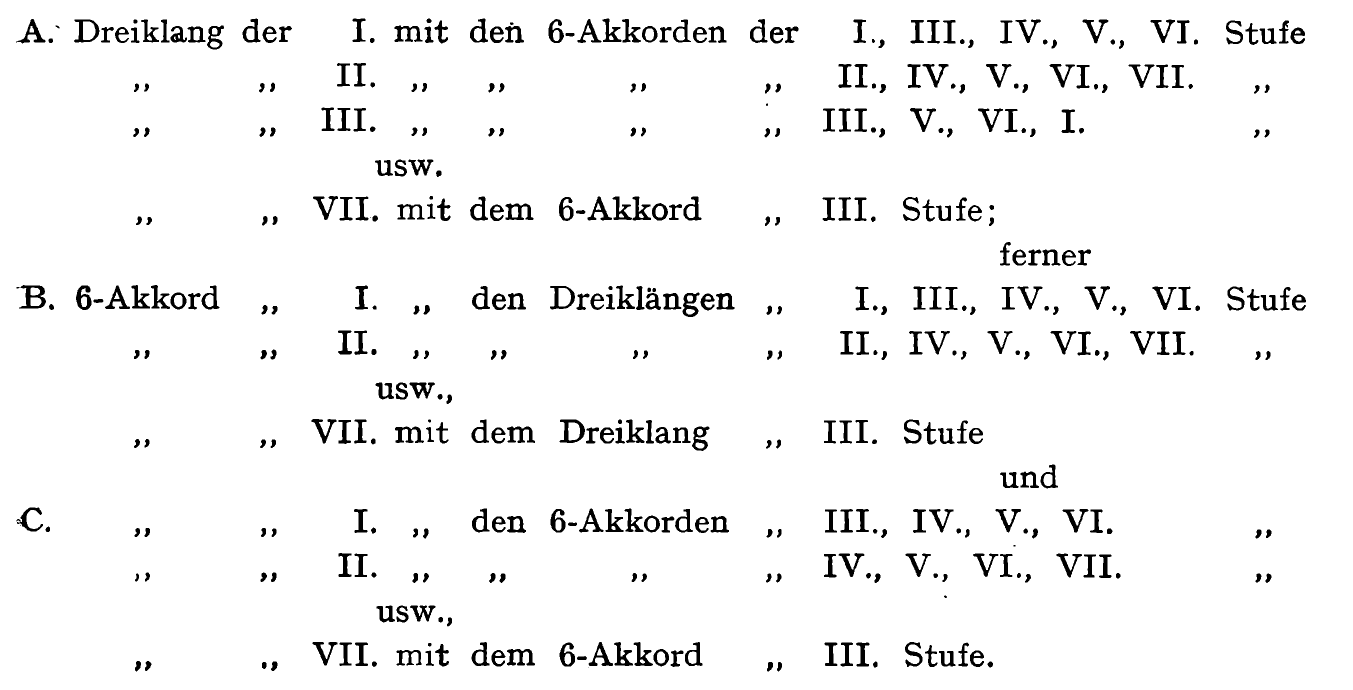
The pupil will do well to work through these tables in full, if possible in several keys. Here voice-leading difficulties arise for the first time, and such matters are best dealt with all at once. It is good to gain the necessary practice here, so that later one does not fail in more important matters because one cannot manage the voice leading.
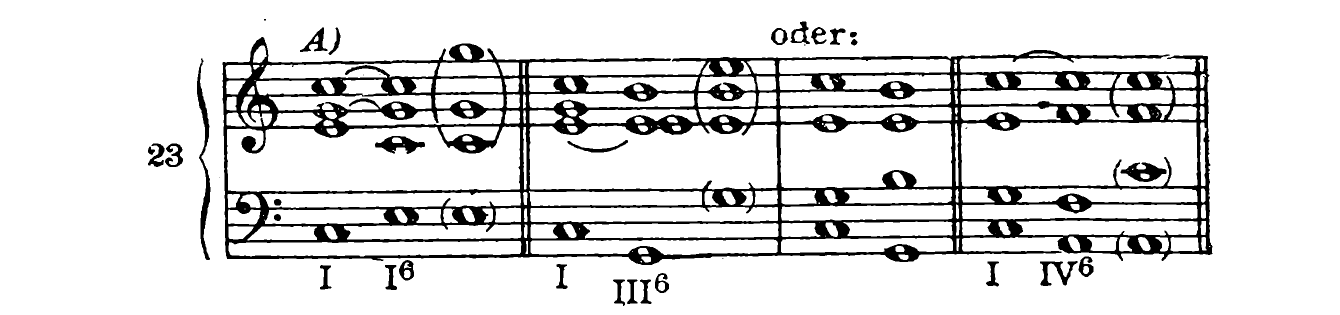
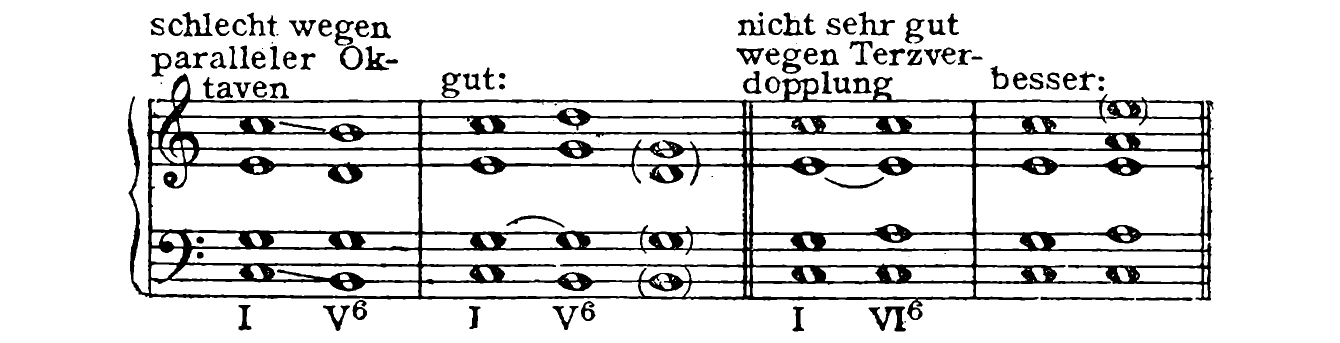
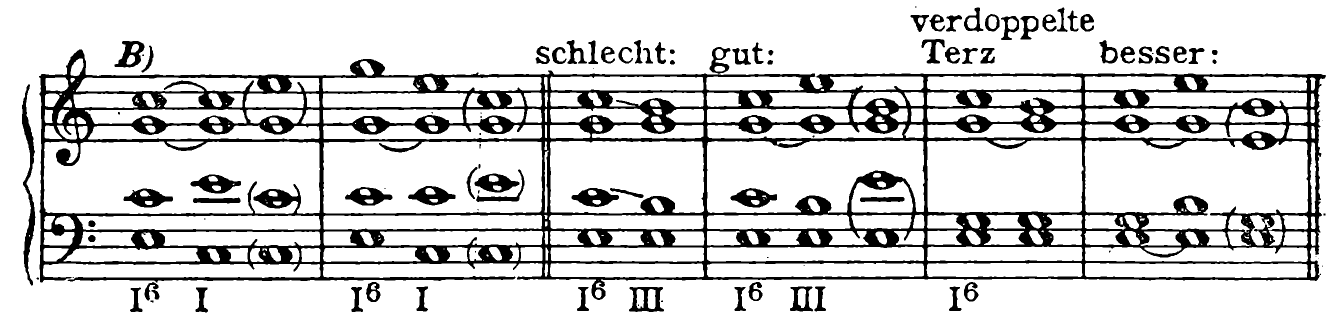
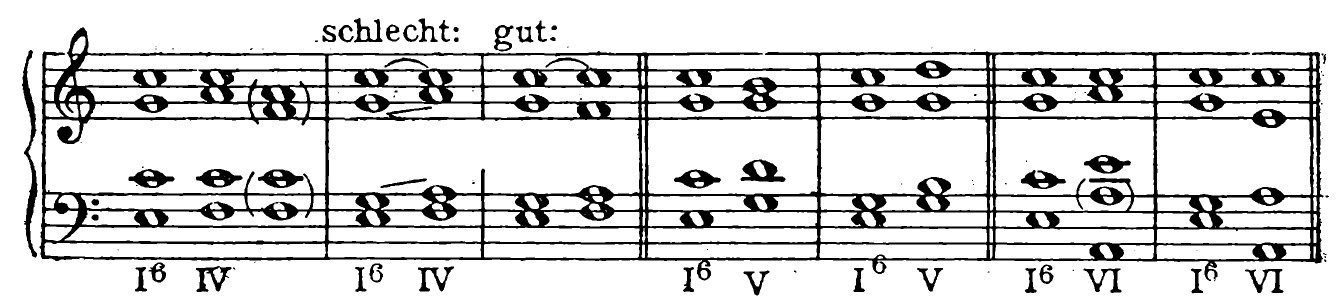
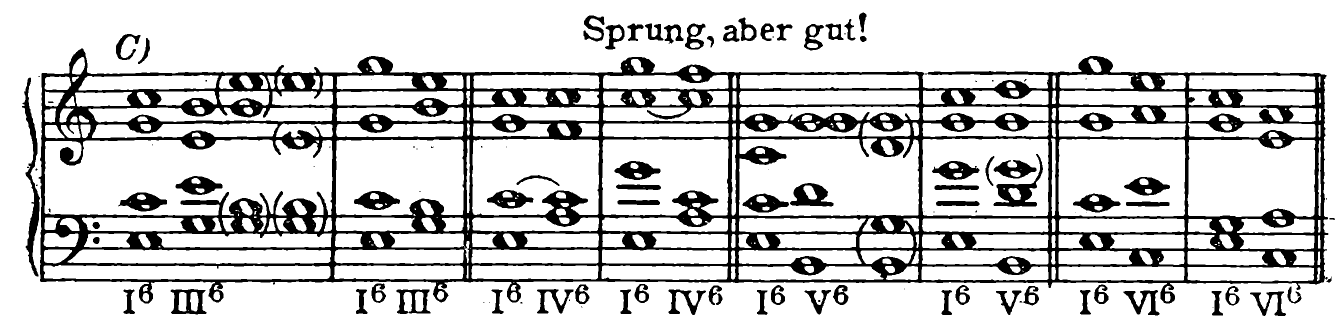
Only degree I has been worked through here. Following this model, the pupil should also work through the other degrees—do not forget other keys! In some cases the pupil will have to avoid open parallel octaves or fifths. In some others it will be necessary to give up holding certain common tones, since otherwise the third would be doubled unnecessarily.
Connecting a triad with an inversion of the same triad, or the reverse—for example I–I in first inversion, II in first inversion–II, IV–IV in second inversion, or V in first inversion–V in second inversion—is called an exchange. Two or more voices, one of which in our case is the bass, exchange their roles without any harmonic change taking place. Exchanges therefore have only melodic value.
The pupil should work each case twice—at least twice! On one occasion the first-inversion chord should have the root doubled at the octave, and on the other the fifth doubled. This always gives different solutions and often new difficulties. The pupil should seek these out, and as often as possible find more than two solutions, since nearly every disposition reveals something different. It is also advisable to try this case: an initial chord with the fifth doubled.
Degree VII requires particular attention.
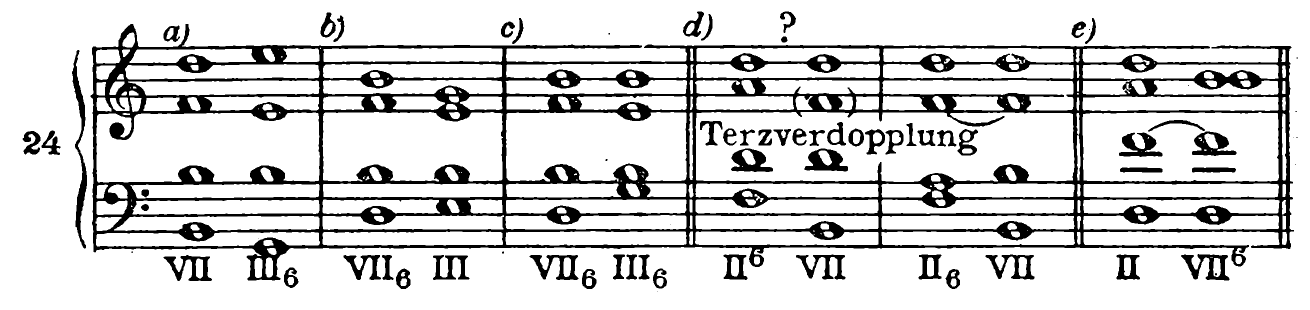
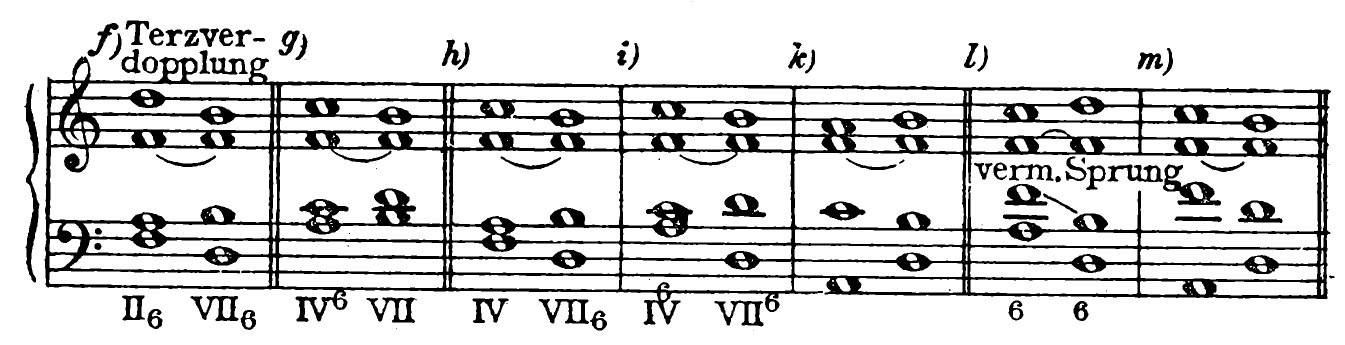
In example 24d we encounter a new case. The chord on degree II is in first inversion here, so f, which is needed to prepare the diminished fifth, occurs only in the bass; the bass must move to b in the next chord. Thus the diminished fifth cannot be prepared unless f also occurs in an upper voice. Here, therefore, f—the third—must be doubled. What deserves attention is the way necessity overrides an instruction. Something similar occurs in 24i and l. In i the tenor’s c could not move to b because of the parallel octaves with the soprano, nor to f because, as a dissonance, it should not be doubled. The only remaining course is to move to d, that is, to double the third in the first-inversion chord of degree VII. Another solution of the same problem is shown in k, where the third was doubled in the first chord. In 24l the tenor is obliged, for the same reason as in i, to leap a diminished fifth. According to the old rules such a leap should be avoided because it is unmelodic—or, perhaps more accurately, because it is difficult to sing in tune. In general we too shall avoid such leaps, as I have already said, so as not to disturb the stylistic balance. But when necessity forces us to make such a move—which is, incidentally, unavoidable in the bass—we shall try, whenever possible, to resolve, as it were, the dissonance contained in a diminished or augmented interval, meaning its difficulty of intonation. This is best done by leading b, the “ascending leading tone,” upward to c, and f, the “descending leading tone,” downward to e. Since this is not always possible, example 25 supplies several other possibilities, in measures 5–10.

Careful attention to such small details makes it possible to achieve formal rounding, which seems to me a useful basis for developing a sense of form. Naturally, the examples will not yet sound particularly “moving,” but they need no longer be quite as stiff as the very first ones.
The pupil should now also use first-inversion chords when constructing the little settings, taking the following as a guide: wherever a triad can stand, a first-inversion chord may be used; only the beginning and ending, always degree I, are in root position. If a degree has to be repeated within a setting, it is good to use its first inversion on one occasion. It will not be good, however, to use too many first-inversion chords. The settings may now be eight to twelve chords long. Making them longer is unnecessary, since too many repetitions would otherwise be required. Example 26 shows several such settings.
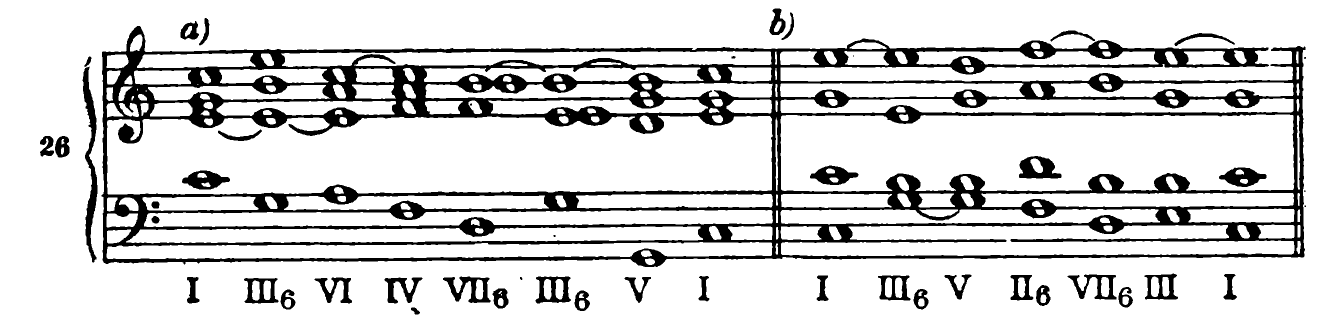
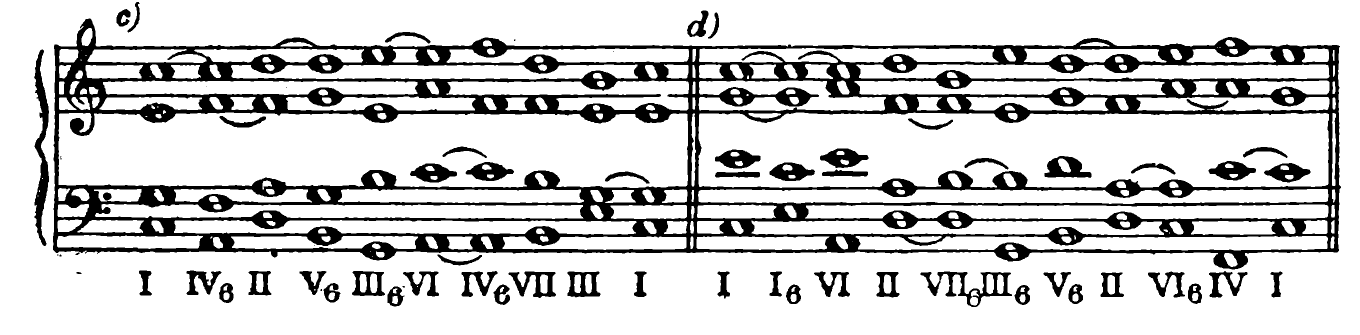
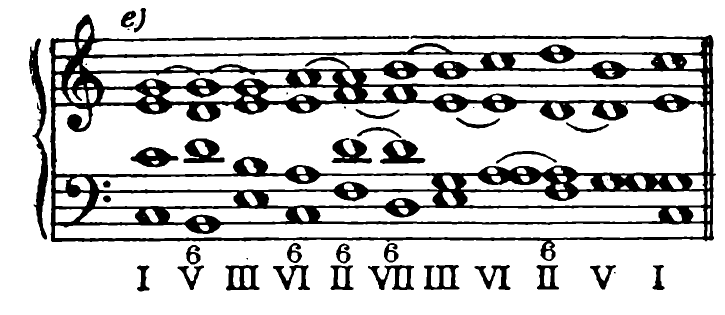
In deciding whether to choose a first-inversion chord or root position, the melodic line of the bass must naturally also be considered. In general the bass should, if possible, avoid remaining on one note. Sometimes this can be avoided, as in example 26a, by changing register with an octave leap; sometimes by choosing first inversion instead of root position, or the reverse. Even repetitions of the same bass note with one or two other notes between them can have a paralysing effect. If, for example, I had taken degree VI in first inversion in 26a instead of root position, even a leap to the lower octave would not have helped much. The pupil should avoid such repetitions wherever possible, and the teacher should correct them; for where, as here, repetition is not justified by a motive, its effect is poor. It is otherwise in 26e, where the repetition of c and e should scarcely disturb. This is less because two chords intervene in one case and three in the other than because the continuation after the repeated bass notes takes a different direction on each occasion. Thus, in judging whether a bass line is good, the only melodic principle initially to be considered is variety. If repeated notes are unavoidable, at least some other notes should intervene, or the line should change direction. The pupil will also do well to attend already to the highest note of a line. This should always be treated as a climax: it should occur only once, since its repetition generally disturbs more noticeably than that of other, less conspicuous notes.