 Playable Books
Arnold Schoenberg · section 16 of 66
b) The Six-Four Chord
Read and hear this section in the playable edition →It has already been mentioned that the six-four chord calls for different treatment, and why. Here another reason given by older theory should be recalled: the fourth was regarded as an imperfect consonance, indeed even as a dissonance. This corresponds to a sound perception, for although the fourth occurs among the earliest overtones, it occurs in the reverse direction, and is therefore a less simple consonance than intervals appearing in the direct direction. Yet the fourth occurs in almost every consonant chord as the relation between two voices, and is regarded there as dissonant only when its lower note is in the bass. Older theory says that it is permitted when a fifth or third below “covers it”; in all other cases it should be prepared and resolved as a dissonance. Thus the peculiar claim is made that the fourth’s two notes form a dissonance on one occasion, when the lower note is in the bass, and a consonance on another, when it is “covered.” Furthermore, in another position, in inversion—for which the rule says that every perfect consonance produces perfect consonances, every dissonance dissonances, and so on—the same two notes produce a perfect consonance, the fifth. This is too contradictory and insufficiently simple to be natural.
The following explanation seems simpler to me. A bass note that is not also the root seems to strive to assert its overtones—in other words, to become the root itself. As shown earlier, on page 69, the bass of the six-four chord receives ample support for this effort from the overtones of the other chord members. Thus a conflict exists in the six-four chord between its outward appearance and its inner constitution. While its appearance points, for example, to degree I, its constitution, its instinctive life, demands degree V. This conflict may bear some resemblance to the one we think we perceive in dissonance, since there too a change of root is sought. But whereas in a true dissonance notes sound together that can never, in any disposition, be consonant, the notes of the six-four chord are fully consonant in another disposition: a triad or first-inversion chord. The six-four chord’s demand for resolution, for treatment as a dissonance, is therefore not as vehement as that of a true dissonance. It shares with dissonances only the circumstance that a conflict within it attracts attention and seems to require special consideration and treatment. That treatment need not necessarily consist of preparation or resolution, as it does with dissonances. And what is called preparation and resolution of the six-four chord bears little resemblance to preparation and resolution of a seventh chord. One thing is certain, however: the six-four chord, whose problem could be felt but not understood, has always been treated in a special way. That alone would have sufficed to give it a special position. Its problems may be smaller, or different; the method by which it has been treated perhaps exaggerates them, perhaps without even exhausting them. But whether this position derives from convention or from nature, it is in any event quite definite. Since the chord was always used in a special way, on the assumption of a particular character, and since certain events always preceded and followed it, its effect resembles that of quoting part of a familiar saying: “Where all love…” One supplies what precedes and follows. A touch upon the familiar cause awakens expectation of the familiar effect. At the first word one understands and expects a particular continuation. This is the effect of the cliché, of the formula. The six-four chord has developed into just such a fixed formula with a stereotyped effect; one cannot imagine its appearance without its customary accompanying circumstances. Whether the treatment expressed in these is appropriate or not is therefore of little consequence in establishing the significance it has had in music for more than three centuries. Nevertheless, it may be useful to examine that treatment as well. I must recapitulate: the bass note’s effort to become the root is supported by the overtones; the six-four chord should therefore be resolved by its bass becoming the root. For example, the six-four chord of degree I passes into V while g remains stationary. This is indeed one of the ways it is treated. But the conflict in the six-four chord and its impulse toward resolution are not absolutely compelling; one need not yield to them, since only overtones support them. It may be possible to pass cautiously by, perhaps by diverting attention from the conflict. This can happen when one of the two conspicuous voices shifts responsibility for the harmonic events to melody. It directs attention from simultaneity to succession, from harmony to melody. A suitable means is a segment of a scale consisting of three or four successive bass notes, one of which, preferably an inner one, carries the six-four chord. When the ear hears such a melodic succession, it takes this as the momentary principal matter, treats the fleeting six-four chord as secondary, and is satisfied. Another interpretation would be this: two notes in the six-four chord contend for supremacy—the bass note and its fourth, the actual root. The following chord is a concession either to the bass or to the root. If the bass wins, I passes into V. Sometimes, however, the concession does not go so far, but takes a middle course. It may even happen that the third becomes the root—when two quarrel, the third rejoices*)—and I passes into III. Something similar occurs when the fourth, the root, does not yield: I is then followed by IV or VI. In these three cases both contending chord tones have actually lost. In degree III, g is only the third; in IV and VI, c is respectively the fifth and the third. Yet they have the satisfaction that their rival has not won. Chord tones seem to become almost as malicious as people as soon as they come into contact with them. This is the other way of addressing the problem of the six-four chord: allowing it to occur in passing in the bass. These two methods resemble certain forms and treatments of other dissonances. It may therefore be justified to speak of resolution here too, although resolution in other dissonances has a different psychology. One should, however, distinguish forms that can be explained harmonically—the assertion of the bass note’s overtones—from those attributable to voice leading, namely the passing six-four chord. Or one must do what I do: broaden the concept of resolution accordingly.
*) The Europeans, I and V, who tore one another apart to the advantage of the subdominant, Japan, and the upper mediant, America, or some other mediant of culture.
So-called preparation can be interpreted in the same way. One of the two chord tones was there first: the root, if degree IV or VI precedes, or possibly the seventh chord on II, whose seventh is c; or the bass note, if V or III precedes. The one that was there first would like to derive its claim to victory from a right acquired by prior possession. One could also regard the matter this way: to prepare for the conflict, at least one of the notes is stated beforehand. Or, to explain introduction by step, melodic bass motion softens the harshness of the event.
I find it difficult to explain the treatment of the six-four chord completely because I do not think that treatment fully corresponds to the problem contained in the chord. I admire the fine discrimination of the older musicians, who correctly sensed that it differs from a triad. But I also know only too well how an insight found through intuition can be removed far from an inspired understanding of nature by exaggeratedly orthodox treatment. Nevertheless, for reasons I have already mentioned several times, we shall now deal with the six-four chord in the sense of the old theory.
According to its rule, the six-four chord should:
1. Be prepared;
2. Be resolved; or
3. Occur only in passing; and
4. Its bass note should neither be approached nor left by leap. It should therefore either remain stationary or be reached and left only by step. This rule coincides to some extent with point 3.
Preparation of the six-four chord differs from preparation of a dissonance in that either of two notes may be considered. One can prepare either the fifth, that is, the bass note, or the root: one of these two notes should have belonged to the preceding chord and should appear in the same voice in the six-four chord. Resolution occurs either by the bass remaining stationary while the other voices change above it to form a new chord, or by the bass moving one step upward or downward and becoming the root or third of the next chord. A six-four chord should neither follow nor precede another six-four chord. That would mean placing another, still unresolved problem immediately beside an unresolved one, which plainly contradicts the sense of form. Such voice leading also seems reminiscent of parallel fifths, which usually arise when the fifth of one degree passes into the fifth of another. Treatment of the six-four chord in passing concerns only the bass voice. I have already mentioned that this is a melodic, not a harmonic, device: its effect depends on attention being diverted toward a melodic succession. Such a succession is the three-note scale segment whose middle note carries the six-four chord. The scale can be regarded as melody, although the simplest and most primitive melody. It is primitive because of its limited articulation and variety: it has only one principle of succession, step by step, and only one direction, either downward or upward. A more complex, more interesting melody is articulated more richly and variously. The direction and size of its intervals change frequently, indeed continually, and the repetitions by which one recognises its system show, if not several principles, at least variations. Yet the scale is a melody all the same, since it has system and structure: a primitive melody, a relatively artless construction, but still a melody, already a form of art. I have mentioned this property of the scale because there will be further occasions to trace certain apparently harmonic problems back to melody. Thus the good effect of a diatonic or wholly or partly chromatic scale in the bass is merely a consequence of melodic force, and is therefore almost more the effect of a kind of polyphony than of harmony.
This effect of melody in a setting that initially serves only harmonic purposes need not on that account be a higher effect; it is nevertheless striking enough to produce a formal satisfaction equal to that produced by harmonic means. It is not necessary always to use an entire scale for this purpose. Part of a scale—three or four successive notes—is also understood as a succession, as melody. Such successions often occur in harmonic settings even where no six-four chord is being treated. One might therefore think the device should be used more sparingly, so that when needed it can exert the necessary force. But this seems unnecessary, since in this form the six-four chord is not supposed to attract attention; it is merely to pass through, to go by. If the scale segment were a device used only for this purpose, the six-four chord would inevitably stand out.
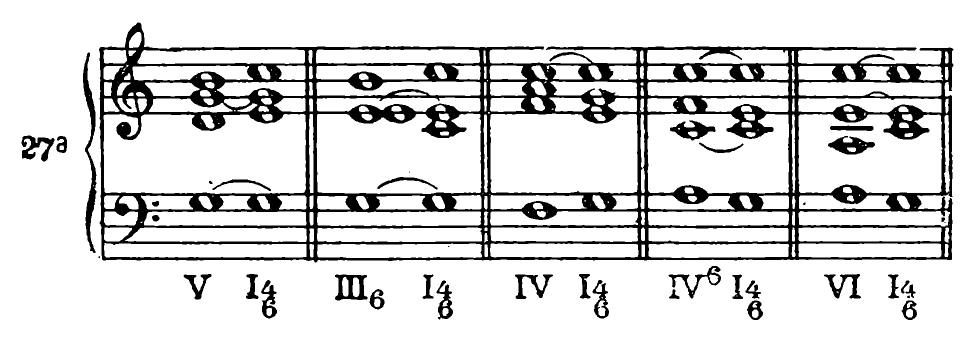
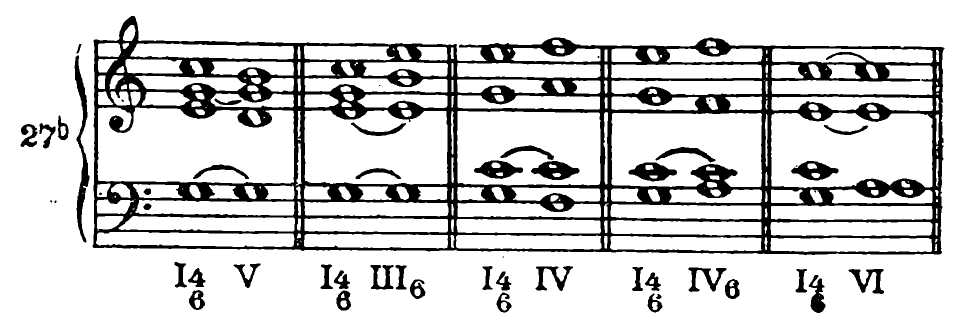
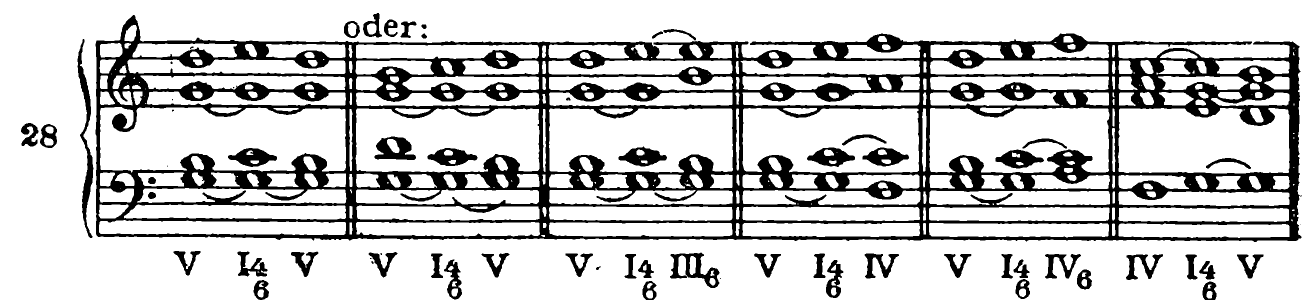
Example 27a shows several preparations, and 27b resolutions. In 28, preparation and resolution are combined into successions of three chords.
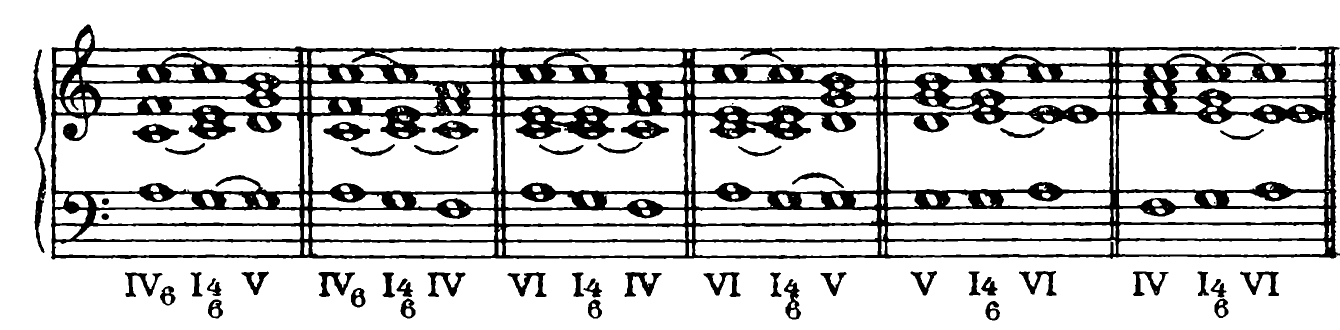
The pupil should also practise preparing and resolving six-four chords on degrees other than I. Although these are less common overall, individual cases occur frequently. Degree VII should receive particular attention, since its fifth is dissonant for another reason already known to us.
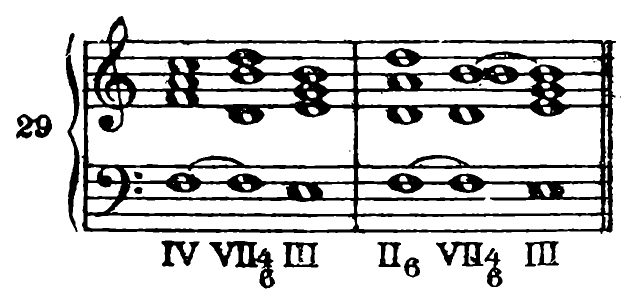
Naturally, here again only degree IV in root position and degree II in first inversion can be used for preparation, and only degree III in root position for resolution. Thus the progression with degree VII can only be IV–VII in second inversion–III, or II in first inversion–VII in second inversion–III.
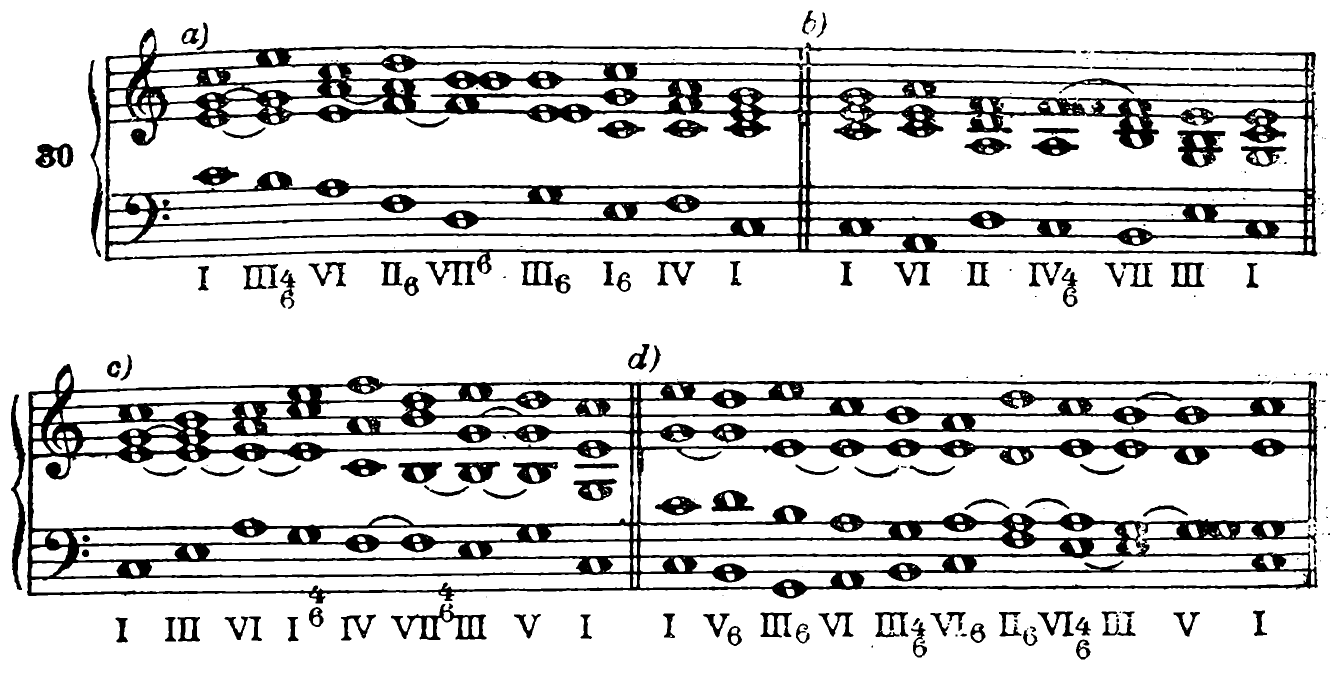
Example 30 shows several short passages. In 30d, degrees III and VI each occur three times. Without wishing to recommend these repetitions, I nevertheless include them so that the pupil can see how a well-varied bass can improve even such passages.