 Playable Books
Arnold Schoenberg · section 17 of 66
Seventh chords
Read and hear this section in the playable edition →


A seventh chord consists of three thirds built above a root: root, third, fifth, and seventh. It is a dissonance and thus belongs to those phenomena produced by the need to put the more remote overtones to use. In discussing degree VII I already mentioned one way in which they may have become established: the passing tone. A voice that would, for example, leap a third connects the two boundary notes of this interval by also sounding the intervening dissonant portions. It sounds them fleetingly, as it were in passing, without accent, so as not to draw attention to them, on the weak part of the measure. Another use of dissonance, probably a later form, introduces it with an accent, on the strong part of the measure. Its origin may be imagined as follows. Suppose a voice has to sing the succession F–E. This melodic step could be accompanied by two chords, F by degree IV, for instance, and E by I. If at some point one wished to make this step stronger by presenting it as the result of a necessity, or conversely wished to express in the harmony the necessity of this step apparent at that point—a consideration of a very high order of artistic craftsmanship—one of the most suitable means would be to make the first note a dissonance. The connection IV–I permits the melodic step F–E, but does not compel it. First, F could equally well move to G; and second, IV could equally well be followed by II, VII, or some other degree. If the step F–E could be given a harmony capable of bringing it about necessarily, the effect of the step would be more organic. This is not easily possible, since there is no means of compelling F to move absolutely nowhere but to E. Yet one can make F conspicuous by allowing a chord to arise beneath it against which it is dissonant; it thereby becomes an event that cannot be passed over without being dealt with. In discussing degree VII I already pointed out that a dissonance is especially conspicuous in simple harmonic passages, and showed that its appearance there will always necessitate a strong means. The same applies here. Once F has been made conspicuous by becoming a dissonance, the harmony must be led so forcefully, in order to bring about a resolution, that the power with which it seemingly pursues its instinctive life can bear responsibility for everything, including the dissonance. We established earlier that an upward leap of a fourth in the root seems eminently suitable for such a purpose. There it happened with this very same F, by giving it B as its root and following with E. But F can also become dissonant as the seventh of degree V, G. The best root to follow for resolution is then degree I, C. With this resolution, the motion of F to E would acquire a semblance of necessity. Taking it to C would be unfavourable, since the unmotivated leap does not have a compelling effect. Taking it to G would be equally unfavourable, since G was already present in the preceding chord, so the note of resolution would not declare conspicuously enough that its action had produced a new consonance. F will therefore best move to E.
We have shown here what purpose can be served by making F a dissonance. It need not unconditionally move to E—there is no such “unconditionally”—but if it moves to E, this will be the most favourable continuation as long as nothing else intervenes. The satisfaction of resolution demonstrates the value of dissonance. This satisfaction is produced by a strong harmonic progression and by a movement of the dissonance suitably adapted to that progression. For the present we shall also use this method of resolution with seventh chords, since it emerges as the immediate result of the simplest effects of our premises. But there are, of course, other forms of dissonance resolution. These will be discussed later, when we move from the simpler, more natural functions of roots to the more complex, more artificial ones. For now we concern ourselves with this simplest treatment of dissonance and use for resolving the seventh chord the same root motion that we chose for resolving degree VII: the upward fourth in the root. Here the descending dissonance becomes the third of the new chord, whereas with degree VII it became the octave of the resolving chord.
We prepare the seventh chord in the same way as degree VII. The note to be prepared should have been a consonance in the preceding chord. Thus, if we had to prepare the seventh chord on degree I, its seventh, B, could have been the root or octave of VII, the fifth of III, or the third of V in the preceding chord. Three kinds of preparation are therefore possible, which we shall consider in turn. We choose preparation by the third first, because the root then moves upward by a fourth. Nothing needs to be said here about preparation and resolution that was not already said about degree VII.
For the present, the seventh chords here are prepared by and resolved into root-position triads; inversions will follow later. In resolving, if one wants a complete chord, one is usually obliged to lead the third of the seventh chord—E in 31a—not to the root of the resolving chord, its nearest destination, but down a third to the fifth. This is self-evident, however, from the fourth question: “What is missing?”
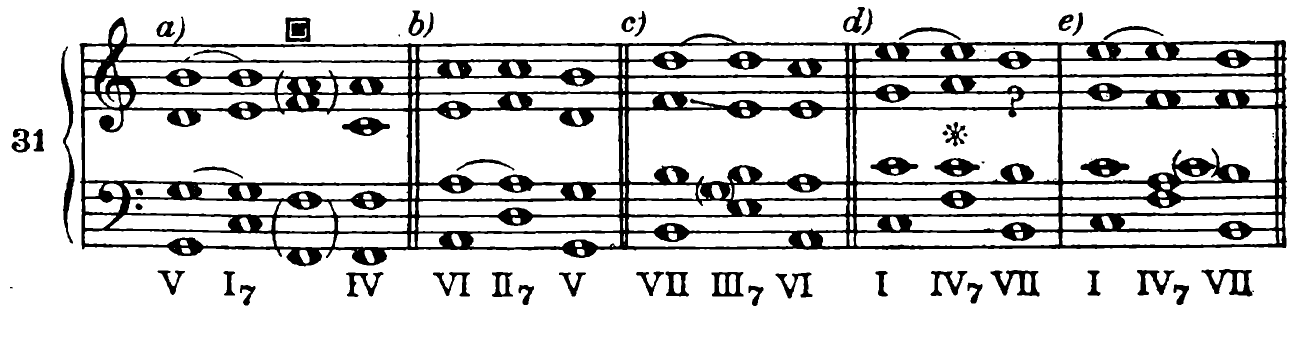
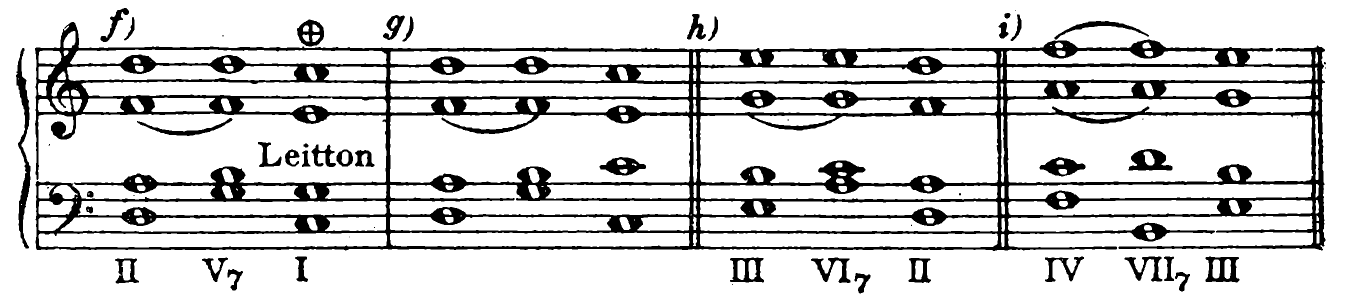
Special attention must always be given to every case involving degree VII, since it contains a dissonance. Thus in 31c, F must descend to E, making it impossible to obtain the seventh chord on III as a complete chord. The seventh and root naturally cannot be omitted, since they are characteristic intervals. The third or fifth, however, may be omitted, since neither is particularly characteristic here. If one of them were characteristic, the other would be more suitable for omission—for example, if the fifth were diminished or the third major, as in A minor. In 31d, the seventh chord on IV cannot be complete, since degree VII, the resolving chord, requires preparation of F. F must therefore be doubled in IV, requiring omission of either the third or fifth (31e). In 31i, which treats the seventh chord on VII, both the fifth and seventh of VII must be prepared and resolved, since both are dissonances. According to what was said earlier, the tenor’s B in 31f should move to G. This is opposed by a rule requiring B to move to C. B, the seventh note of the scale, is called the leading tone—more precisely, the ascending leading tone. Leading it upward to the eighth note follows the model of the ascending major scale. Yet it must follow this melodic impulse, the leading-tone impulse, only when it truly participates in a melodic matter, and even then only when it was the third of degree V and the next chord is I. In melodic terms, the seventh note has leading-tone character only in the ascending major scale. In the descending scale, B freely moves to A; otherwise, for example, resolution of the seventh chord on I would be impossible. For now, the melodic necessity of leading B to C can arise only in the upper voice. But even there it can often be disregarded—above all when other compelling reasons oppose it—and at most one will prefer to lead B to C rather than downward at the close, when it is in the upper voice.
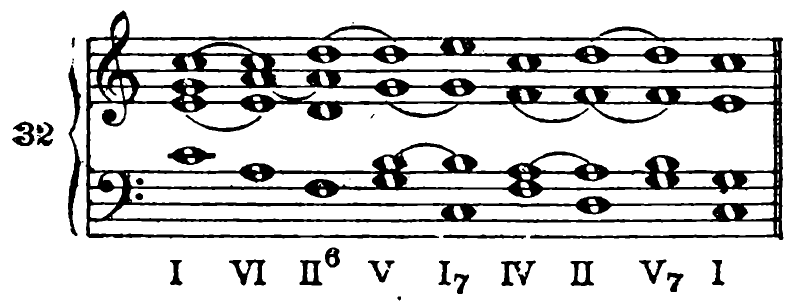
The pupil should practise preparing and resolving seventh chords on every degree, first in short passages consisting of the three chords involved, in various keys. He should then again invent passages of eight to twelve chords, each setting, alongside what has already been practised, the task of preparing a seventh chord chosen beforehand. The roots should be planned as before, always according to the table. Suppose, for example, the intention is to use the seventh chord on I in the first passage. Since degree I is the opening and concluding chord and should appear in root position both times, monotony will be difficult to avoid here. In any case, the seventh chord on I should not appear too soon after the opening chord; at least three or four chords should intervene. For example: I, VI, II, V; now the seventh chord on I, then its resolution IV, and finally the close II, V, I.
This example is, of course, rather poor because of the repetition II–V–I.
The pupil should notice how the passage here moves from the close position in which it begins to open position through the use of the sixth chord on degree II. In this respect too, he should aim for variety.
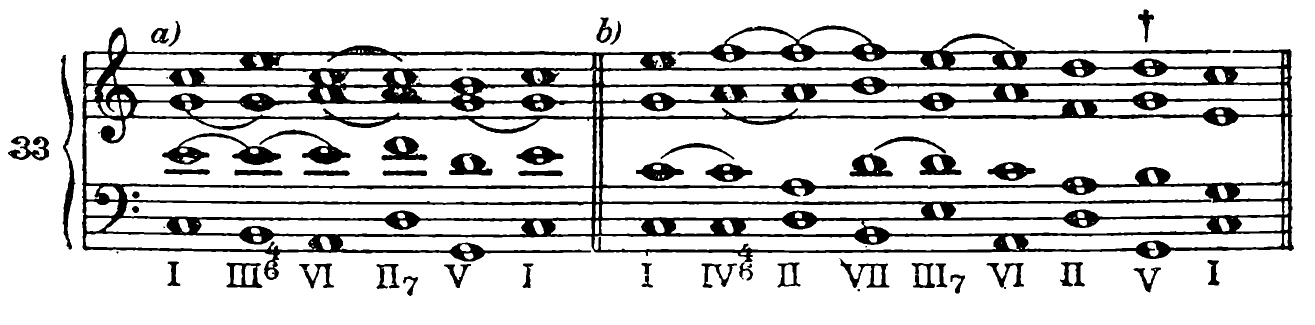
Example 33a treated the seventh chord on degree II; 33b, that on degree III.
Now that the pupil is certainly sufficiently practised in observing the instructions about parallels, he may occasionally lead the voices by a route other than the nearest one if he believes this will yield a melodically better upper voice—for example, at the dagger in 33b. For the present, of course, only the upper voice is concerned, and the sole purpose is to avoid excessive monotony that could result from too frequent repetition of a note. But note this: it is not the long-held note that sounds monotonous, since it is not sounded anew and therefore produces no movement. What can easily become boring is repeating a particular succession of notes, or repeating a note after two or three others have intervened, without sufficient changes of direction to modify the line adequately. The pupil should not be overly anxious in attending to such melodic matters. For now the smoothness he can achieve is still very limited. As our means increase, our demands in this respect will grow.
Preparation by the fifth takes place under the same conditions as preparation by the third.
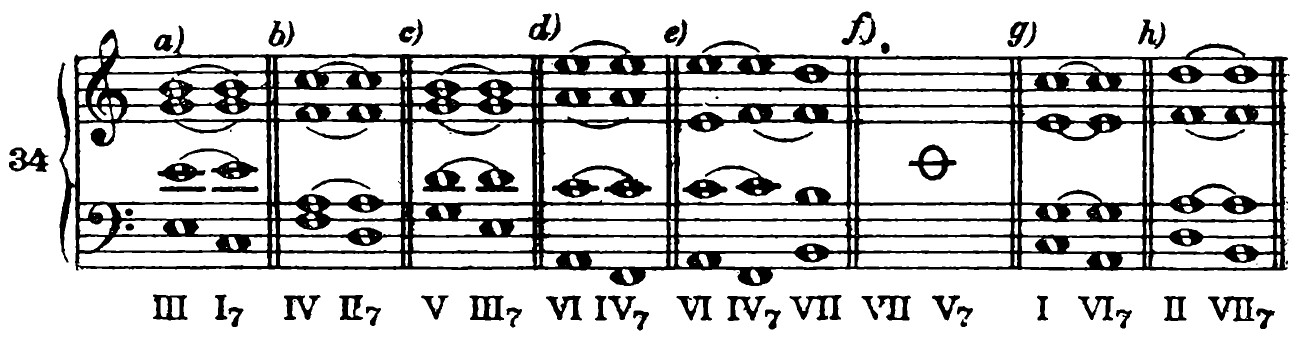
In these examples there are always three common notes that can remain in place as a harmonic link. In preparing degree IV, the root must again be doubled so that F is prepared for VII. Degree VII is unsuitable for preparing V because it does not meet the conditions we impose on a preparatory chord: it should contain the note to be prepared as a consonance, whereas F in VII is a diminished fifth and thus a dissonance. This could be disregarded, since F was previously prepared for VII and is still being sustained by the same voice. But the connection has a certain feebleness, since F, having already been dissonant against B, is deprived of its conspicuous dissonant effect. The newly entering G in the bass scarcely enhances this effect; rather, it seems as though it had merely been omitted before. This connection should therefore be excluded.
Preparation of the seventh chord by the octave is omitted for now; we shall return to it later. It remains to consider the preparation and resolution of seventh chords through sixth and six-four chords.
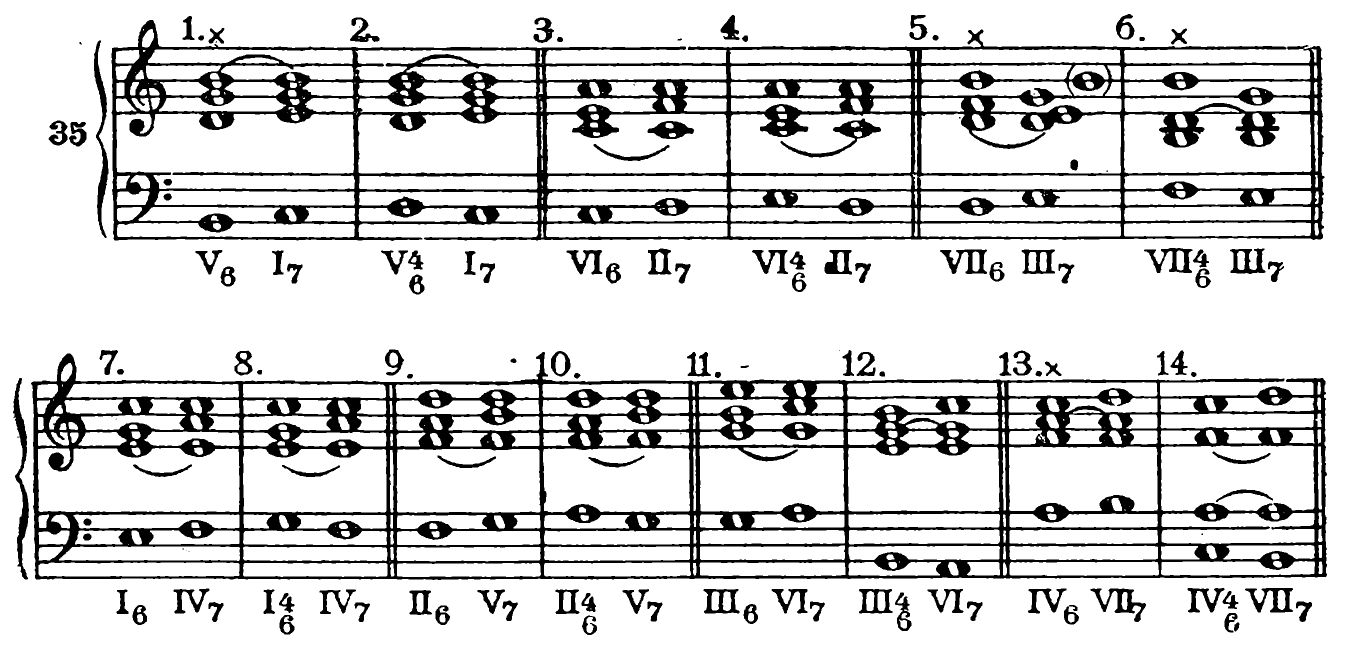
When a seventh chord is prepared by the third and the preparatory chord is in sixth-chord position, the third must be doubled (35, nos. 1, 3, 5, 7, 9, 11, 13). Preparation through the six-four chord, by contrast, proceeds without difficulty.
That we must double the third of the sixth chord here shows how bad it would be to give the rule: the third must not be doubled in a sixth chord. As we see, it must occasionally be doubled. Our instruction, as long as it truly applied, was that doubling the third is superfluous; here it becomes necessary and is therefore no longer superfluous. Even had I given a rule, I would not have wished to do so without adding that every rule is set aside by a stronger necessity. I am almost inclined to say that this is the only rule one should give.
If the sixth chord on VII is used to prepare III (35, no. 5), III cannot appear as a complete chord: either the fifth or third must be absent, because resolving the diminished fifth, F, forces a doubling of the root E. Two further points require attention. 1. Naturally, the preparatory degree VII must itself also be prepared. 2. It is advisable to make the second question “Which dissonances?” since there are two: the diminished fifth of the preparatory chord, which must descend, and the seventh of III, which must remain in place. In preparation by the fifth, it is advisable to double the fifth rather than the octave in the preparatory sixth chord; octave doubling naturally also works if one is not troubled by hidden fifths. The third could also be doubled here if one attaches importance to all the voices remaining in place, but this is not necessary (36, nos. 1, 1a, 1b).
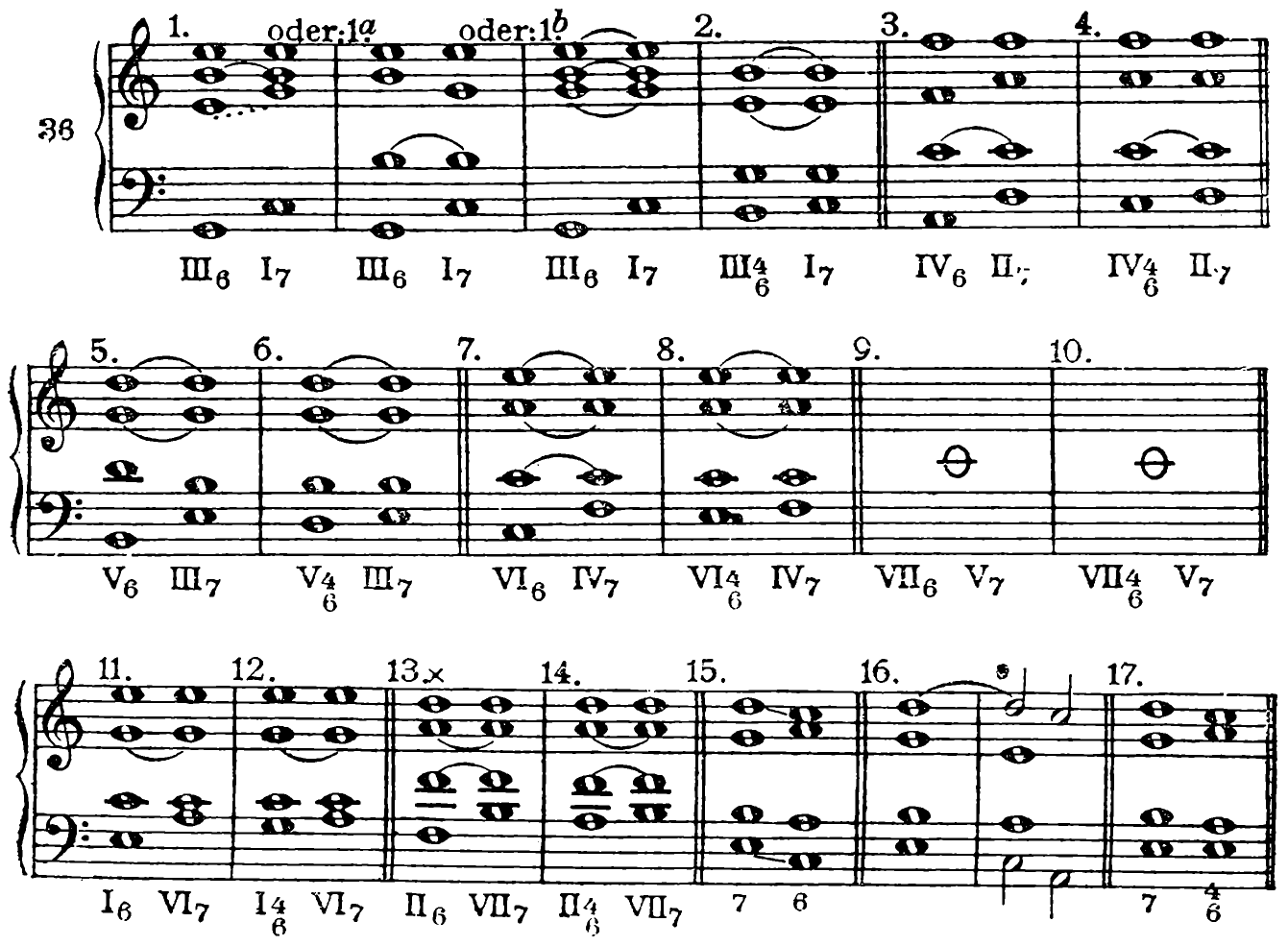
I cannot recommend resolving a seventh chord into a sixth chord. We shall see later, in Example 244, that this connection, from which we must abstain for now, will be quite possible under certain conditions (36, no. 16); for the present, however, we must be content to forgo it. The hidden octaves produced here (36, no. 15), when the seventh moves to the same note that is the nearest destination of the bass or root in parallel motion, are the only hidden octaves I find truly bad in harmonic writing. The reason is this: the seventh is a tendency tone, a note showing a compelling impulse to resolve into another. Here the seventh of the first chord is followed by the third of the next. But this same third is also to become the bass note; and if the bass takes the nearest path, as is only reasonable, it too descends. Leaping a sixth upward would help little, since to our ear the sixth has become more a melodic than a harmonic motion, perhaps solely through convention, solely because it has always been used that way. Thus the bass moves to a note expected in another voice. While that note’s appearance in the other voice is satisfying, its appearance in the bass is weak, since the arbitrariness of this choice cannot compete successfully with the necessity of that compulsion. Here one could truly speak of diminished independence of the bass voice*).
*) It might be objected that I too make an exception here, although I condemn exceptions so strictly. In reply, consider this: the case is indeed an exception, but—and this is important—an exception to a law I did not give. On the contrary, to a law I refuted. And if I give force here to the refuted law, that is surely no exception. For my refutation did not mean that composers of several centuries had not observed this law, but that their observance lacked justification. I did not dispute that people followed the law; I merely showed that they had no right to do so. But if this law has a trace of justification, this case is one of the most extreme. These hidden octaves are then truly almost as bad as open ones. And if I recommend avoiding open octaves, I may also forbid those hidden ones I find almost as bad. Consider: those I find almost as bad as open ones. Just how bad, then, do I find open octaves? Surely that must have emerged from my refutation!
Resolution into the six-four chord, by contrast, proceeds without difficulty (36, no. 17).
Here too, the pupil should first practise the connections individually, then form short passages that work through the task as systematically as possible.
Planning the bass is no longer as easy as before. The possibility of choice brings the obligation to choose well. Inversions allowing melodic bass leading should always be selected. But other conditions also arise: if, for example, one wishes to prepare a seventh chord through a six-four chord—the pupil should always formulate the task this way—the six-four chord must itself also be prepared. It is therefore best to put the task one has set in the middle, determine the beginning by working back from there, and then determine the continuation.
Suppose, for example, I have set myself the task of including in a short passage the seventh chord on III, prepared by the six-four chord on V, and the seventh chord on VII, prepared by the sixth chord on IV. I first write the degree and bass figures, and the bass notes, in the middle (37):
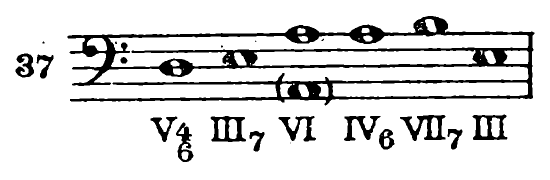
The D of the six-four chord on V could be preceded only by D, E, or C in the bass. An E bass could mean degree III, the sixth chord on I, or the six-four chord on VI. E with a six-four is ruled out from the outset, since otherwise two six-four chords would follow one another; E as degree III is also inadvisable, since III follows as the second subsequent chord. The sixth chord on I would be possible, but would repeat the note E, which is avoided when possible. Thus only D or C can be chosen as the preceding bass. D could mean only II or VII. VII is excluded because it would have to resolve to III. Only II remains, and it would be quite good if the bass did not stay in place, which is still a minor blemish. If C is to precede, only degree I is eligible, at least for now, since IV and VI have no harmonic link with V. The best solution is therefore to place the six-four chord on V, preparing the introduction of this seventh chord, immediately after the opening chord, degree I.
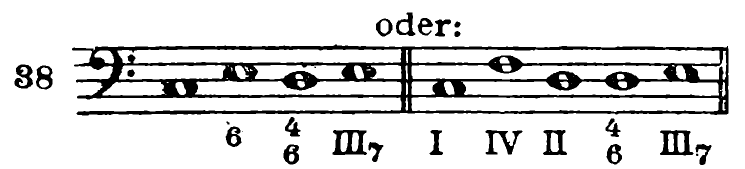
Example 38 shows another way of shaping the beginning. Example 39 gives a realization of the whole task.
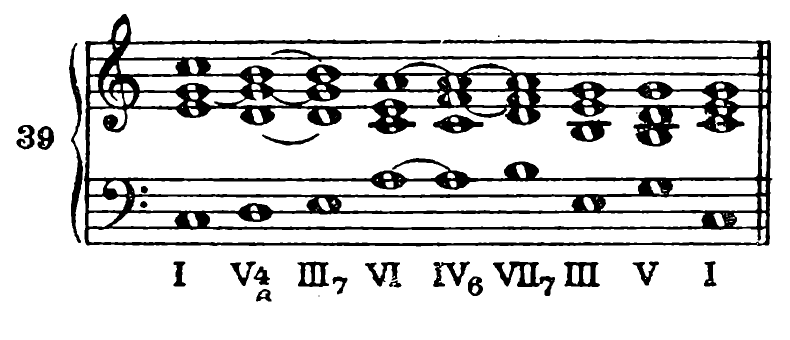
Another difficulty arose: the resolution of the seventh chord on III ends on A, and the preparation of the seventh chord on VII by the sixth chord on IV begins on A. At least three or four chords would need to be inserted here, and even then a good bass would be uncertain. The least unfavourable solution is to connect the two cases by holding A, unless one chooses the most thorough improvement: not placing these two cases together in so short an example, but choosing a different first or second case. This is not necessary, however, since finding the relatively best solution suffices. In pupils’ work, it is not always so important that the result be flawless as that the pupil have the opportunity to think through everything involved. Even without yielding a faultless result, this mental exercise often improves ability more than flawless examples could. Such examples are possible only by clearing away every difficulty, sparing the pupil the agony of choice while also diminishing the pleasure of success. A solution found independently, even if more imperfect, not only gives greater pleasure but strengthens the relevant muscles more intensely.