 Playable Books
Arnold Schoenberg · section 23 of 66
Seventh chords and their inversions in minor
Read and hear this section in the playable edition →
Using raised and unraised notes produces two seventh chords on each degree, and even four on VII. Not everything obtained here is usable yet if we are to follow the earlier instructions. Naturally, connecting seventh chords without raised notes to triads without raised notes presents no difficulty. Of the seventh chords containing a raised note, however, some are usable only conditionally; others, and the one containing two raised notes—G♯–B–D–F♯ on VII—are entirely unusable for now under our instructions.
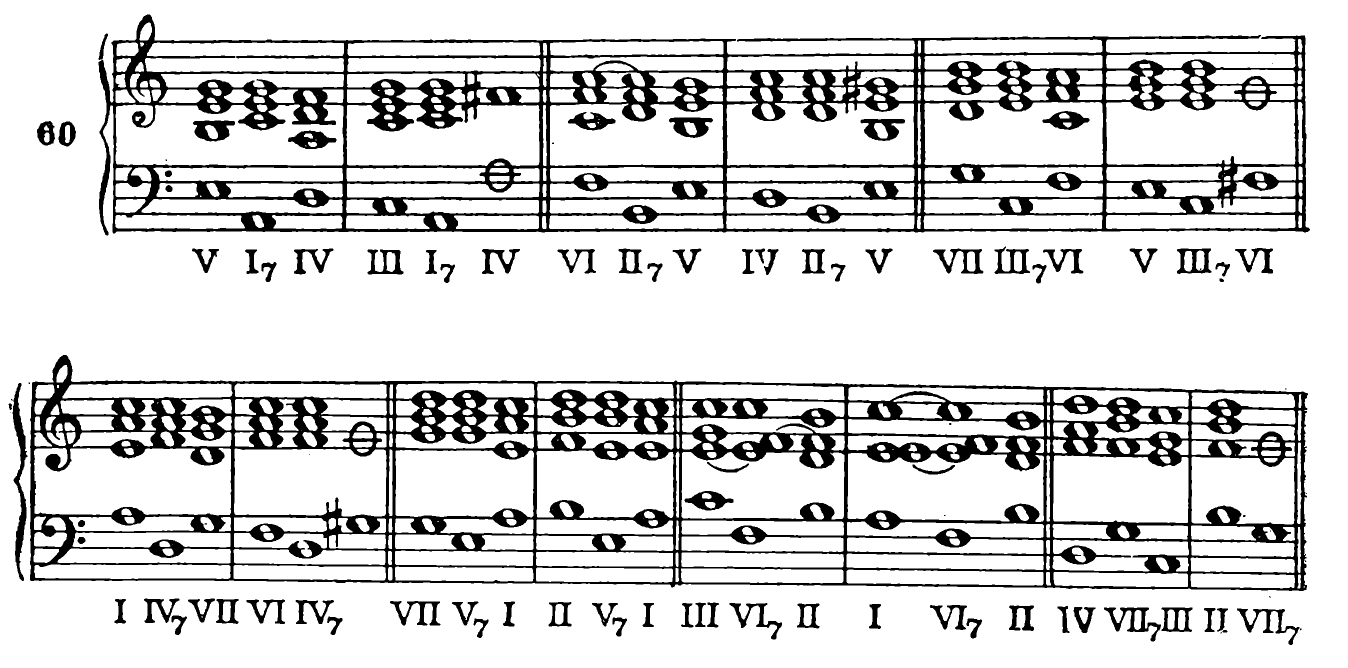
Example 60 shows preparation and resolution of seventh chords without raised notes: preparation by the third and fifth, resolution through a fourth motion in the root. This proceeds as before, without new instructions. Under our existing instructions these seventh chords can connect with triads containing raised intervals in only one case: resolution of the seventh chord on II into V with a major third. All others fail—for example the one on I, because G cannot move to F♯, and so forth.
Example 61 examines the chords containing raised notes.
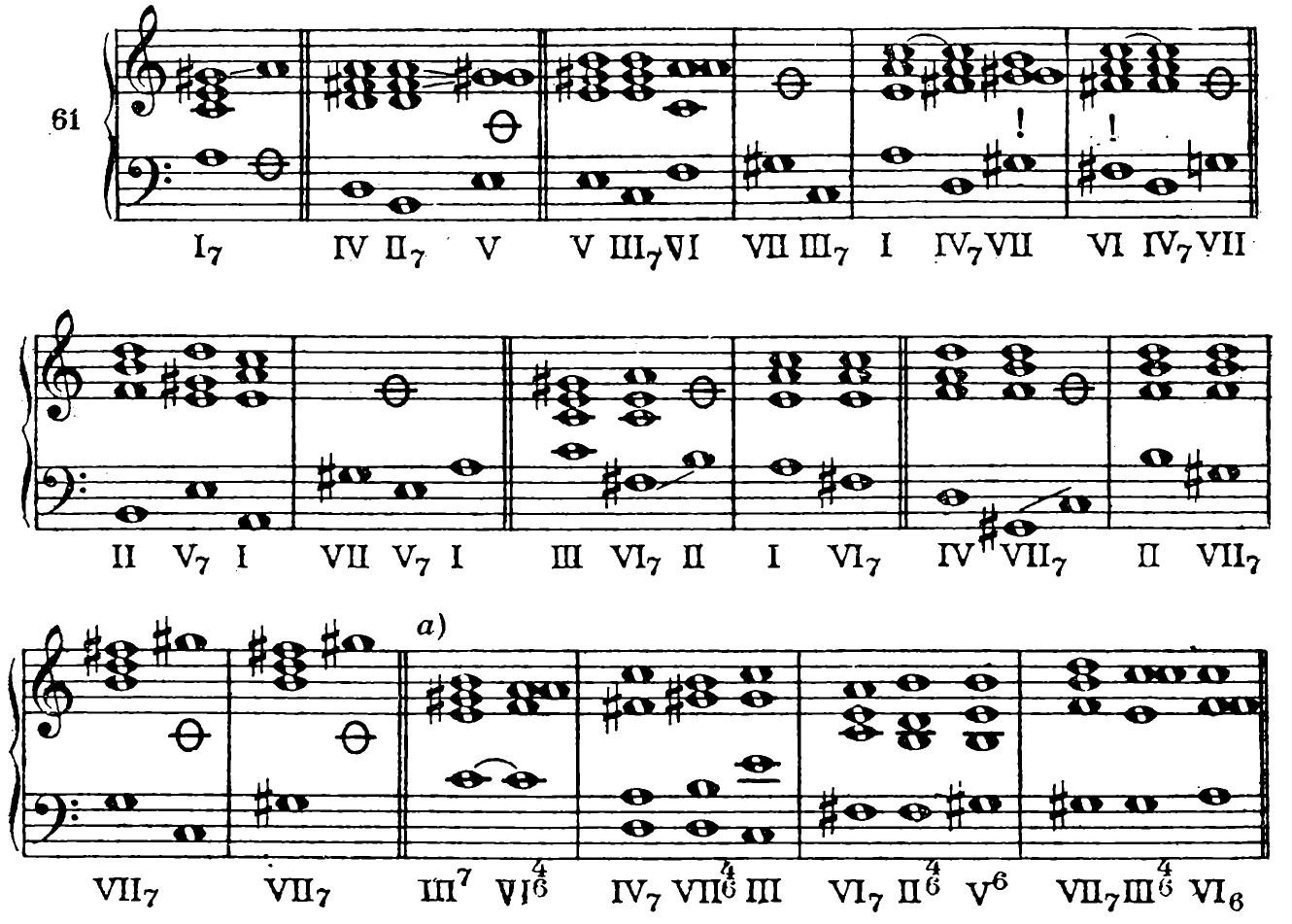
For example, the seventh chord on I, A–C–E–G♯, is presently unusable for us because its seventh G♯ must ascend as a leading tone but descend as a seventh. In II, B–D–F♯–A, both F♯ and A should move to G♯, one as a turning point and the other as a seventh. But G♯ cannot be doubled, since both G♯s would then have to move to A, producing parallel unisons or octaves. The triad on VII cannot prepare III because one must not leap away from G♯. For the same reason the seventh chord on VI cannot resolve into root-position II; resolution into the six-four chord on II is naturally possible. The same reason presently excludes the seventh chord G♯–B–D–F on VII. The other forms of VII, G–B–D–F♯ and G♯–B–D–F♯, are unusable because the seventh F♯ would have to move to G♯, and also because these chords could easily divert attention from the key. The seventh chord on IV cannot resolve into unraised VII because F♯ must move to G♯; nor into raised VII, because G♯ would be doubled. That doubling might be avoided by resolving into the six-four chord on VII. Using inversions of the three chords involved naturally opens many possibilities. The pupil is presumably now able to examine the cases himself and recognize their suitability, so I may omit that examination.
Usually most of these chords, some of which prove unusable here too—for now!—are not examined at all but simply declared unusable. I would not do that, since despite our very restrictive premises, some can be connected in inversions and with inversions. In any case, ways of using some of them will be found later. It is more useful to admit as many chords as possible, perhaps even some generally less customary ones, since they enrich a key’s harmonic possibilities, than to exclude the unusual from the outset merely because it cannot be connected according to the laws. Resolving seventh chords into six-four chords opens further possibilities (61a).
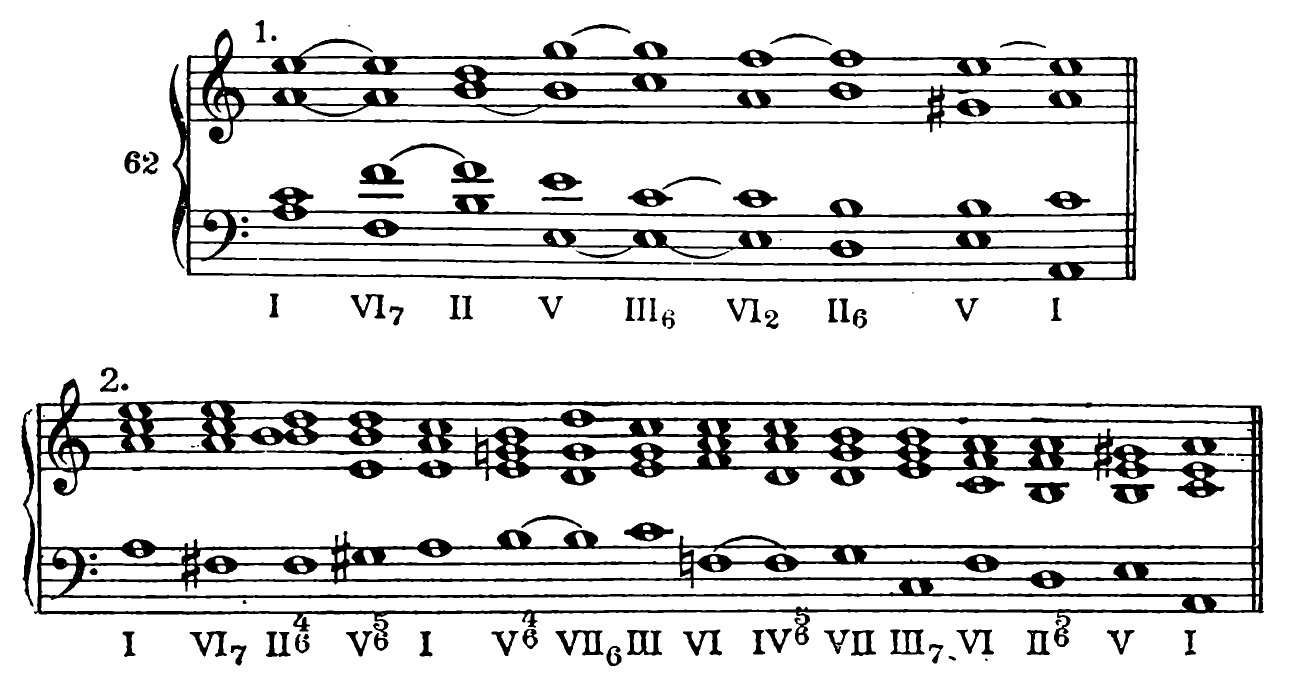
The pupil should incorporate preparation and resolution of seventh chords into short passages. Example 62 provides several models.
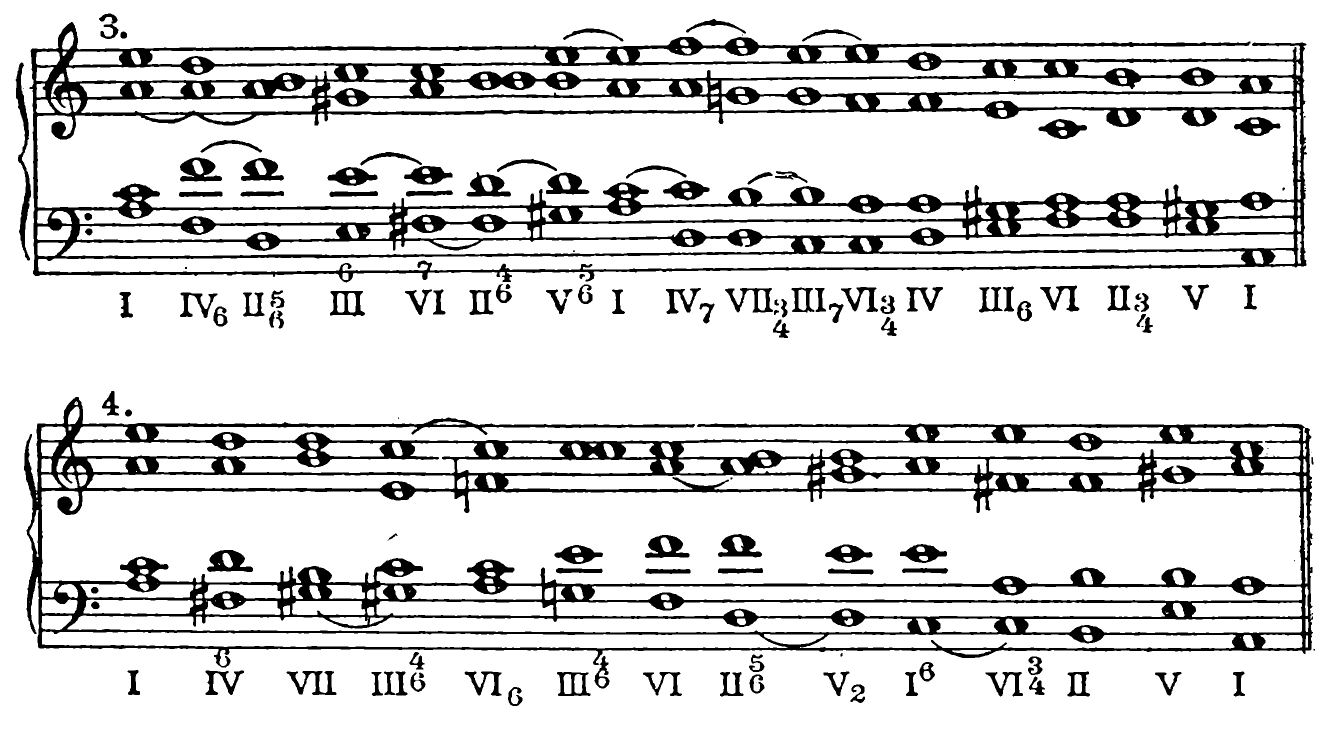
No new instruction applies to inversions of seventh chords in minor either; the earlier instructions need only be observed. Their use will again make some previously excluded connections possible. This will generally rest on the fact that the raised sixth or seventh note, when in the bass and when the connection permits, can remain in place before proceeding onward. Seventh chords can of course also be connected with one another here. Although some of this is uncommon, the pupil will do well to practise it all. It increases his understanding and skill, and that too is something. Besides, must one gain an advantage from everything one does?