 Playable Books
Arnold Schoenberg · section 24 of 66
Connecting Chords That Have No Harmonic Link
Read and hear this section in the playable edition →Connections between chords without a common-tone link were omitted at first only because they present voice-leading difficulties and because the planning of the roots might easily turn out less well. Now that we include them in our exercises, some consideration will be needed to guard against both problems. First, the voice-leading difficulties; the other matters will be discussed in detail in the following chapter.
What concerns us is connecting a degree with its two neighbours, the one immediately preceding and the one immediately following it—for example, II with I and with III. If all the voices took the nearest path, open parallel octaves and fifths would result.
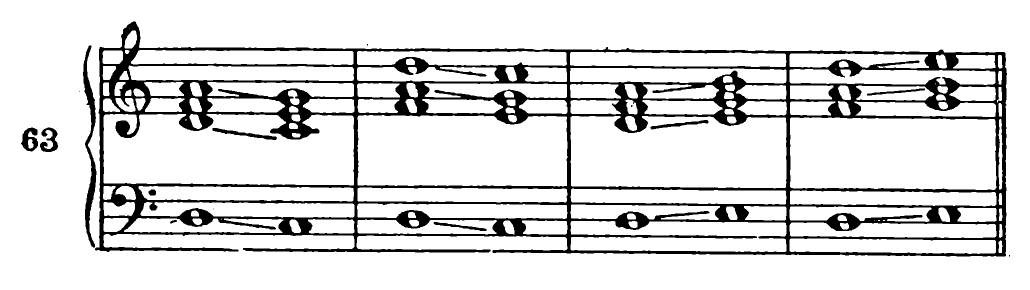
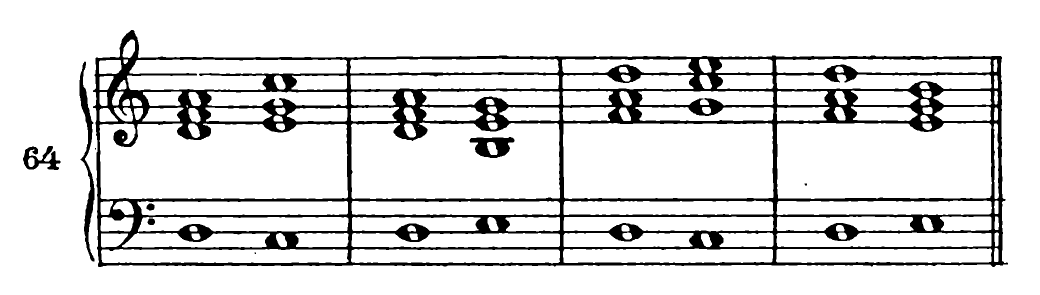
Here, then, it is impossible to take the nearest path. Contrary motion must be used to avoid parallels. The pupil is advised first to determine clearly which voices are in danger of producing them.
If first-inversion chords are used, fifths and octaves are still easier to avoid.
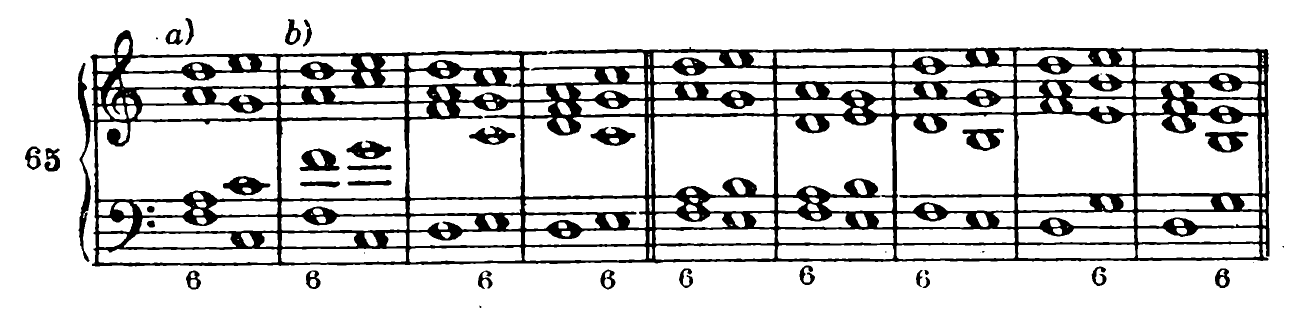
When connecting two such first-inversion chords, it is advisable to double the third in one of them, although the connection can also be made without doing so.
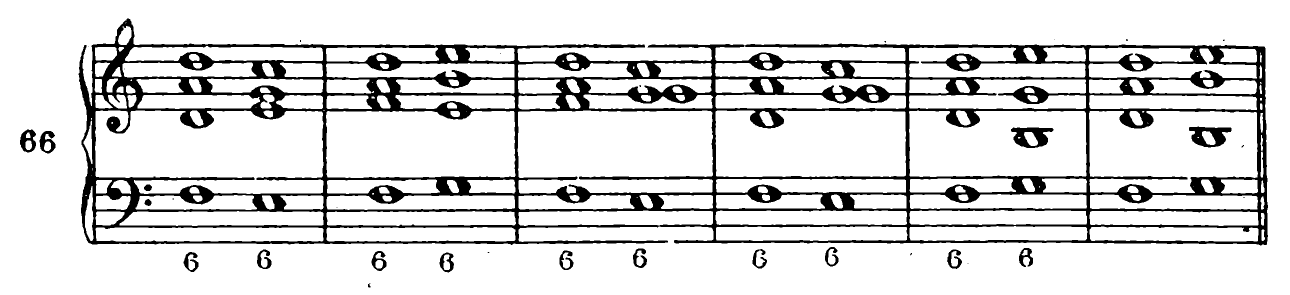
I should mention here that older theory assumes the following. When two successive degrees are connected, the lower to the higher—as in 67, II to III—the first chord is the incomplete representative of a seventh chord whose unexpressed root lies a third below: thus the seventh chord of degree VII. When the higher degree is connected to the lower, as in 67, III to II, the first chord represents a ninth chord whose root and third are omitted. Older theory gave precise instructions for resolving every note of seventh and ninth chords, and contrary motion of the voices followed automatically. This assumption is somewhat complicated, but it has the merit of tracing these connections too back to upward fourths in the roots, hence to the strongest root movement.
I mention this because on another occasion, which seems to me more important, I shall argue similarly. I am therefore very much in favour of this conception, but, since it seems unnecessary, I do not insist that the connections actually be carried out in accordance with it.
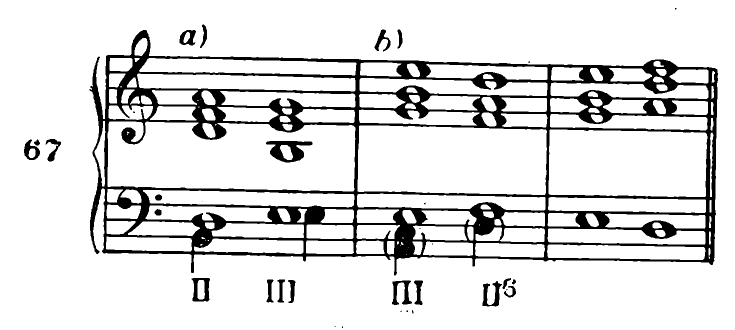
Before proceeding to use these connections in little settings, we shall add the preparation of seventh chords by the octave.
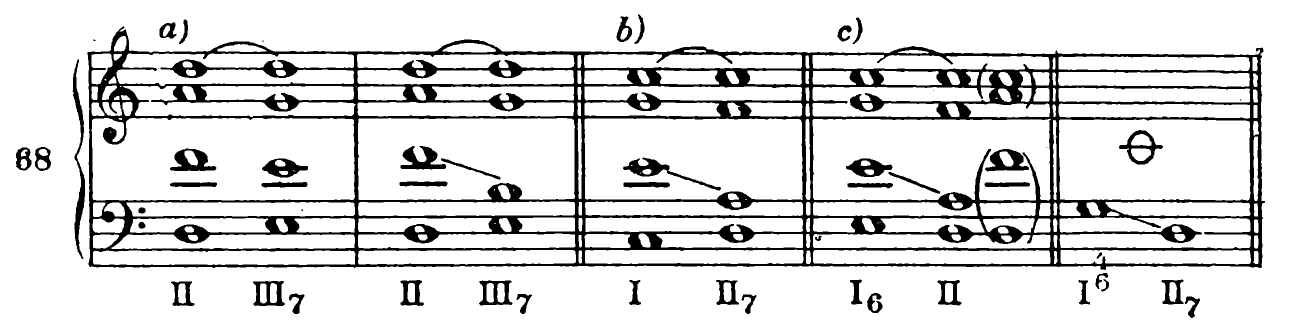
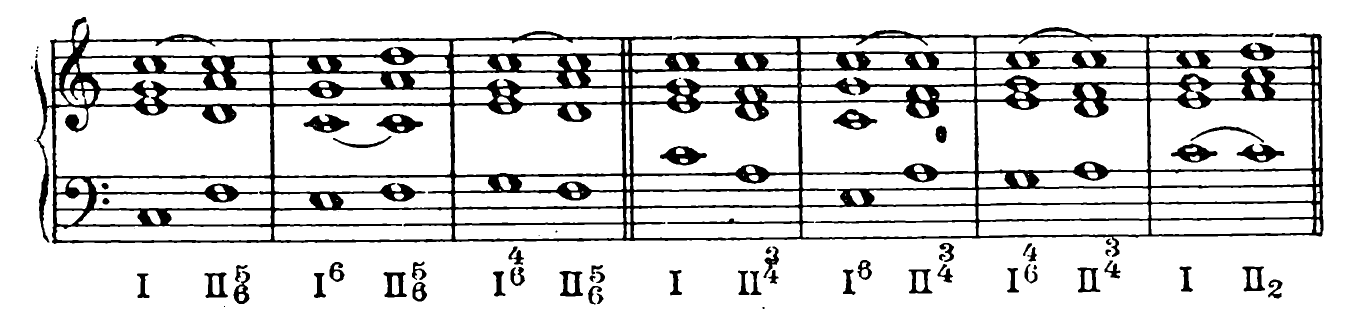
Provided the pupil takes care to avoid parallel fifths and octaves, these examples present no new difficulty. Only when the root positions of the two chords are connected, as in 68a, is it sometimes difficult to obtain a complete chord. This is possible only by leaping from the third of the first chord to the fifth of the second, as in 68b. If that fifth is diminished, as in 68a, the leap should strictly speaking be avoided because the interval is unmelodic. But if other advantages or necessities make a complete chord desirable, the pupil may now make the leap without hesitation.
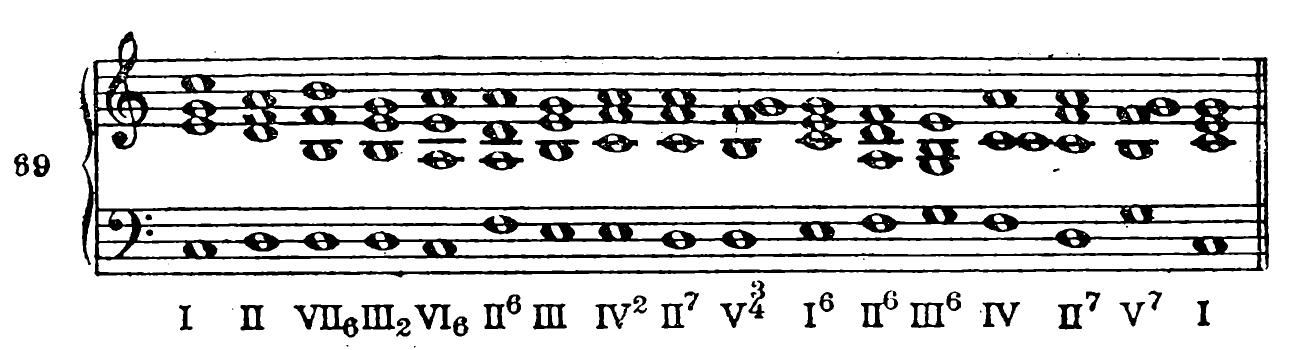
Example 69 shows their use in the form of a little setting. Naturally, the settings may now be more extensive. Practise these in minor as well.