 Playable Books
Arnold Schoenberg · section 25 of 66
Voice Leading and Cadences
Read and hear this section in the playable edition →


Planning bass lines now becomes increasingly difficult. If the many possibilities are to be used, incorporating the problems already presupposes some skill in arranging progressions, since the pupil is always working toward a particular case. Because the effort of planning demands a greater reward than a merely schematic, correct solution, the examples approach the point at which we must begin to give the sense of form richer satisfaction than before. In a word, as our means grow richer, the little settings should begin to become more rounded and smoother. Example 69, for instance, reveals a defect the pupil cannot yet easily avoid while favouring the rule of the nearest path. The soprano, beginning in a middle register, cannot escape its inexorable descent into the low register, at least not with the necessary energy. The resulting monotony can deprive even an example faultless in its harmonic progressions of part of its deserved effect. For this reason, and only for such a reason, we shall concern ourselves with melodic questions.*) But something else is disturbing too. The connection of individual chords frequently causes the other principal voice, the bass, to remain stationary. Nor do the root progressions always produce a truly good harmonic effect. We shall therefore also have to attend to the bass melody and the root progressions.
*) This apparently contradicts my assertion that harmony teaching should deal with harmonic progressions rather than voice leading. But the contradiction is only apparent: that polemic was directed against the figured-bass method, which develops only skill in voice leading, not in directing harmony. That harmonies frequently arise through incidents of voice leading is, on the contrary, one of the foundations of my approach, as shown in my discussions of dissonance treatment, ornaments, and other matters. One must distinguish a teaching method that practises voice leading where it ought to practise harmonic progression from a mode of presentation that considers the influence of voice leading on harmonic events and gives voice leading its due where that helps explain the problems.
First, the root progressions. We recognised earlier that the strongest root movement is upward by a fourth, since it seems to answer a need of the tone. This movement produces the following harmonic change, shown in example 70.
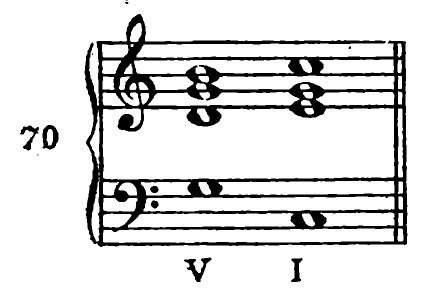
The note that was formerly principal, the root, becomes a dependent note—the fifth—in the second chord. More generally, the bass of the second chord is a higher category, a higher power, since it contains within itself the first note, which had previously been a root. In the triad on G, g is the governing tone; in the triad on C, g is subordinate and c the governing tone.*) A movement that brings this about, that gives a prince a king as his superior, so to speak, can only be strong. But c does not merely subjugate the root: it also forces the other chord members to adapt to its conditions, and apart from the subjugated former root the new chord contains nothing recalling the old rule. All its other notes are new. We may rightly assume that movements producing similar changes are similarly, or nearly as, strong.
*) This need of a tone to be absorbed into a lower tone naturally contradicts the need it exhibits at another, earlier stage: to become a root and remain a root. This contradiction is its problem, and it develops out of it. As long as a bass note was not a root, its sole aim was to become one. Once it is a root, it has another aim: to dissolve into a higher unity. I ought really to say a downward leap of a fifth, since the tone strives to be absorbed into one a fifth below. Simply to preserve the image of ascending and descending movements—which, like our terms high and low pitch, is only an image; tones are not really absolutely high or low, and the distinction could be expressed by other opposites, such as sharp and blunt, short and long—I call the ascending movement upward by a fourth, and the descending movement downward by a fourth. This is hardly unjustified: the movements rise in the direction we call depth, but their intensity rises. It is also the direction of increasing string thickness and length.
The movement that comes closest to this is a downward third in the root, as in example 71.
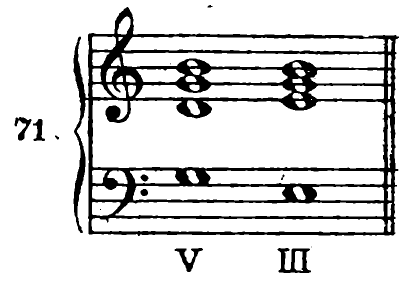
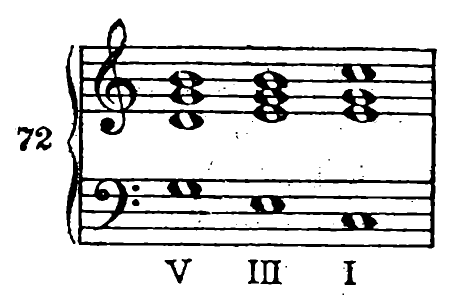
Here the former root is overcome and becomes merely the third. But the former third becomes the fifth, and thus advances; only one new note distinguishes the new chord from the previous one. Although that new note is the root, the movement, judged by the root’s victory, cannot be considered as strong as the upward fourth. Too much still recalls the former rule; too many former notes remain. Nevertheless it is among the strongest movements, as is already evident from the fact that two such movements in succession produce the same result as an upward fourth, as in 72.
Judging the two root movements by a second—upward, II–III, and downward, II–I—is somewhat more complicated. There are many reasons to call them the strongest root movements, but their use in music does not bear this out. If we consider their results, the composition of the chords, all the chord tones are overcome, since in both cases entirely new notes appear. In this respect they go further than the movements examined so far. They connect a degree with the two degrees with which it has nothing in common and is least closely related. They force this connection, which may account for older theory’s peculiar explanation of them as the sum of two movements, the principal one being an upward fourth in the root. Thus V–VI equals V–III–VI, as in 73a, and V–IV equals V–I–IV, as in 73b.
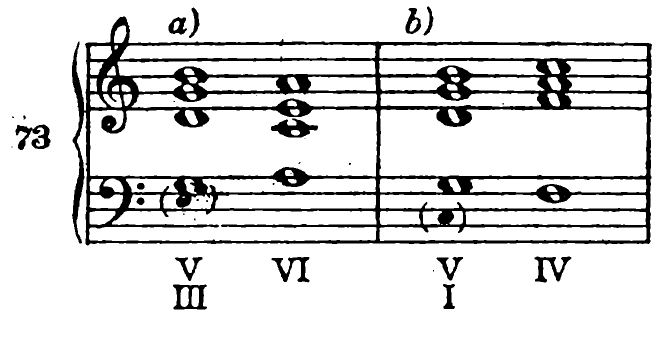
In the connection of V, G, with VI, A, in 73a, it would actually be III, E, that connects, though its root is left unexpressed. In V, G, to IV, F, the unexpressed I, C, would play the same role.
This conception has much in its favour and fits perfectly into a system of presentation that fulfils its purpose by arranging events in logical unity, opening broad perspectives and making exceptions unnecessary. But apart from its explanatory strength, it also suggests something quite different. One is almost inclined to believe that the older musicians, who sat at the source when harmony sprang forth and were present as it grew, may even have known that such a connection represents a sum. This summary procedure, this abbreviation, may have been used by them like a shorthand sign for clearly recognised purposes, such as the deceptive cadence. The interpretation would then be more than a theory: it would be an account of what happened.
The case in which only two chords stand in place of a connection otherwise made by three—which is best explained as abbreviation—also occurs frequently elsewhere. One example, to be shown later, is the dominant of the dominant in 74: I in six-four position and V, which lie between it and the closing chord in 74a, are often omitted, as in 74b.
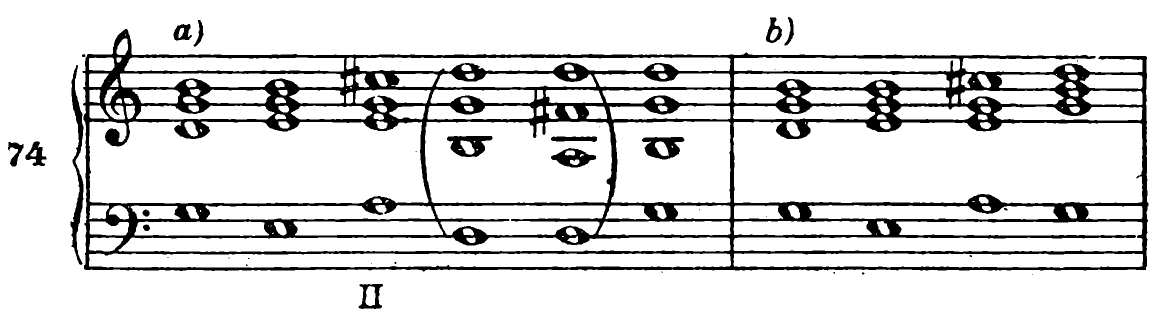
This too rests on the previously mentioned effect of the cliché, but in another sense. A stereotyped turn need not be written out in full: everyone knows that “d.h.” means “das heißt,” or “that is.” Everyone knows that degree II as the dominant of the dominant will, at one point or another and by one means or another, bring about degree I. The intermediate links may therefore be omitted and the effect joined directly to the cause. Something similar probably happened here: habit may have led, on the assumption of a familiar formula’s effect, to omitting what was superfluous. There are other examples of such abbreviation in music. Anyone who understands transposition will recognise a similar process when figuration in a double-bass part is often simpler than in the cello part. Only the essentials appear; subsidiary details are omitted, though for different reasons.
Interpreting root movements by a second as sums, as abbreviations, testifies to the older masters’ reluctance to regard them as movements like any others, and their occurrence in the masterpieces agrees with this. If one of them—which one?—were the strongest movement, it would have to play a different role in establishing the key, in the cadence. That most prominent role, however, is played by root movement by a fourth. The cadential progression IV–V is by no means insignificant, but it can be replaced unobtrusively by II–V, which cannot be said of V–I. The dominant region’s overcoming of the subdominant region, IV to V, appears as an auxiliary movement beside the finally determining movement, whose task is then easy. Similarly, the deceptive cadence is a strong means of introducing something subsidiary: it provides a connection for a digression. It always operates either in a subsidiary position or for a subsidiary purpose, yet the work demanded of it is usually rough work. Certainly it is strong, even excessively strong, since it adds two strong movements together. But it is probably too strong for everyday use: an edge made too sharp becomes chipped.
I should therefore like to call it the superstrong movement. Or, since I call the strong movements ascending*), one might also say skipping, which would express the abbreviation. It is clear that strong or ascending movements, alongside weak or descending ones, will generally always be permissible as devices of normal strength, whereas superstrong or skipping movements require a special occasion. It is equally clear that here, as elsewhere, brute force need not be identical with the strongest effect.
*) Dr Heinrich Schenker, in his book “Neue musikalische Theorien und Phantasien,” also uses this terminology for root movements. But he reverses it, calling the upward fourth descending. When the book recently came into my hands, I at first thought I had derived the terminology from it. This would not have been impossible, since I had read some of it four years earlier. But then I remembered, and confirmed by questioning pupils, that I had used these expressions in teaching long before—at least seven years earlier. Thus we independently found something similar, which is easily explained to me by the fact that it must suggest itself, given proper observation, to anyone familiar with Brahms’s harmony.
I call the two remaining movements—upward by a fifth and upward by a third—descending movements. Here is what happens in them. The upward fifth in 75a allows a note formerly of relatively subordinate importance to become principal: the fifth, an upstart, rises and becomes root. This is decadence. One might object that the advancement demonstrates the strength of the newcomer and that the root has been overcome. But the newcomer’s strength consists here only in a slackening of the root’s strength, a deliberate slackening to which the root, since it contains the fifth within itself, consents merely out of good nature, as it were, like a lion entering into friendship with a hare. The upward third shows this still more conspicuously. The former third, the weakest interval, becomes root; the new chord differs from the preceding one by only a single note, since only its fifth is new, as in 75b. This therefore seems the relatively weakest movement, which may also be indicated by the fact that two such movements in succession produce the same result as an upward fifth, as in 75c.
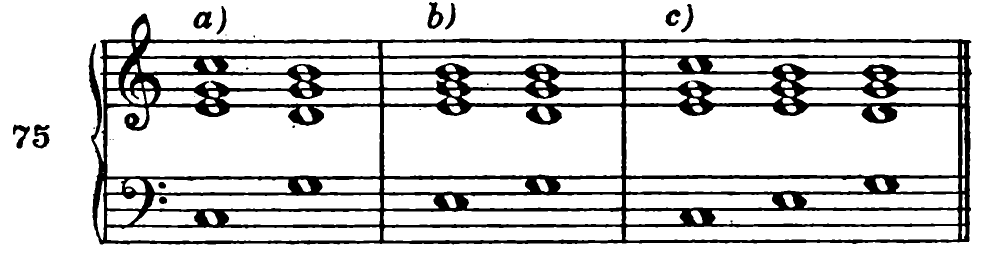
Since such a sharp distinction between strong and weak movements has been constructed here, it must now be emphasised that we cannot be concerned with using strong movements exclusively. Otherwise weak ones would have to be excluded altogether, since weak would mean bad. For that reason, as already stated, I prefer to classify the movements as ascending and descending: upward fourths, upward and downward seconds, and downward thirds are ascending; upward fifths and upward thirds are descending. This is meant to indicate the purposes served by each. That there are such purposes is self-evident, since the articulation of a musical phrase, like that of speech, requires rises and falls of tone and emphasis. Descending movements are therefore as much an artistic means as ascending ones. Since articulation cannot yet be our concern, however, we shall decidedly prefer ascending movements in planning our root progressions, and use descending ones chiefly in connections whose overall result is nevertheless ascending. Thus, in 76a, an upward fifth followed by an upward second ultimately produces a downward third, hence a rise in the harmony. The same applies when an upward third is followed by an upward fourth, as in 76b, or even by an upward second, as in 76c.
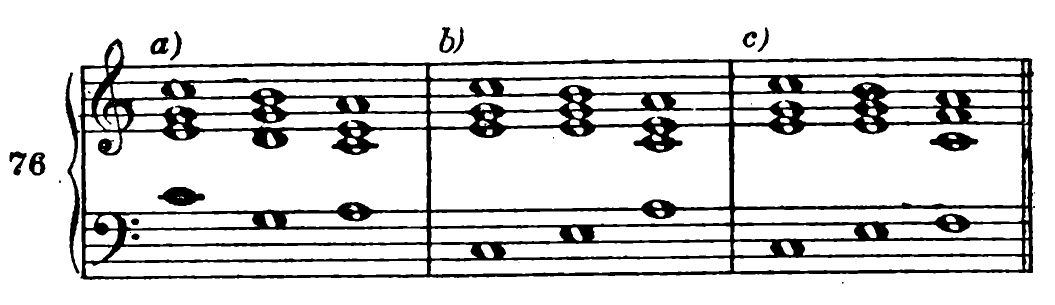
The effect is then rather as though the intervening chord had been inserted solely for melodic reasons. In our exercises, at any rate, descending movements should be used only in this sense.
To recapitulate briefly: the root movements the pupil should use while relying solely on harmonic means, without yet being able to seek a different character through melody, rhythm or dynamics, are upward fourths, upward seconds, downward seconds and downward thirds—the ascending movements.
The descending movements—upward fifths and upward thirds—are to be used only in connections such as those shown in example 76.
Naturally, these instructions do not invariably guarantee good harmonic progressions, as 77a shows, and by no means exhaust the range of possible good progressions. Above all, they are intended not as a judgement of value but only as a description of effect. As already stated, good progressions can also arise by combining descending and ascending movements; and a succession of descending movements likewise produces a musical effect, as in 77b. But until the pupil has in his ear a guide enabling him to judge new things independently, he will do well to follow these instructions. What they permit will almost always be good and only exceptionally bad, whereas an unfortunate choice of descending movements often produces weaknesses. I believe this should be the aim of teaching: to show the learner what is reliably good, or at least of moderate quality, while opening a view of what, once he has acquired cultivation, he may create through combinations of his own.
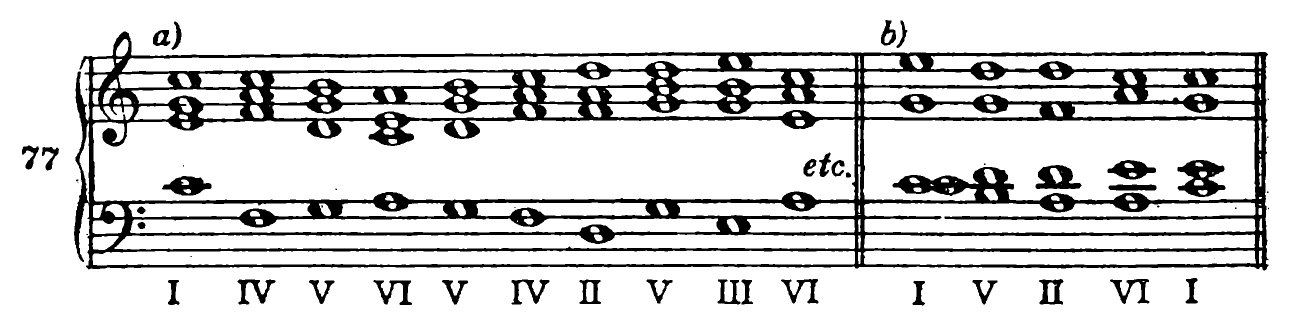
In example 77a only ascending movements were joined together, yet the little setting is not very good—naturally, judged only from the harmonic standpoint; a splendid melody above it could cancel every objection I now make. The succession of so many stepwise progressions inevitably sounds monotonous and cold. Here too the pupil will have to introduce variety: avoiding overly uniform successions and frequently and skilfully mixing root steps with root leaps. A succession consisting entirely of leaps would also be rather poor in itself, considered simply as harmony, because it is too mechanical; see 78a, b and c.
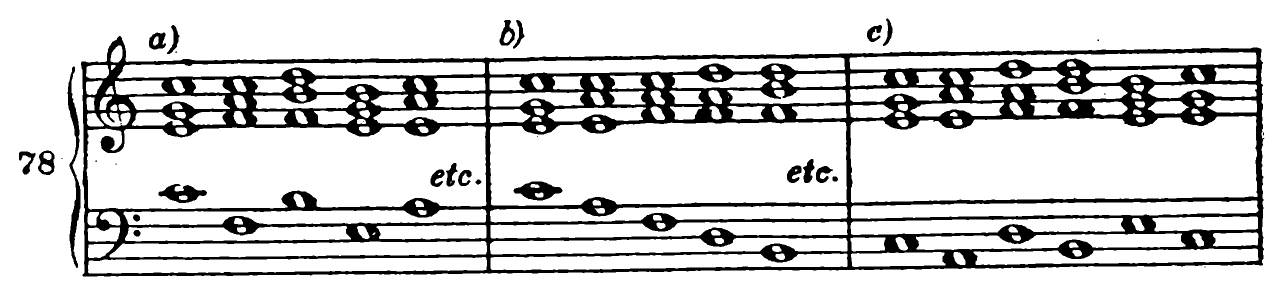
We have thus reached a second requirement in planning good little settings: the demand for variety. It is difficult to discuss this without also speaking of the opposite requirement, repetition. If the former produces diversity, the latter gives that diversity coherence, meaning and system; and system can rest only on repetition. We shall have little occasion to make use of repetition. One of the few cases relevant to harmonic construction, which touches upon motive without necessarily requiring a theme, is the sequence. Other repetitions ought really to be avoided or, if unavoidable, concealed. For now we must forgo the advantage of achieving effects through them, while guarding against their disadvantages. Within a key, our bass has a range of twelve to fourteen notes. If the setting uses more than fourteen chords, even taking the same notes in another octave no longer suffices to avoid repetition. It is not so much repetition of a note that has a poor effect as repetition of successions of notes. Even that need not necessarily disturb if at least different chords stand above the same notes. And if enough other things happen between such repeated chords, repetition need do no harm at all. Its worst form would be repeating the highest or lowest note of a line. These two points demand special attention: the climax and, if one may say so, the lowest point. Almost every melody will have such a note, and the climax in particular will hardly be repeated. Naturally, this applies here only to our simple constructions, in which the poor effect of a particular voice leading cannot be improved by another means. If one were to demonstrate that the highest note occurs repeatedly in a Schubert song—for example “Mit dem grünen Lautenbande,” “With the Green Lute Ribbon”—that is naturally another case, since other means provide the necessary variety. Nor is it meant that failure to maintain a single climax must have a poor effect under every circumstance. Above all, it must again be emphasised that this is no criterion for judging a work of art, at most one for judging pupils’ work. It merely points out something that, when observed, can never worsen the effect and may sometimes improve it substantially. The pupil will nevertheless do well to wait before disregarding this instruction until his sense of form is sufficiently developed.
Repetition of a succession of notes has an unfavourable effect not only in the upper voice but also in the bass, and sometimes even a different harmonisation cannot remedy the fault.
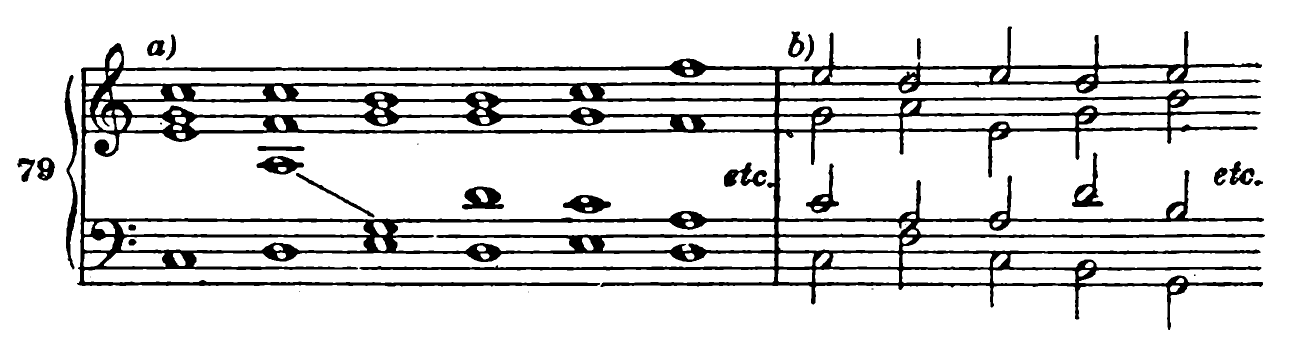
Avoiding this—in the bass in 79a and the soprano in 79b—is usually fairly easy: one need only change the soprano’s register by a leap at the right moment, or remedy the bass by choosing a different inversion. But repetition of notes in a voice suggests that repetitions may also occur in the roots. The fault must then be sought and corrected in the initial plan.
In general, the pupil must not go too far in striving for variety. Achieving melodic effects is not his task, since he could not yet succeed at it. Here the concern is more to avoid the unmelodic than to achieve an effective melody.
The following