 Playable Books
Arnold Schoenberg · section 30 of 66
Endings and cadences
Read and hear this section in the playable edition → Treatise on HarmonyJean-Philippe Rameau · the authentic cadence
 Practical Manual of HarmonyNikolai Rimsky-Korsakov · the authentic cadence and the plagal cadence
 Guide to the Practical Study of HarmonyPyotr Ilyich Tchaikovsky · the authentic cadence, the half cadence and the plagal cadencePractical Manual of HarmonyNikolai Rimsky-Korsakov · the half cadenceTreatise on HarmonyJean-Philippe Rameau · the plagal cadence
One certainly cannot attach another piece of porcelain or bronze to a vessel—a vase, for instance—of porcelain or bronze without a complicated procedure. In any case, it is doubtful whether it would still be a vase and whether the addition would stay attached. Yet once one has seen a piece of music reach a point where an ending would be conceivable—for example before the repeat sign in a sonata, or better still before the trio in a scherzo—and seen how it nevertheless continues at these and similar places, one can easily doubt the impossibility of continuation even where a piece actually ends. Indeed, leaving the sense of form aside, one could imagine following the final tonic with the same kinds of chords that have repeatedly followed it earlier.
We are therefore entitled to ask: why, how, and when does a piece of music end? The answer can only be general: as soon as its purpose has been attained. What this purpose is can scarcely be explained here even in outline: until the sense of form is satisfied, the need for expression fulfilled, the thought at issue clearly presented, and so forth. For our teaching aim, only this matters: until the purpose has been attained. To the extent that our exercises stand below the artwork, it is correspondingly easier to say what their purpose is. Our exercises always have such a purpose; the artwork never does. The artist perhaps sometimes has one, or at least believes he does, whereas in reality he follows his impulses, not a purpose. This difference makes assembling harmony exercises accessible to everyone, while producing an artwork, or even comprehending one, remains inaccessible to most. Although the artist finds his bearings in the higher sphere of purposelessness, suitability to purpose remains the only reliable foundation for teaching artistic craftsmanship. Such teaching lives by trying to recognize as compulsion what, in the artist, was the highest freedom. And the power of this highest freedom, viewed from the close proximity of craftsmanship, is inconceivable without laws and purpose. Only a distance appropriate to such expanses reveals the true picture. Here proximity diminishes, while respectful distance alone shows true greatness.
Our purpose might be, for example, to prepare and resolve a seventh chord, to demonstrate the connection of a sixth chord with a six-four chord, and the like. The pupil could always set himself the additional purpose of reviewing earlier learning at the same time. According to what has been said, we should stop at the very moment such a purpose is fulfilled, for only this modesty can excuse our attempts. The point at which we should stop is therefore easy to determine. But stopping is not closing. Stopping simply means not continuing. Closing is different: an effect of closure requires special means.
I must say at once that I do not believe it possible to shape an ending so that every continuation is excluded. Just as The Magic Flute and Faust admit a second part, so does every drama; every novel admits a Twenty Years After. And although death is the ending of tragedy, it is not the ending of everything. In music too one could continually add new chords, as the many cadences and frequent repetitions of the final chord, especially in older masterpieces, testify. Yet even then one could undoubtedly continue, develop the thought further, or add new thoughts. This might violate proportion, but we have no formula for that. Often enough, what was first thought excessive has later proved proportionate. In this respect music resembles a gas: in itself without form, yet capable of unlimited expansion. Put it into a form, however, and it fills that form without changing its mass or content. Considering this, I must regard making an ending truly compelling as difficult, almost impossible. It is not unlikely—perhaps even certain—that every idea and its manner of realization contain something pointing to limits that should be reached but must not be exceeded. It is not unlikely, though not entirely certain, that each idea carries such a proportion within itself; but this proportion may lie not in the idea, or at least not in it alone, but also in us. It need not therefore lie in us as something immutable, naturally given and incapable of change or development, but as something transformed with currents of taste, perhaps even with fashion, following the spirit of the times. I do not believe in the golden section. At least, I do not believe it is the sole formal law of our sense of beauty, but at most one among many, countless many. Thus I do not believe a movement must necessarily be precisely so long, neither longer nor shorter; that a motive, considered as the germ of the whole, could have permitted only this one realization. Otherwise it would scarcely be possible to write two or more different fugues on the same subject, as Bach and others repeatedly did. If such laws exist, we have not yet recognized them. But I believe something else: each age has a particular sense of form that tells it how far an idea must be developed and how far one must not go. What matters is to fulfil the conditions acknowledged by convention and by the age’s sense of form: conditions that, through possibility, arouse expectation and thereby guarantee the satisfaction of the ending.
Until today, music has had the possibility of drawing such boundaries by following the laws of tonality. I have already said that I do not regard tonality as a requirement of artistic effect imposed by natural law. The laws through which it comes about are still less such a requirement: they merely exploit natural properties in a one-sided, straight-line manner. They do not teach the essence, but merely aim at the regular, mechanical execution of an artistic device that can give musical ideas the appearance of completeness. I shall return to tonality repeatedly and at length, so here again I say only what is immediately necessary. Certainly the idea of ending on the same tone with which one began contains something very right and in some respects also seems natural. Since all the simple relationships derive from the tone’s simplest nature, its nearest overtones, the fundamental already has a certain predominance over the structures proceeding from it: their most important constituents, deriving from its brilliance, are, so to speak, its satraps and representatives—Napoleon placing his relatives and friends on European thrones. This alone, I think, would explain why obeying the fundamental’s will is justified: gratitude toward the progenitor and dependence on it. It is alpha and omega. This is moral as long as no other morality prevails. Things may therefore turn out differently! For example, when the supreme ruler becomes weak and his subjects strong—a case arising all too often in harmony. But just as a conqueror need not remain a dictator, tonality need not be governed by one fundamental, even if derived from it. On the contrary: the struggle of two such fundamentals for predominance can be highly attractive, as many examples of modern harmony show. Even if it ends there too in one fundamental’s victory, that need not be inevitable. This question could remain open when so many others remain unanswered. We take no less interest in the problem than in its supposed solution. It is superfluous to return each time to the earliest ancestors, to prove the chords’ descent from the fundamental with the utmost thoroughness, and not merely to demonstrate their reducibility to it in full detail each time—although everyone knows it and it lives in memory and the sense of form—but also to arrange everything so that these relationships leap to the eye. The elaborate way earlier musicians tied up, bolted, nailed down, and sealed the end of a piece would be too cumbersome for today’s sense of form to wish to use. The premise that the tone is the source of all this may safely remain suspended in the air, since every tone reminds us of it anew anyway. And when we fantasize, we do not bind ourselves to limits either, although our body has them.
The present-day sense of form does not demand this exaggerated comprehensibility through the explicit working-out of tonality. A piece remains comprehensible to it without the relation to the fundamental being treated as foundational; it can follow even when tonality is kept, so to speak, suspended. As many examples testify, nothing of completeness is lost when tonality is merely suggested, or even blurred. And without claiming that the most modern music is truly atonal—for perhaps we simply cannot yet demonstrate its tonality or something corresponding to it—the analogy with infinity could hardly be brought closer than through a suspended, so to speak infinite harmony: one that does not constantly carry its certificate of domicile and passport, carefully documenting its country of departure and destination. It is quite nice of respectable citizens to want to know where infinity begins and where it will end. We can forgive their limited confidence in an infinity they have not measured. But if art is to share anything with the eternal, it must not fear the vacuum.
Earlier musicians’ sense of form demanded otherwise. For them comedy ended in marriage, tragedy in atonement or retribution, and the musical piece “in the same key.” Thus choosing a scale imposed the obligation to treat its first tone as the fundamental, to present it as the alpha and omega of every event, the patriarchal ruler of the territory bounded by its power and will. Its coat of arms stood in the most visible places, especially at the beginning and end. This gave them a possibility of closure whose effect resembles necessity.
We shall have to learn the artistic means through which tonality is expressed. First, however, we return to our starting point: the ending. When the pupil is more advanced, the study of form will show him that producing an ending requires means beyond harmony alone. Discussing these means and their function, and thus guiding him as he needs, is much harder there—so hard that it is advisable to acquaint him already with what such an effect depends upon.
Melodically, the key is represented by the scale; harmonically, by its diatonic chords. Merely using these constituents without emphasis, however, does not suffice to establish the key. Certain keys are so similar and so closely related that it is not always easy to determine which is intended unless special means are used to distinguish them. Clearly, the most closely related keys are those most alike: first relative keys, such as C major and A minor; then keys with the same tonic, such as A minor and A major; and then—here the most dangerous relatives—keys differing by only one accidental, a natural, flat, or sharp, such as C major and G major, or C major and F major. Whereas the difference between A minor and A major, for example, is noticeable almost at every moment and disappears only on degree V as the dominant, the situation is nearly reversed with the last kind of relationship. Almost all notes and a large number of chords are shared. C major differs from G major only in having F where the latter has F♯; from F major only in having B where the latter has B♭. It is therefore easy to make progressions in C major that could be taken for G major or F major.
Is this C major or G major?
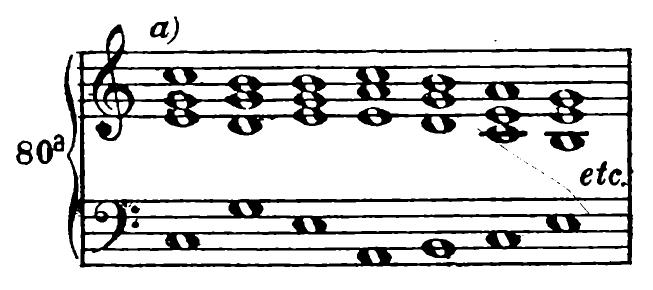
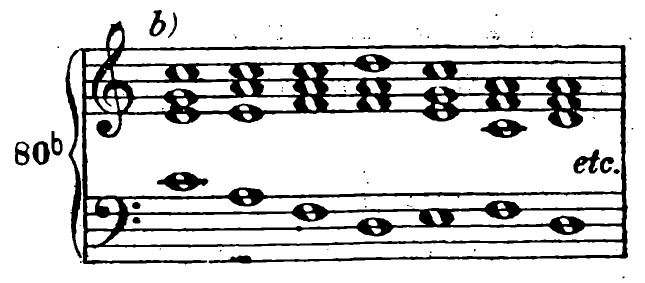
Is this C major or F major?
If the note F is avoided, successions arise that point just as readily to G major as to C major; if B is avoided, the passage can be heard as F major and can also be turned in that direction.
To establish C major without any doubt, so that neither F major nor G major can come to mind, one must therefore introduce B and F. The most important means of expressing a key will thus be to distinguish it from the keys it most resembles, to separate it clearly from its nearest neighbours. Once confusion has been ruled out even with those keys with which it could most easily be confused, it has been established unambiguously.
The tendency mentioned several times already—a tone’s tendency to lose itself in a tone a fifth below it, which is its root, and to become that tone’s fifth—naturally operates in degree I as well. F major is therefore its greatest danger. Our first effort must consequently be directed toward preventing the pull to the subdominant, the feeling of F major, from arising. Melodically this is done by the note B. Since B belongs to three chords, degrees III, V and VII can express this intention harmonically. All three might be used, but V is rightly preferred: its root finds in I the root lying a fifth below it, whose fifth it instinctively seeks to become.
A key could clearly be established by its degree I alone, especially if nothing contradicts it. Admittedly, every chord joined to I must, as a departure from the tonic, divert attention from the key. Only a particular grouping makes it possible to master this diversion and lead back to the tonic. Thus even the smallest harmonic sentence contains a problem: wandering away from the tonic and finding the way back. But if the tonic stood alone and were not contradicted, the key would be expressed primitively, yet unambiguously. The more often it is contradicted, and the stronger the means used, the stronger the means must be that restore the key. Conversely, the fewer the harmonic events, the simpler the repair will be. There are therefore cases in which merely stating I, V and I suffices to establish tonality clearly enough. Melody can naturally contribute, since on another plane it too arises through the functions of the fundamental tone. Indeed, even without the aid of harmony it can express the key, as in the familiar post-horn melody, which consists only of the first natural harmonics (81a), or in simple dances and folk songs (81b).

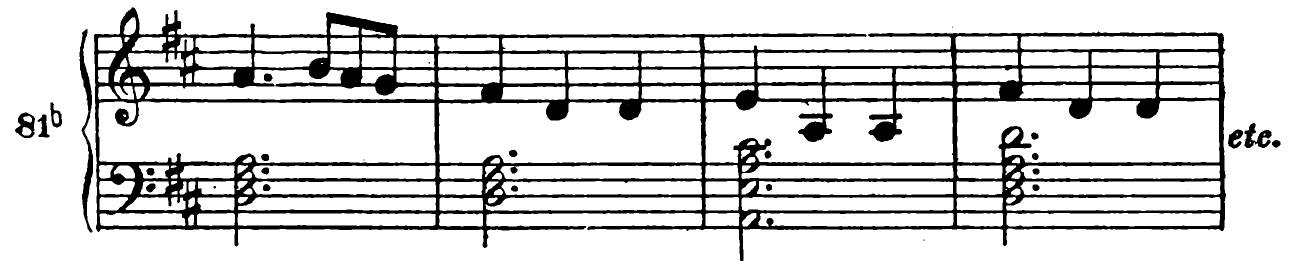
Here the key is established unambiguously, although in the first case, without any harmonic accompaniment, only components of I are used, and in the second case the accompaniment uses only I and V: neither is ever contradicted. The two simplest ways of expressing the key and forming a close are to use only I—a possibility excluded for us—or only I and V, which is also unlikely in our work. Yet this already gives us the first and simplest cadence.
In a longer piece, successions will naturally occur that point toward the dominant. This makes it necessary to rule out that implication as well. The melodic requirement for doing so is F; harmonically, degrees IV, II and VII come into consideration. Since VII seems suitable both here and for countering F major, one might think it should be preferred exclusively as the most effective means for both purposes. Indeed, this was done in earlier times. Yet it plainly lacks the force of the other means we have mentioned. Perhaps part of the attraction of a key lies precisely in the way a G chord momentarily suggests G major and an F chord suggests F major. Perhaps the subjection of such complete triads—each of which could, in itself, lay claim to a key—their subjection to the will of the tonic, is what gives these successions their force and confirms the tonic’s power (“as the servant, so the master”). It is therefore natural to suppress the feeling of G major with a chord or root movement similarly strong to the one used earlier against the feeling of F major. Degree II has the upward leap of a fourth into V. It contains F, but IV is more complete. Its movement into V is a second upward. We have understood such a movement as the sum of two movements; here that would be IV–V = IV–(II)–V, so that II would be contained within it. But IV also has another quality that possesses a special attraction in the sense suggested above: within this framework it is the sharpest contrast to G major, and its relationship to the tonic C is the reverse of V’s. The way these two degrees, V and IV, relate to I—the one, as it were, its already illuminated past, the other its still dark future—gives the proportion G : C = C : F, the “golden section”. The smaller, past term (G) relates to the larger, present term (C) as the larger, present term (C) relates to the whole, future term (F). One might imagine that the motion that produces music could arise from the tonic alone, from the relationship of its two moons to it and to one another. This relationship, because it agrees in every respect and admits so much interpretation, seems so remarkable that one might be led to think it, or something similar, must be found in all music if it is truly to be music. Yet not only need this not be so; perhaps the search has simply been insufficient, and therefore nothing has been found. For it is probable that higher and more complex numbers, more composite harmonic relationships, contain an even richer mysticism than prime numbers and indivisible, simpler harmonic relationships. On this rests the hope of a continuation richer still in intriguing mysteries. I therefore consider it important to stress all these peculiarities again and again, so that they can never be forgotten: I am certain they also contain the key to phenomena that remain obscure to us today.
Degree IV is therefore even better suited than II to establish the key, together with V and I, in a way that promotes a close. The remaining question is whether these degrees should occur in the order in which our investigation brought them to us: IV–(II)–V–I or V–IV (II)–I. Clearly V–IV–I also fulfils the purpose, since it presents the same evidence for the key. Nevertheless, IV (II)–V–I is more effective, for the following reason. The root movement V–IV is certainly entirely equivalent to IV–V and forcefully overcomes the dominant region by opposing the subdominant to it. But the subdominant, which in turn is drawn toward its own subdominant, does not follow its own impulse when the tonic comes after it; the tonic’s appearance is correspondingly less decisive. In the other arrangement, however, every pull toward the subdominant has found fulfilment in IV, which appears as the third-to-last chord. This entire downward tendency is then overcome by the dominant, which in turn follows its natural pull downward by a fifth and introduces I as the self-evident fulfilment of that impulse. The same result is reached if V–IV is understood as the sum V–I–IV, two movements of a fourth, and IV–V correspondingly as IV–II–V, a movement of a third followed by one of a fourth. One arrangement then reads V–(I)–IV–I: its unexpressed repetition of I is feeble. The other reads IV–(II)–V–I, in which the unexpressed II proves to be IV’s familiar rival. The last three chords of our closes will therefore best be IV–V–I or II–V–I.
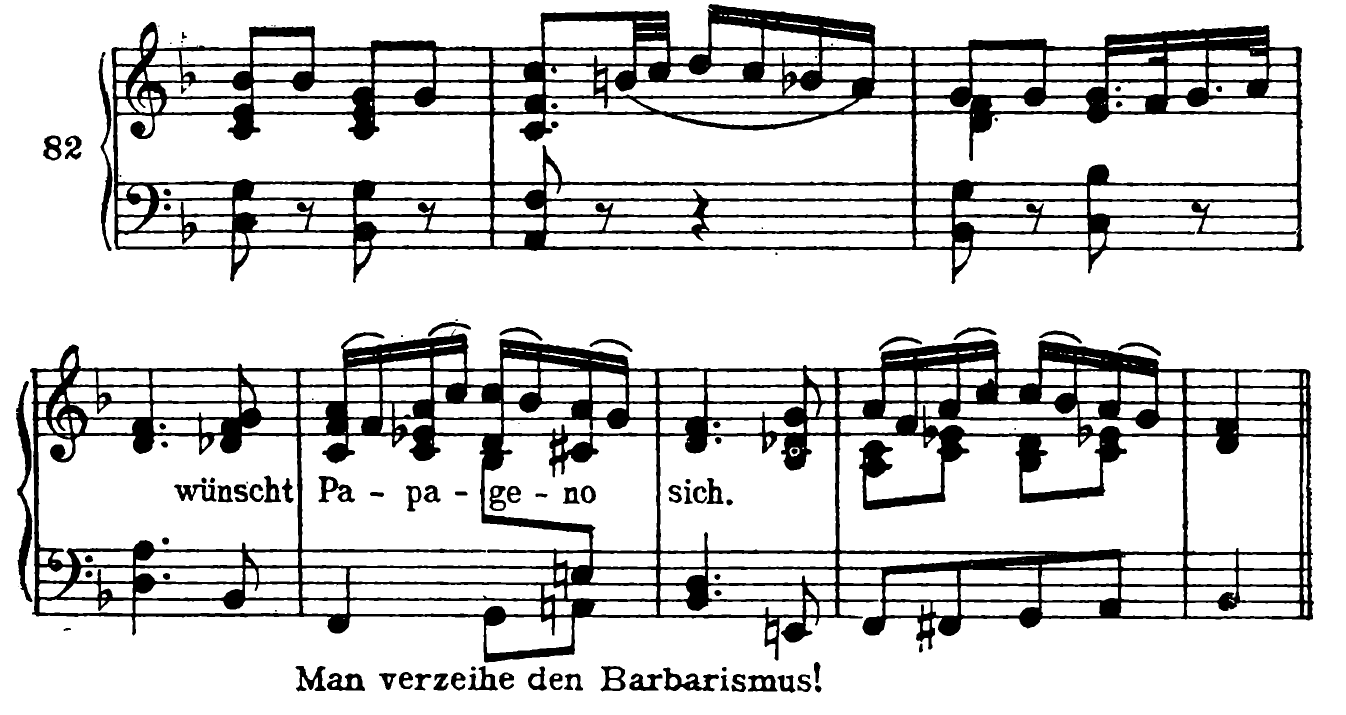
If a passage is directed so that one of these two three-chord successions can be placed at its close, the possibilities of harmonic interpretation have been given a boundary capable of bringing the passage to an end. Naturally there are other means of producing a closing effect, and naturally they have been and continue to be used together with harmonic means. Rhythm and melody can certainly cadence on their own. Otherwise a single-line melody would have to continue for all eternity, and a drummer could never stop. There are surely also harmonic means not yet theoretically identified whose ability to form closes—or rather to permit them—is as great as that of IV, II, V and I. But a close can certainly be brought about without employing all these means at once. Sometimes one suffices; sometimes several are needed. Harmony is the least capable of achieving this alone, without the others’ assistance or even against them, whereas melody can manage it on its own. This can be demonstrated only through simple examples and an untrained ear. If, for example, a familiar melody that clearly cadences in its key is harmonised differently from what suits it—by deceptive cadences and the like—and played to someone without musical training, a child for instance, then, if the child knows the melody, it will know that the melody has ended with the last bar here, although the harmony has not ended. This may be disturbing, but it does not alter the feeling of a close.
And this is indeed understandable. Grasping musical events is nothing other than a rapid analysis, a determination of the components and of how they belong together. Now, in succession—in melody—one naturally has more time to put the impression in order (unconsciously) than in simultaneity, in harmony. It is therefore clear why the ear must be better trained for melody than for harmony. And this indeed agrees with practice. Whoever grasps and retains harmonic events certainly stands at a higher level than one who merely grasps melodies. The effect of the horizontal is therefore greater than that of the vertical. A close carried out in the horizontal will have a stronger effect than one carried out in the vertical.
The question whether music of our time still needs to secure its endings by harmonic cadences may be answered in the negative. Above all because such cadences at most create a possibility of closing, without the close thereby becoming any more compelling. They constitute the peculiarity of a particular musical style, in which only certain chords are used, and these only in a certain way. There the diatonic chords are in the majority; therefore the stylistic need for balance, and habit, perhaps demand the establishment of the key, a cadence. But where, as in more modern music, non-diatonic or (as I call them) vagrant chords predominate, the necessity of confirming the key may be doubted.
The cadences can be elaborated still further, and our attention will be directed toward making ever new means serve this purpose. Among the chords known to us so far, the succession IV–(II)–V–I proves to be the strongest cadence. But what is weaker can also have its charm under certain circumstances, and therefore the suitability of other degrees will be discussed here as well. Looking first for a substitute for V, we consider the capacity of degree III. It has two chord tones in common with I, and that is a shortcoming here. But it has the leading tone, and so marks the boundary against F major, and its root progression is relatively strong (a step of a third downward). It ought therefore to be suitable after all. Nevertheless it is not customary, and so we shall hardly use it; but we shall note why we do not: chiefly because it is not customary; that is, it could be used; its effect would probably be weaker, but above all unaccustomed. I have already indicated to what extent VII was used in earlier times. It does define the key, it does lead to the final chord, but it too is uncustomary today, and so we leave it out. Nor does it come into consideration as a substitute for IV or II, for it chattily blurts out the most important secret of degree V, which is supposed to follow it: the leading tone. It also deprives V of the possibility of leading into degree I with even stronger effect as a seventh chord, since its diminished fifth is identical with the seventh of degree V (in C major, F). On the other hand, it is possible to precede degree V with VI in place of IV or II. Perhaps this connection, too, rests on what the hypothesis of the older theory assumes for steps of a second: that what is really being connected here is an unexpressed root lying a third or a fifth lower (IV or II). This succession, VI–V–I, is not uncustomary and is therefore available to us.
The pupil should first practise cadences in separate examples. From now on every little exercise is to be concluded with a cadence, and a few further directions will be given for this. It is uncustomary to bring the penultimate chord of the cadence, degree V, in an inversion. On this occasion one likes to use the strongest form, which is understandable. It is, however, often brought as a seventh chord, but again only in root position. Degree II, on the other hand, can be set in root position as well as in inversions, and as a seventh chord, likewise with the suitable inversions (thus not as a four-two chord). Its six-four chord is little used, but its four-three chord is quite good. The seventh chord of degree IV occurs rarely, to be sure, but it is certainly not impossible. Of the inversions of the IV triad, only the sixth chord comes into consideration, not the six-four chord. The inversions of its seventh chord are almost entirely uncustomary. Degree VI is unsuitable as a seventh chord, because its seventh would have to be treated. Its inversions are likewise hardly usable: the six-four chord not at all, the sixth chord only a little, because of the weak step from C to G and the repetition of C that follows. But in case of need it would work after all.
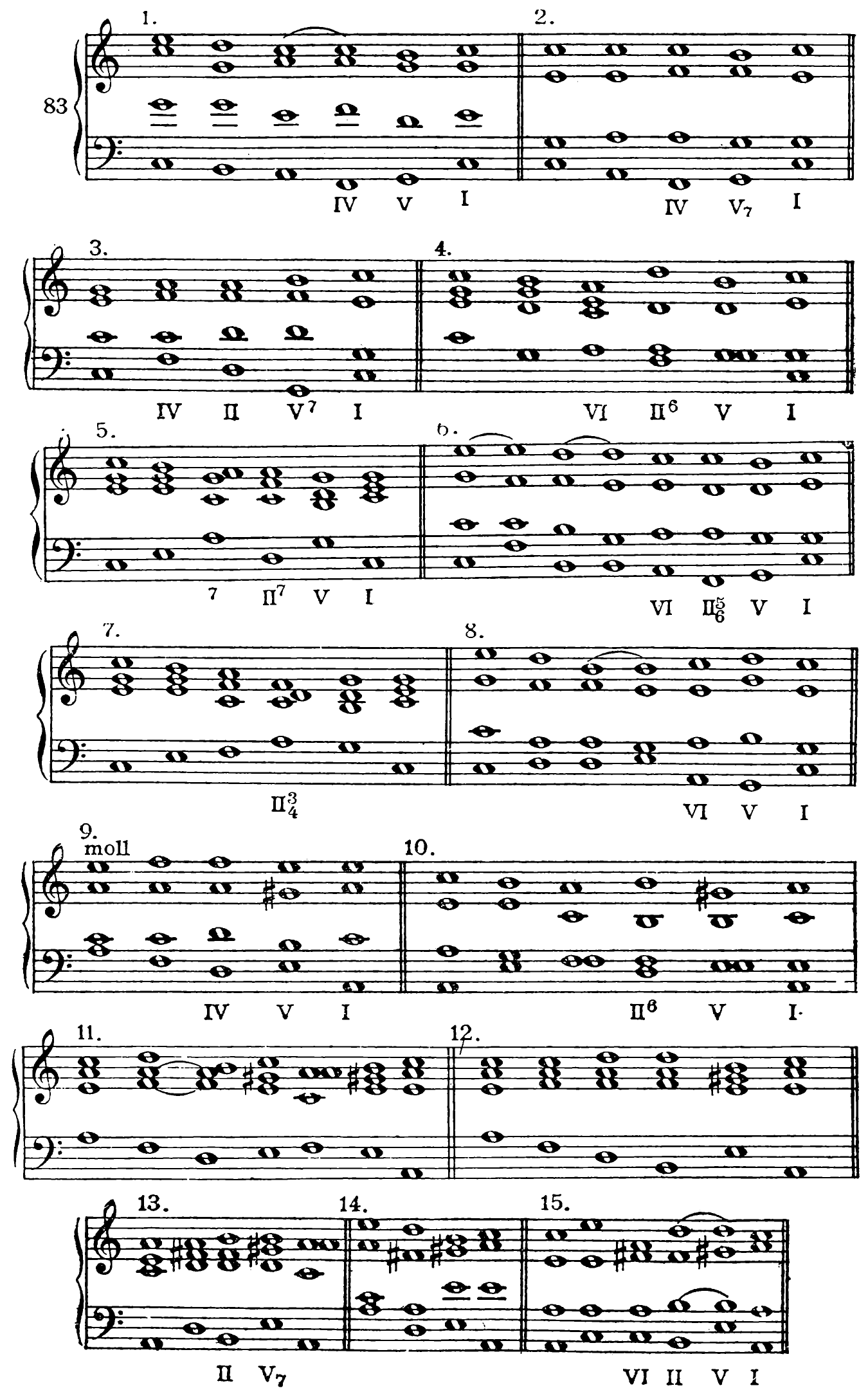
The pupil will do well (in order to try out many possibilities) to devise the cadences systematically, much as he did in the first exercises according to the table. Thus first all the possibilities with IV–V–I, for example I–IV–V–I, VI–IV–V–I, III–IV–V–I, etc., in which IV may also be brought alternately in root position or as a sixth chord. Then everything with II–V–I and VI–V–I. — There is nothing special to say about minor; the same applies as for major. That degree V comes with a major third at the close goes without saying; for the major third is there precisely for the sake of the close, for the sake of the leading-tone effect.