 Playable Books
Arnold Schoenberg · section 31 of 66
Deceptive cadences
Read and hear this section in the playable edition →


The step from degree V to I bears the name authentic cadence; that from IV to I, plagal cadence. These are only names, technical terms, which tell us nothing of harmonic significance. We have already considered the authentic cadence. We have, however, no reason to concern ourselves with the plagal cadence, because harmonically it is without particular significance. It can* hardly occur except after the conditions for delimiting the key have been fulfilled before it by the familiar means, and so it does not enrich our cadence with respect to its main purposes. Of harmonically constructive significance, on the other hand, are the so-called deceptive cadences. By this is meant the replacement of the expected step V–I by V–VI or V–IV. That is the original form: I is expected after V, but it does not come; VI or IV comes instead. But I is expected after V only at the close, in the cadence; since it does not come, this is not yet the close after all, but only a deceptive close. A possibility of closing is prepared but not exploited. This is naturally a very strong effect, for it makes it possible to prepare once more for the real close and to end with strength heightened by the repetition.
* If it does not merely represent an archaizing echo of the church modes.
First we introduce the deceptive cadence into the cadence and use it for the purpose mentioned earlier, the lengthening of the cadence. Some things must be observed in doing so. Since the deceptive cadence takes the cadential degree V (thus not just any V) as its point of departure, this V will above all have to be brought in root position. Inversions of V are used only a little for deceptive-cadence purposes. This does not prevent the succession V–VI or V–IV from starting from an inversion of V at some place other than in the cadence. On the other hand, the seventh chord of V is readily taken. Something must now be said about this; for the case in which we resolve a seventh chord otherwise than with a root step of a fourth upward has so far occurred, though in a different way, only in the connections of seventh chords with one another.
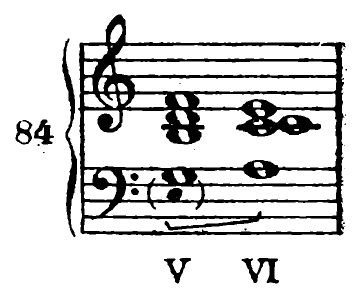
In the connection of degree V with VI (84) one can again imagine that the ninth chord over a root lying a third lower, degree III, is being connected with VI. It then follows of itself that the seventh, which is to be regarded as a ninth, and the fifth, which is to be regarded as a seventh, descend.
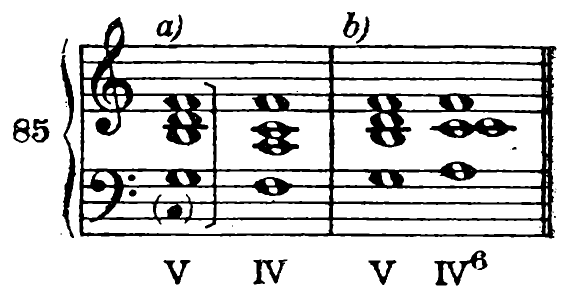
It is more complicated to base the connection V–IV on the same assumption, for the seventh does not descend and would have no way of going to E, because there is no E in IV (85a).
One will therefore do better to imagine it differently. I have already said that there are various ways of resolving the dissonance. Letting it descend was one of the means. There remain the three other possibilities: letting it ascend, stay, or leap away. If one is clear that dissonances can hardly have arisen in the way our teaching method presents them for the sake of clarity—namely, by adding one more third on top of a triad—but that they are probably notated accidents of melodic motion, ornaments, then one understands that the other forms of resolution can also occur. Just as a voice can move G, F, E against an E lying above or below it, so it also occurs in reverse, as E, F, G (86). That is the model for the upward resolution of the dissonance, and the holding of the dissonance is included in it: for if one regards the E as the dissonance, then after the simultaneity E, F the E stays while the F moves on.

Such a dissonance was called passing, and the old counterpoint had a number of rules and conditions restricting its use. If one now imagines the seventh chord of degree V as arising through passing tones of this kind,
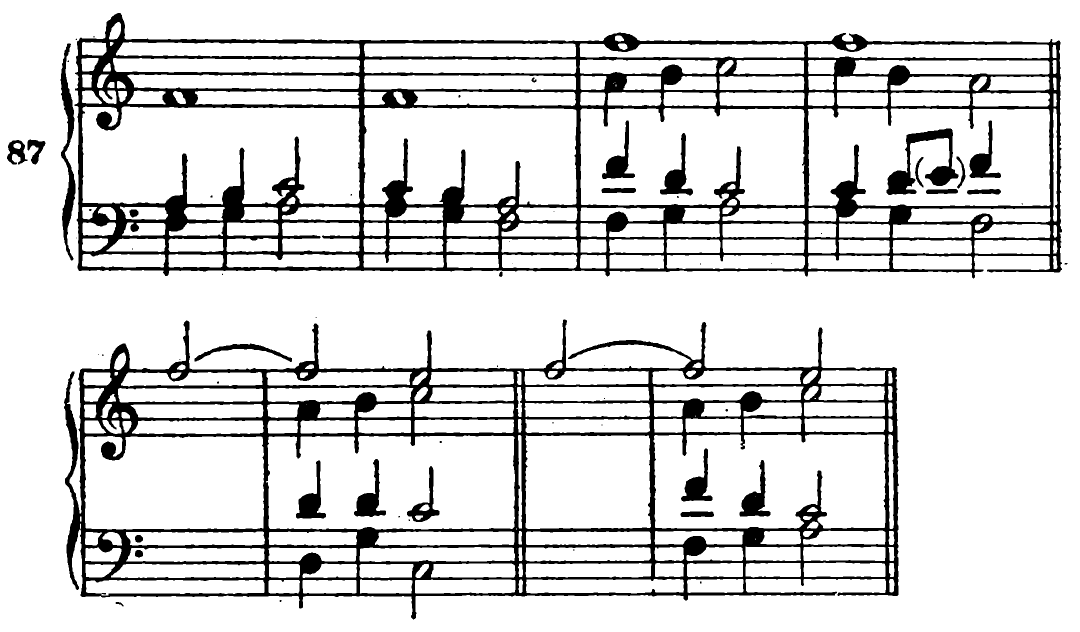
then the seventh chord is a phenomenon appearing in passing, and its laws are derived from the form in which it appears. These might therefore read (insofar as they come into consideration here): an interval of a seventh can be resolved by the seventh descending (88a, b), staying (88c, d) or ascending (88e, f), whereupon the bass tone must, respectively, stay or ascend, ascend or descend, and stay or leap away. Once one has become familiar with the idea that the treatment of dissonance is not such a dangerous matter, and that the masterworks would almost permit this formulation of a law: the dissonance must be resolved, that is, a dissonant chord must be followed by some other chord (which would say nothing at all, but which in this case is the most accurate statement), then the conception of an underlying step of a fourth, I–IV, for the resolution V7–IV (85) is no longer so strange either: the eleventh chord C–E–G–B–D–F resolves, with the seventh held, into F–A–C–F.
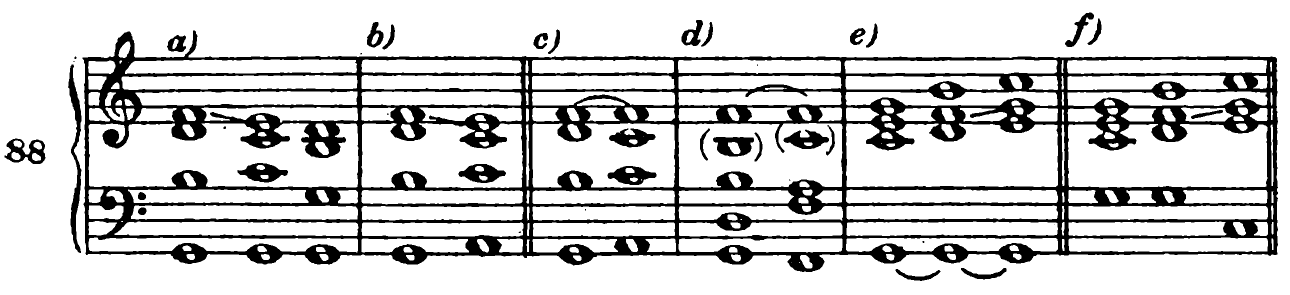
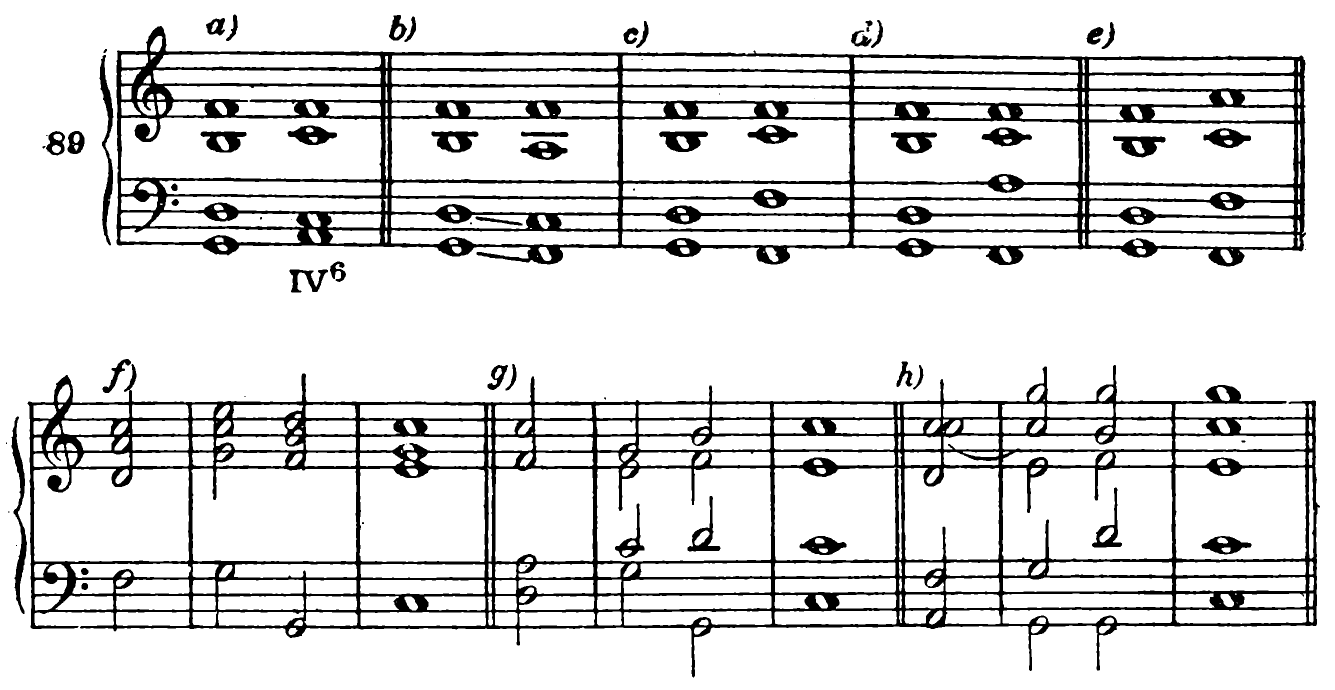
Cases 88e and f are usually not regarded as harmonic; the seventh chord occurring in them is regarded as passing because of its upward-moving seventh. Nonetheless practice used them. But the laws of harmony ran: a seventh must descend, or if it stays, the root must move upward. Later an exception was made (an exception, naturally, instead of framing the rule broadly enough and adapting it to the phenomena), and it was said: if ..., then ... may, etc., and the ascent of the seventh was permitted by way of exception in order to obtain a complete chord. Yet the rule of the so-called “bad seven” (that is, a seventh in which the lower tone descends while the seventh stays, or conversely the seventh ascends while the lower tone stays, and which thus resolves into the octave) nevertheless remained in force. And it remained forbidden to resolve a seventh into the octave by the descent of the lower tone or the ascent of the seventh, although the case occurs often enough in the masterworks when the voices are led independently. Case 88d, too, is frowned upon for the same reason. But since one evidently could not do entirely without this progression, theory permitted the resolution into the sixth chord (89a), which to be sure avoided the difficulties of voice leading (concerning the avoidance of fifths and the attainment of a complete chord, 89b, c, d). The solution 89d would nevertheless be possible. But today one would calmly do as in 89e: simply leap away from the dissonance, as is familiar from the very common forms 89f, g, h.
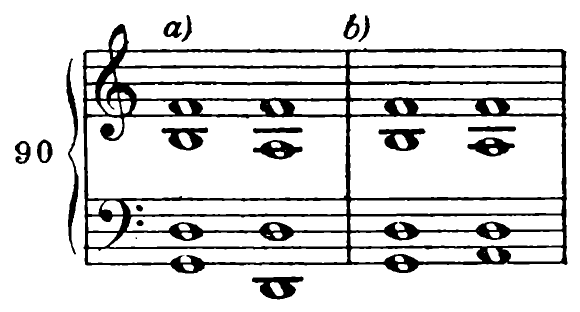
But the connection 90a as well, which occurred often enough in the masterworks, could be permitted only by an exception to the rule, whereas otherwise 90b would have to suffice as a substitute.
I would be most inclined to frame the rule so that all these events were included. But the danger would arise that I might again exclude much that is good (good is what occurs in masterworks, but also much that does not yet occur), or that I would have to construct exceptions. Since, however, it is clear that at least those rules are suspended at the pupil's more advanced stage of ability which I have shown to be too narrow or even wrong, and in what sense, I find it superfluous to trouble myself particularly with setting up new rules. And I choose, as so often before, this path: after showing the pupil to what extent these rules are by no means binding, I bolt the door against the wantonness that would like to run riot in total disregard of them, by developing his sense of form according to the old strict rules to the point where it will itself tell him, at the right time, how far he may go, and what must be the nature of that which would set itself above rules.
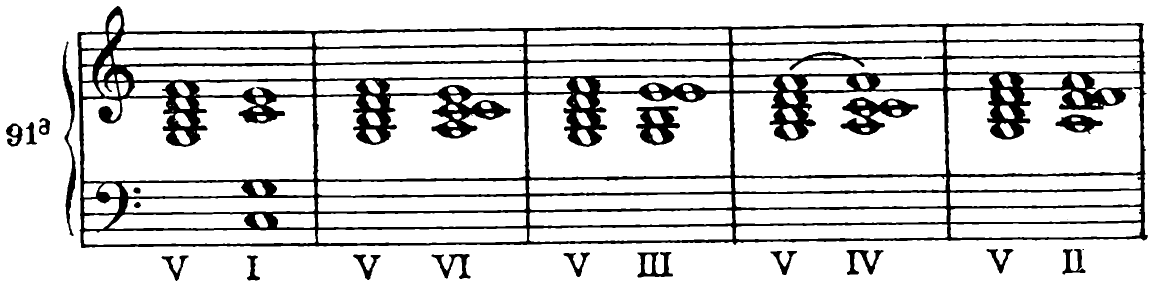
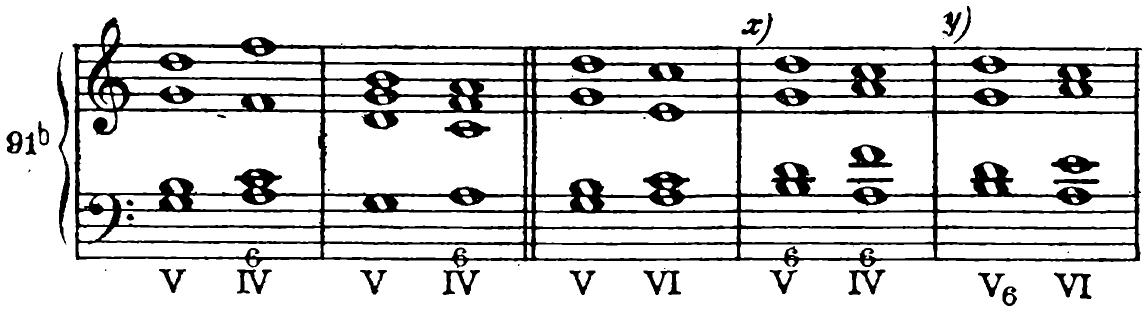
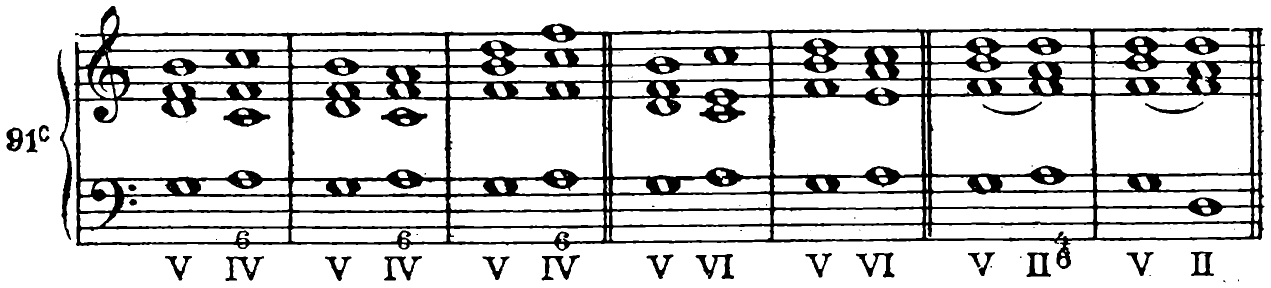
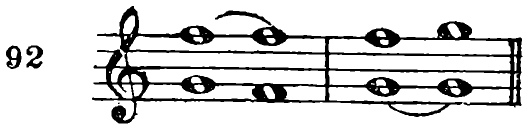
For the time being, then, we treat the seventh only as in 91a, use only the forms in 91b (x and y are not really to be regarded as deceptive cadences) and 91c (the same, starting from the seventh chord), and exclude everything that produces a “wicked seven” (resolution into the octave: 92).
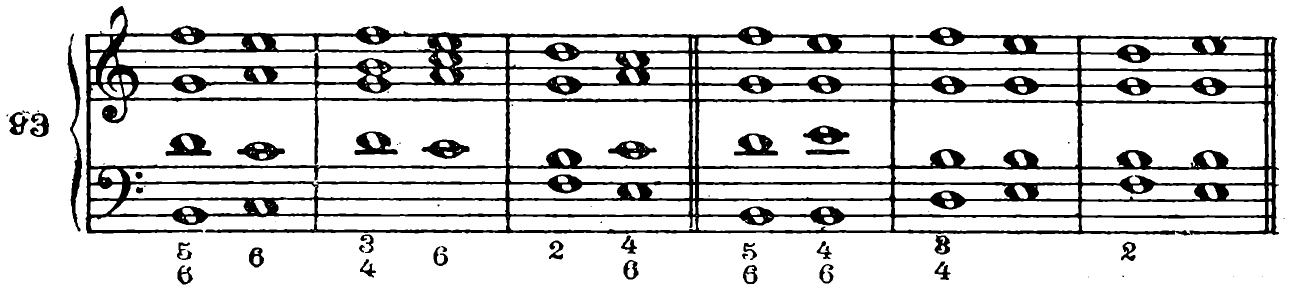
Except where the deceptive cadence is concerned (that deceptive cadence which we have recognized as a specific resource of the cadence), these connections may also start from inversions of the seventh chords (93); only those cases that lead into a six-four chord will perhaps have to be handled with some caution. For the six-four chord, as has already been discussed, has a very important function in a particular context, and in that sense it is used almost like a cliché; hence every six-four chord, even when it appears in a context only roughly similar, draws attention to itself and arouses the expectation of certain continuations.
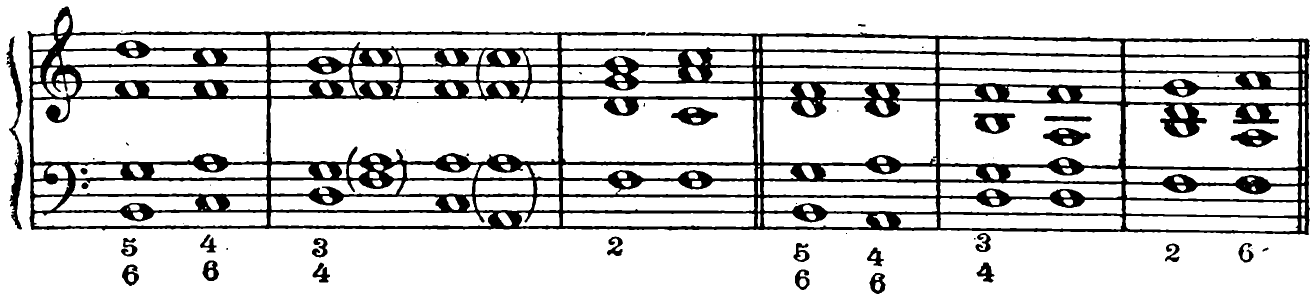
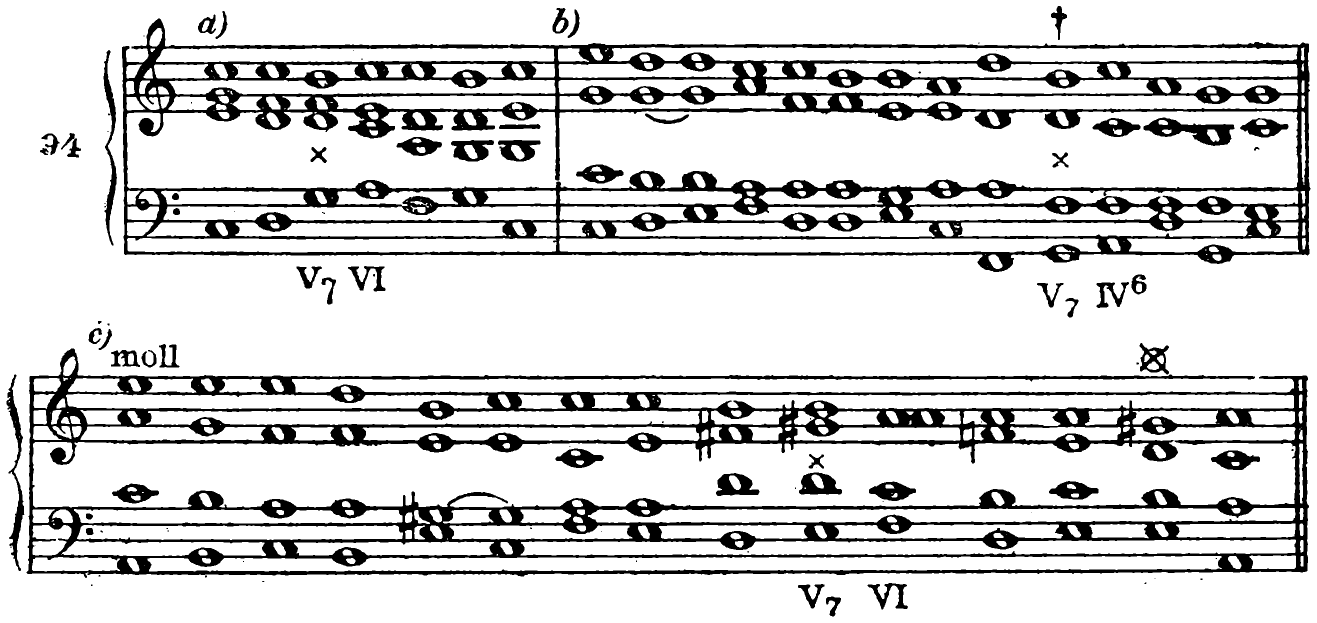
In Example 94, deceptive cadences of the dominant seventh chord were used at ×. At ⊗ and † the dominant seventh chord was introduced without preparation. I announced earlier that we would later treat the seventh chords freely as well.*) For the time being it may be permitted to bring in the dominant seventh chord without preparation. In particular, the preparation can be omitted when the seventh arises in passing, as in 94c (melodic justification). Some other cases of such a passing seventh are shown in Example 95, where other seventh chords also arise through passing motion.
*) The unprepared use of the diminished fifth will be discussed in the following chapter.
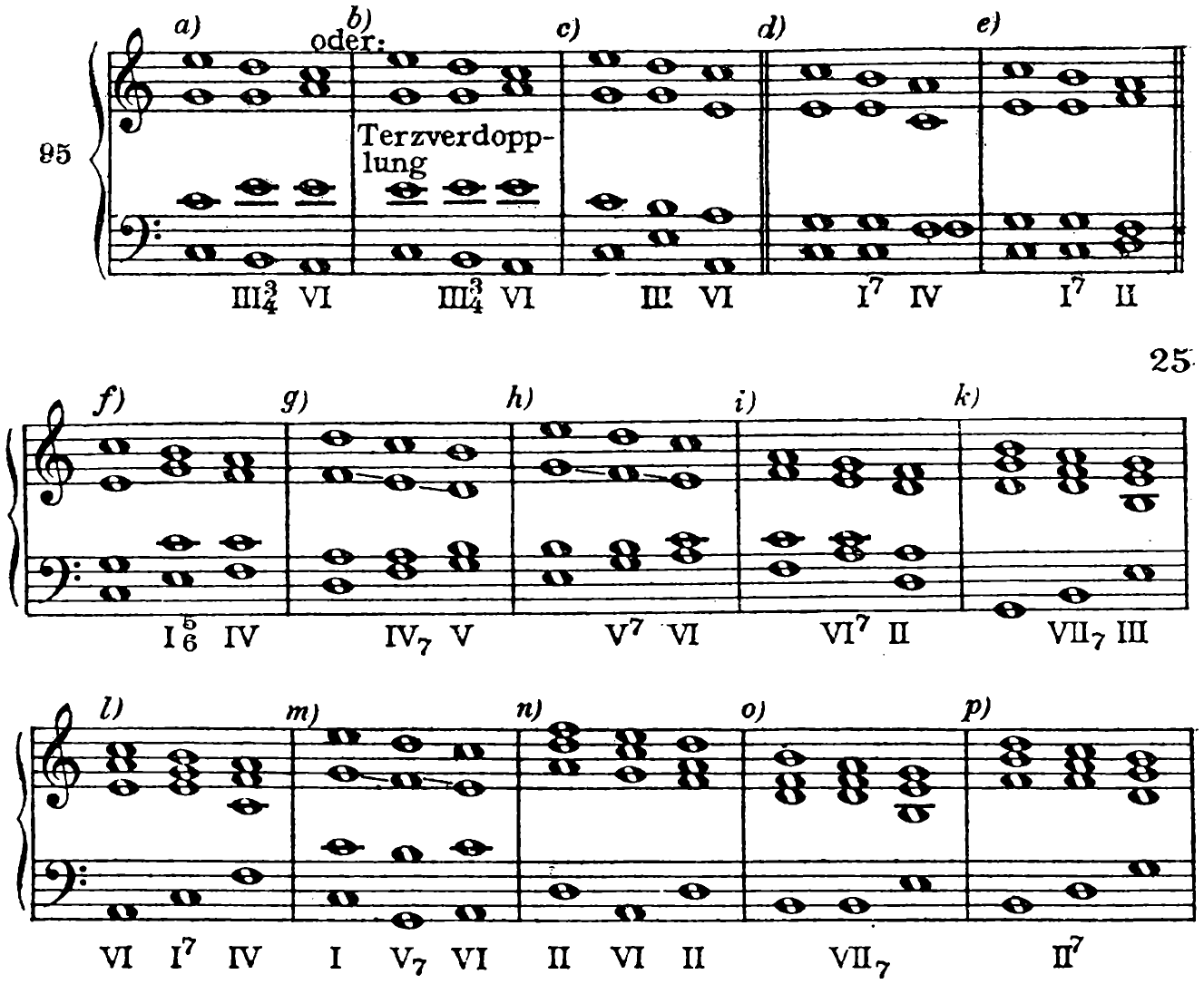
With us, this freer treatment of the seventh chords does not arise as an exception to the rule; rather, it rests on the important assumptions and insights, repeatedly put forward here, about the multiple origin of dissonance and its merely gradual difference from consonance. These two premises enabled us to break down the law of dissonance resolution into a small number of directions for the treatment of dissonance, directions that do justice to the facts of art.