 Playable Books
Pyotr Ilyich Tchaikovsky · section 36 of 36
Chapter XXXIV. Cadences (closes)
Read and hear this section in the playable edition → Theory of HarmonyArnold Schoenberg · the deceptive cadence
 Treatise on HarmonyJean-Philippe Rameau · the deceptive cadence
 Practical Manual of HarmonyNikolai Rimsky-Korsakov · the deceptive cadenceTheory of HarmonyArnold Schoenberg · the authentic cadence, the half cadence and the plagal cadenceTreatise on HarmonyJean-Philippe Rameau · the authentic cadencePractical Manual of HarmonyNikolai Rimsky-Korsakov · the authentic cadence and the plagal cadencePractical Manual of HarmonyNikolai Rimsky-Korsakov · the half cadenceTreatise on HarmonyJean-Philippe Rameau · the plagal cadence
§ 139. In conclusion let us complete and systematize our knowledge of the different cadences, our treatment of which has hitherto been but fragmentary.
Complete close (authentic). Half close and Deceptive cadence.
The complete close consists of the harmonies of dominant and tonic. If both these chords appear in fundamental form, and the tonic triad moreover in octave position, the cadence is called perfect; otherwise it is termed imperfect.
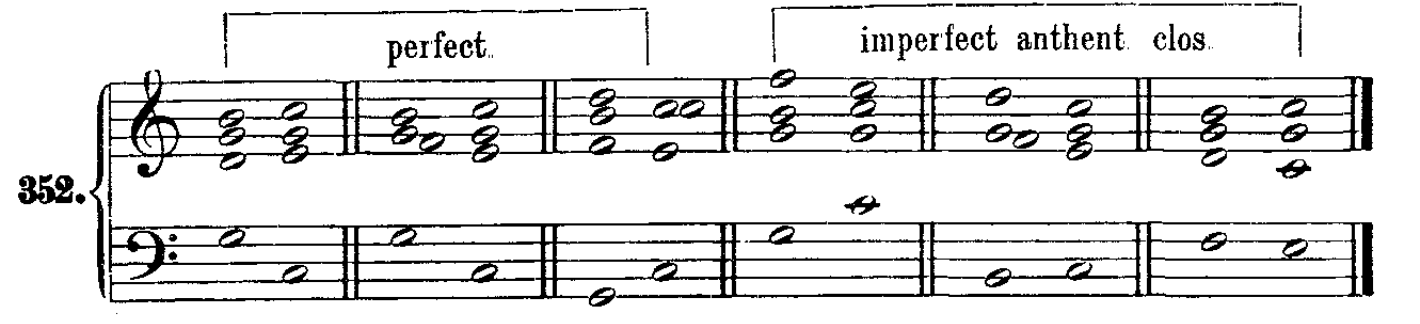
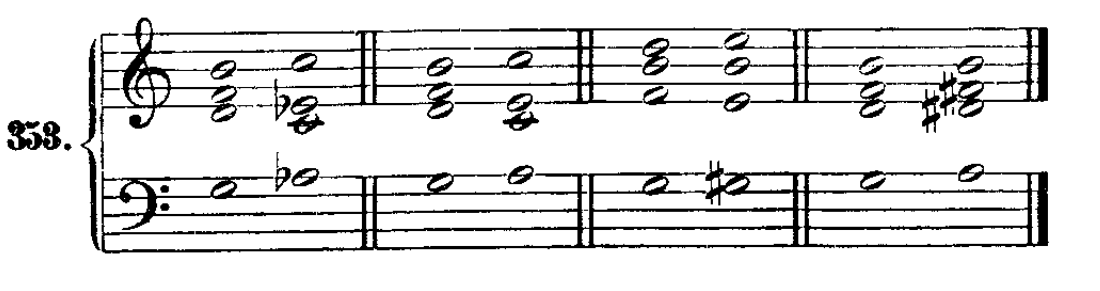
When the fundamental (in the Bass) of the Dominant resolves into a degree other than that of the tonic, we have a deceptive cadence.
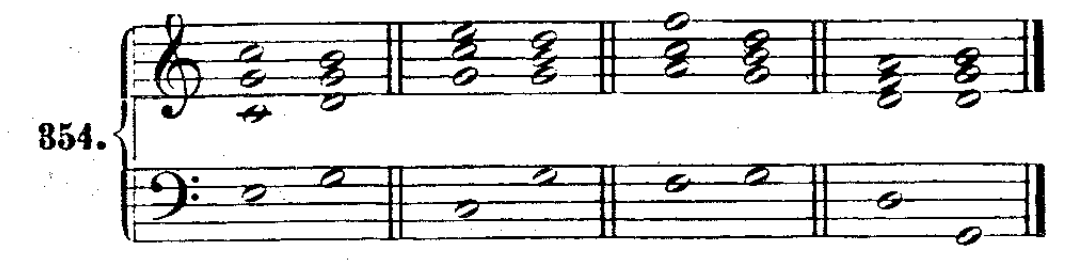
The Half-close is a full close reversed; the first chord of the Half-close is the tonic triad or some chord of the subdominant group; this is followed by the dominant-triad.
In addition to these closes there is the so-called Plagal or Church close, which was mentioned in an earlier chapter.
A further knowledge of cadences must be sought in the treatises on mu- ‘sical torm.