 Playable Books
Arnold Schoenberg · section 33 of 66
Freer Use of the Seventh Degree
Read and hear this section in the playable edition →For the seventh degree in major we recognised preparation and resolution as the simplest way of treating the dissonance. Now, with the seventh chords, we have seen how the dissonance can appear without preparation when it occurs in passing, and how the resolution can also take place in other ways than through the leap of a fourth upward in the root. This can be applied to the diminished triad, which makes accessible those forms that occur in practice more often than the one we treated first.
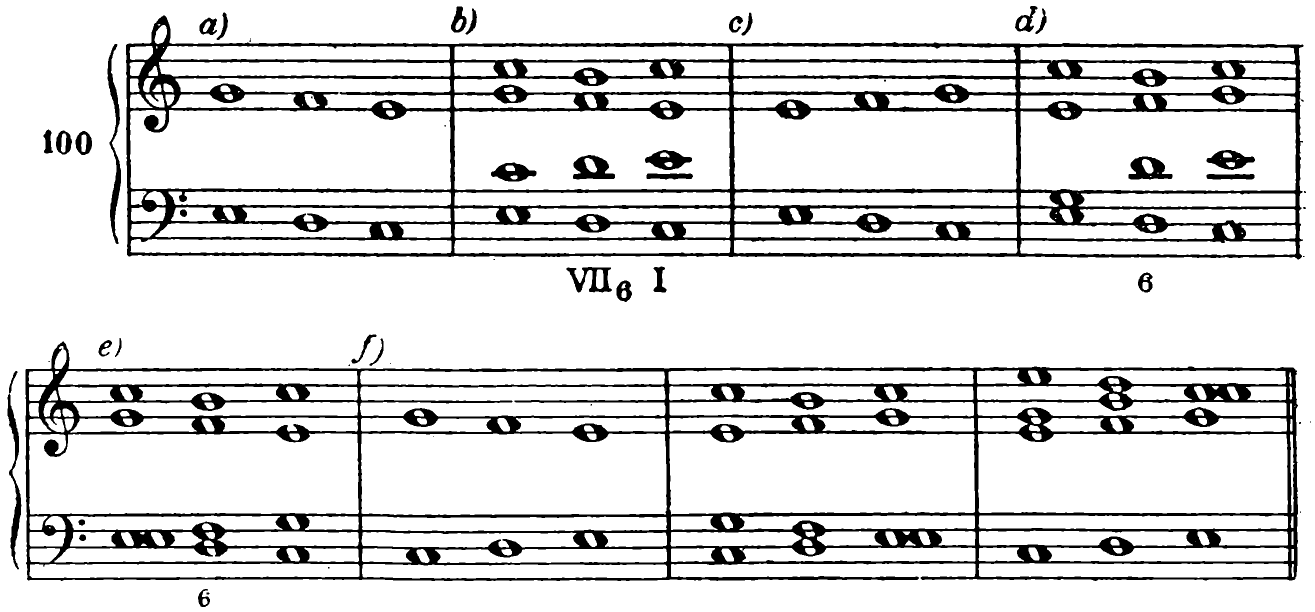
If one imagines the course of two voices as in Example 100a, c and f, it becomes understandable that a sixth chord of the seventh degree appearing over D is justified by the melodic motion of these voices just as it otherwise is by preparation. In this connection 100e then presents a picture that corresponds to the strict rules of contrapuntal writing and to what is found in older music, but stands in glaring contrast to what we have done so far. For the diminished fifth is not only neither prepared nor resolved, but is even doubled!
I list some of the most customary connections of the triad on the seventh degree, and mention in general that root position and the six-four chord are not customary; the sixth chord, however, occurs often.
In the connection VII–I the function of VII is such that it must be understood as a substitute for V, and this chiefly distinguishes it from our previous VII–III. That prompts us to try the progressions customary from V also from VII, its substitute: VII–VI, VII–IV, VII–II.
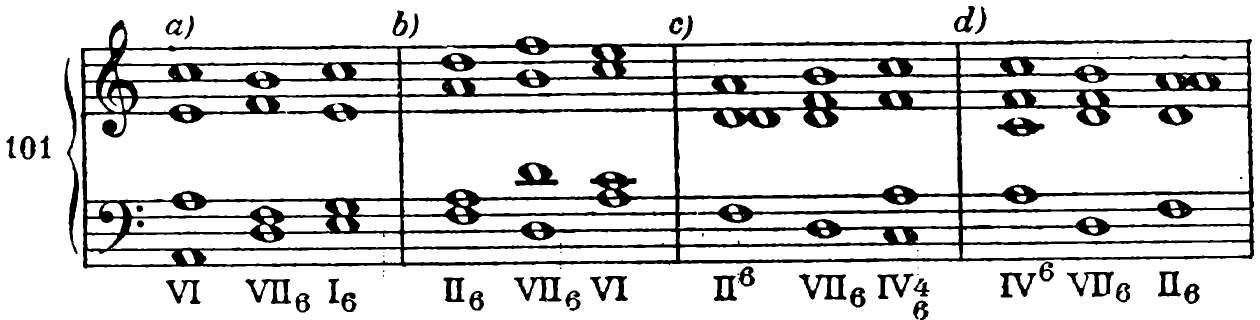
The diminished triads in minor, those on the second, sixth and seventh degrees, naturally admit the same treatment.
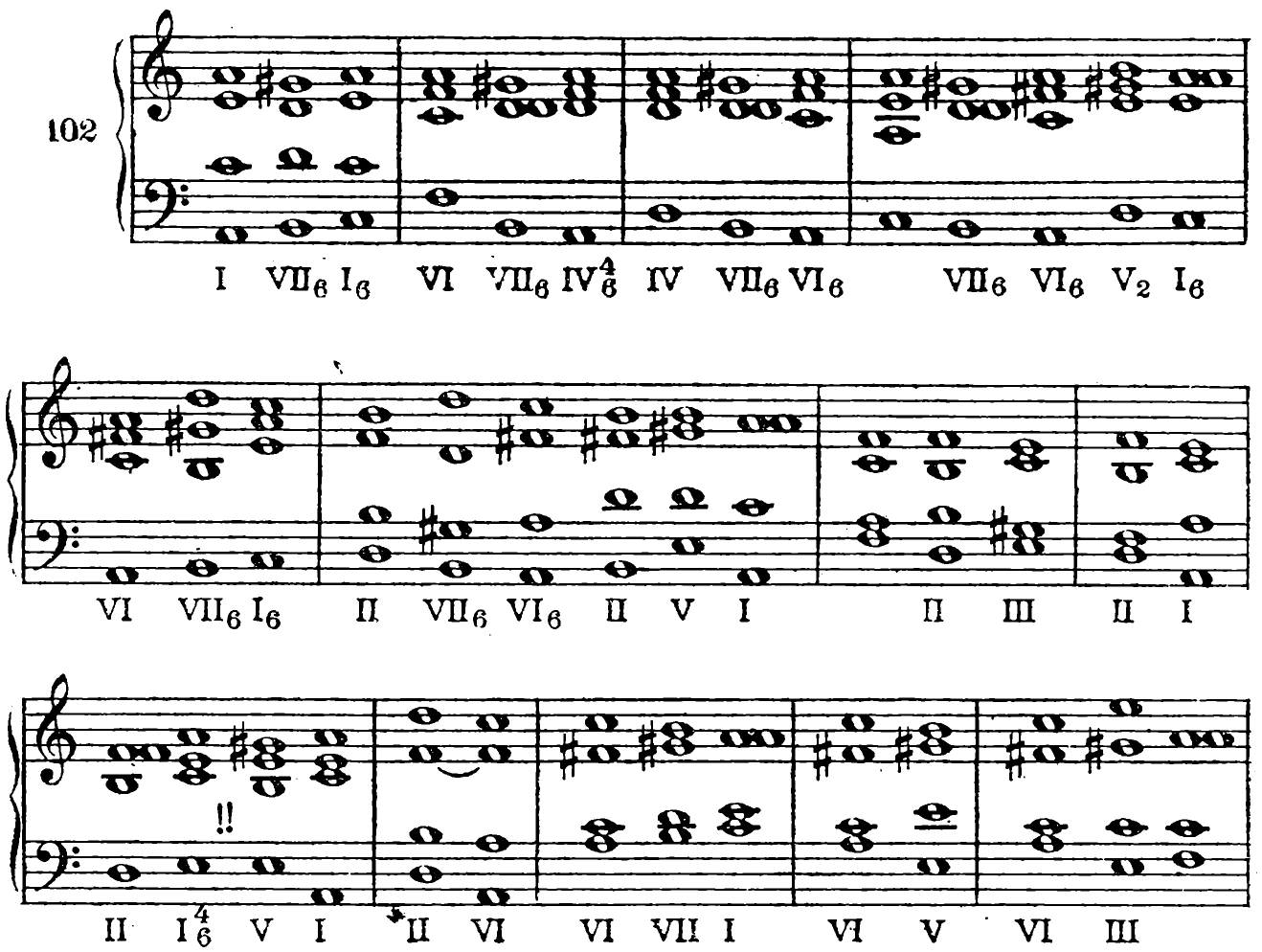
In doing so, the turning-point laws must be strictly observed.
Particularly frequent and varied use is made of the seventh chord on the seventh degree in major, or, respectively, on the second degree in minor. This will be shown in the discussion of modulations. About the seventh chord on the seventh degree in minor, the so-called diminished seventh chord, let the following be said for the present: on the basis of our first considerations we could connect it only with the third degree (a leap of a fourth upward in the root), as in Example 103a, b, c, d. But now some of the possibilities that this extremely ambiguous chord admits are already becoming apparent.
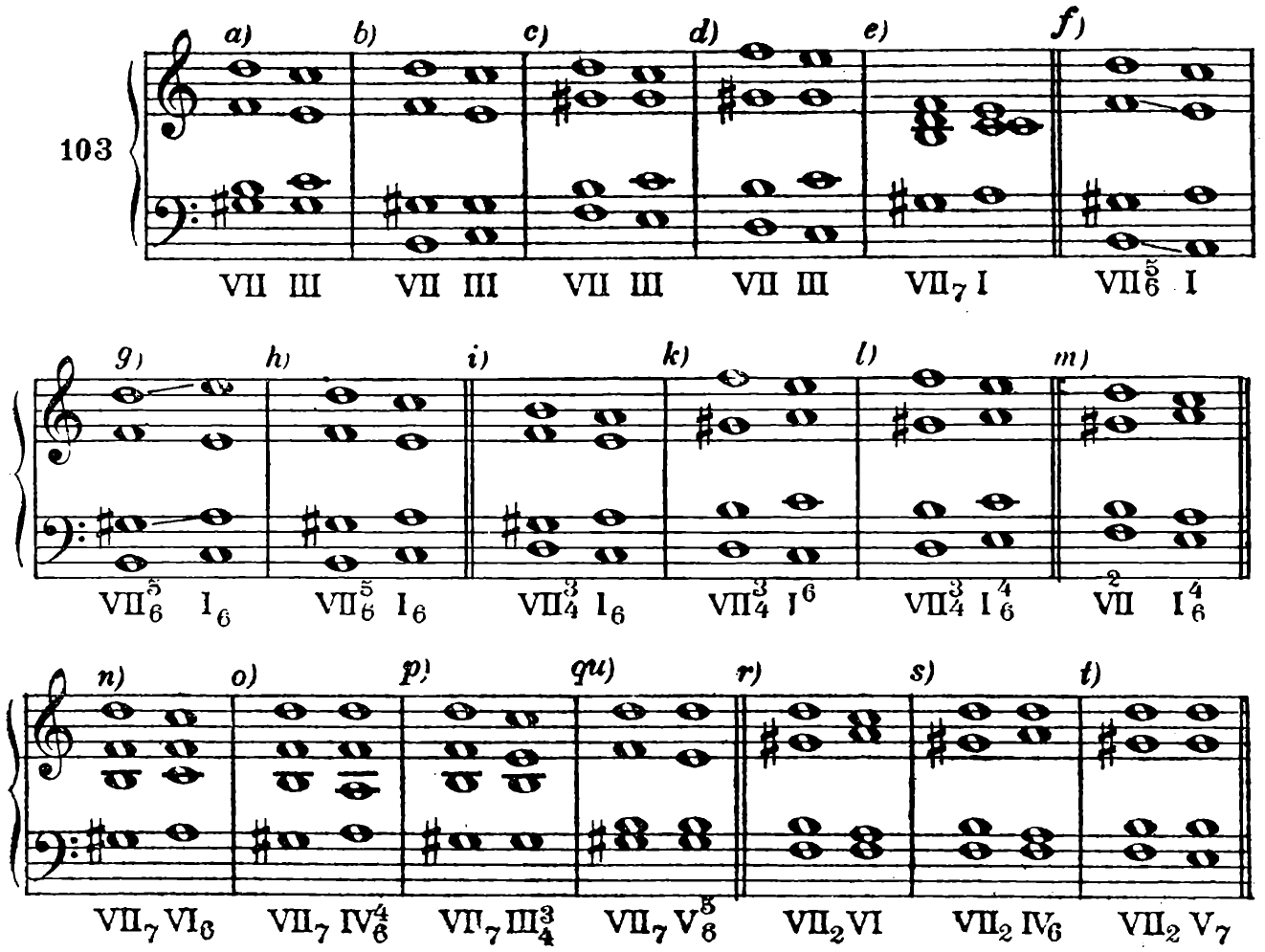
In some connections of the diminished seventh chord hidden fifths arise, as at 103f and g. For that reason some connections (103f) would have to be omitted altogether, or in others (103g) the third would have to be doubled, as in 103h. But these hidden fifths occur so often in masterworks and are so seldom avoided that I consider it superfluous to demand that they be avoided. On the other hand, for reasons still to be discussed later, I advise the pupil to refrain from those connections of the seventh degree that resolve into the six-four chord of I (103l and m). In connecting the diminished seventh chord it will probably also be best to let the voices take the nearest path; but Example 104 shows some frequently occurring connections in which the voices leap.
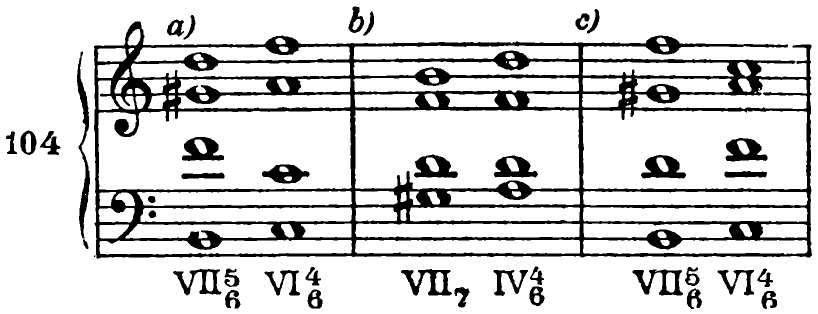
Later on many more reasons will emerge why, with the diminished seventh chord more than with other chords, it is possible to use leaping voice-leading in place of the simplest. For now the often-chosen justification will suffice: the connection is familiar. The voices, then, need not slavishly serve the filling-out of the chord, but may obey whatever melodic needs arise.