 Playable Books
Arnold Schoenberg · section 32 of 66
The Six-Four Chord in the Cadence
Read and hear this section in the playable edition →
The cadences can be extended further by inserting degree I before degree V (that is, after IV or II). The original form of this may have been the cadence I–V–I, which we called (page 160) the first and simplest cadence.
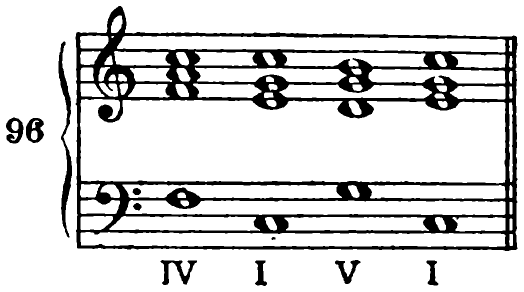
But this is also explained in another way, namely thus: IV–V–I.
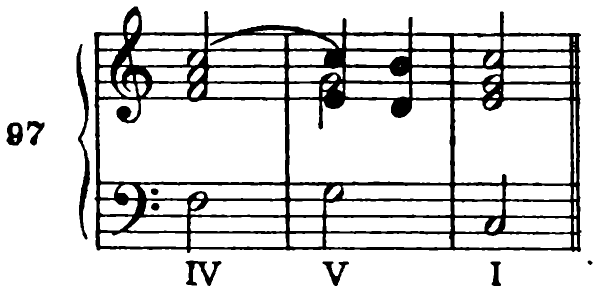
When V is to come, the c remains hanging (like an ornament), and the f goes (likewise like an ornament) through e to d. The a, on the other hand, moves at once to its place by going to the g that belongs to the chord. The e is thus a passing note; the form in which the c delays its step to b, becomes a dissonance and must resolve, is called a suspension. More about this later. This interpretation has much in its favour. It seems likely to me, however, that although either of the two ways shown could by itself have produced the six-four chord, it was the union of the two ideas that led to this form of cadence. In the first case (96) it is enough to recognize that the c appearing twice in the bass is an unpleasant repetition, which can be remedied by an inversion. The sixth chord could just as well stand there, and this sometimes happens. But the six-four chord, which was after all regarded as a kind of dissonance that ought to resolve and that likes to resolve into degree V, is more suitable, because it almost compels what the sixth chord merely permits. Yet the other way of looking at it is convincing too. The suspension creates tension, and the resolution does justice to that tension; the resolution takes place into the chord suited to the purpose, whose arrival, through so careful a preparation, gains the appearance of necessity and thereby arouses a heightened feeling of satisfaction.
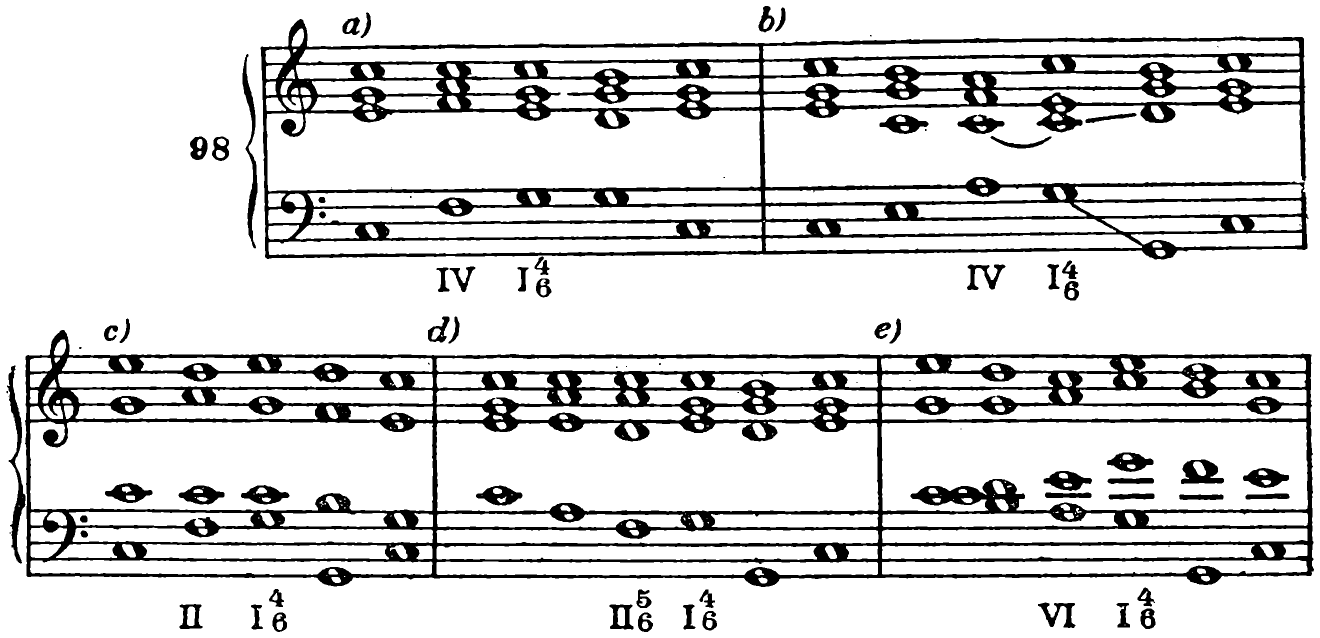
Here are cited some forms of using the six-four chord which also show that the one derivation, according to which the six-four chord arises through passing motion and suspension, does not by itself suffice as an explanation (98b, c and d). In 98b one cannot speak of a suspended c, because the resolution this explanation needs is missing (in the tenor). Nor of a passing e, because the e goes up to g. In 98c the suspension does take place, but not the passing motion; likewise in 98d. But if one thinks of the other explanation, the six-four chord is readily understood. For judging the root progressions, the question of origin is immaterial. If it is taken as suspension and passing motion, then (since the six-four chord is not to be counted here as an independent phenomenon) these degree numbers result: IV (I⁴₆)–V–I or II (I⁴₆)–V–I or VI (I⁴₆)–V–I, that is, nothing but strong progressions. But if the six-four chord is taken as I, the result is IV–I–V–I; II–I–V–I; VI–I–V–I, in which there are many descending progressions. This, however, is made up for by the quasi-dissonant character of the six-four chord. If one assumes that the familiar effect of this form of the six-four chord makes it possible to disregard its origin and to insert it like a cliché even when what precedes is not exactly as its origin would require, but only similar, then the freedom shown in 99 is also explained, where the six-four chord is even leapt into from degree II in root position: a very common form of close.
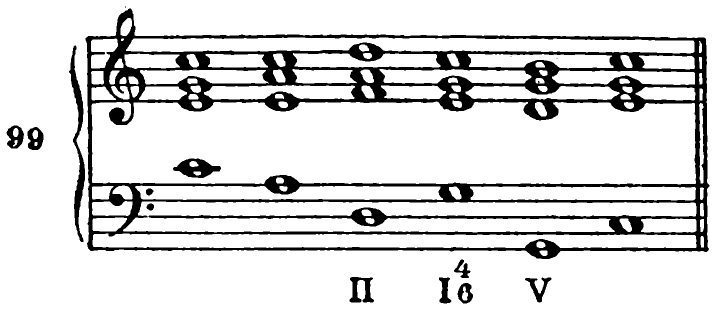
To avoid the monotony produced by the g remaining in place (which, incidentally, is not very dangerous), the bass is often allowed to change register by an octave leap.
I have mentioned repeatedly that the six-four chord occupies a peculiar position, and I have shown that we must leave open whether it owes this position to its constitution or to convention. This position, which has been spoken of so often, is precisely the one just shown, namely its position in the cadence as a holding back, a check, so to speak, before the appearance of the dominant (seventh) chord. Since this form has taken on the effect of a cliché, whose citation arouses the expectation of a certain continuation, it is self-evident why such a chord must be treated cautiously in those cases where it does not have these consequences: precisely because the appearance of the expected continuation must be avoided, and the disappointment this brings could easily lead to unevenness. Admittedly, such unevenness can have its charm; but these are effects the pupil cannot yet aim for.