 Playable Books
Arnold Schoenberg · section 43 of 66
Relations to the Minor Subdominant
Read and hear this section in the playable edition →In modulating to the third and fourth circles of fifths downward we came to know the relation of a major tonic to the minor subdominant: namely, its capacity to be the dominant of a minor triad. Naturally this circumstance is exploited not only for modulation but also for extending the cadence and enriching what goes on within a key. The new kinship established through this relation of the principal chord makes it possible to bring into the key, besides the diatonic chords and those we gained by imitating the peculiarities of the church modes, also the secondary triads of the keys to whose domain this minor-subdominant chord belongs—the chords of the third and fourth circles of fifths—and thereby to extend the tonality considerably. For C major these are:

Before we set about testing the usefulness of the new chords, we shall have to account for the points of view that are decisive here, and we ask as the first question: Is it permissible and necessary to use these chords within one key? The answer must be: it is natural and corresponds to the development of harmony. In the sense relevant here, its tendency can only be this: having first used all three- and four-part combinations of a seven-tone series, and having then, through accidentals, admitted the remaining five tones (though in part only in one meaning: in C major an F-sharp, say, but no G-flat, a B-flat but no A-sharp), it now works through all the combinations of the twelve available semitones—for the time being still referred to one fundamental, that is, within one key. Now if a modulation, as in opera, merely forms a bridge between two independent pieces that are not connected with each other, then its degree of remoteness is basically irrelevant, since each of the two pieces is formally bounded by its own tonal rounding-off. But a digression within a closed movement can be justified, insofar as harmonic unity is the meaning of tonality, only if it can be referred to the principal key. That this is indeed the case even with the most far-reaching digressions is shown, for example, already in Beethoven, who in C-minor movements brings sections in B minor, and in E-flat major, groups in E minor—something Bach and Mozart did not yet do. Within the tonality, then, the fundamental chords of such sections and groups, if they are to be understood as a unity, must behave, when placed side by side, like the successive chords within a section; that is, they must be capable of being understood as a unity, and so must have coherence. Even in older music, therefore, the question of the justification of such digressions is not a question of kinship, but only a question of presenting this kinship through appropriate distance in time and space and through gradual connection. But time, space and speed are not absolute measures. That is why today we can reduce those distances to a minimum and set side by side, abruptly, what formerly had to stand far apart and be carefully connected. The coherence is familiar to us; it was presented in earlier epochs, and so need not be composed in anew each time, but is taken as given.
With the first question answered, the second is now only of subordinate, only of practical importance: What is the value of this enrichment of tonality, what advantages can be drawn from it? Expressive values such as mood, characterization, tension, etc. are to be disregarded here, and only the constructive is to be discussed. As such we already know the capacity of harmony to form a close: the cadence, the end of a whole. Now, certainly, with seven diatonic chords one is also able to set off the parts of this whole. But since these same seven chords also occur within the parts, in larger forms the need makes itself felt for means of stronger contrast. The further harmony develops, however, the faster the delivery becomes, the quicker the presentation. For more and more, it is not mere concepts but whole complexes that are strung together, and this faster delivery requires, for the clear working-out of the large-scale articulation and for keeping principal and subordinate matters apart, richer punctuation, sharper separation of phrases, a harmonic dynamics richer in degrees. The closer degrees of kinship no longer separate; they only connect and flow into one another. Sharper lights, darker shadows: that is what these more remote chords serve.
Our judgement about the usefulness of these chords will be limited on the one hand by pedagogical considerations, on the other by the consideration that it cannot be our task to help unusual or little-used details to a right that art denies them and that theory can no longer procure for them; and finally by the question of how far they have a place in the system of presentation, that is, whether they are to be used already now or only later.
Above all, let us recall the descent of these chords: the minor-subdominant region. They therefore stand in strong contrast to the secondary dominants, which for the most part belong to the upper-dominant region (only the one on I leads into the subdominant, and the one on VI also leads into the double dominant). And that is probably why many a connection is unusual as being too harsh. In general, therefore, they will serve for a richer elaboration, a stronger emphasis of the subdominant region, and cannot always easily be joined directly to the upper-dominant region. For the kinship of the two regions—this should not be forgotten—is not direct but indirect. VI of C major and I of F minor are related only through their common relation to I of C major: they are, so to speak, “relatives by marriage.” But with the same right with which, in the lower, simpler relations, one assumes that IV and V of a key (which in another sense form opposites) are related (through their position with respect to I), one may, in the higher, more complicated ones, also regard the kinship of VI of C major with I of F minor as explained through I of C major. The capacity to acknowledge the kinship of remote elements depends chiefly on the understanding and insight of the observer. The most primitively perceiving and feeling being considers only its limbs and its senses as something belonging to it. The more highly developed being, the family descended from it. At the next stages the feeling of community rises to belief in the nation and in the race; but the most highly developed extends love of one’s neighbour beyond the species, beyond humanity, to the world. If he thus becomes a tiny particle of something infinitely great, he nevertheless (remarkably) still finds himself more often and more fully than those more limited in their love.
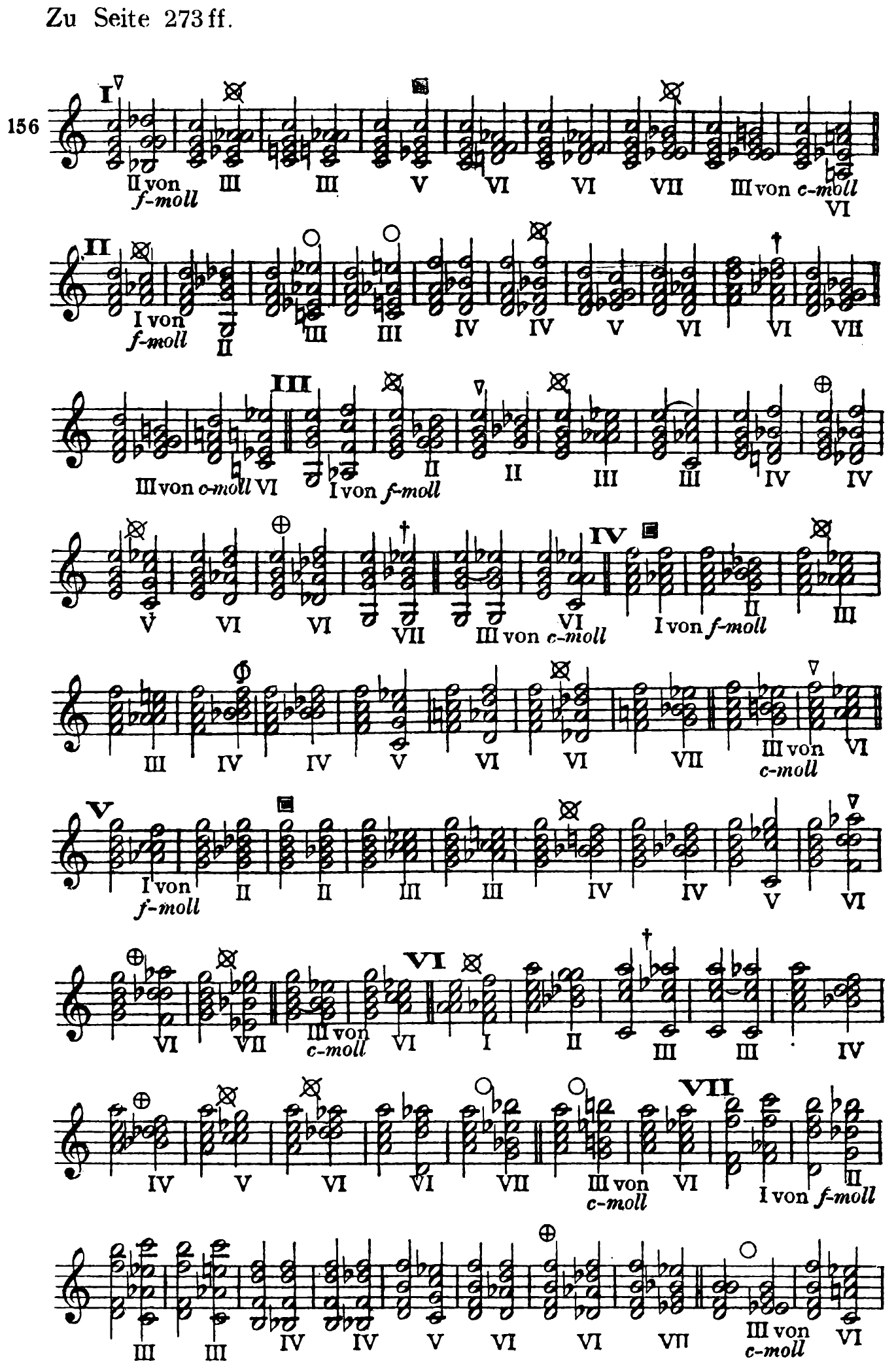
So even if the kinship relations of some chords, in the primitive conditions of tonality, are apparently not direct ones, they are nevertheless still such that the ear must grasp their capacity to form a unity; for in the model given by nature, the tone, sounds of still more remote kinship unite into a consonance, into euphony. And moreover: that happens in what sounds simultaneously, where the ear has less time to determine. How much more so in succession! Certainly, the sounds are graded in intensity according to their degree of kinship, but they do sound. And this imitation still falls far short of going as far as its model.
In 156, connections of all seven degrees of C major with the new chords are shown. Above all: none of these connections, though unusual, is bad or unusable. Under certain circumstances each may even be the only one that fits—quite apart from any expressive value it may have. On this assumption, in what follows