 Playable Books
Arnold Schoenberg · section 44 of 66
Guidelines
Read and hear this section in the playable edition →
are given and restrictions made.
I. Unusual, first and foremost, are connections that create difficulties of voice leading. Our theory of harmony is derived for the most part from the events that arose in polyphonic music through the movement of voices; what caused voice-leading difficulties therefore did not occur there and is unusual. Such are, for example, cases like II with VI, III with VII, VI with III (at †), because of the danger of fifths, but also for yet another reason that will be discussed later; and: III with IV, V with VI, VI with IV and VII with VI (at ⊕), because of the augmented and diminished steps. The pupil will do best to leave these cases out entirely for now. Whether he will ever make use of them depends not on the teachings of the theory of harmony but on the need of an artist sure of his form. What such an artist does is well done. Harmony teaching recommends only what is customary and what has a place in its system of presentation.
II. Diminished triads that are introduced weakly take care of themselves for us (I with II, III with II, IV with VI [of C minor], V with VI [at ▽]).
III. The IV degree of C major with IV of F minor (Φ). IV of F minor is the subdominant of the subdominant, and given the natural power the subdominant has over the tonic, it is clear that the key could easily be lost. We do, to be sure, already have many means of restoring it. But here the means of restoring it would be more interesting than those by which it was lost. It is boring when the policemen are more interesting than the robbers. If we want to move so far from the key, to behave so revolutionarily, we shall later know more amusing means.
IV. III with I can arouse justified misgivings, which is especially noticeable when one connects them the other way round: I of F minor with III of C major (157 a and b). In this connection, unfamiliar to it, the ear does not want to take the chord E–G–B as III of C major, but prefers to hear it as a variant of 157 d, which 157 c does indeed sound very like. Less because these two chords do not occur side by side in any key than because this similarity suggests the more convenient interpretation to the ear too strongly for it to decide on the correct one. Nevertheless, 157 e and f prove that this six-chord can indeed be the III degree if it is continued as such.
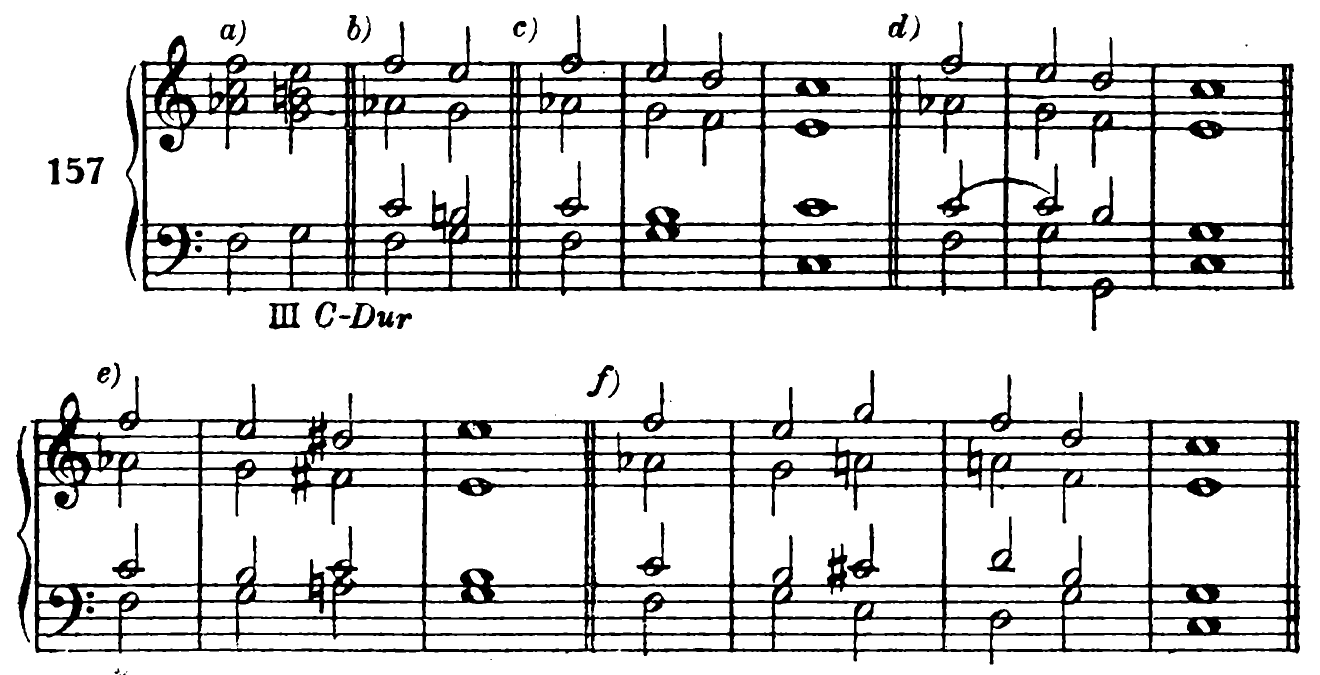
V. Progressions for which an analogy can be found in some not too distant key, where the chords in question thus occur diatonically, or where only one of the two is a secondary dominant, will present no difficulties once cross-relations have been eliminated melodically (that is, by turning-point treatment or chromatically). Here it will often be possible to reinterpret a chord.
VI. The same applies to progressions in which chromatic voice leading is possible without requiring augmented or diminished intervals in the other voices.
VII. As always, the succession of roots is decisive.
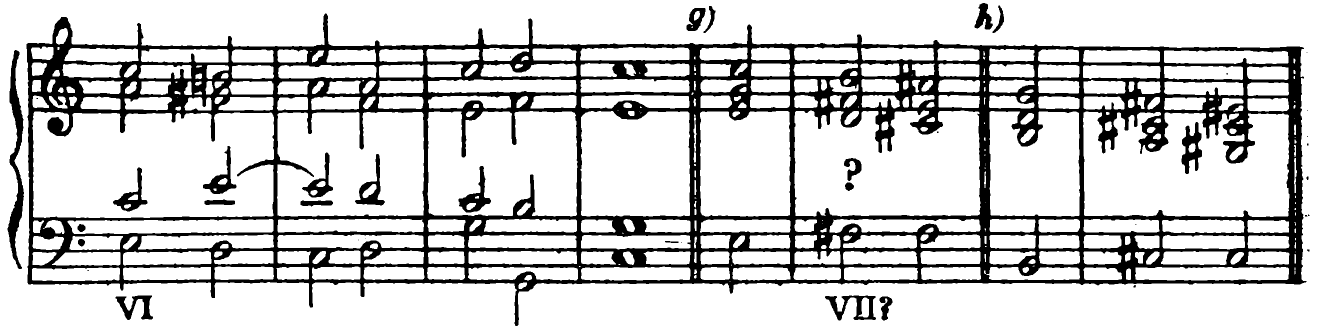
Example 158a–g presents those forms that can readily be connected to dominants, secondary dominants, and the like. In 158a and b, degree I serves to introduce them; in 158c, degree V; in 158e, the secondary dominant on degree II; in 158f, that on degree VI; and in 158g, the diminished seventh chords on degrees I, II, V, and VI. There is nothing new about these progressions. Analogies can be found for each of them (in C minor, F minor, G minor, and D minor). Only the elimination of cross-relations is sometimes difficult, as 158h shows.

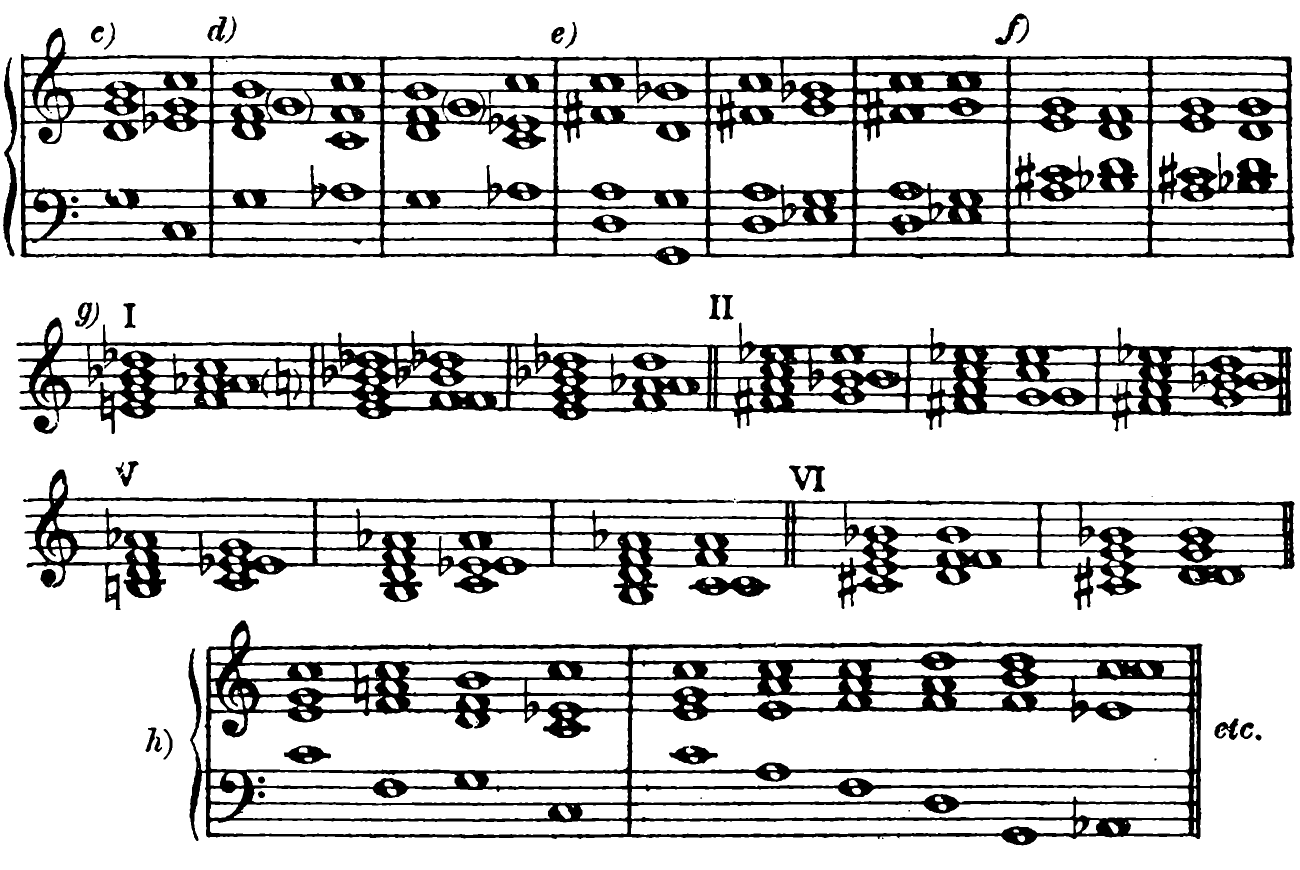
Treatment in the manner of turning points, chromaticism, and diminished seventh chords, whose use is quite familiar to the pupil, nevertheless make it easy to overcome this difficulty.
Readily suggested and easy to place are connections that turn a major chord into a minor chord over the same root (156 ▣). The pupil already knows how to proceed here, and that the chromatic creation of such minor chords usually has more melodic than harmonic significance, from the chapter on secondary dominants, which discussed the Dorian-derived fifth degree G–B-flat–D (in C major). In 159a the minor chord (the sixth chord over E-flat) has no influence on what follows. In 159b, however, the minor chord on V of C (over B-flat) prepares the subdominant region. And in 159c the chromatically introduced A-flat in the bass certainly brings about the unobtrusive entry of the following sixth chord, F–A-flat–D-flat.
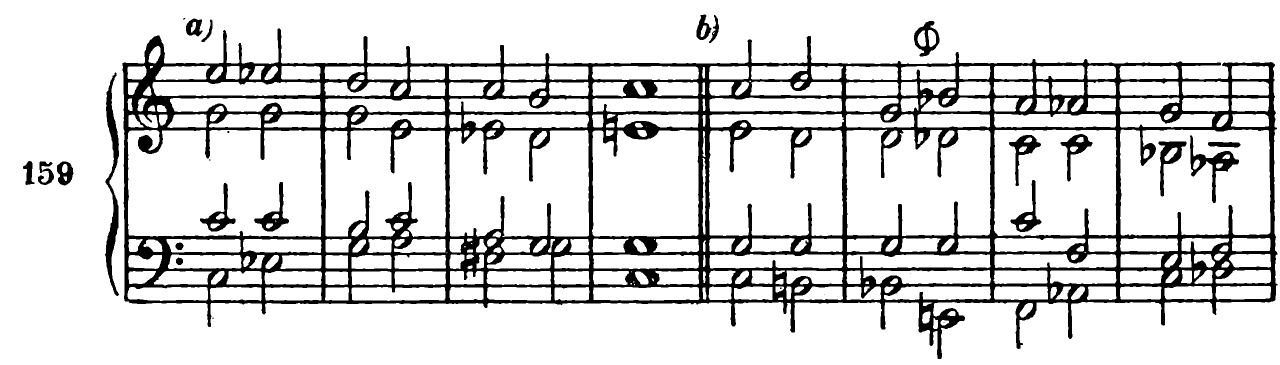
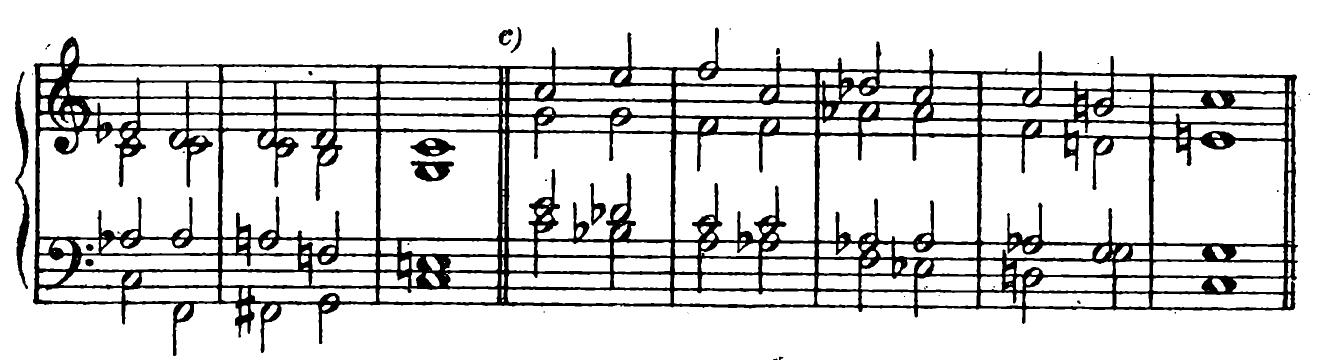
In these connections that transform a major triad into a minor triad, it is advisable to let the third progress chromatically in the bass, so that its motion does not falter. Yet even this will yield little benefit, because the change in the total sound is too slight. That is probably why such voice movements usually occur in shorter note values than the rest of the harmony, and why, in our case, where we write half notes, they would best occur in quarter notes.
Connections such as I of C major with III or VII of F minor (I or V of A-flat major), and the analogous connections from the other degrees, have far-reaching effects (156 ⊗). On the second degree there is one fewer case than with the other minor chords (160 Φ). The relationship found in those cases could certainly be reproduced here, but without appealing to the degree of relationship under discussion. Likewise, there are only two cases for the major chords.
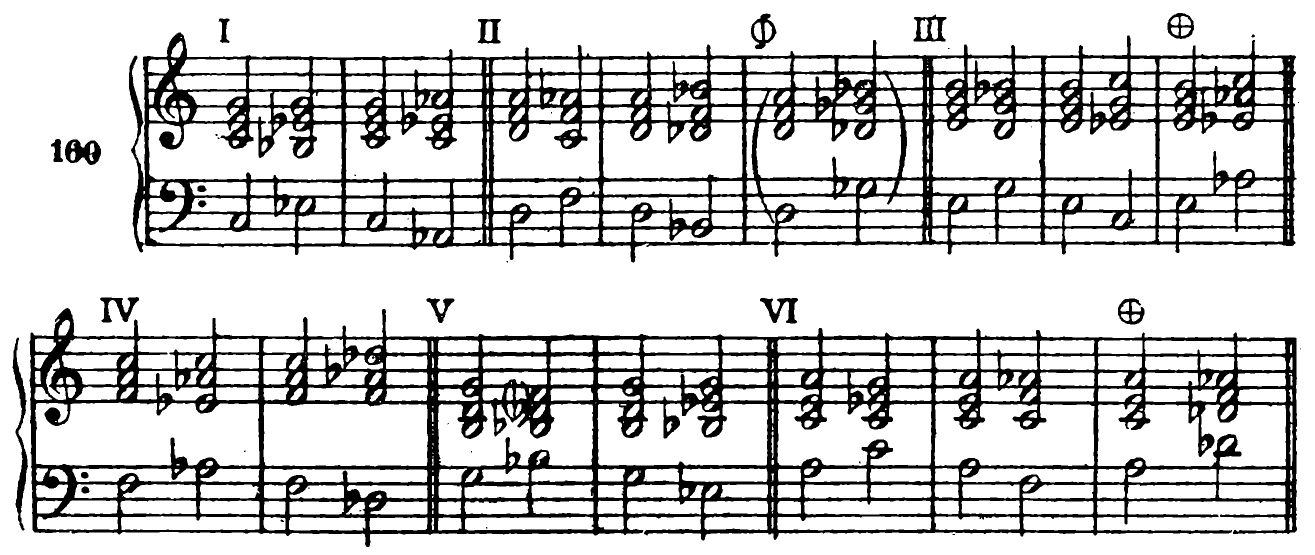
Only the root progression determines the harmonic assessment of these connections. The strong leap down a third needs no justification; the weaker leap up a third is to be judged as before. I can dispense with explaining these connections as “related by thirds,” “related by fifths,” and so on, as is otherwise customary today, because I find sufficient justification in their being related at all. In some way all chords are of course related to one another, as are all human beings. Whether they form a family, nation, or race is certainly not uninteresting, but is inessential beside the concept of the species, which opens perspectives other than those of particular relationships.
For such connections there will always be one suitable means of making them smoothly and convincingly: chromaticism. Earlier, in the simpler cases, with the closest relationships, a segment of the scale of the underlying key or a related key supplied the justification for the harmonic events. Here it is increasingly a single scale that takes over all such functions: the chromatic scale. It is easy to see why. If we recognized the scale as a simple melody, as a musical form founded on a law that is primitive yet clear and readily grasped, then we cannot deny this same quality to the chromatic scale. Its melodic power helps connect what is more distantly related: that is the meaning of chromaticism.
The cases marked 160 ⊕ are somewhat difficult to handle as regards voice leading. Here an unusual leap in a voice will not always be easy to avoid. The pupil would do well initially to choose only connections in which this necessity does not arise (161). Once secure in these, the pupil may also venture augmented or diminished intervals, especially in the inner voices. They are already much less disturbing here, since the melodic and harmonic events refer less and less often exclusively to the model of the major or minor scale. It is therefore no longer inappropriate to assume a reinterpretation of a note (enharmonic substitution), which will then generally restore melodic balance. Admittedly, the more closely the voice leading approaches the major or minor scale, the more readily the voice will be grasped. The pupil should still strive for this here. For steps of an augmented second, I recommend imitating the model of the so-called “harmonic minor scale” (which I regard as the true melodic minor scale).
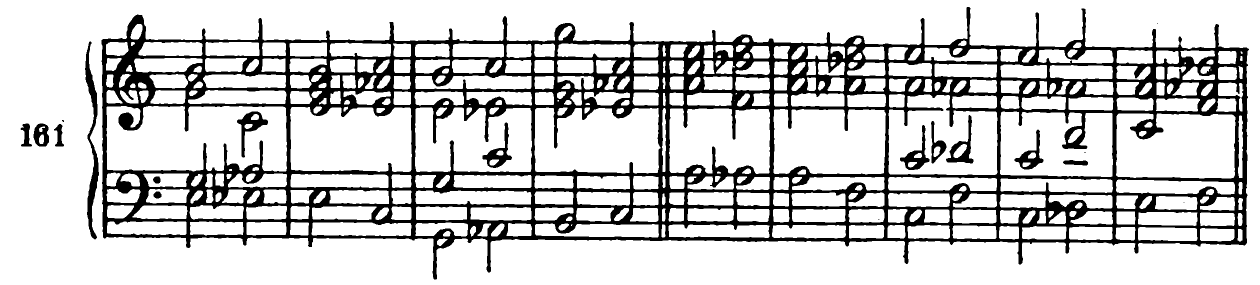
A few musical examples show how these connections can be used.
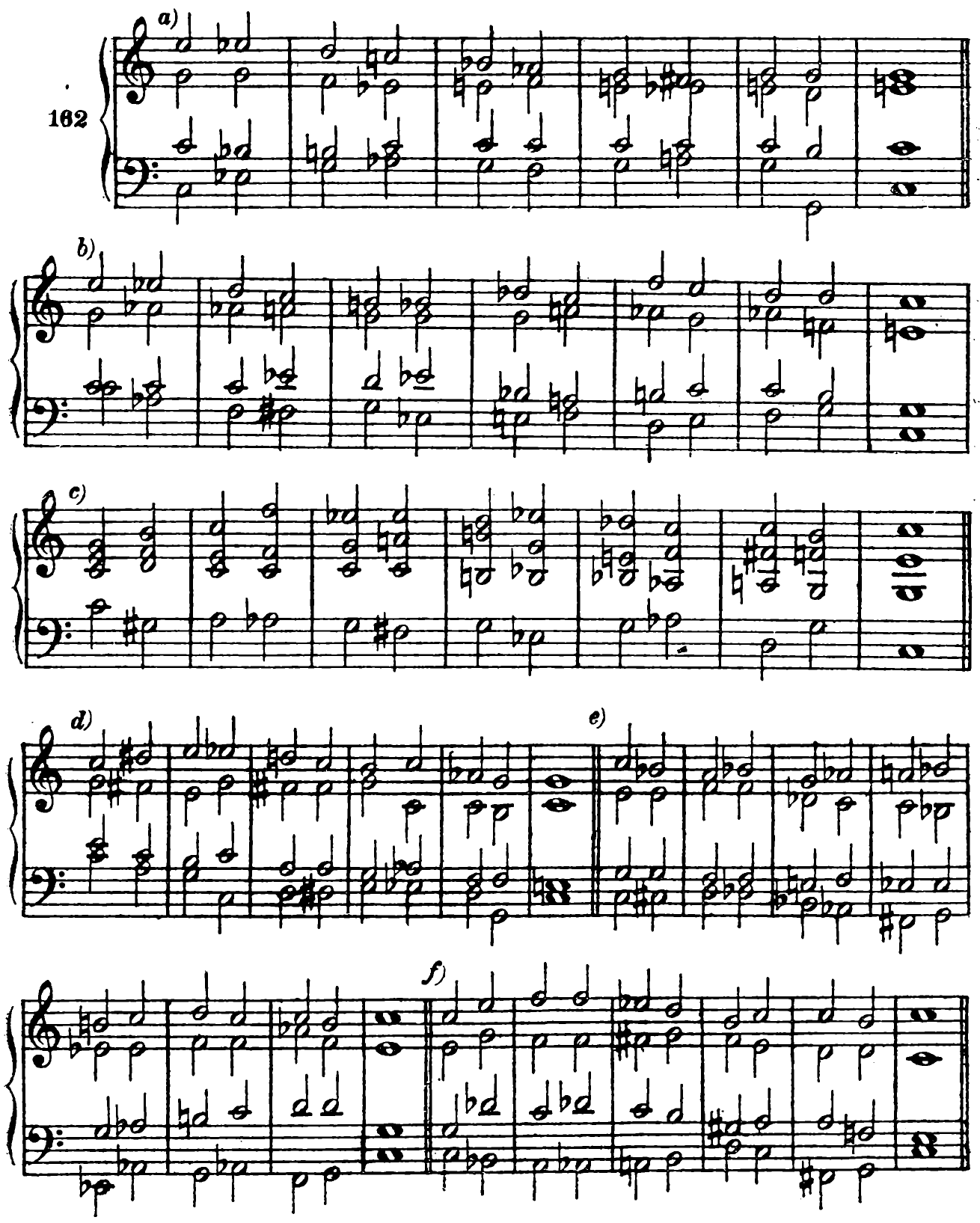
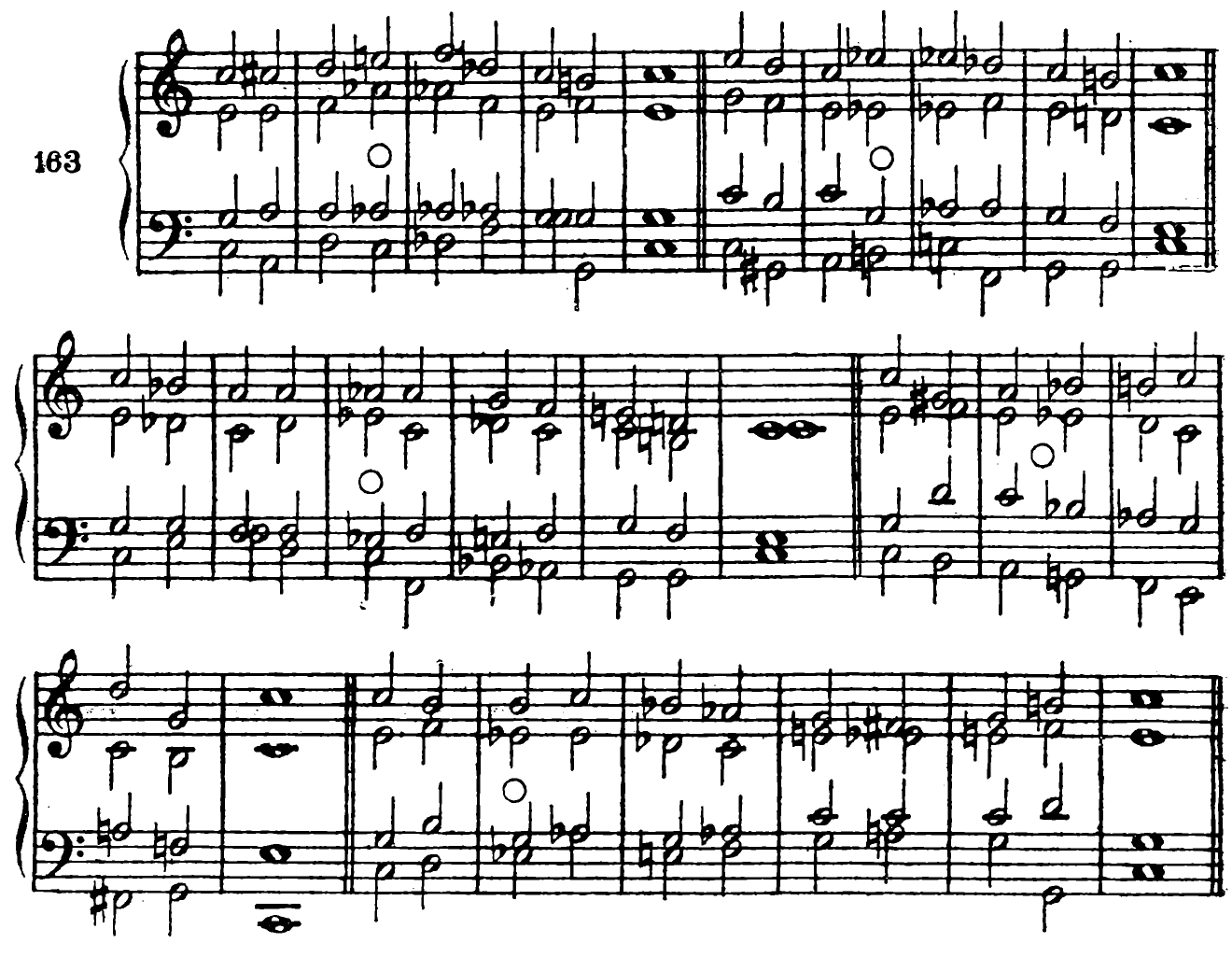
I chose the cadence for this purpose. For everyone will more readily believe that these connections modulate than that they cadence. And theorists will probably maintain that these are modulations from C to . . . “and back.” That too can occur. But one can speak here of modulations only in the sense mentioned earlier, whose strictest interpretation regards every chord after the tonic chord as already a departure; thus there are no modulations here in the narrower sense. This view has above all the advantage of teaching the pupil to regard the whole as a unity. It certainly accords better with musical thinking as revealed, for example, in harmonic variation: the theme often unquestionably remains in its key, yet the variations exploit relationships between keys that one readily regards as modulations because that is more convenient. They are, however, no more modulations than the corresponding passages of the theme were.
Among the connections presented in 156, those marked ○ have not yet been discussed. All that matters is introducing and continuing them appropriately. Here too, melodic voice leading provides the best service.
Example 164 illustrates the use of chords related to the minor subdominant. Starting from a minor key, I recommend at first exploiting only the relationship through the major key of the same name: thus, in C minor, the chords of C major’s minor-subdominant relationship. Later the pupil can also exploit the more far-reaching relationship through the relative major—that is, in C minor, the relationship belonging to E-flat major. At first this will often put the pupil in difficult situations.
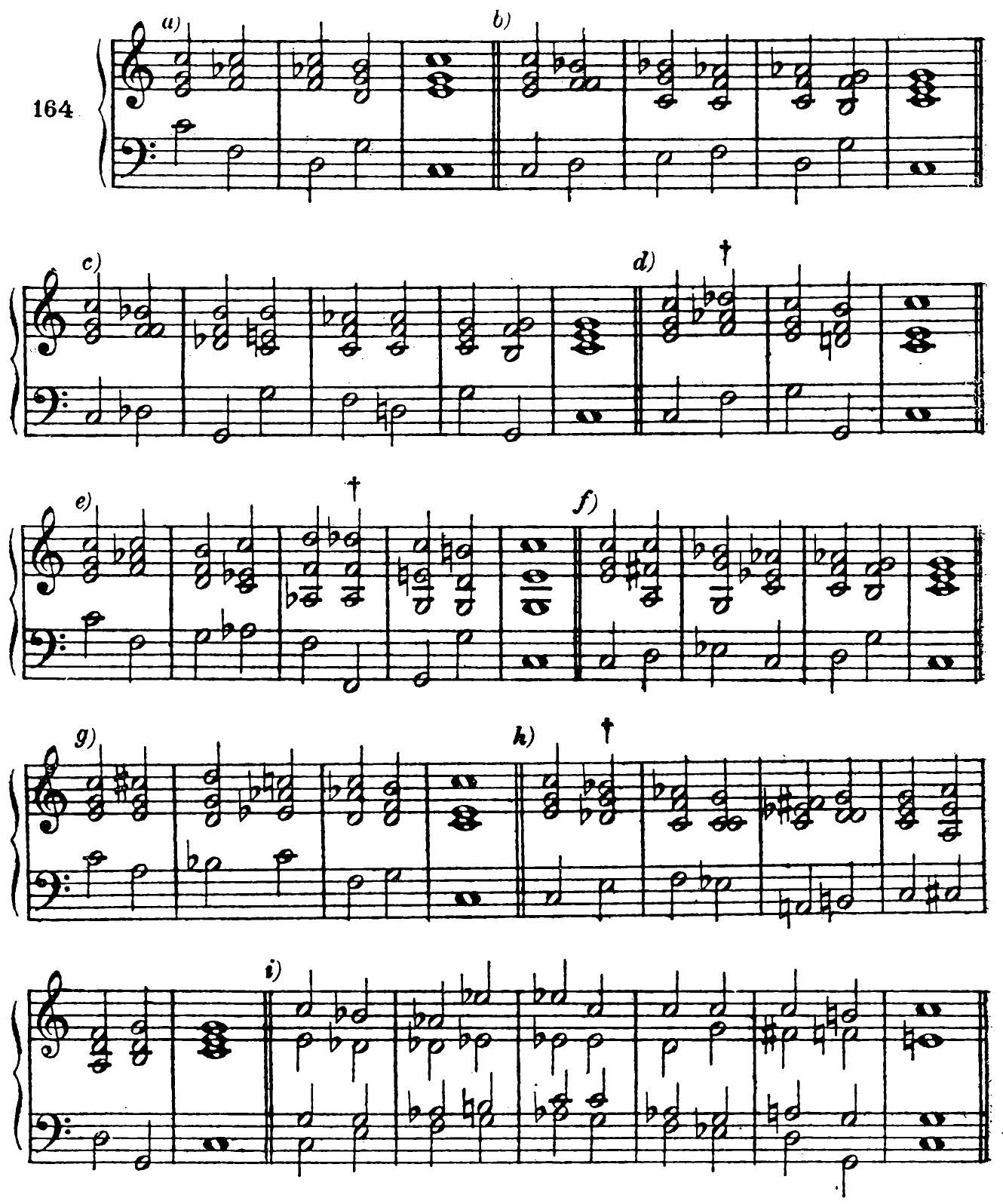
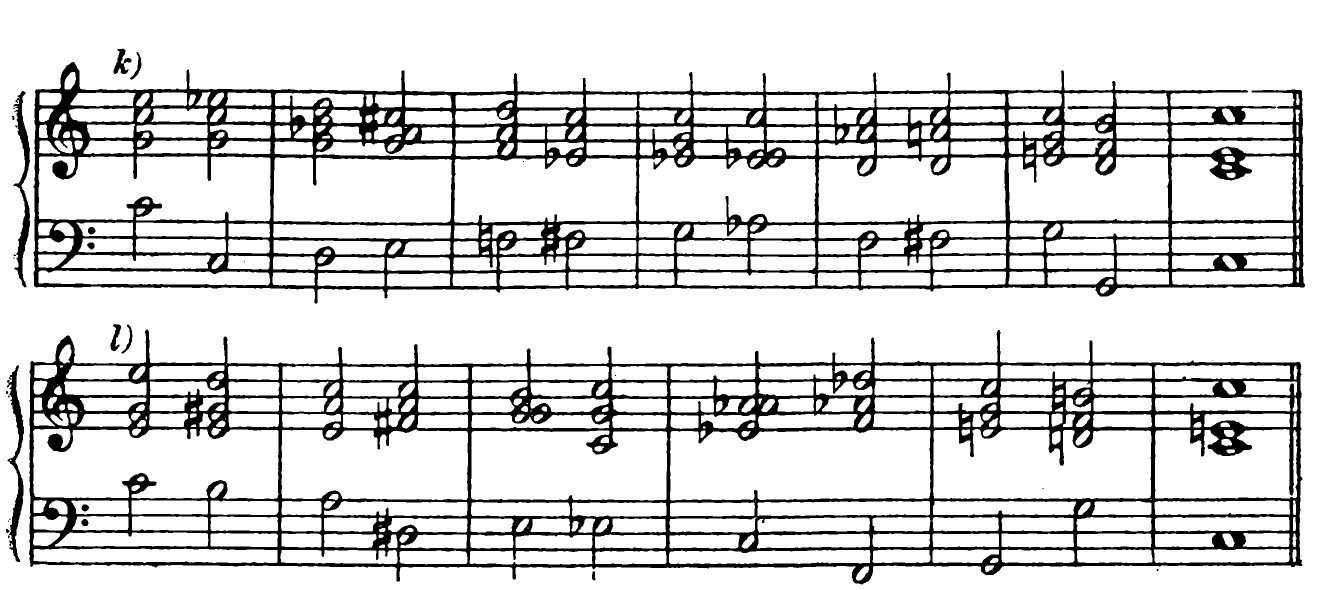
In 164g it would be better to lead the bass B-flat to A-flat. Yet the continuation shows that the strong chords that follow help overcome such objections, as does the continuation in 164k of the C that moves to D, though it would be better directed to B-flat.
In 165, starting from C minor, the minor-subdominant relationships of the major key of the same name (C major) are used first, followed by the more far-reaching relationships of the relative major, starting from A minor
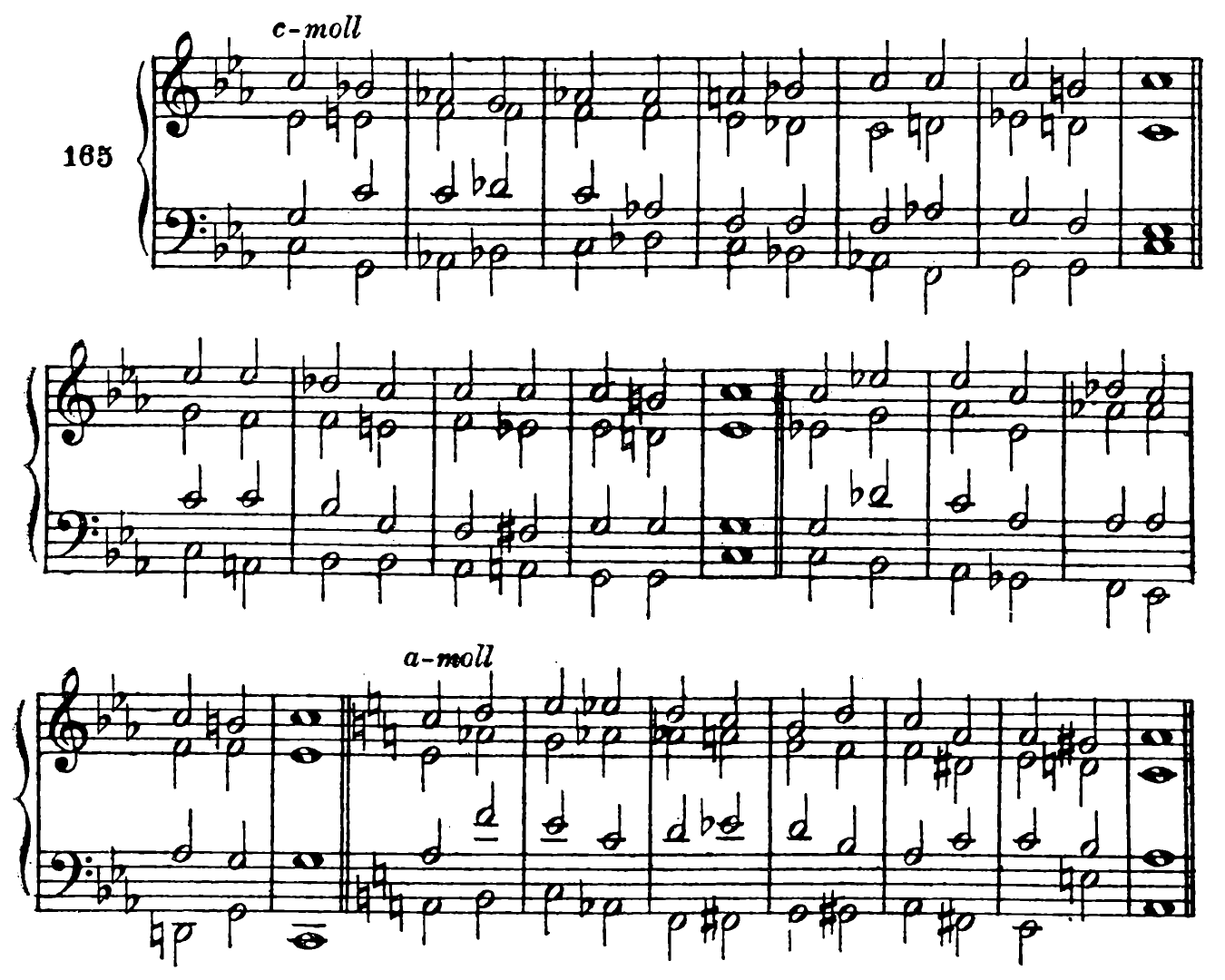
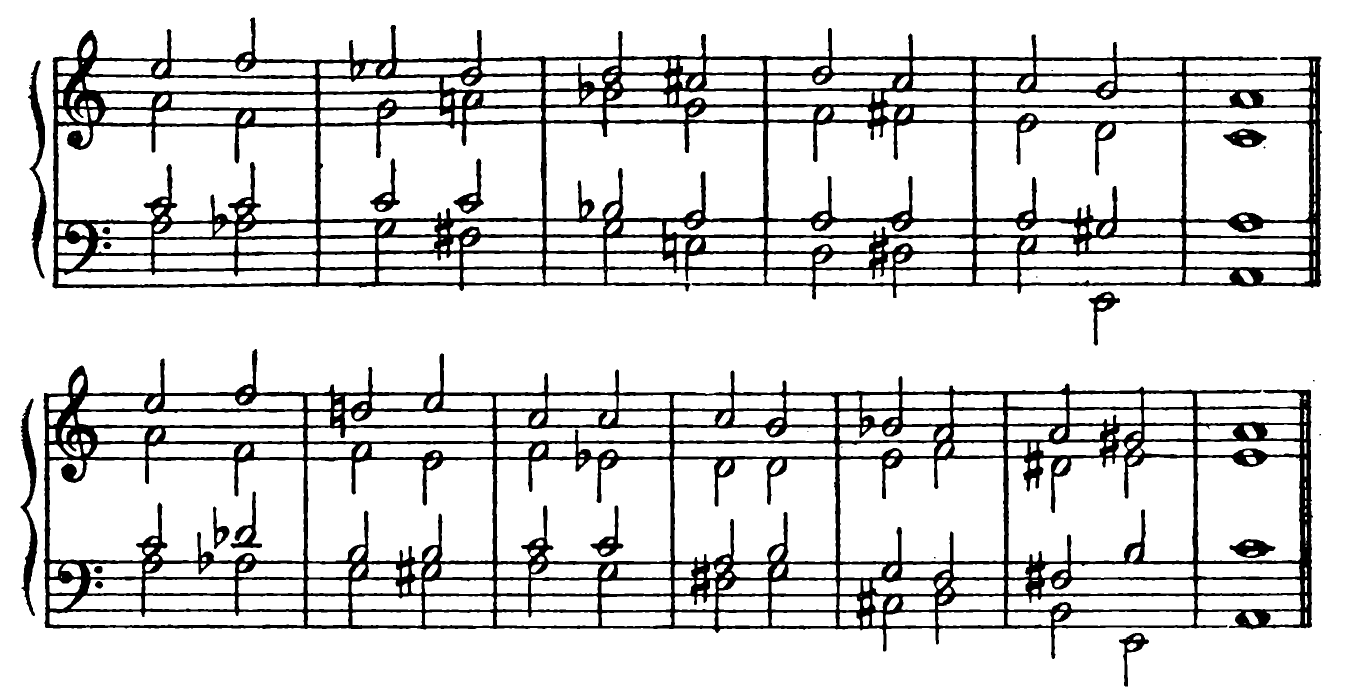
The pupil must already show taste and a sense of form here. Instructions alone can no longer deal with the abundance of events. I consider it more advantageous for the pupil to be cautious than bold, to hesitate before adding harsh connections rather than decide upon them too readily. The pupil should discriminate! And even if one goes far beyond anything that can occur here, even if nothing is bad in itself, and perhaps nothing good in itself either, the faculty to be developed—the sense of form—nevertheless exercises itself more through making choices than when it has no inhibitions.
At † in 164d, the so-called Neapolitan sixth was used. This is a sixth chord obtained through the minor-subdominant relationship; in C major and C minor it consists of F–A-flat–D-flat. In this relationship it can be traced to its diatonic occurrence as degree VI in F minor, or degree IV in A-flat major. Within F minor, its connection with V of that key is nothing new (VI–V, 166a). Its characteristic appearance, however, is modelled on that of degree II in the cadence (166b and c). It was therefore assumed to be a chromatic transformation of degree II. Properly, however, it must be called a substitute for II.
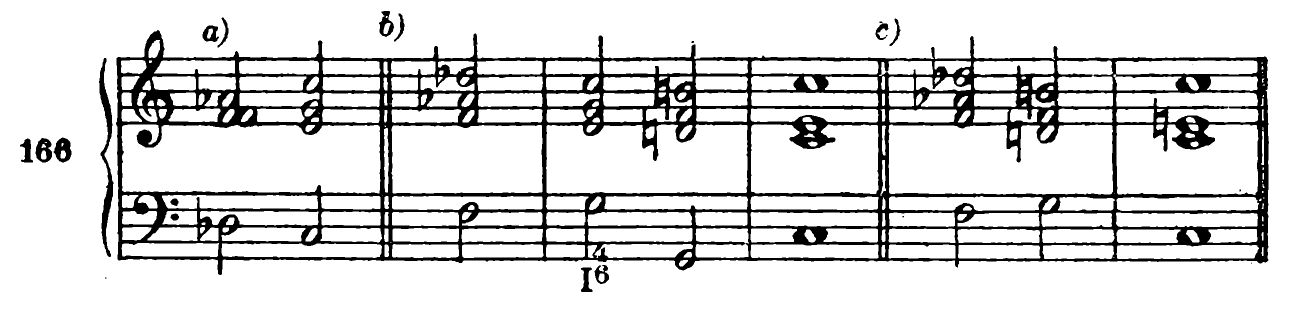
For if we assume that it is a chromatically produced transformation of degree II, this means that the root and fifth have been lowered. The assumption that the root is lowered must, however, be firmly rejected. Quite apart from its being used in only one other case (that of the augmented six-five chord, to be discussed shortly), and thus constituting one of those familiar exceptions, it is the most mistaken thing one can do. In our account, roots are fixed points from which measurements are taken. The consistency of all the measurements obtained is guaranteed by the immovability of these points. But then one must surely not move them!! It is another matter to assume that at the second position in the scale there are two roots, D and D-flat—just as there are at the sixth and seventh positions in minor, and at many positions in the church modes. This assumption can easily be extended to the entire scale, giving us the chromatic scale as the basis for considering harmonic events. There can then be two chords of degree II in C major. Perhaps a new theory will be founded on the chromatic scale; but the degrees will then probably also receive different names.
The way the Neapolitan sixth appears also argues against assuming a lowered root. It frequently occurs as follows (167a, b, c, d, e): immediately after I—but also after many other chords suitable for introducing it—it generally resolves to the six-four chord of I or to degree V.
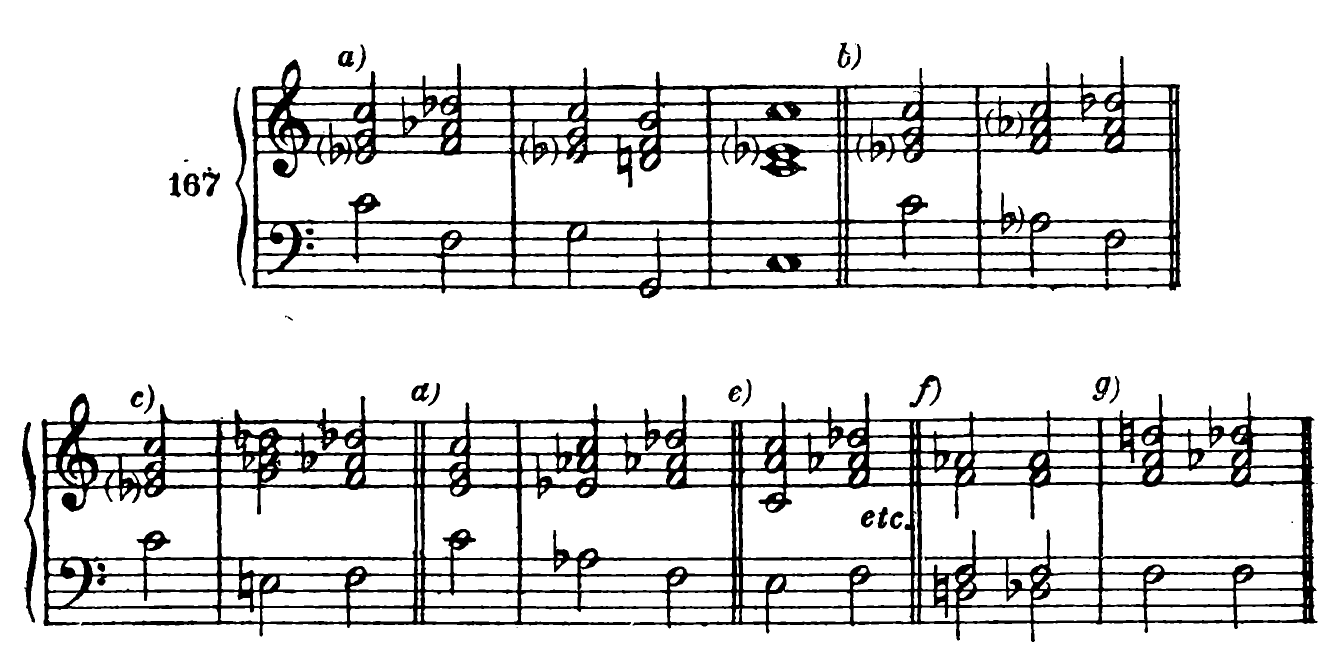
But if the root really were lowered, it would have to occur just as often as it does in 167f and g. These cases are, of course, not exceptions, but they are rare. Their occurrence does not prove an origin through lowering the root; it proves only that anything can be good in the right place.
The Neapolitan sixth is therefore best regarded as a substitute for degree II in the cadence. In this sense it is sometimes also used as a six-four chord (168a); moreover, the chord made up of its tones is also used in root position, through the effect of the familiar pattern (168b). Whether this chord still deserves the name Neapolitan sixth in cases where it does not have the Neapolitan sixth’s typical function—as a substitute for a cadential degree (168c)—is doubtful but unimportant.
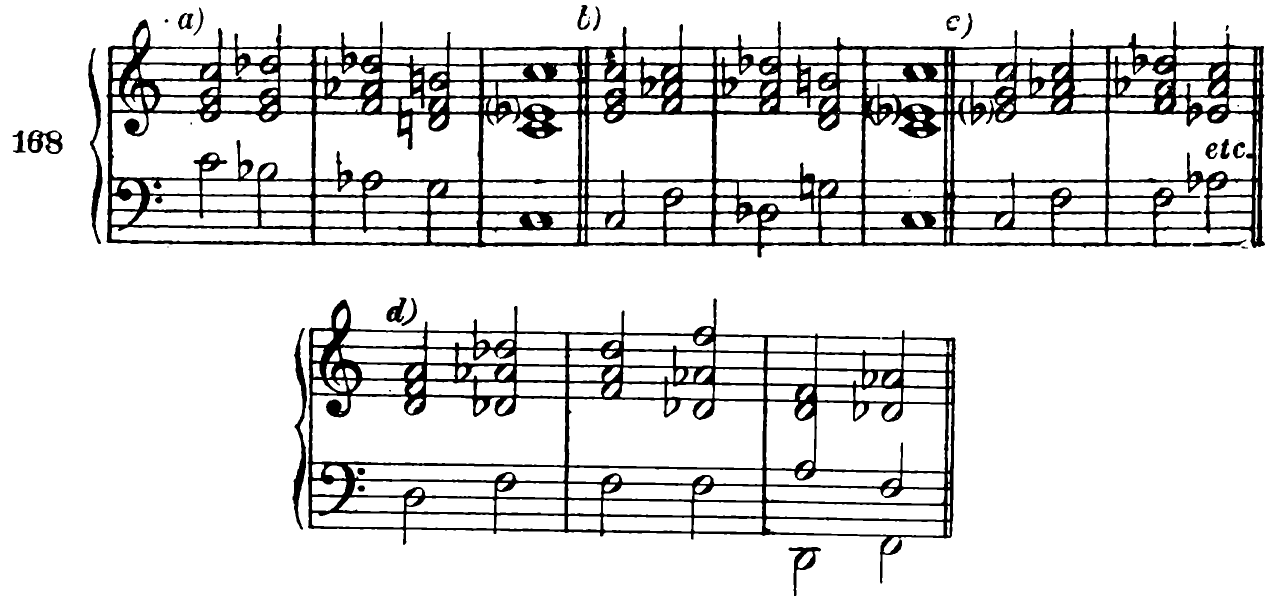
Example 167g showed a possible way of producing the Neapolitan sixth by lowering the root and fifth simultaneously. If one wishes to avoid parallel fifths, this introduction is possible only when the voices concerned are arranged in fourths, or through particularly elaborate voice leading (168d). Naturally, this introduction is neither bad nor forbidden. Yet despite the mediation of the minor-subdominant relationship, these two chords are about as distantly related as chords can be. Connecting them directly in this way brings us right up to the boundary at which we say: all chords can be connected with one another. Since these progressions are scarcely customary in any case, the pupil should still exclude them for the time being. For the same reason, the analogous progressions from the other minor chords are also omitted, as was stated earlier (degrees III and VI; the dagger sign in 156).
Any first-inversion major triad can imitate the function of the Neapolitan sixth, including those on degrees I and V. These two, however, do not lead to diatonic chords (169g and h), and are therefore unusable for the time being. But if we proceed in the opposite direction—that is, seek for the diatonic chords those possibly nondiatonic first-inversion triads that stand in the same relation to them as the Neapolitan sixth does to the six-four chord of I or to V—we obtain the forms used in 169.
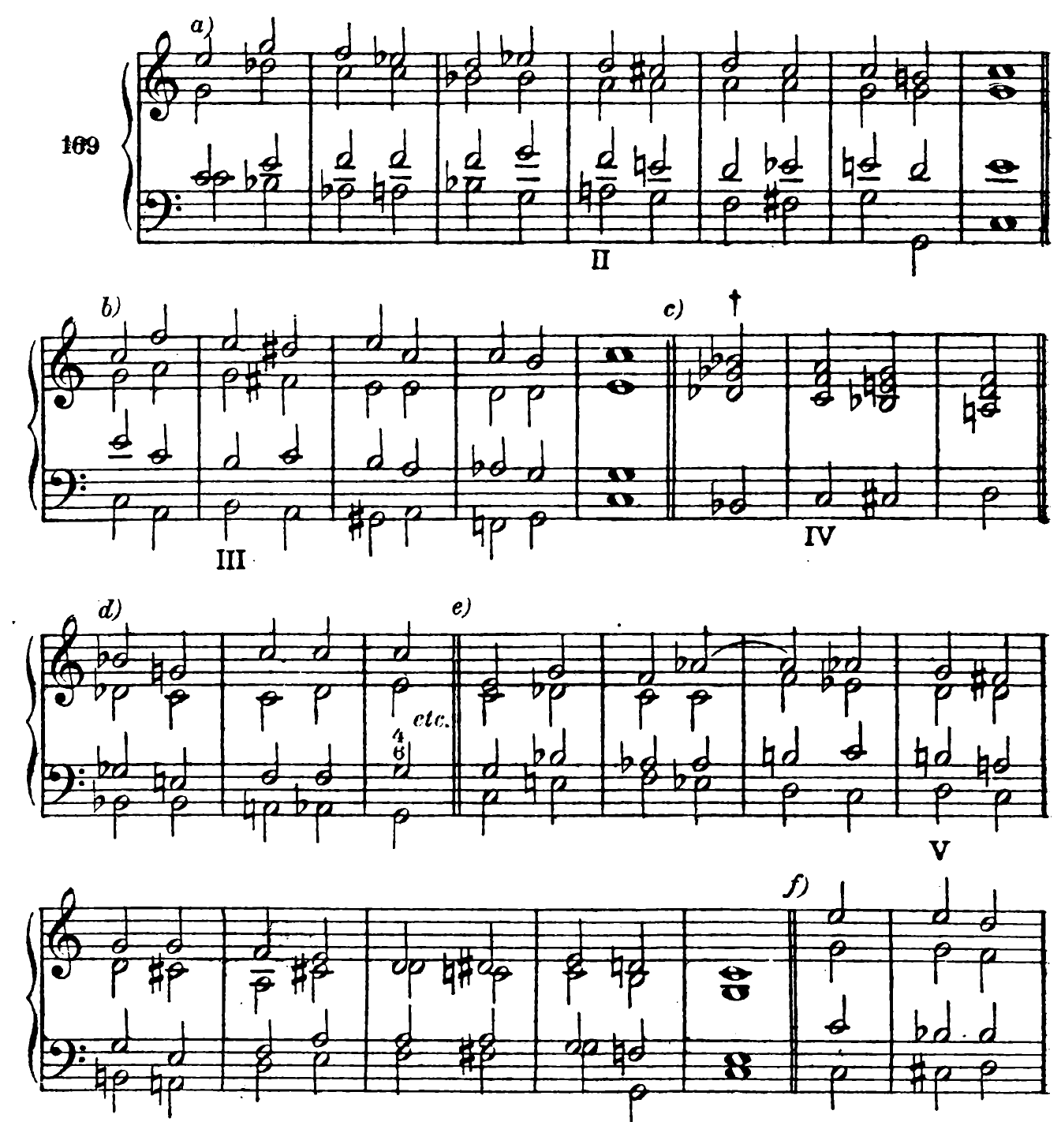
It should be noted here that, because of the six-four chord’s familiar associations, the connection to it can easily mislead us about the harmonic significance this turn has for the key. Such ambiguity can certainly be controlled easily, but it must be noticed. It will therefore be advisable to use these chords instead in their other function, following the pattern II–V.
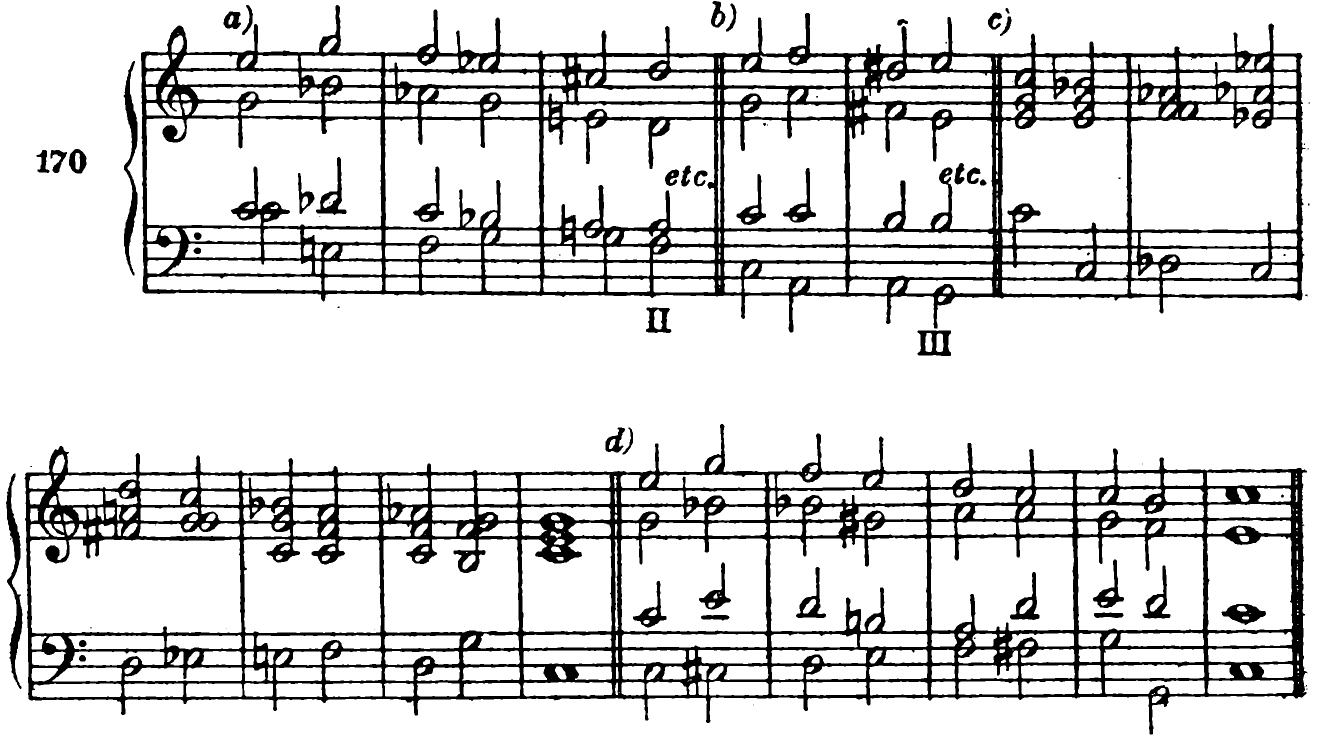
Only a few progressions belonging to the minor-subdominant relationship have remained unexamined. Assuming the principle that any progression can be good in the right place, we may assert that scarcely anything of real value has thereby been excluded.