 Playable Books
Arnold Schoenberg · section 45 of 66
At the Boundaries of the Key
Read and hear this section in the playable edition →A little more about the diminished seventh chord; then the augmented triad; further: the augmented six-five, four-three, and second chords, and the augmented sixth chord, derived from degree II and on other degrees. Some other alterations of degree II, and the same alterations on other degrees. Connections between altered and vagrant chords.
The chords discussed above can be introduced much more gently, with more mediation, by using vagrant chords. So far we know two of these: the diminished seventh chord and the augmented triad. It was shown on page 235 how the diminished seventh chord can occur in major and minor if it is regarded as a ninth chord with its root omitted, and built not only on degree V but also on other degrees, by analogy with secondary dominants. When the two most common deceptive cadences were then examined in example 141a, connections to a great many heterogeneous chords had already been established, and the chord’s outstanding ability to bring distant relationships closer and soften seemingly violent transitions had been demonstrated. These properties account for its great role in earlier music. Whenever something difficult had to be accomplished, this wonder-worker, equally at home in every saddle, was called upon. And when a piece is called a “Chromatic Fantasia and Fugue,” one can be certain that this chord plays a leading part in producing its chromaticism. Yet another significance was recognized in it: it was the “expressive” chord of that period. Wherever pain, agitation, anger, or some other intense emotion is expressed, it is almost exclusively this chord that we find. So it is with Bach, Haydn, Mozart, Beethoven, Weber, and others. It still plays this role in Wagner’s earliest works. But soon it has played itself out. The unusual, flighty, unreliable guest, here today and there tomorrow, had settled down, become respectable, become a worn-out philistine. It had lost the charm of novelty, and with it some of its harshness, but also its brilliance. It had nothing more to say to a newer age. Thus it sank from the higher sphere of art music to the lower one of entertainment music. There it now serves as the sentimental expression of sentimental matters. It has become banal and effeminate. Become banal! It was not so by nature; it was harsh and brilliant. Today, however, it is used almost only by that languishing musical literature which, some time afterward, always apes what had earlier been an event in great art. Other chords took its place: some intended to replace its expressive power, others its capacity to turn in different directions—the augmented triad and certain altered chords; then certain sonorities already foreshadowed as suspensions and passing formations in Mozart or Beethoven, and appearing as independent chords in Wagner. None of them quite equalled it, however; this did give them the advantage of being better protected against becoming banal, since they were not subjected to such excessive use. But these too soon wore out and lost their charm. This explains why new paths were sought so soon after Wagner’s harmonies, which had seemed incredibly bold to his contemporaries: the diminished seventh chord had set this movement in motion, and it cannot cease before it fulfils nature’s will, before we attain the utmost perfection in imitating nature—then to turn increasingly away from the outward model and toward the inward one.
Later I shall have occasion to consider what it is in such chords that strikes us as so expressive. Here, therefore, only this: I value originality without overvaluing it, as those who lack it usually do. It is a symptom scarcely ever absent from what is good, but it occurs in lesser things too, and therefore is not in itself a criterion. Nevertheless, I believe in the new. I believe it is that good and beautiful thing toward which our innermost being strives as involuntarily and irresistibly as it does toward the future. Somewhere in our future there must be a glorious fulfilment, still hidden from us, since all our striving continually attaches its hopes to it. Perhaps this future is a high stage in the development of our species, in which the longing that now leaves us no peace is fulfilled. Perhaps it is only death; perhaps, however, it is also the certainty of a higher life after death. The future brings the new, and perhaps that is why the new so often, and with so much justification, is for us identical with the beautiful and the good.
Since the pupil is expected to acquire knowledge, he must try to use as many properties of the diminished seventh chord as possible to benefit his modulations and cadences. But he should not overestimate its value or use too much of it, lest his exercises become—and that would indeed be dreadful—as bad as the first act of Tristan, according to the verdict of an old, very old, indeed already deceased professor of composition. We young people had attended every Wagner performance, probably unconsciously, for the sole purpose of discovering the cause of this, and could not explain it to ourselves. At last enlightenment came. The old gentleman had said: “The first act of Tristan is so boring because so many diminished seventh chords occur in it.” At last we knew.
In general, the pupil will do well not to go too far for the time being in using chords from the minor-subdominant region. For even with the universal remedy called the diminished seventh chord, restoring equilibrium is not always easy. Besides, using a universal remedy is decidedly unartistic. Unimaginative and comfortable, without merit! That is why I find example 171 quite bad.
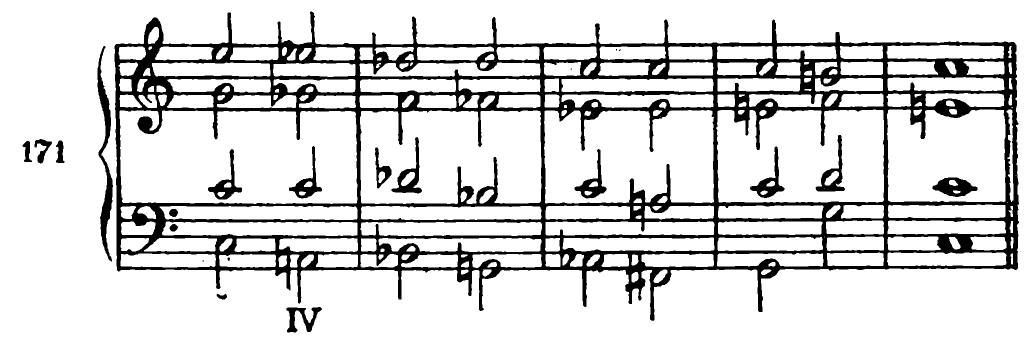
In discussing modulation I explained why a gradually developing modulation is better suited to exercises. For the reasons given there, I therefore cannot approve even extensions of the cadence made by such means. It should not be concealed, however, that the situation here is already different. Drawing on so many relationships in itself makes tonality a more mobile phenomenon. It thereby already contains greater unrest, to which more forceful action is no longer so inappropriate. Still, the diminished seventh chord can do a good many things, but not everything. Thus, when starting from a diatonic chord, for example, the pupil should scarcely use it to bring about every nondiatonic chord. This often sounds harsh, which is no calamity, but does not accord with our aim.
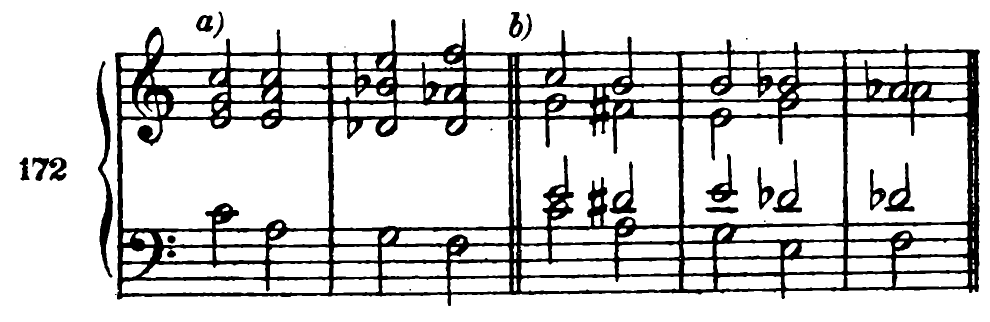
Naturally, example 172 is not absolutely bad. A good melody might be placed above it; indeed, better soprano writing alone might soften it. In itself, however, it is more abrupt and harsher than what we have admitted so far. Much will depend here on the voice leading. It will be best to shape each voice so that it resembles a nearby minor or major key. In 172a it may be the tenor that introduces D-flat in a way in which a D-flat would scarcely occur, say, in F minor or A-flat major. Perhaps it is also the bass’s “open” A, which has not been disposed of; in 172b, the course of the alto and tenor voices.
On an earlier occasion, on page 244, I excluded a use of the diminished seventh chord that often occurs in masterpieces: the form in which the diminished seventh chord of degree V—a ninth chord with its root omitted—precedes the six-four chord of I.
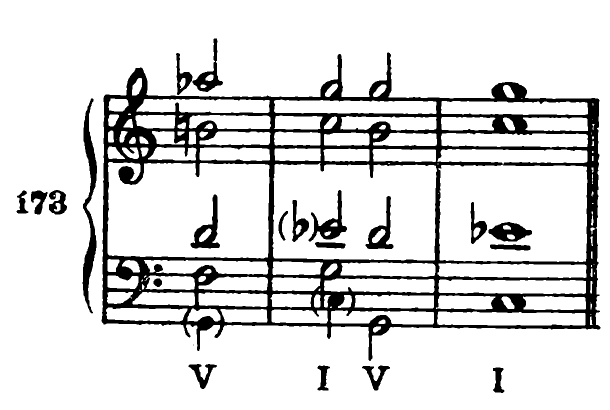
The old masters’ rule seems to have run approximately as follows: the diminished seventh chord can be connected with any chord, and therefore also with the six-four chord of degree I. But whether it is understood as degree VII of C minor or as degree V, it weakens the following dominant, because it contains that dominant’s most important elements: the ascending and descending leading tones. Moreover, degree VII is in any case only a substitute for V, so the roots are VII (= V), I, V, I, which is not very favorable. Although this occurs in masterpieces by Mozart, Beethoven, Weber, Wagner, and others—perhaps it is wrong only in relation to the other rules laid down by the harmony teaching of that time—the pupil should not do it: harmony exercises are not masterpieces. These masters’ ears were no doubt right when they said that the diminished seventh chord can be connected with any chord. Yet this connection is good not for the reason they assumed, but because any chord can be connected with any other chord. Naturally, certain conditions and qualifications apply: one must first know them, one’s sense of form must first possess them, and one must be able to take responsibility for them. Thus this is not for the pupil’s harmony exercises, but it is for the artist’s free creation.