 Playable Books
Arnold Schoenberg · section 46 of 66
The Augmented Triad
Read and hear this section in the playable edition →

The augmented triad is constituted similarly to the diminished seventh chord. As was shown earlier, its shape too has something that returns upon itself: if its lowest tone is transposed an octave higher, the distance from the formerly highest tone to the new highest tone is the same as that between the others—as that from the first to the second and from the second to the third: a major third (174a). The minor third divides the chromatic scale into four equal parts; the major third divides it into three. Whereas there are only three diminished seventh chords, there are only four augmented triads (174b). For this reason alone, by analogy with the preceding case, every augmented triad belongs to at least three minor keys (174c).

If we examine its two most important tonal resolutions—to I and VI—in all three minor keys to which it belongs, we find that the same sonority, called E–G-sharp–C in one case, E–G-sharp–B-sharp or E–A-flat–C in another, connects twice with each of three roots, each root supporting a major chord in one case and a minor chord in the other. Namely:
in A minor, to A–C–E (I) and F–A–C (VI);
in C-sharp minor, to A–C-sharp–E (VI) and C-sharp–E–G-sharp (I);
in F minor, to F–A-flat–C (I) and D-flat–F–A-flat (VI).
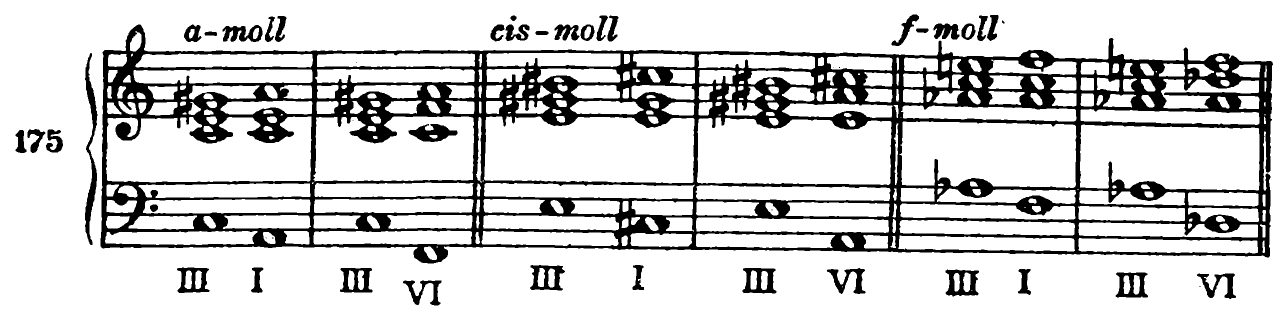
Since the root moves by a fourth in the resolutions to major chords—III–VI in minor—it is natural to use them to bring about a tonic, and for this purpose to construct them artificially on degree V of the corresponding major keys, like secondary dominants. They are introduced most simply by chromatically raising the fifth.
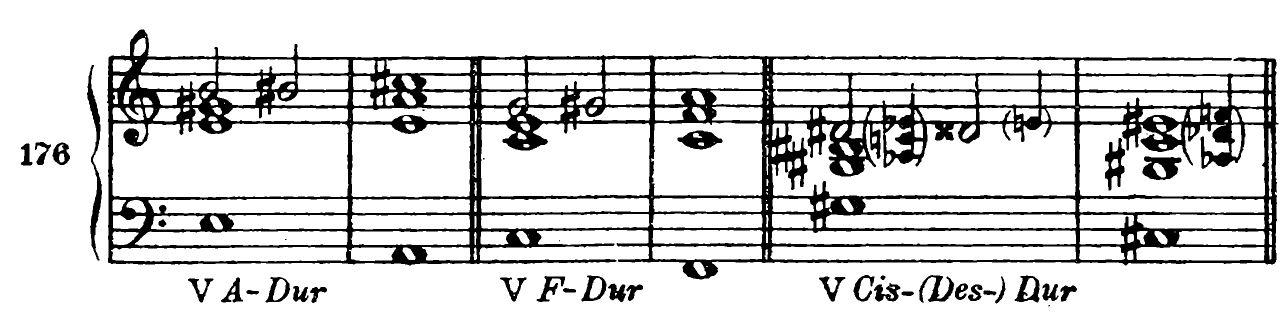
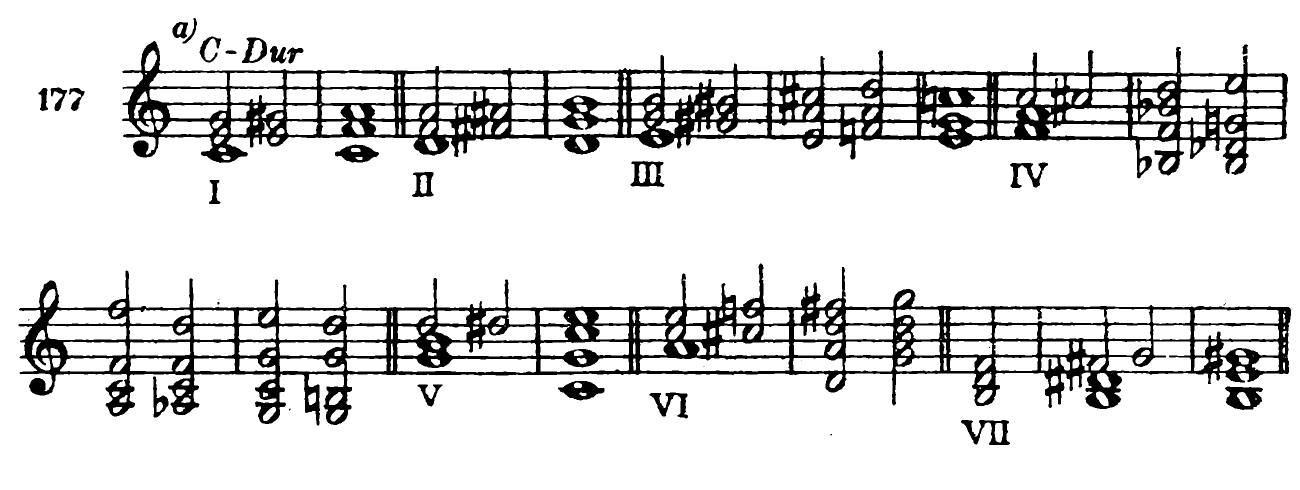
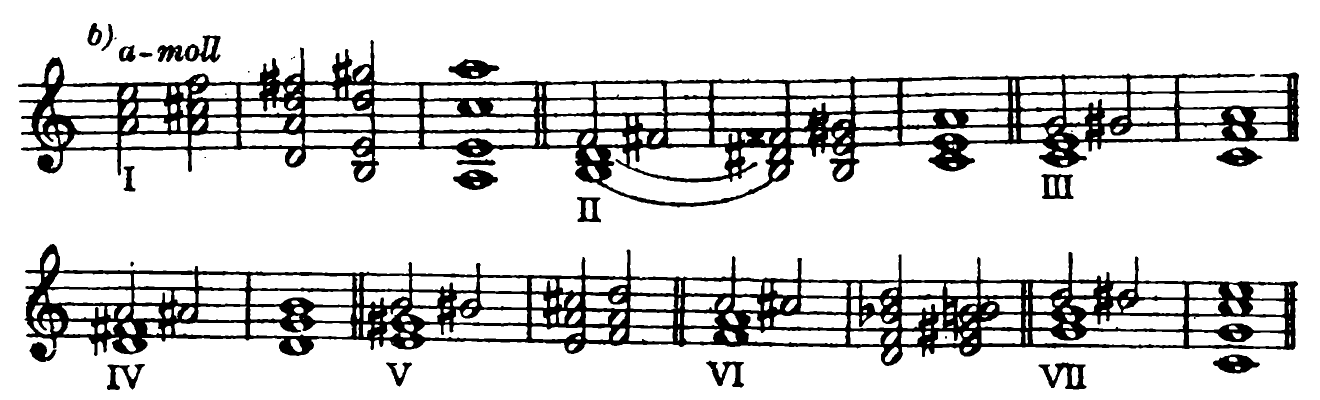
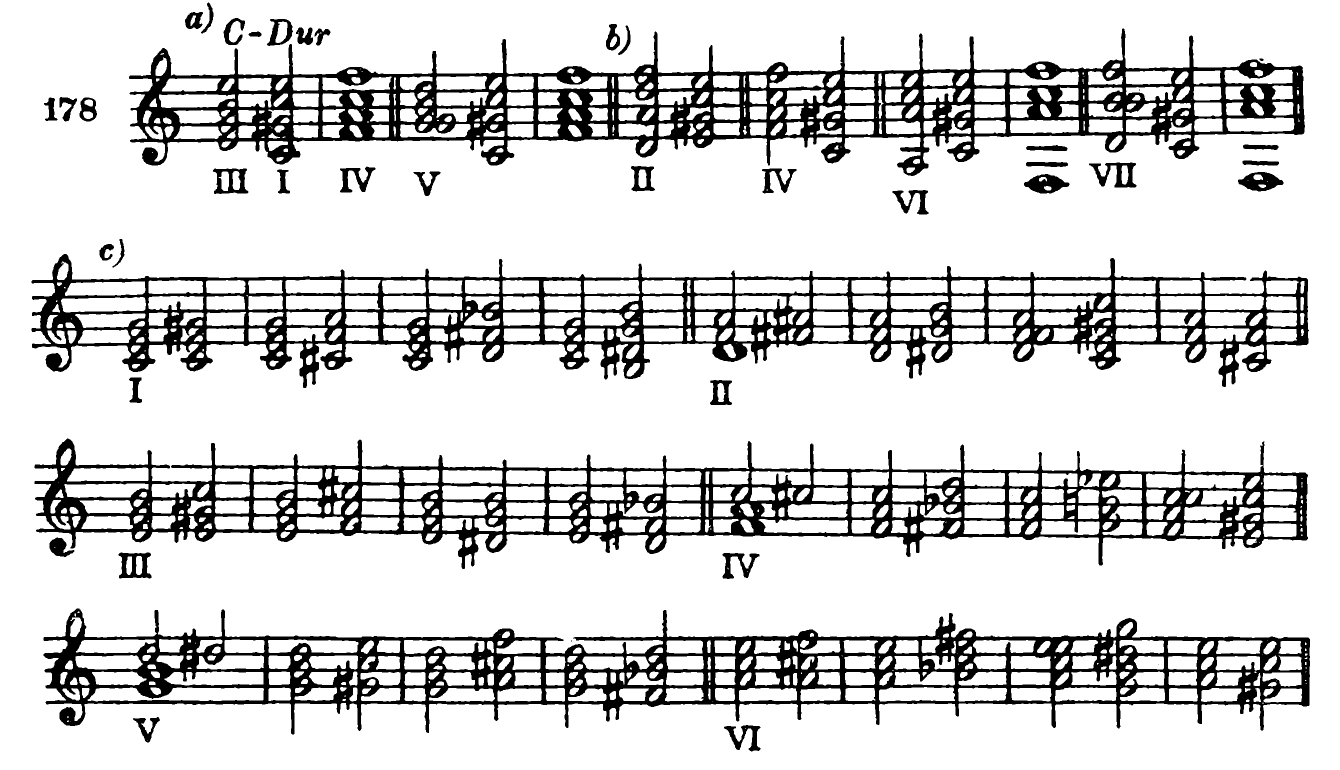
This alteration can naturally also be applied on the secondary degrees, sometimes with the third altered as well (177). Introduction is also possible chromatically through the other degrees (178a), and without chromaticism (178b). Finally, any degree can also be connected with the other augmented triads, as in 178c. For by its constitution, as its membership in three keys demonstrates, the augmented triad is a vagrant chord, like the diminished seventh chord. Although it has fewer resolutions, it resembles the diminished seventh in that its multiple meanings allow it to be introduced after almost any chord. It too permits augmented and diminished steps, since the meaning of an entering foreign tone is by no means unequivocally determined at the moment of its entry.
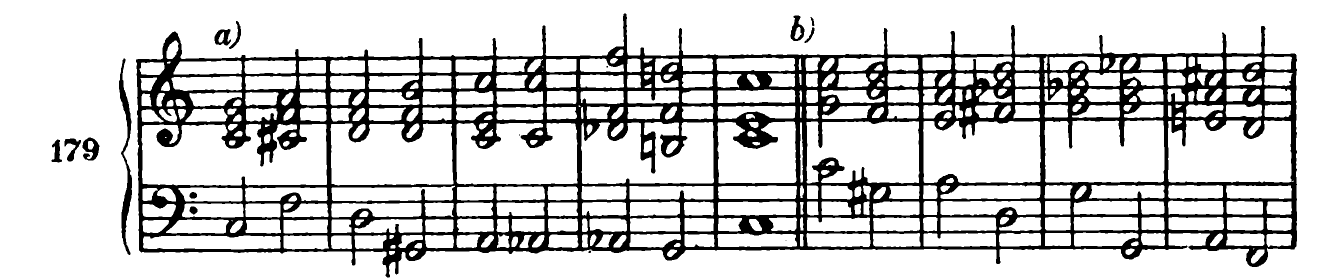
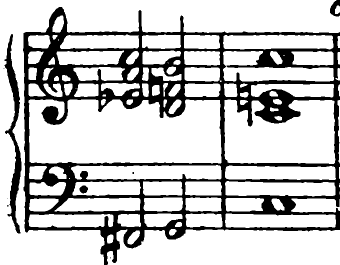
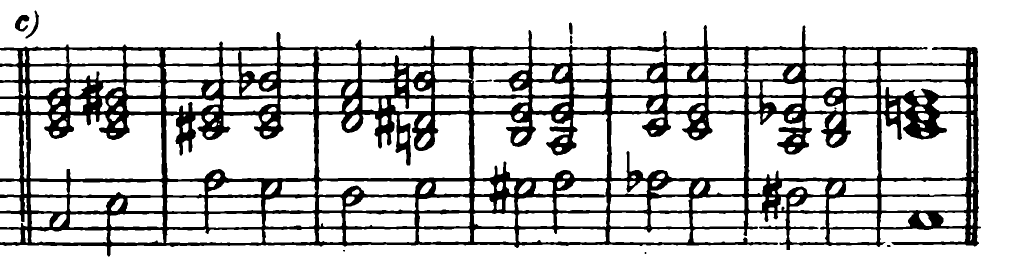
Example 179 gives several examples, which the pupil can multiply at will by trying everything indicated above. With the augmented triad there is no need to distinguish between root position and inversions. It is almost always reinterpreted, so the feeling of a six-four chord can scarcely ever arise. Enharmonic respelling will often be used to avoid complicated notation. Thus in 179d, for example, A-sharp should be written instead of B-flat. But A-sharp in C major is a notation one prefers to avoid.
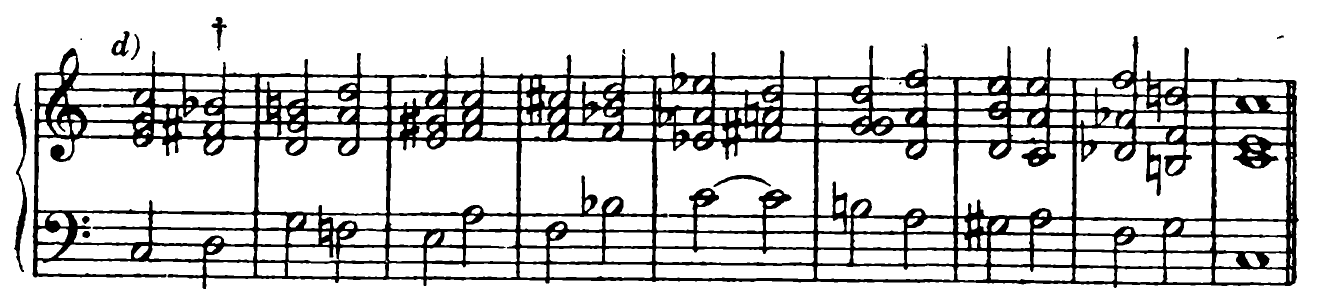
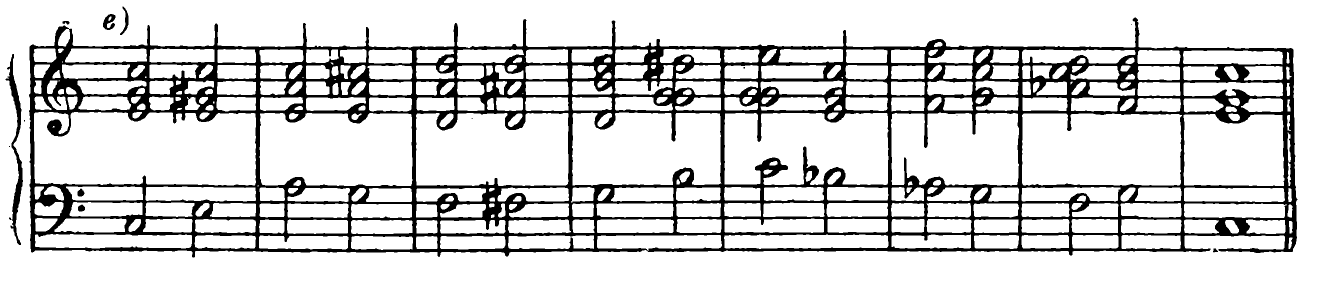
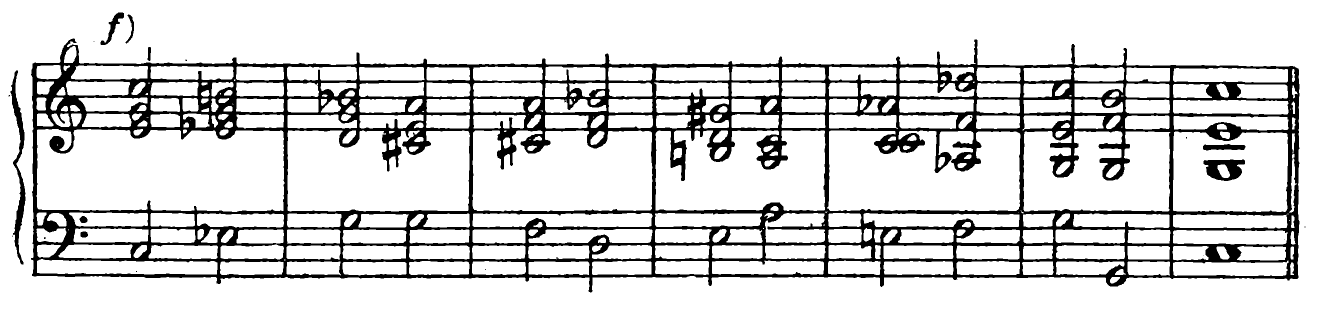
The fact that the augmented triad resolves to a major key by a strong progression—the root rising a fourth—even when it originated in the minor key of the same name, favors its use in connecting major with minor. The pupil will be able to use this advantage in modulation, but, as with the diminished seventh chord, I do not favor basing a modulation solely on this chord. As before, the pupil will do well to use a carefully considered modulation plan that prepares the destination.
Two other ways of treating the augmented triad should be mentioned. Though harmonically insignificant, they should not be excluded: lowering one tone at a time produces three new major triads (180a); lowering two tones at a time produces three minor triads on the same roots (180b).

These resolutions sound more like resolutions of suspensions, since they are based on a descending progression—a root movement upward by a third. But they are useful as preparation for a stronger progression that follows.