 Playable Books
Arnold Schoenberg · section 48 of 66
Modulation through Intermediate Keys
Read and hear this section in the playable edition →For his first exercises in these modulations, the pupil will initially do best to set aside the harmonic enrichments most recently learned. At first he should again accomplish these modulations by the simplest means, exploiting the simplest relationships. Naturally, the harmonic resources supplied in the preceding chapter would accomplish them more quickly. But it is important for the pupil to know the simple, fundamental means too, and to learn to produce suitable results smoothly with those alone, so that he develops a sense of form before venturing upon the others. Their immense range of possibilities alone makes equally precise instructions impossible, leaving the pupil increasingly dependent on correction by his sense of form.
Modulation to the second circle of fifths is most simply accomplished by dividing the route into two sections. The starting and destination keys have very few chords in common. From major upward, these are the chords of the dominant region, III and V, of which III stands closer to the second circle; from major downward, the chords of the subdominant region, II and IV, of which IV again stands closer to the second circle. Nevertheless, modulation using only these common chords is not impossible, and most textbooks present it that way. Upward, I–III–V gives nothing but descending root progressions, whereas I–V–III is quite good (206).
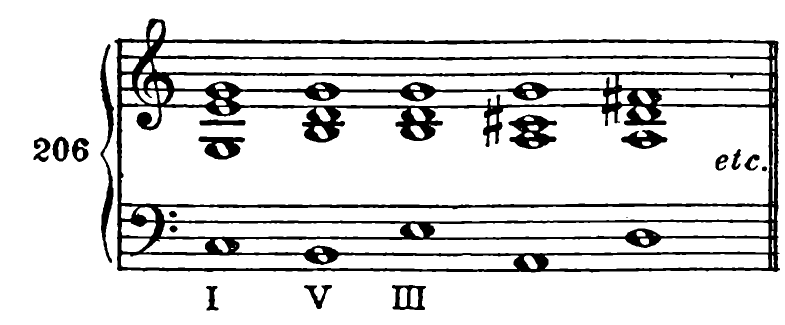
Downward, the arrangement I–IV–II produces a usable and fairly quick modulation.
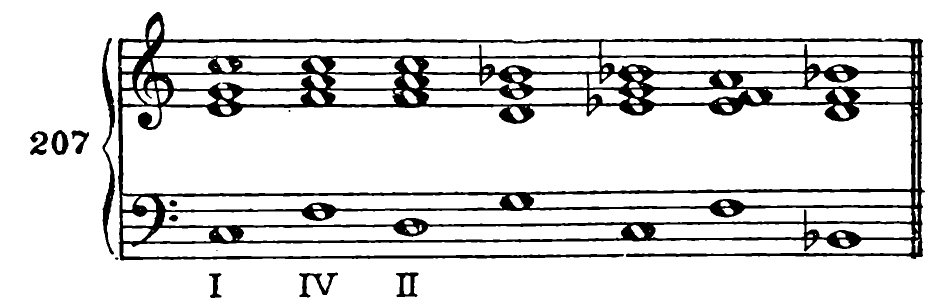
But unless one is taking an examination and has to hurry, one has time for a modulation and can plan it: can make its route genuinely one of close relationships rather than accidents, and can draw on characteristic means to obtain a characteristic effect. Accomplishing distant modulations merely by stringing triads together, as most textbooks recommend, is absolutely bad. This does not follow the path of art; it merely serves the many examinations to which the unqualified are subjected, protecting the appointed against the chosen. And it does fulfil that purpose: putting into the pupil’s hands an easily grasped and remembered formula that rarely fails, even when he is agitated—the examinations’ most excellent result. There is extremely seldom any occasion for a rapid modulation, certainly not where only simple harmonic means are being used. Modulations to remote keys occur in the literature only where rich modulatory resources are available. Anyone wishing to verify this should look at Bach. He will find that distant modulation proceeds either through gradual division of the route or, when it occurs suddenly, through an exceptionally strong modulatory device, usually the diminished seventh chord, since Bach knew no other strong modulatory devices. But also, and this is very important, through preparatory passing and neighboring notes that bring the key relationships closer. What matters is that an apparently sudden departure almost invariably announces itself beforehand: through a certain loosening of the harmony, through altered and usually enlarged melodic steps, through characteristic increases or decreases in polyphony, through dynamics—in short, in everything that matters. Very often the harmony prepares it by already suggesting the capacity of the pivotal chord to turn in different directions, placing it in an ambiguous light so that its reinterpretation feels like the fulfilment of a necessity. And the pupil is supposed to present all this through harmony alone, allowed no means other than triads and dominant seventh chords—dominant seventh chords!—with no underlying plan beyond the accidental possibilities of a cold relationship. “Because you are my father’s brother-in-law’s nephew, I am your friend.” I am not practicing aesthetics; I do not declare something unbeautiful or prohibit as ugly what I do not understand. But if anything lacks proportion, it is this way of modulating.
Dividing distant modulations into stages, like many excellent things in this book, is not my invention. It appears in the teachings of good older theorists.* But these shallow simplifiers, who merely shorten things because they can recognize meaning only in fulfilment and not in the route toward it, contribute to the deterioration of the old teaching as much as they obstruct the development of a new one. Formulas matter to them, so they present as a final result what is only a practical device. And since art must be an “ideal” to these feeble minds, they pass off the formula as aesthetics. They never knew, or long ago forgot, the why, when, and how of these laws, and therefore consider them eternal. Yet sound craftsmanship may attend to its practical requirements without having to rest on aesthetics. They will never grasp this. One need not be ashamed of meeting the material’s practical requirements, and may admit it openly without gilding or glorifying it. Then, however, one will not do the opposite of what is right in everything. Those who simplify on one side by suppressing meaning and preserving only its shell, the formula, complicate on the other by decorating that shell “artistically.” Thus they fail in everything that matters, because they always supply form and formula in place of meaning. Their simplicity and complexity bear a false relation to the content. They are simple where they must be composite, intricate where they could be straightforward. I have long known this in my own field, but in another I had to learn it through a deserved slap in the face. It made clear how thoroughly our taste in almost every field has been spoiled by the “ornamenters,” as Adolf Loos calls them, who masquerade as simplifiers. I once drew a music stand for a carpenter, with two pillars to be held together by heavy wooden strips. The heavy strips seemed beautiful to me—beautiful! The carpenter, a Czech who could not even speak German well, said: “No good carpenter will make that for you. We learned that a connecting piece must be lighter than a pillar.” I was deeply ashamed. I had pursued a beauty inappropriate to the task, and a carpenter who understood his craft could demolish it so easily. Naturally: economy of material! That is artistic economy—to expend only those means indispensable to producing a particular effect. Everything else is purposeless and therefore clumsy. It can never be beautiful because it is inorganic. Whoever pursues it is a ridiculous dilettante, a seeker after beauty without reason or insight into the nature of things. The carpenter understood his craft and knew that material must be conserved. I would gladly have paid the slight additional cost, but the idea struck him as so ridiculous that his honor as a capable craftsman would not have permitted such nonsense. Our aestheticians, however, seek beauty: they regard discovered forms as given ones, accidental formal possibilities as indispensable formal necessities, and seek eternal laws in them, although they themselves know forms to which those laws do not apply. Those then become exceptions. But they seldom think to recognize the origins and deeper meaning of these forms in practical craftsmanship and usefulness, preferring to “seek their way in the fog”—that chaotic primordial fog of nonsense from which, by chance, a world of meaning might once arise. But to mistake that meaning for the meaning of the world, and the world for that meaning, is questionable.
* For example, S. Sechter.
It is certainly possible, then, to modulate as these textbooks recommend. Particularly in simpler harmony, however, I prefer the older masters’ method. They did not merely push a modulation straight to its destination along a single track, but breached the tonality at several points, allowing at least two or three principal currents, starting from different places, to converge for joint action.
The keys in the second circle of fifths are less closely related to one another than those in the first, third, or fourth circles. In the first circle there was a more direct relationship between I of one key and V of the other: I of C major was IV of G major or V of F major. In the third and fourth circles, using V of a minor key to bring about a major triad seems to fulfil a need of that V, a necessity. Here G is indeed IV of D major, and F is V of B-flat major, but C is no degree of D major or B-flat major. Reinterpretation can occur only as follows: I (V) of C major = IV (I) of G major; I (V) of G major = IV (I) of D major; and I (IV) of C major = V (I) of F major, with I (IV) of F major = V (I) of B-flat major. This already expresses both the necessity and the manner of combining stages. The simplest choice of “intermediate key”* is the key of the first circle lying along the route; one thus adds, as it were, two first-circle modulations: 1 + 1 = 2. Later the pupil may choose other intermediate keys, possibly more than one. This gives:
Routes through intermediate keys; repeated ditto marks expanded.
* I postponed the assumption of an intermediate key for as long as possible, and can admit it here only as an auxiliary idea. Above all, it seems superfluous to me: secondary dominants can represent much more generally what intermediate keys accomplish. Moreover, it is both better and possible to regard all events within a piece as proceeding from a single center. Otherwise the almost exclusive form in which modulations occur in works of art has no proper meaning. Return to the principal key makes no proper sense unless both departure and return flow from the conditions of a single source of power: the underlying key. I therefore admit intermediate keys here only in the same sense as before—as an auxiliary concept, a means by which the pupil simplifies the composite by dividing it, solely because this makes it easier to understand. Once the chromatic scale is made the basis for considering harmonies, however, one will also be able to understand such modulations as functions of the key and assume here too that the key has not been left. This resembles what we already do in our cadences, which will soon contain everything generally regarded as modulatory, while here it serves to express the key.
Naturally, the intermediate key is not established as firmly as the destination key; otherwise it too would demand a cadence. It is kept loose enough to permit further movement, yet stated clearly enough to displace the starting key. Unless the stronger modulatory resources discussed in the preceding chapter are used, the pupil will do well to treat sensitive tones like the sixth and seventh tones of a minor scale. Two intermediate keys may of course also be used: for example, C major through G major and E minor to D major. Only a few examples follow. The pupil can carry out first-circle modulations in many ways, providing a large number of beginnings and an equally large number of continuations.
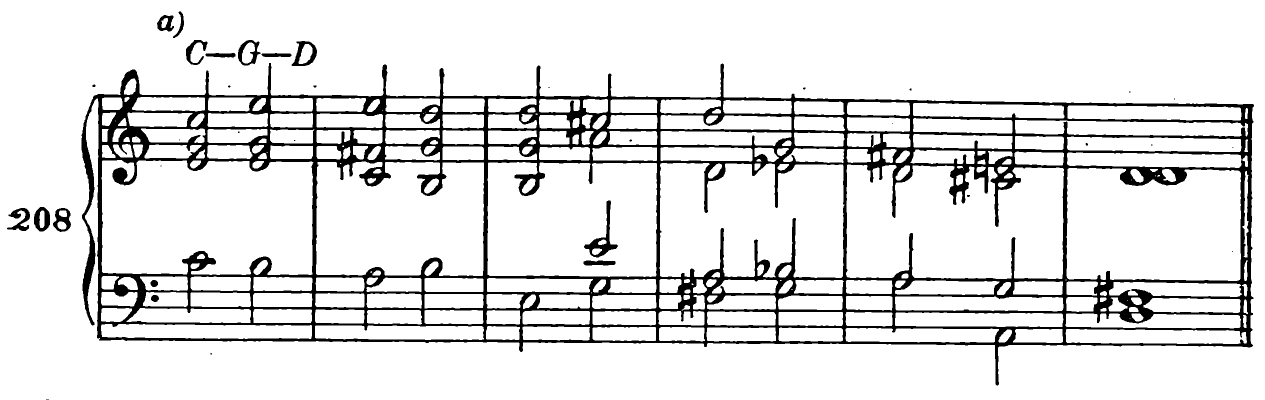
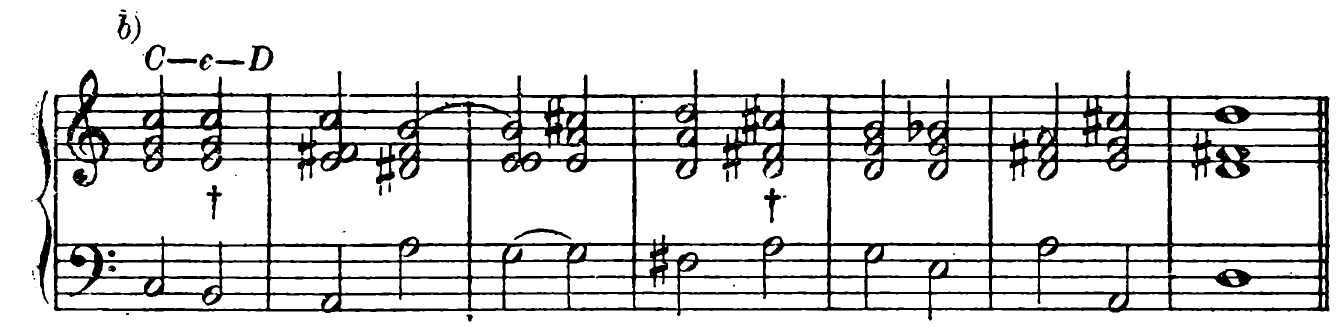
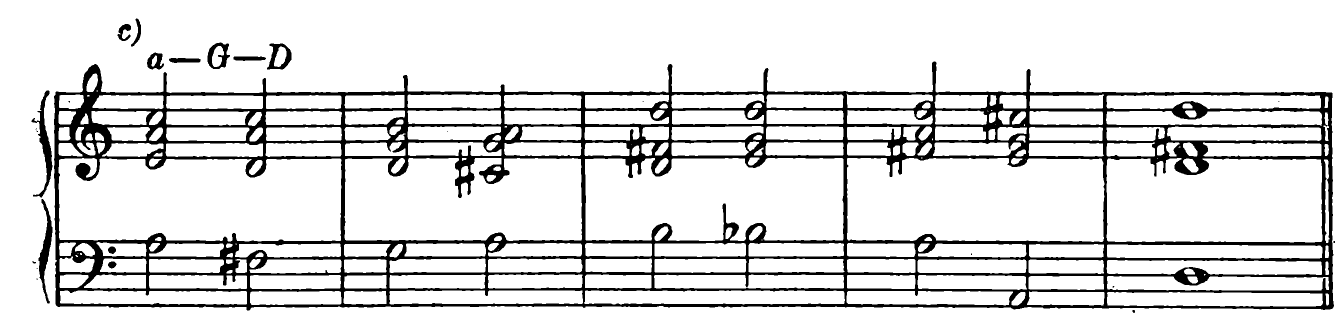
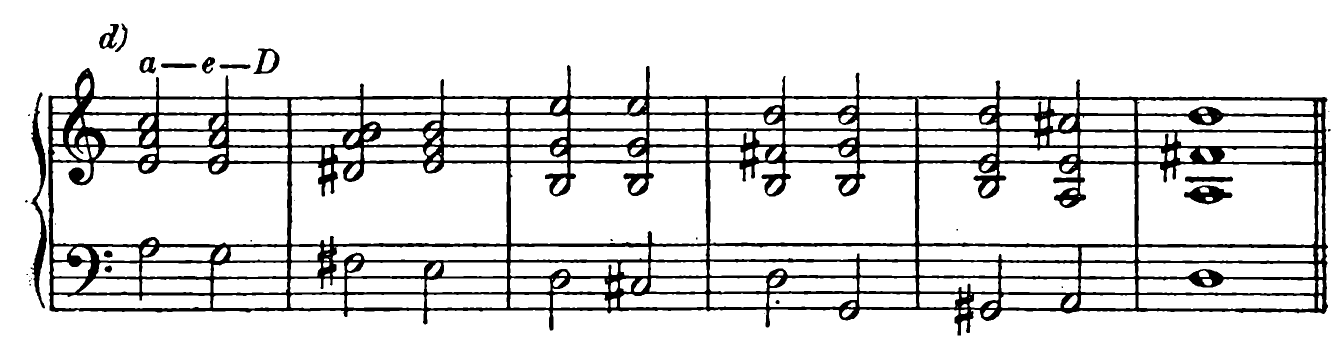
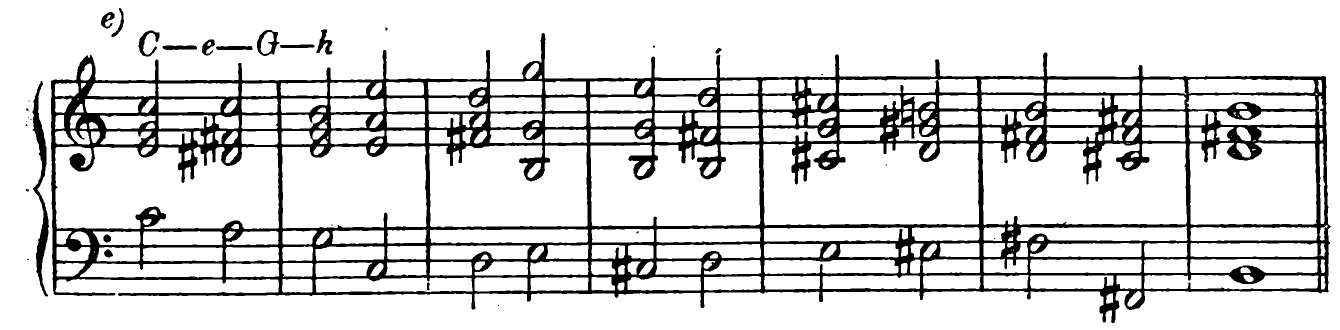
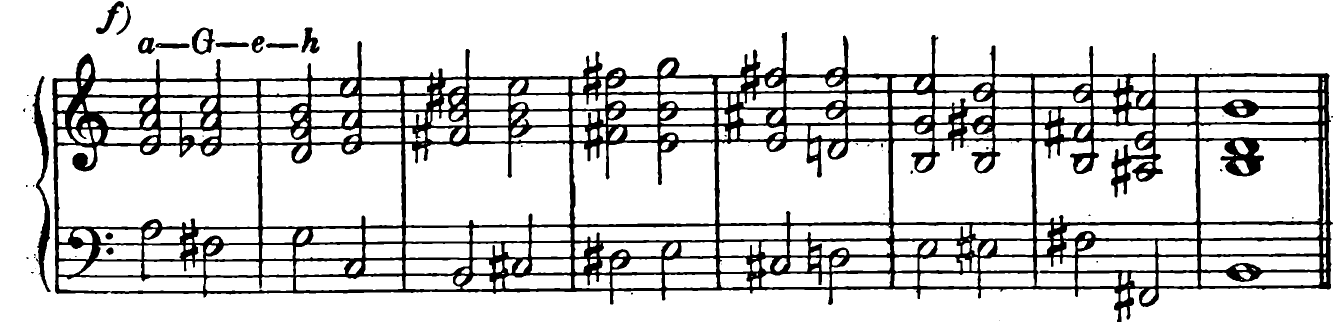
The pupil may use some secondary dominants and other nondiatonic chords in the cadence. On the whole, however, restraint is advisable here because the first half of the modulation is very simple. In 208b, secondary seventh chords were introduced without preparation. It needs no further explanation that later the pupil may introduce them unprepared, like triads, without even appealing to the “passing seventh” still invoked here. Naturally, the deceptive cadence plays an important role in these modulations: it avoids the danger of the two halves into which the modulation is divided resembling one another too closely. It is also advisable to express one of the keys through chords other than dominant and tonic (208d). When several intermediate keys are used, they should not all be minor or all major. In 208f, the bass melody proceeds from B through the sixth and seventh tones of E minor, preparing the C-sharp of B minor. The effect is very gentle.
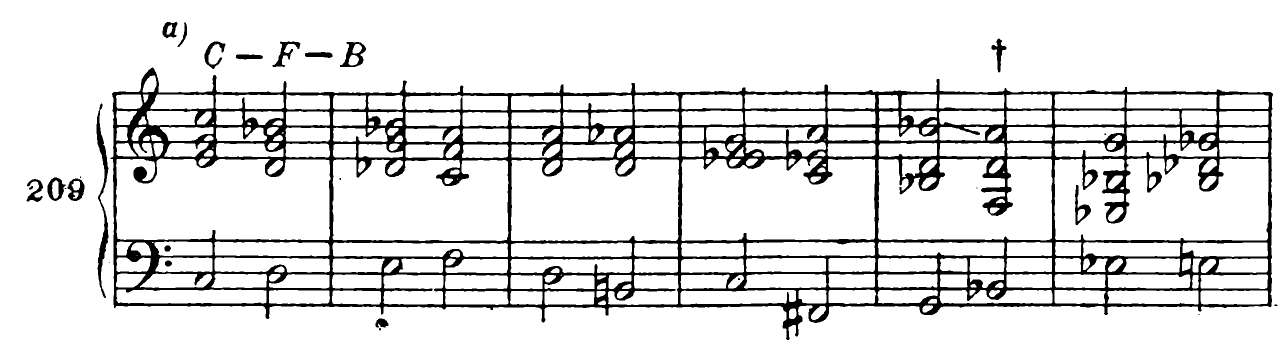
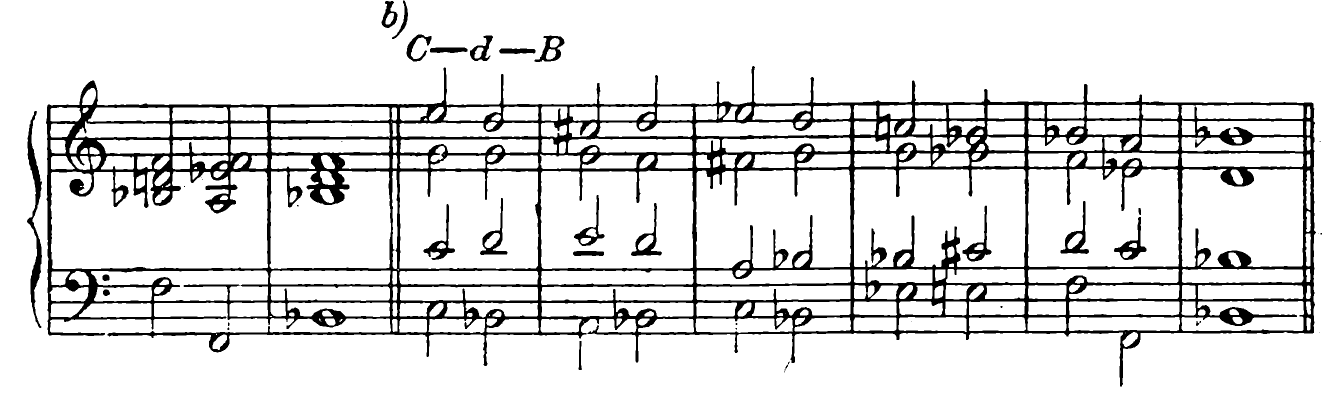
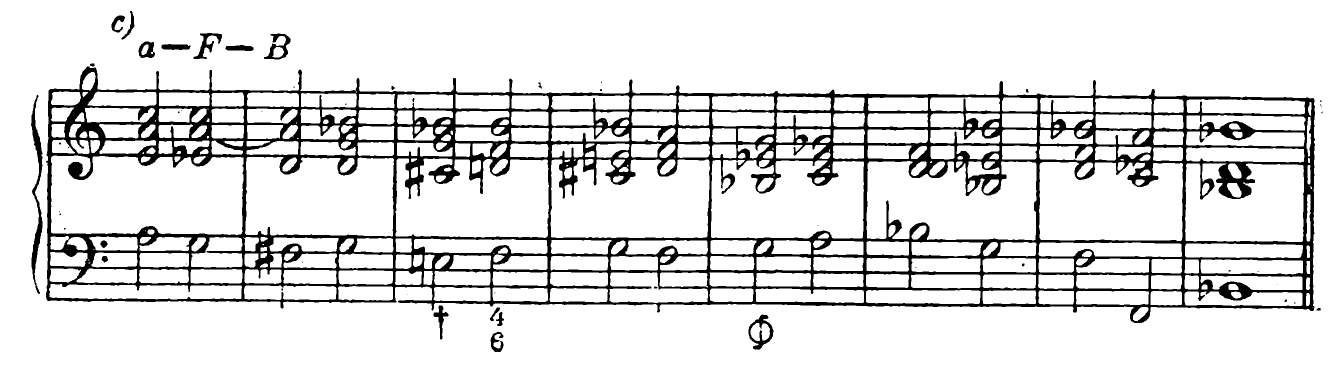
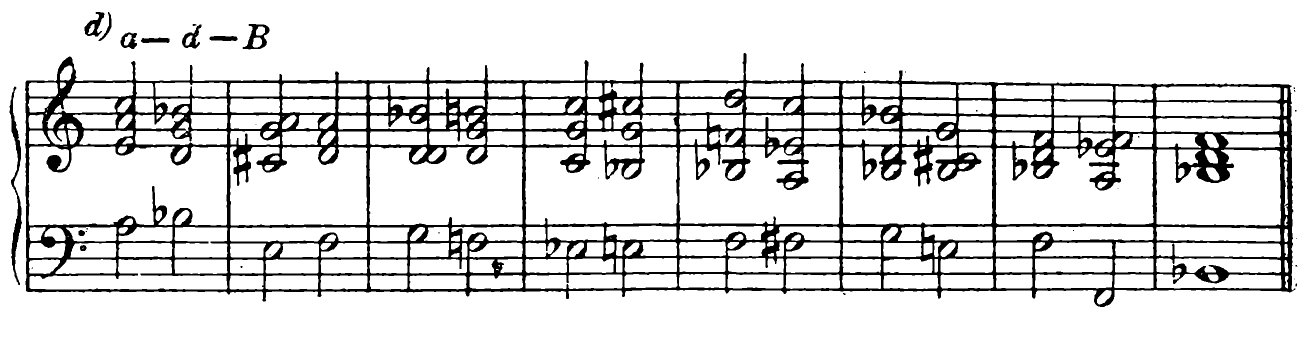
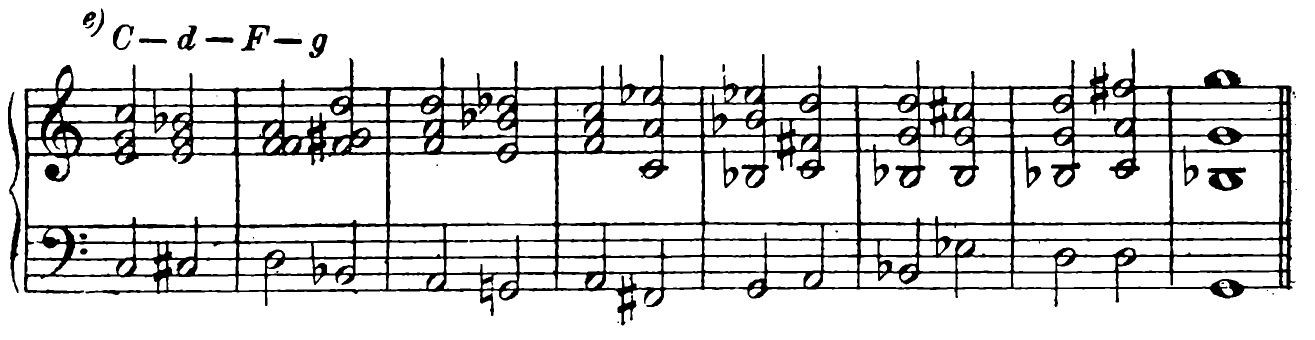
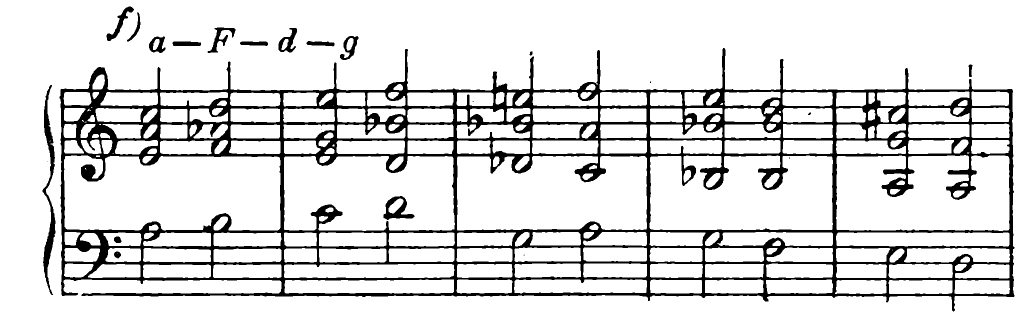
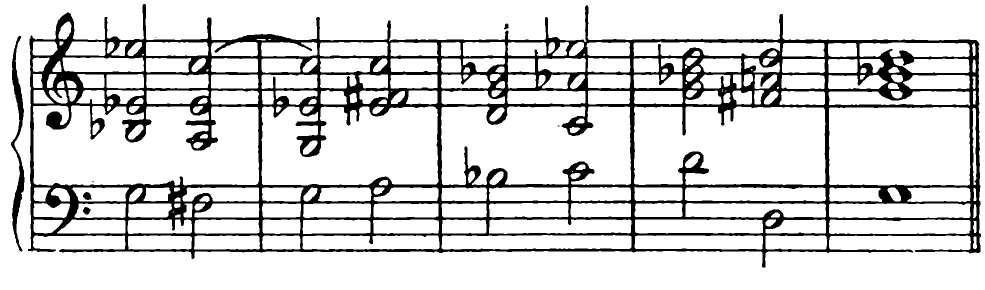
Especially when modulating downward to the second circle of fifths, the means used in the first half must be clearly distinguished from those in the second. Perhaps the pupil can already make sparing use of secondary dominants and diminished seventh chords here. Naturally, the cadence must then be richer. At the dagger in 209a, another secondary seventh chord is used unprepared as a passing formation. Judging by its continuation, the diminished seventh chord at the dagger in 209c still belongs to F major, despite the following six-four chord over F. The chord at the circle-and-line sign enters like a Neapolitan sixth but is then treated as IV of B-flat. Naturally, all these modulations can be shortened. But one should not do so, especially the pupil, who should learn to exploit the means he has been given. There is ample opportunity here. I deliberately worked out the modulations in such long passages; accommodating as much as possible is practically an end in itself. The pupil’s sense of form will soon let him observe that once one part has been elaborated broadly, the continuation is subject to a certain constraint. It cannot be arbitrarily long or short, but necessarily demands something: a special harmonic resource, perhaps also a particular melodic device. In any case it is bound, not free—but bound by the sense of form, not by laws. The pupil will do well to observe this keenly and not readily override it by suppressing his formal conscience.
Once he has practiced these simple types sufficiently, he may begin using more complicated means. I recommend introducing the resources into the exercises in approximately the same order as in the preceding chapters. This reviews what has been learned and increases the number of possible cases.
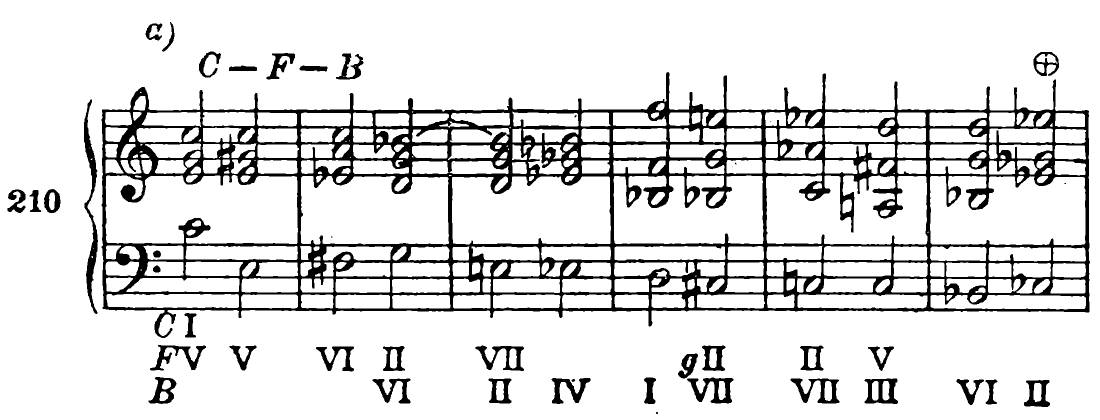
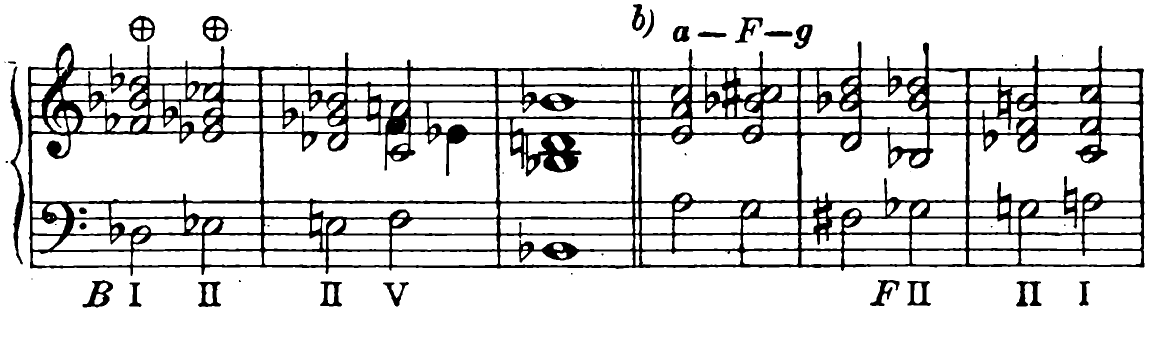
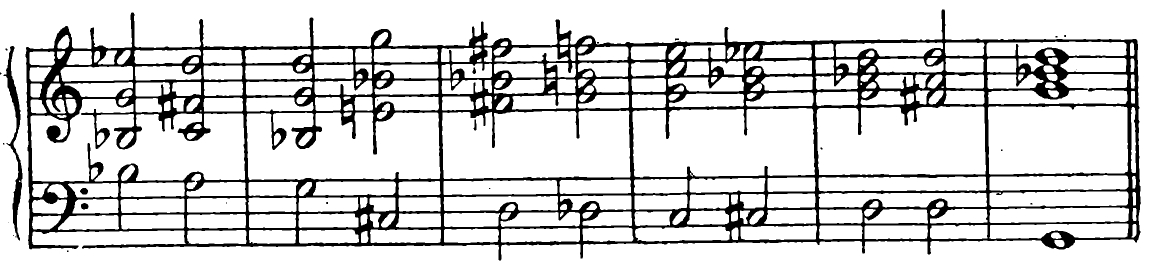
In 210a, two quarter notes were used in the alto to accommodate the seventh of the dominant seventh chord. The pupil may occasionally do this, but may also introduce the seventh freely without regard to a cross-relation, especially in the dominant seventh chord.
At the circled-plus signs in 210a, the degree labels are II–I–II, although the chords scarcely resemble their diatonic counterparts. But we know what this II is: a rearrangement, into root position, of the tones of the Neapolitan sixth chord. If, here and in similar cases, we temporarily understand the Neapolitan sixth as a tonic and call it I merely to make the root progressions easier to follow, the following diminished triad is its VII. The connection is thus I–VII–I, something very familiar. Yet since the Neapolitan sixth stands on II here, the succession that looks like I–VII–I in C-flat major is II–I–II in B-flat major: the Neapolitan sixth has been elaborated here as a key. The pupil should not call this C-flat major, however, but remain aware that he is using only an auxiliary concept.