 Playable Books
Arnold Schoenberg · section 49 of 66
Fifth and Sixth Circles of Fifths
Read and hear this section in the playable edition →Modulations to these circles are also most easily accomplished by dividing the route. They are best assembled from two, perhaps three, uncompounded modulations—those to the first, third, and fourth circles. Thus a modulation to the fifth circle can be assembled as 4 + 1 or 1 + 4: first to the fourth circle and from there to the first, or the reverse. A modulation to the sixth can be assembled as 3 + 3. Since upward and downward movement here reaches the same key, C major to F-sharp or G-flat major, 3 + 3 can be carried out in either direction. But 6 could also be assembled as 3 + 4 − 1, 4 + 3 − 1, −1 + 3 + 4, −1 + 4 + 3, 4 − 1 + 3, 3 − 1 + 4, and so forth.* The route to 5 can likewise be subdivided further, as 3 + 3 − 1, 3 − 1 + 3, 4 + 4 − 3, and so on. One will also sometimes choose 3 + 2 or 2 + 3, although 2 itself consists of 1 + 1. The same considerations apply to establishing these intermediate keys as were given for second-circle modulations. Secondary dominants, diminished seventh chords, and other vagrant chords will be useful here. Yet the pupil is again advised to begin with exercises using simple means. The following modulations are to be worked out: from C major and A minor to D-flat major, B-flat minor, B major, G-sharp minor, G-flat major, E-flat minor, F-sharp major, and D-sharp minor.
* Plus and minus are understood relative to the chosen direction; when moving downward around the circle, minus therefore denotes upward movement. Mathematically, this can be expressed as follows: to the fifth circle in either direction, ±(4 + 1); or to the sixth, ±(3 + 4 − 1), ±(−1 + 3 + 4), and so forth.
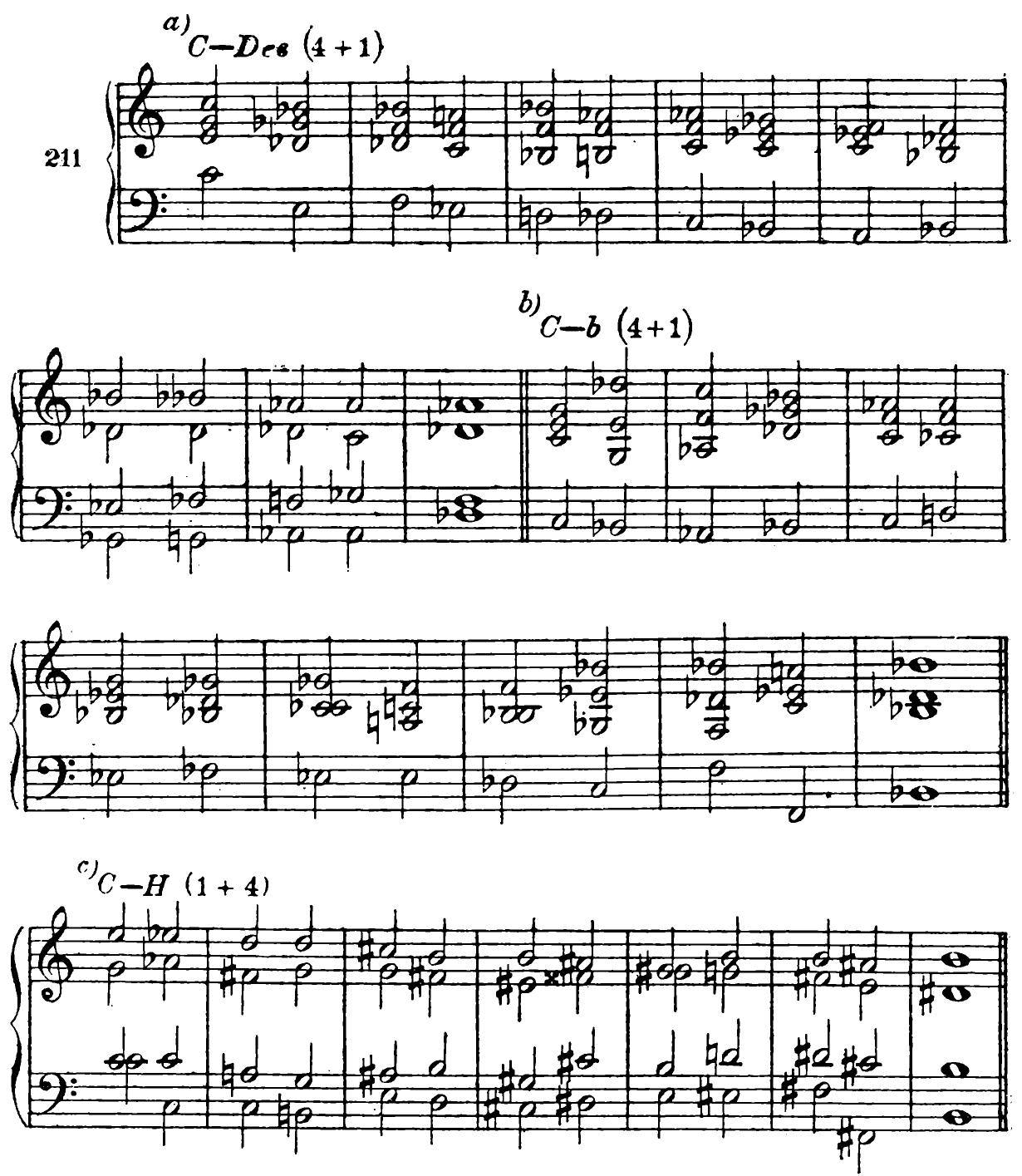
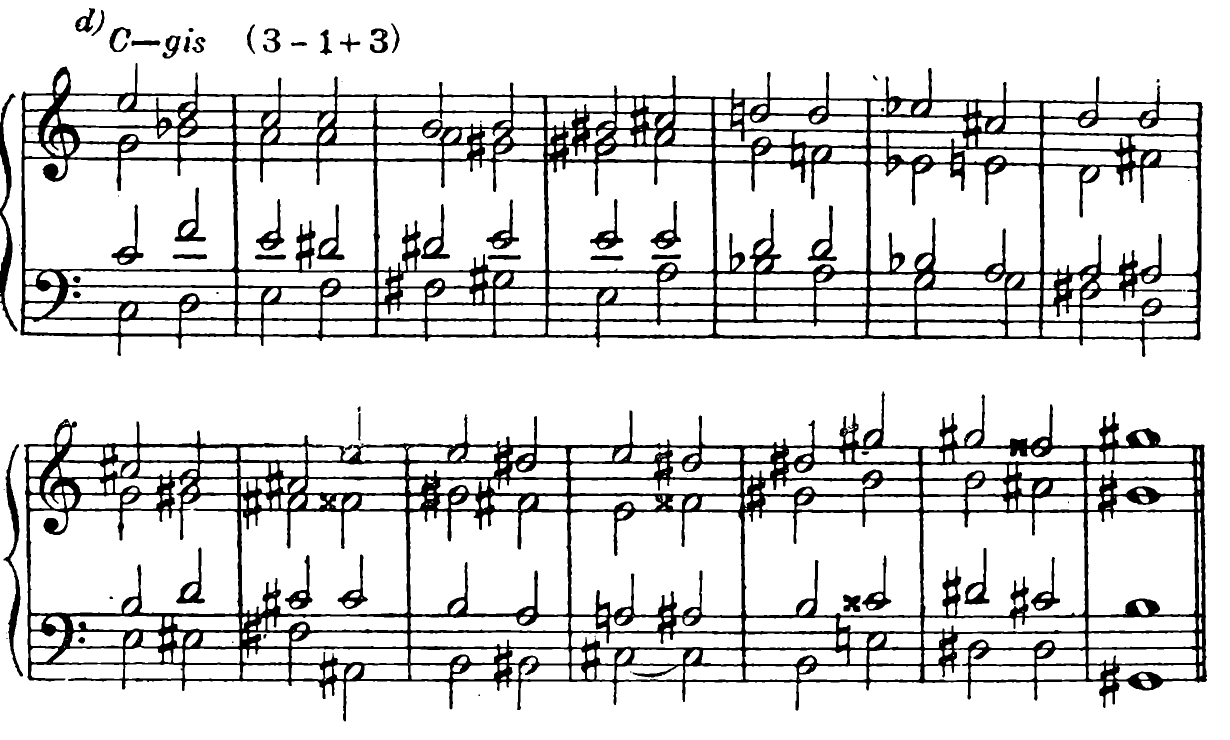
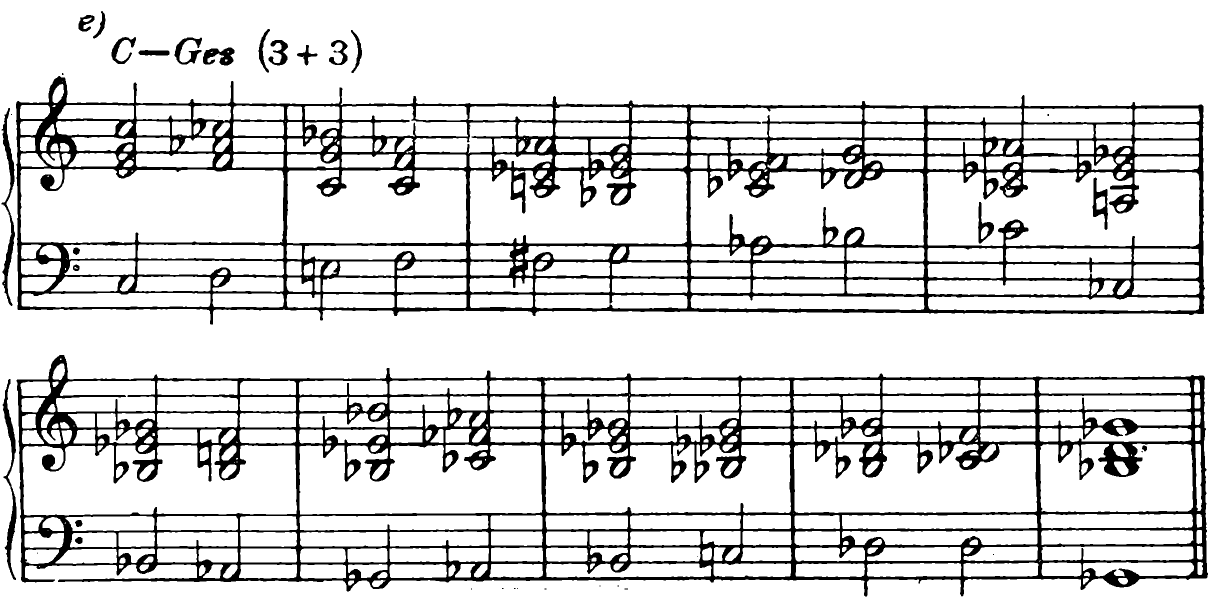
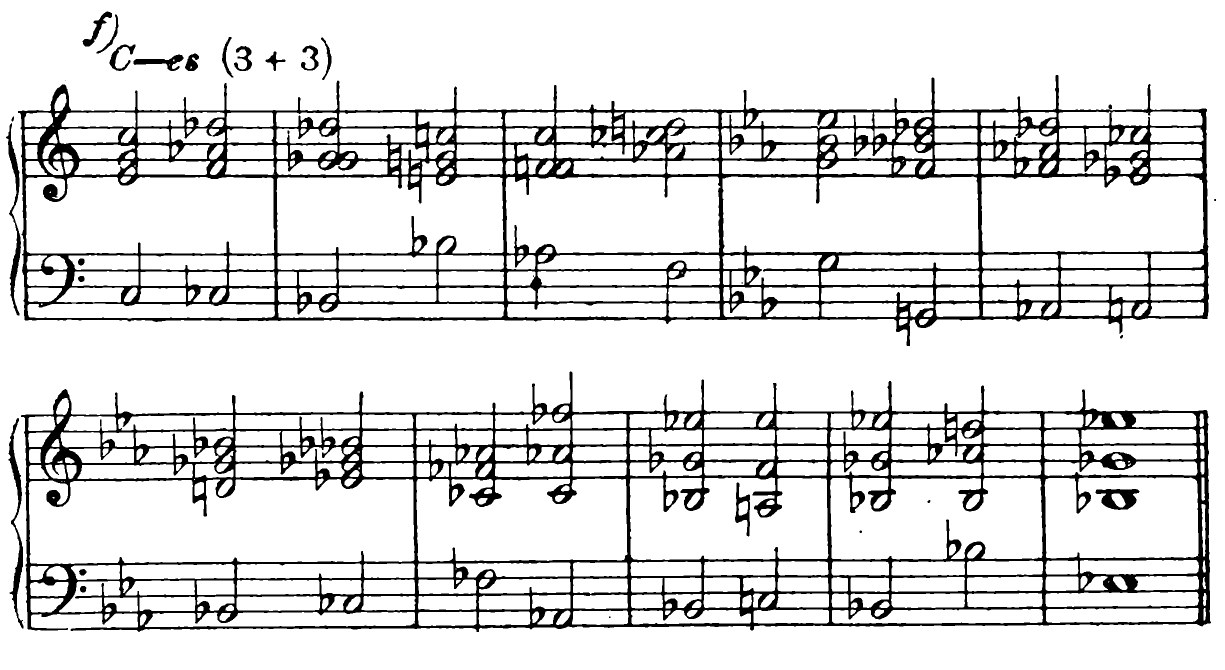
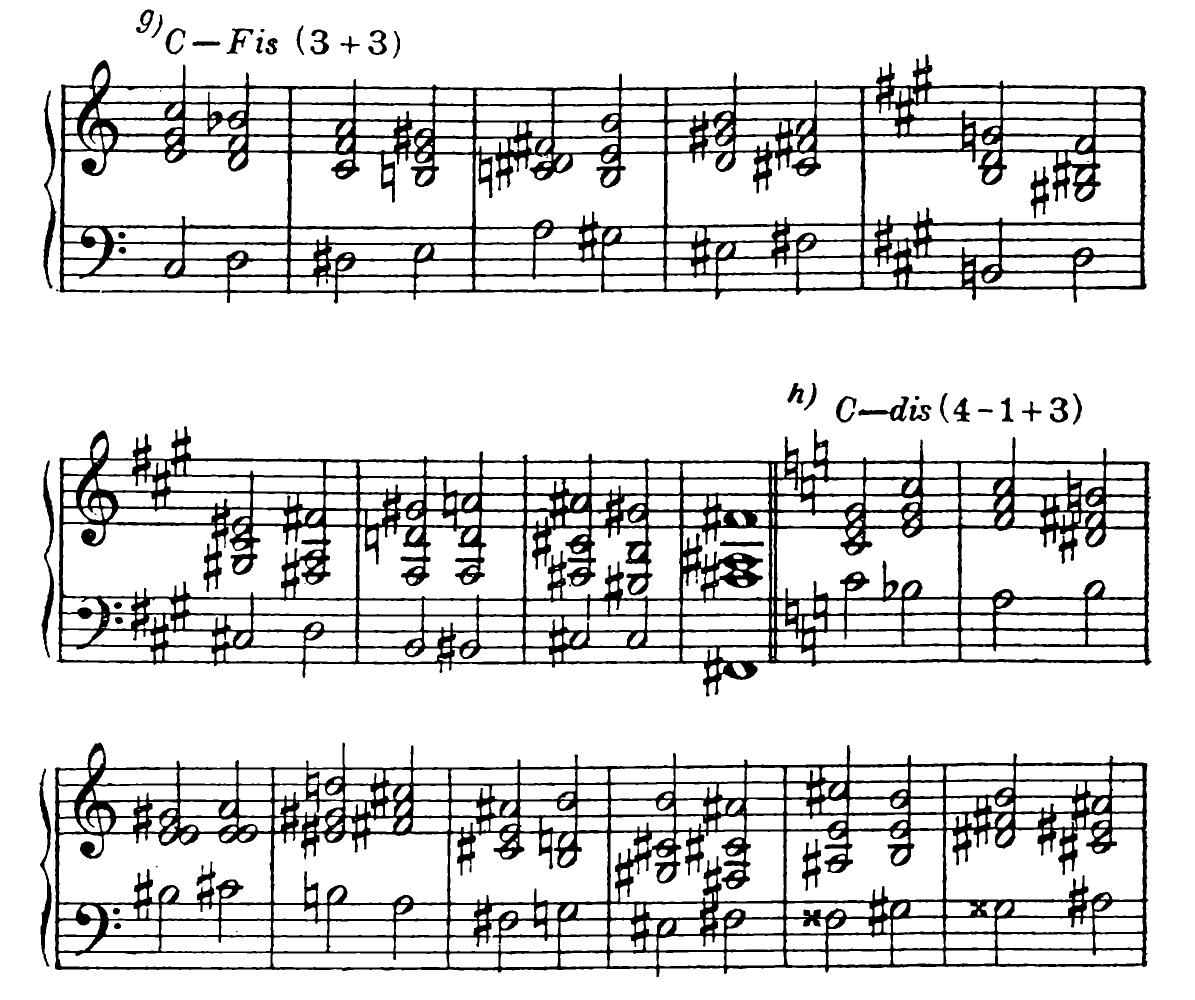
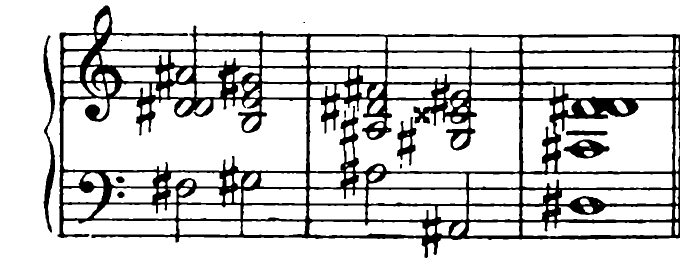
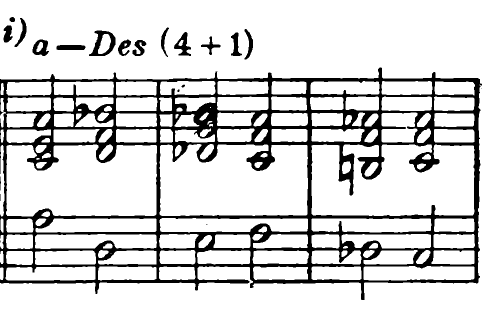
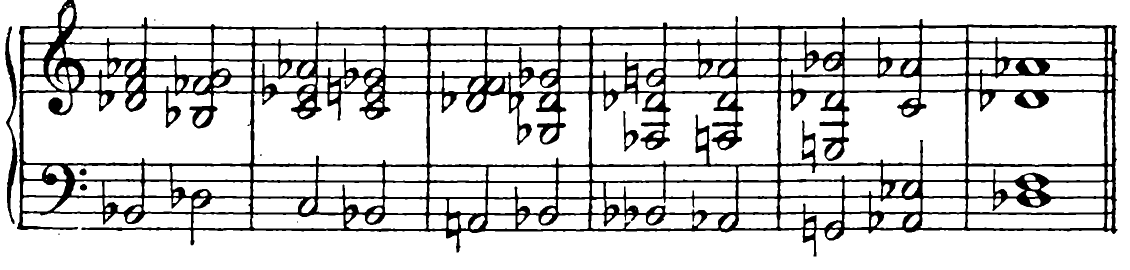
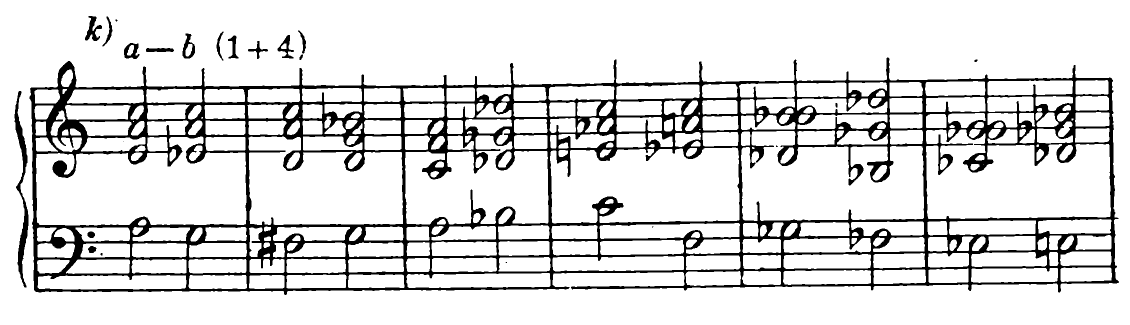
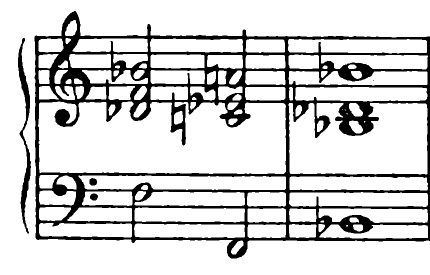
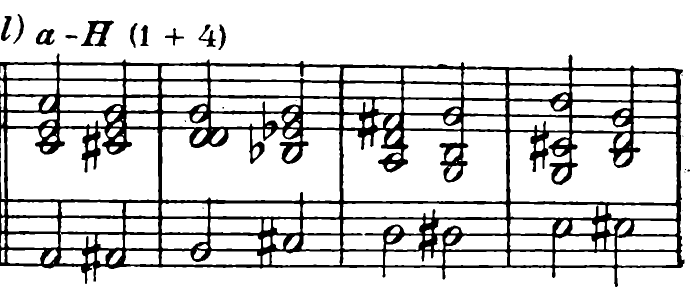
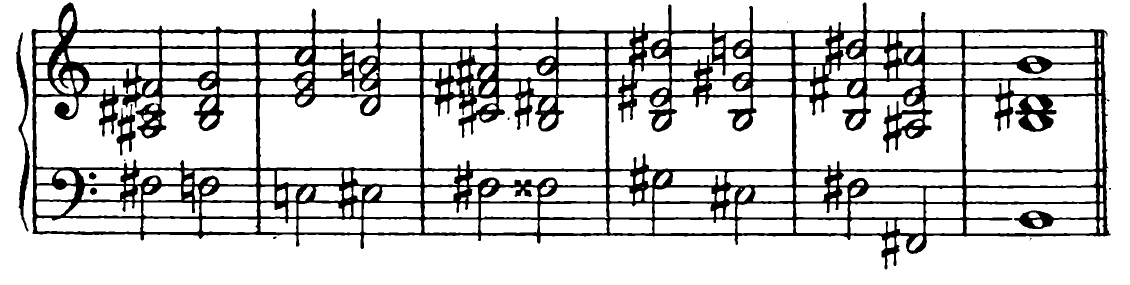
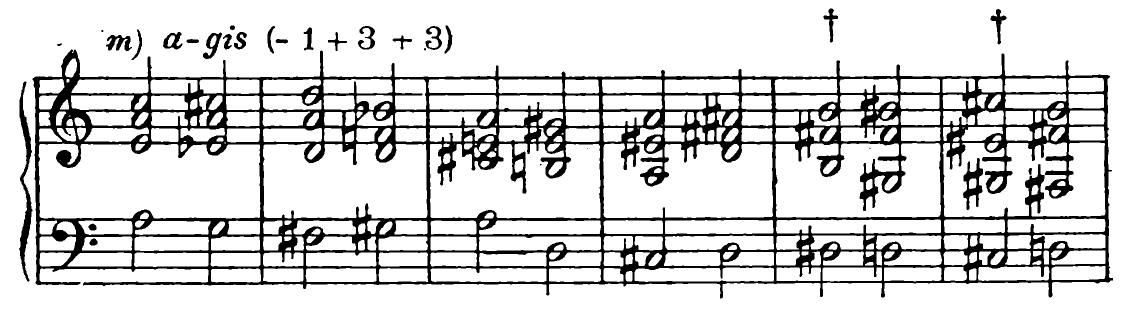
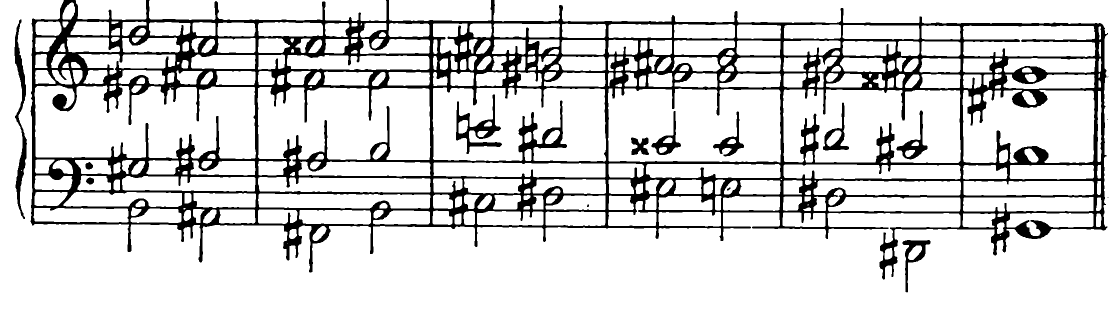
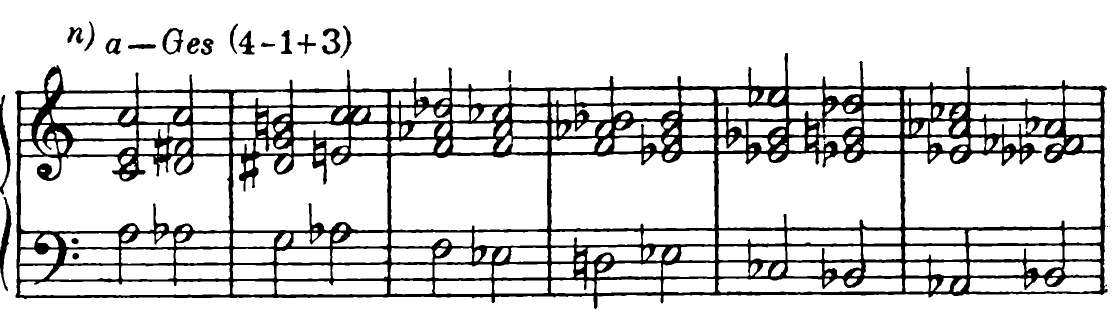
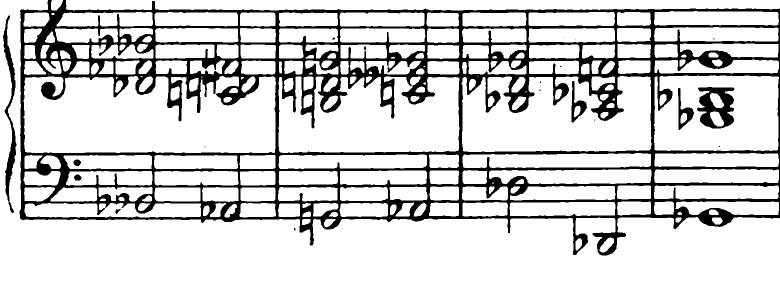
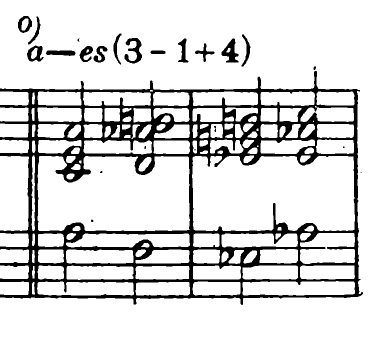
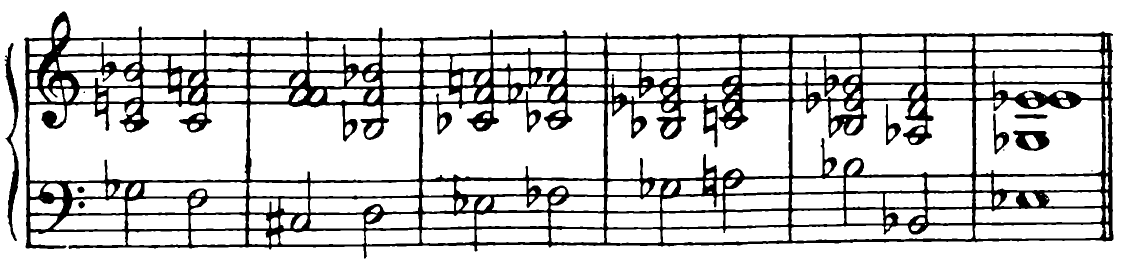
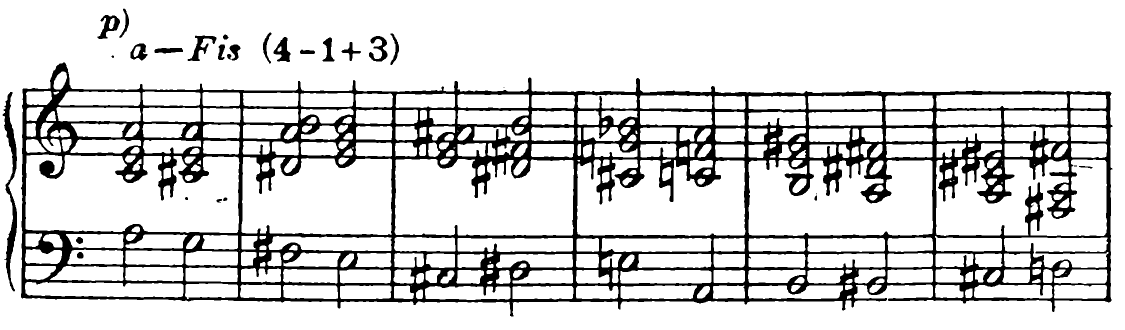
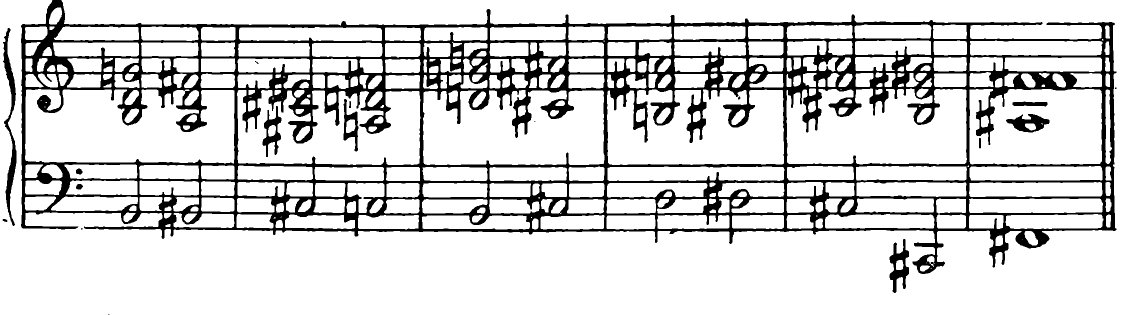
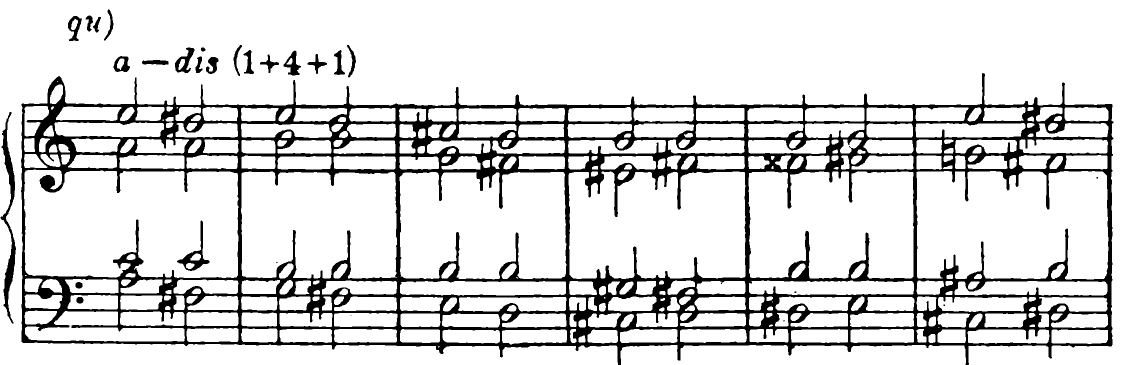
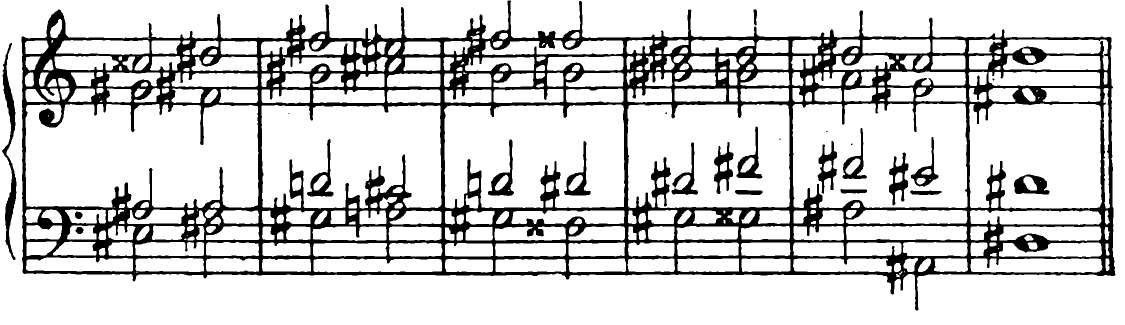
These examples make frequent use of the modulatory resources mentioned most recently. In 211c, for example, the modulation C–G is introduced through the Neapolitan sixth; in 211f, the Neapolitan sixth of F minor is itself introduced through the corresponding augmented four-three chord. These means allow the “lingering on the dominant” in third- and fourth-circle modulations to be omitted. I should point out one further distinction that emerges when the “rapid” modulations I criticized are compared with mine. One might claim that I juxtapose such distantly related chords that the result ultimately amounts to the same rapid modulation. The difference is this: there, those chords are supposed to accomplish the modulation; in my examples, they merely introduce and prepare it, putting the passage into the instability that will permit modulation. The goal is always kept in view and its attainment prepared. In a very well-known harmony textbook, I find equally distant modulations made with the very means criticized here. Yet the examples work well, and one might think my elaborate procedure superfluous. On closer inspection, however, their author, a composer with considerable command of form, achieves smooth modulation chiefly by following his sense of form and unconsciously doing what I do: preparing the destination key. By this unconscious means he achieves his purpose far more than through the modulatory devices he recommends. Why, then, does he recommend those devices instead? Because neither he nor his eloquent literary collaborator notices what he is doing.
It is precisely this preparation of the destination key that makes a modulation satisfying. In 211a, for example, the second chord, the augmented six-five chord over bass E, already points toward the G-flat of D-flat major; its resolution to the six-four chord supplies another allusion. Yet neither is D-flat major itself, only a step toward it. Something similar occurs in 211b. In 211c, the third measure, which could be called B minor, points toward the B major of the close; in 211k, the Neapolitan sixth over B-flat in the third measure points toward B-flat minor, and so on. The pupil will find many such things in the examples and should naturally strive for similar effects. If the result is not good, it is no disaster: my examples are not outstanding “artistic achievements” either, and are meant as suggestions, not models. The main thing is to strive for something. Whether one achieves it is of secondary importance.
One device recommended in most textbooks, and occasionally used in 211, is the sequence. A sequence is a kind of repetition capable of establishing coherence. Repetition, sometimes felt as monotony, produces reinforcement and intensification when properly used. Many kinds of repetition serve these and other formal purposes, but discussing them belongs to the study of form, since they extend into thematic and motivic work. Only the following general remarks belong here. A sequence is an exact repetition of some part of a passage. A harmonic sequence occurs when a harmonic succession of at least two chords is repeated immediately, but, unlike a simple repetition, begins on another degree: a major or minor second or third, a perfect or augmented fourth higher or lower. Harmonic sequence is a very popular and effective means of shaping musical form, because it secures continuation and coherence and helps comprehension through a clear, broad presentation, repeating what might have been missed the first time. It accomplishes all this without requiring the composer to exert his inventiveness on a newly shaped continuation beyond what is needed to connect the two equivalent forms of his idea smoothly and without a gap. Because sequence is good in itself, it has been used extensively. Yet there is little merit in so convenient a way of gaining space, and excessive use must therefore be discouraged. I do not object to the pupil’s occasional use of it. At his stage, creating a point of connection for a sequential repetition is already enough of an achievement. Nor do I object to his using it, as textbooks recommend, to accomplish a modulation in two approaches, as it were. But I do not recommend using it too often, because the mechanical scheme of such work is unappealing.
To a certain extent, the transposed repetition of part of a melody can also be regarded as a sequence, even when the harmony is not sequenced. I consider such a sequence more meritorious, since it is less mechanical. The soprano in 211m is an example, as is 211p.
The pupil should choose other combinations independently. If, for example, he chooses 4 + 3 − 2 for the fifth circle, this means a route such as C major through E major to C-sharp major, then back through F-sharp major to G-sharp minor (212a).
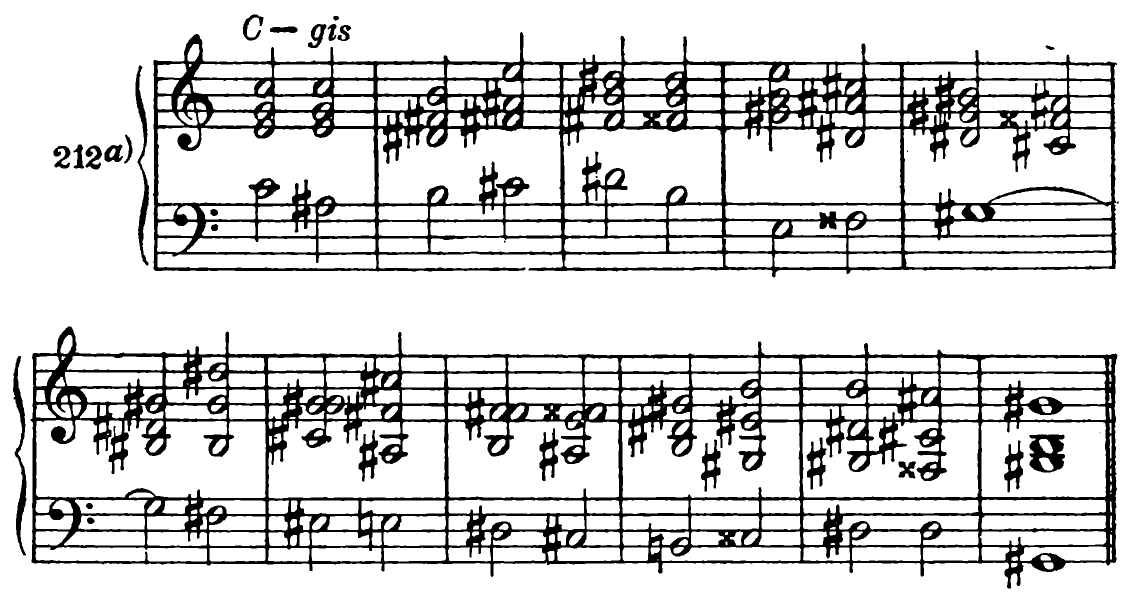
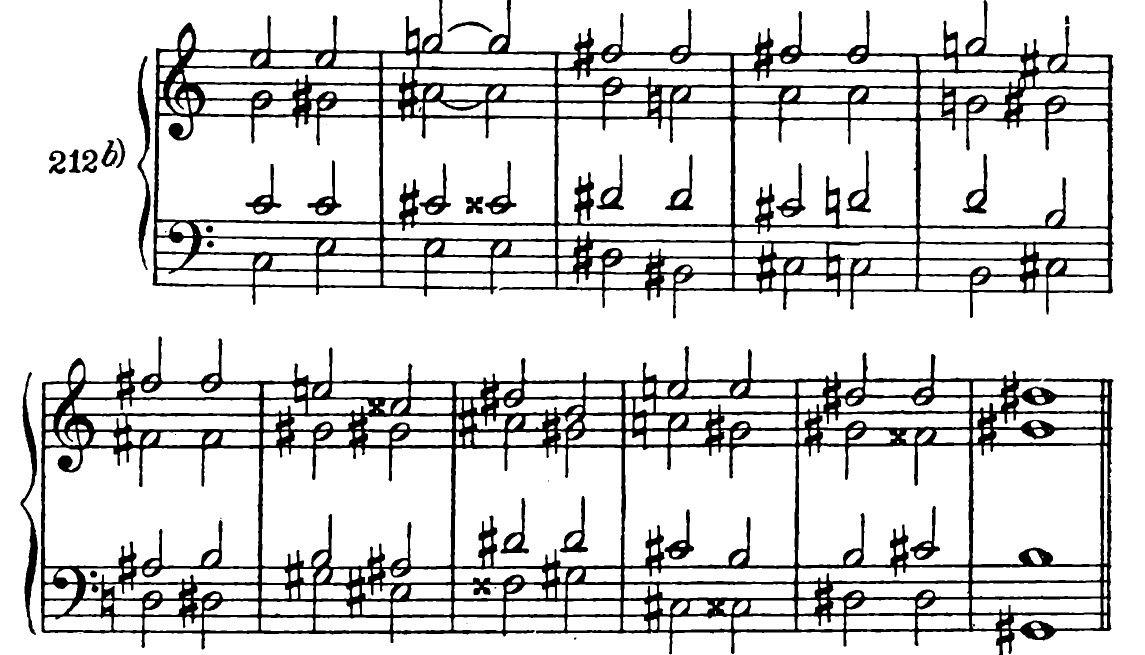
Such a plan would probably be somewhat too complicated. If every part of the modulation were elaborated extensively, the whole would become very long. If each part is kept short, however, the result is precisely that excessively rapid modulation I could approve only when very strong modulatory devices are used.
The pupil will have to decide. If he chooses a route made up of so many stages, he must realize that the example will become very long and that strong modulatory devices will be needed to blur the transitions between its stages as much as possible. Example 212b shows another solution to this task, based on a less composite plan.
Modulations to keys as distant as those in the fifth or sixth circle will not occur very frequently in passages with simple harmony, because a composition that modulates so intensely will generally call for stronger modulatory resources. Exercises using simple means can therefore never produce results as smooth as those involving nearer keys. The same applies to the seventh, eighth, ninth, and subsequent circles. These are composite routes that would be easier to reach as the fifth, fourth, third, and subsequent circles in the opposite direction. For example, modulations from C major to C-flat, F-flat, and B-double-flat major become modulations to B, E, and A major when approached in the other direction. Nevertheless, the more composite route must often be taken too, so the pupil may practice it. I give no examples, however: in simple form they would be inadequate, while in complicated form they would seem inflated, since there is no occasion for complexity. This is something easier for a person who can do nothing than for one who can do much. Even in development sections, the older masters generally confined themselves to closely related keys. Modulations to remote keys, by contrast, are often introduced suddenly through drastic means, without harmonic preparation, as a surprise—for example, in Beethoven’s C-minor Trio.
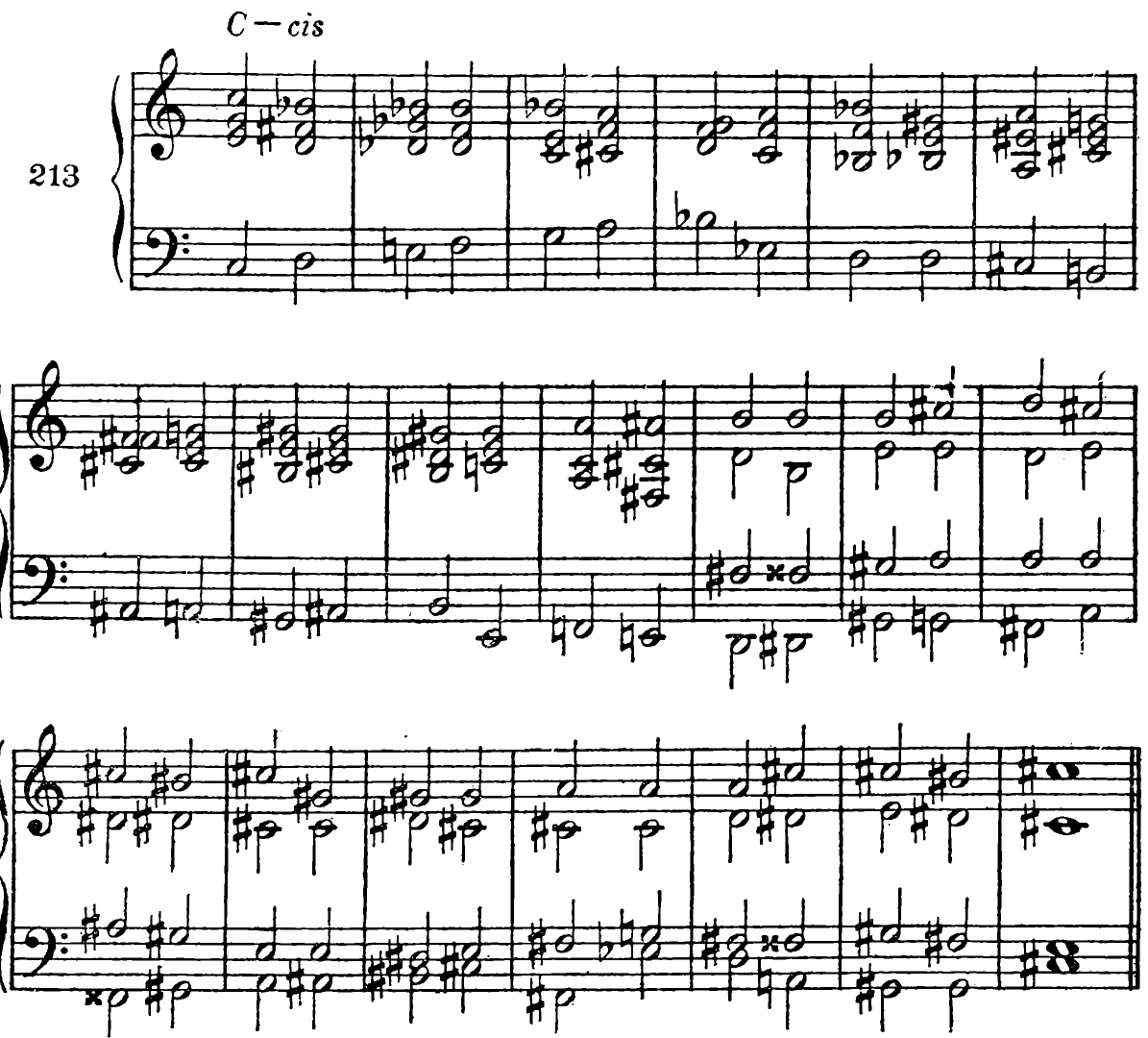
Examples in the literature of such frequent changes of key within so small a space as in example 213 can be found only in the post-Wagnerian period. There the aim is not to reach a new key but to leave an old one without lingering in it at all. The harmony is led, as it were, melodically: its richness, mobility, and rapid turns correspond to the same qualities in the principal melody, on which it depends like a subsidiary contrapuntal voice. My example 213 attests that such things are unlikely to turn out well as exercises, though it does not prove this, since I could certainly produce something better. Nevertheless, the pupil should try them too, since otherwise he will not become acquainted with his modulatory resources.