 Playable Books
Arnold Schoenberg · section 47 of 66
Augmented Sixth and Vagrant Chords
Read and hear this section in the playable edition →

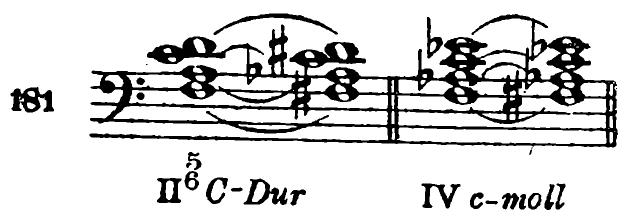
The augmented six-five chord is usually derived as follows: in major, one can raise the third and root and lower the fifth of the six-five chord on degree II; or, in minor, raise the root of the seventh chord on degree IV. This produces two chords identical in sound and rather similar in function.*
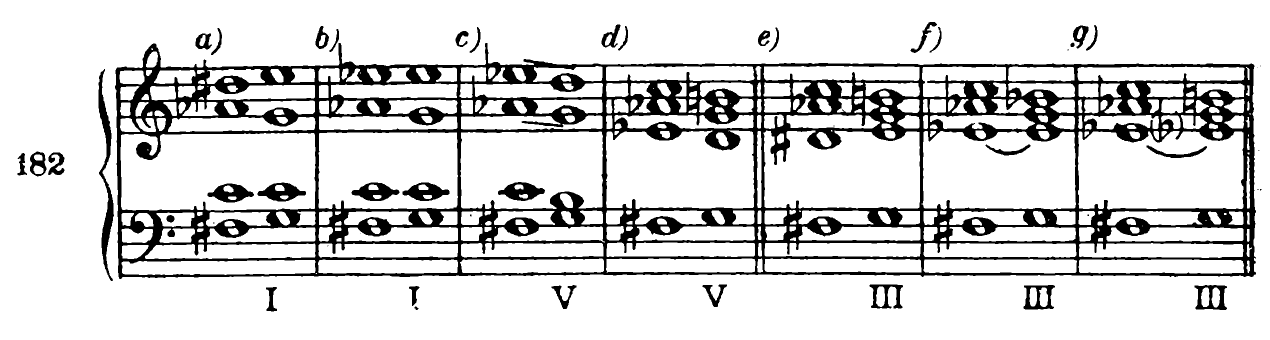
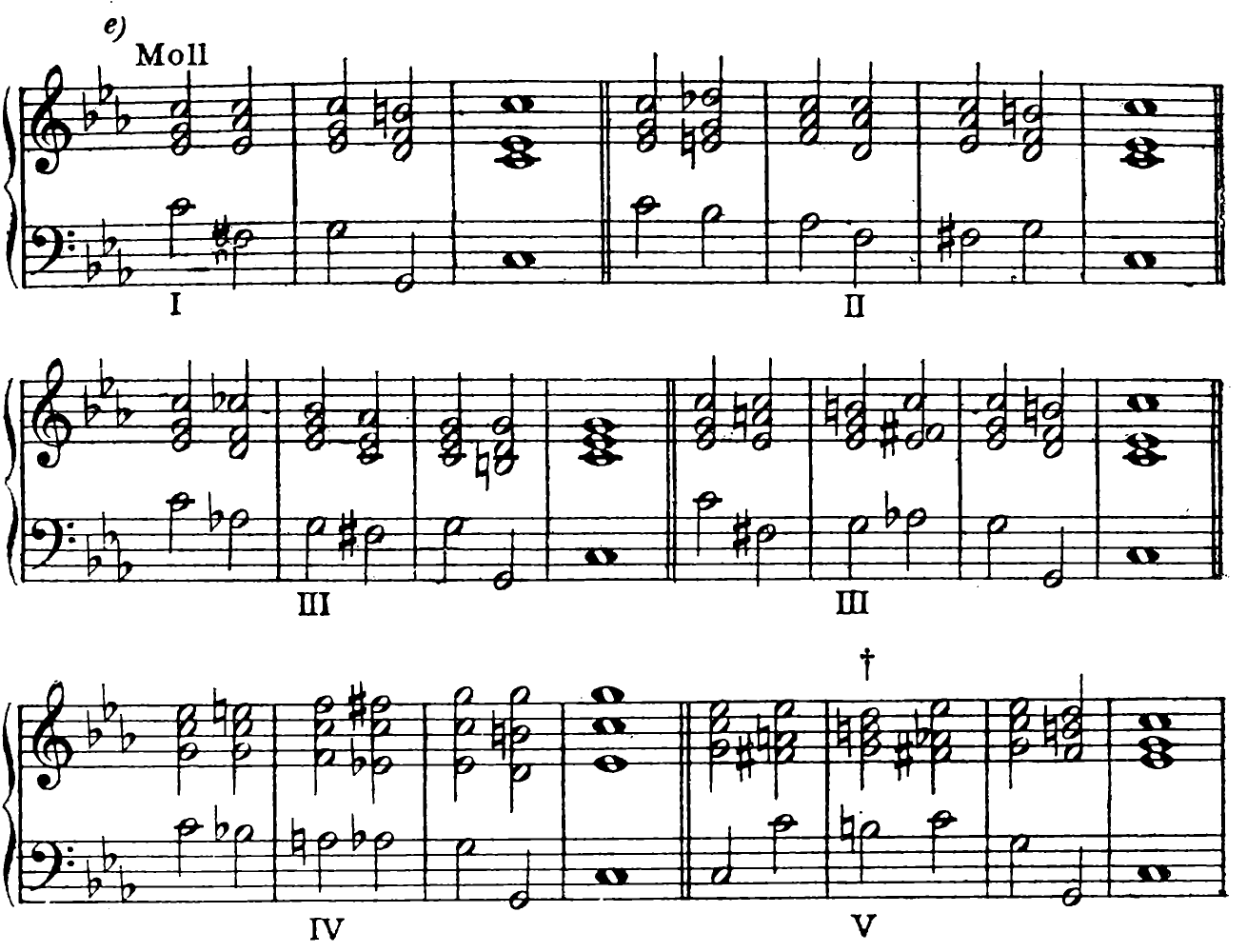
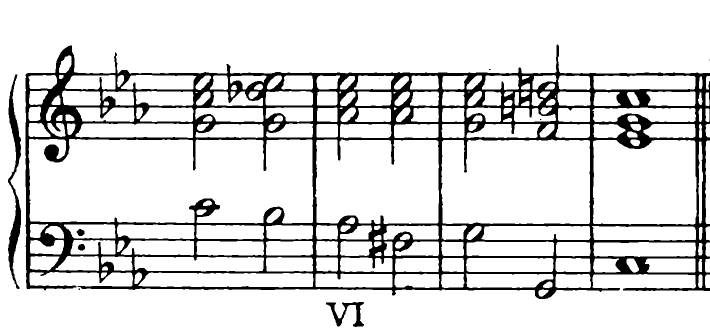
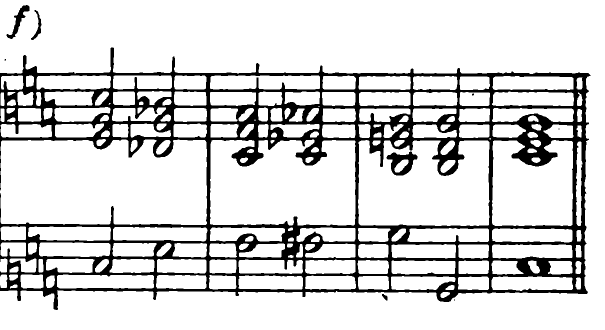
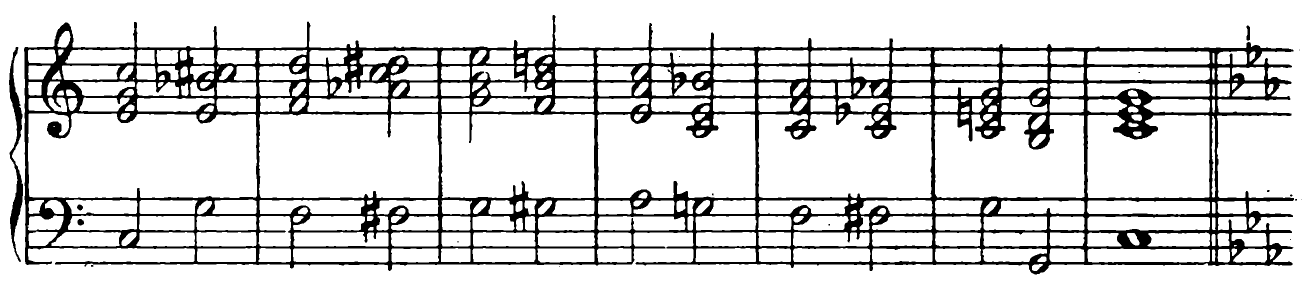
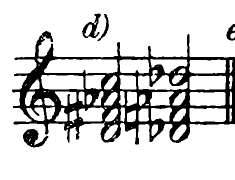
Both can resolve to the six-four chord of degree I (182a and b), and also—since they sound the same despite their different spellings—to the triad of degree V (182c). The latter case produces parallel fifths, so the disposition in 182d is often chosen. Or else they are called “Mozart fifths”: fifths permitted not because they sound good, but because Mozart wrote them. I strongly favor this respect for the masters’ works, and likewise favor theory’s permitting at least everything written by masters who did not ask permission. But such a procedure is more practical than theoretical: it rests on a fundamental effort to accommodate actual events and forfeits the right to judge them aesthetically and theoretically. Applied consistently, however, it is the proper basis for instruction in craftsmanship, whereas an isolated practical exception within an aesthetic-theoretical system is nonsense. Our attitude to these fifths will be no different from our attitude to others: we find that they sound good, but for the time being we shall avoid writing them if possible. “For the time being”: the pupil can write them later. “If possible”: if there is no other way, he may write them even now.
* The derivation of these chords cited here is by no means the only one. I know the others, and the many different names that consequently exist, scarcely even by hearsay. But I must mention that apparently a quite different chord generally bears the name “augmented four-three chord” from the one entitled to it. If the tones of the augmented six-five chord are arranged differently, with different tones taking turns in the bass, surely chords behaving in this way can only be understood as inversions of a single chord—especially when their functions are the same! Where, then, do these names come from?
The derivation of the augmented six-five chord mentioned above again assumes that the root is raised, an assumption I consider incorrect in a system that measures by roots—which can only be unraised roots. Deriving it from two degrees is also impractical: it not only obscures the function but fails to gain what might perhaps justify it. It does not spare us enharmonically reinterpreting the tone that can be understood in different ways, D-sharp/E-flat, when, for example, 182d occurs in C major, where this derivation would require us to think D-sharp. I therefore consider it more useful to derive the chord from the ninth chord on degree II in major or minor, by way of secondary dominants and the diminished seventh chord. It is then represented consistently in major and minor as follows: degree II in C major or minor; secondary dominant, secondary dominant seventh chord, secondary dominant seventh-and-ninth chord; root omitted, diminished seventh chord, fifth lowered.
The reinterpretation of E-flat as D-sharp had already been assumed in the diminished seventh chord, so the chord derived from it can be used in both senses. More important than the question of its derivation seems to me the question of the harmonic needs or possibilities to which it owes its origin. Answering that question immediately gives guidance for its treatment—its introduction and continuation. It is most often found where degree II or IV would otherwise stand: in the cadence, before the six-four chord of degree I or the dominant seventh chord, V (182). It can therefore be regarded as a substitute for one of these degrees. The most advantageous assumption is that it substitutes for II, as I showed above, since we have seen similar things concerning degree II elsewhere, and since II moves authentically to V and deceptively to I. Its use then becomes very simple: in major, it is introduced like the chords of the minor-subdominant relationship; in minor, like a secondary dominant or a diminished seventh chord. Within the cadence, continuation to V or I is self-evident, and possibly to III (182e, f, g) is readily comprehensible: II–V, II–I, II–III—the authentic progression, upward by a fourth, and the two most common deceptive progressions, upward and downward by a second: the three important ascending progressions.
The question of what needs and possibilities the augmented six-five chord answers is connected with the same question concerning other vagrant chords. Above all, such chords will be good where they fit their surroundings, where they are not the only events of their kind and therefore do not fall outside the style of the whole. Thus vagrant chords, appearing, so to speak, in company, will usually give the harmony a particular coloring, as in Bach’s “Chromatic” Fantasia and Fugue. Since nothing is bad in itself, one cannot assert that an isolated occurrence must necessarily be bad. Yet it is clear that large numbers of chords distant from the key favor taking a new conceptual unity—the chromatic scale—as the basis. It should not be concealed that an accumulation of such events might burst apart tonality’s firm structure. But this danger can easily be averted, and tonal consolidation can always be achieved. Even if a breakthrough did occur, it need not result in dissolution or formlessness. For the chromatic scale too is a form. It too has a formal principle, different from that of the major or minor scale, simpler and more unified. Perhaps an unconscious striving for simplicity guides musicians here, for replacing major and minor with a chromatic scale is surely a step in the same direction as replacing the seven church modes with just two series, major and minor: a more unified relationship with the number of related possibilities unchanged. In any event, vagrant chords reveal a striving to use the chromatic scale and the advantages of the leading-tone affinities it contains throughout to achieve more convincing, compelling, and smoother chord connections. The fortunate concurrence of so many favorable circumstances may well be interpreted as a reward for treating the material in accordance with nature. We may hope to have divined nature’s will in this small matter, and in following these enticements we obey its compulsion. Nature sometimes does this: it lets us experience as pleasure what fulfils its purposes. Perhaps it does so through longing as well.
The augmented four-three chord and augmented second chord are to be regarded as further inversions of the same underlying chord: the four-three chord as the second inversion, the second chord as the third (184a), or simply as inversions of the augmented six-five chord. Naturally there is therefore nothing further to say about their treatment. They occur wherever the augmented six-five chord can stand and the melodic line requires a different bass tone. Only the augmented second chord will sometimes cause difficulty, because the repetition of C in the bass is not very fortunate (185d). Since this chord consists of four tones, there must be a fourth position as well (184e). In my derivation from the ninth chord, this is simply the fourth inversion of a ninth chord. According to the derivation mentioned first, it should actually be root position, which again shows how unnatural that interpretation is. There is nothing special to say about this position either. At most, one may need to be cautious about resolving it to the six-four chord of V (184f). But this too is nothing new, recalling the analogous case with the diminished seventh chord. Resolution to the first-inversion chord of I is very common (184g and h).
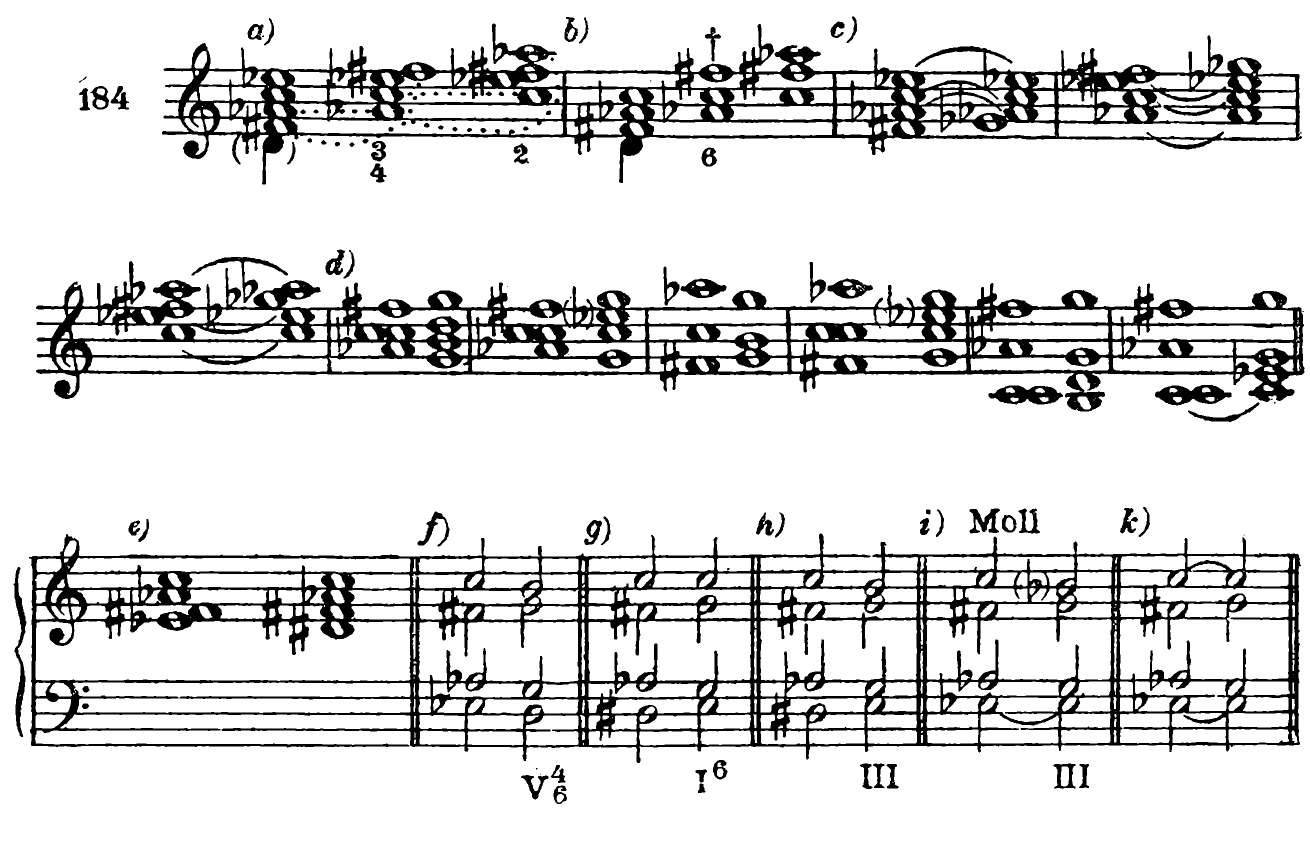
The so-called augmented sixth chord needs no further explanation. It is nothing other than an augmented six-five chord without the ninth—or, under the other derivation, the seventh (184b)—and thus stands in a relation to that chord similar to that of the diminished triad on degree VII to the seventh chord on V, or to the seventh chord on its own root, VII. It occurs wherever the augmented six-five, four-three, or second chord can stand, presumably whenever one does not dare write fifths (184d). Naturally its tones can also be placed in other positions or inversions. There is no need to prepare augmented six-five, four-three, second, and sixth chords in the manner of other seventh chords. Since the assumed root does not sound, the tone that is a seventh according to the derivation is in fact merely a diminished fifth, and the ninth merely a diminished seventh, both of which we have already used freely. The third above the imagined root, on the other hand, sounds like a minor seventh, as enharmonic respelling makes visible (184c); in this meaning it certainly need not be prepared. As will be shown later, however, advantage can be taken of the fact that, with altered spelling, these chords sound identical to a dominant seventh chord—for example, on A-flat: A-flat–C–E-flat–G-flat.
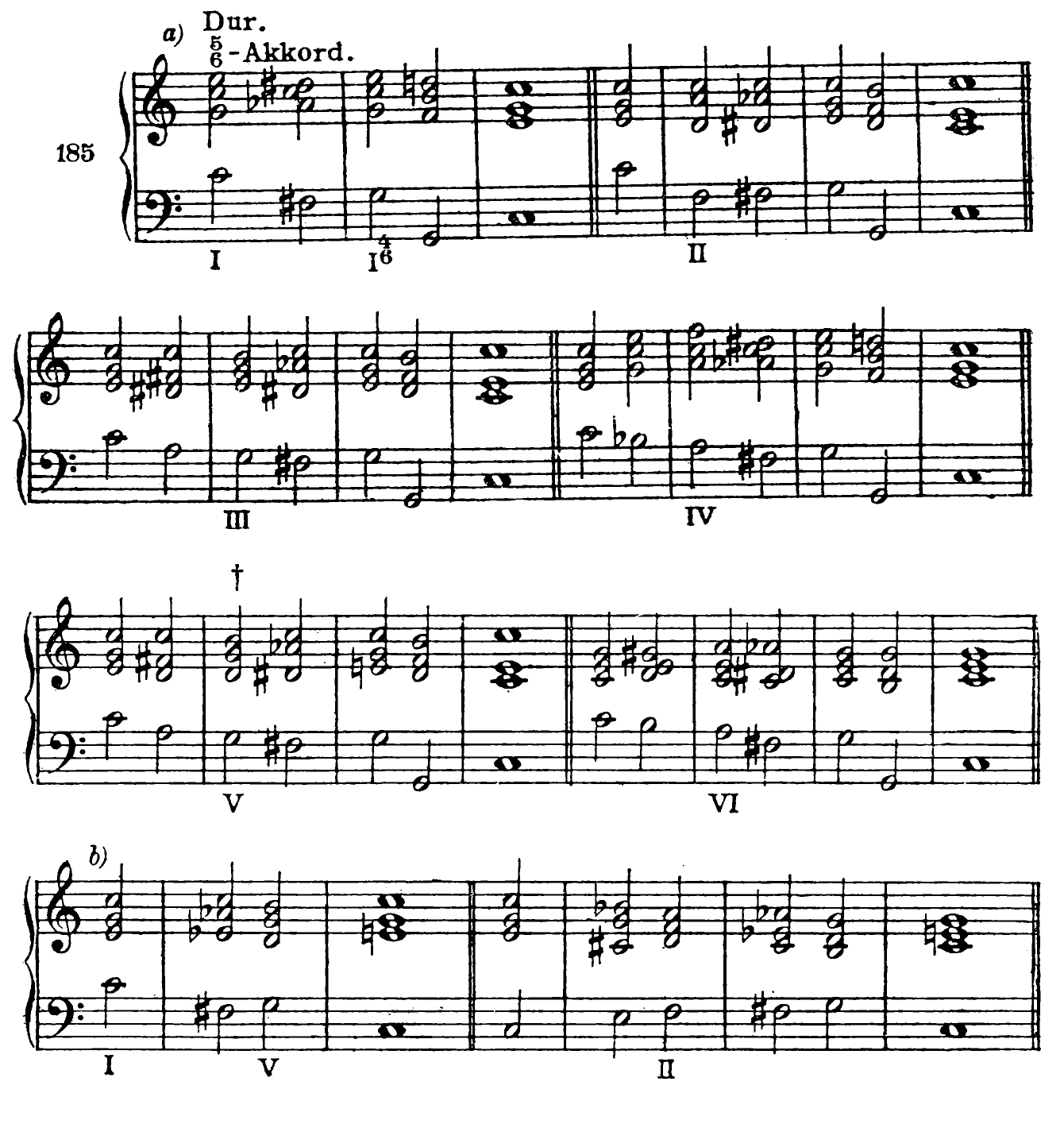
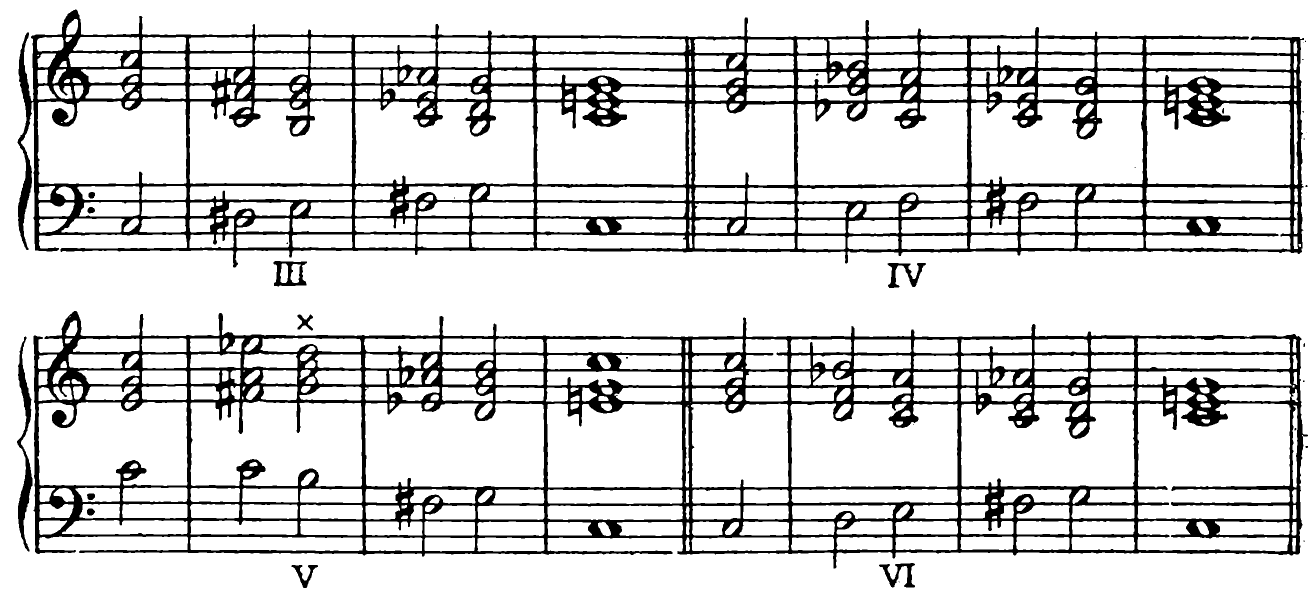
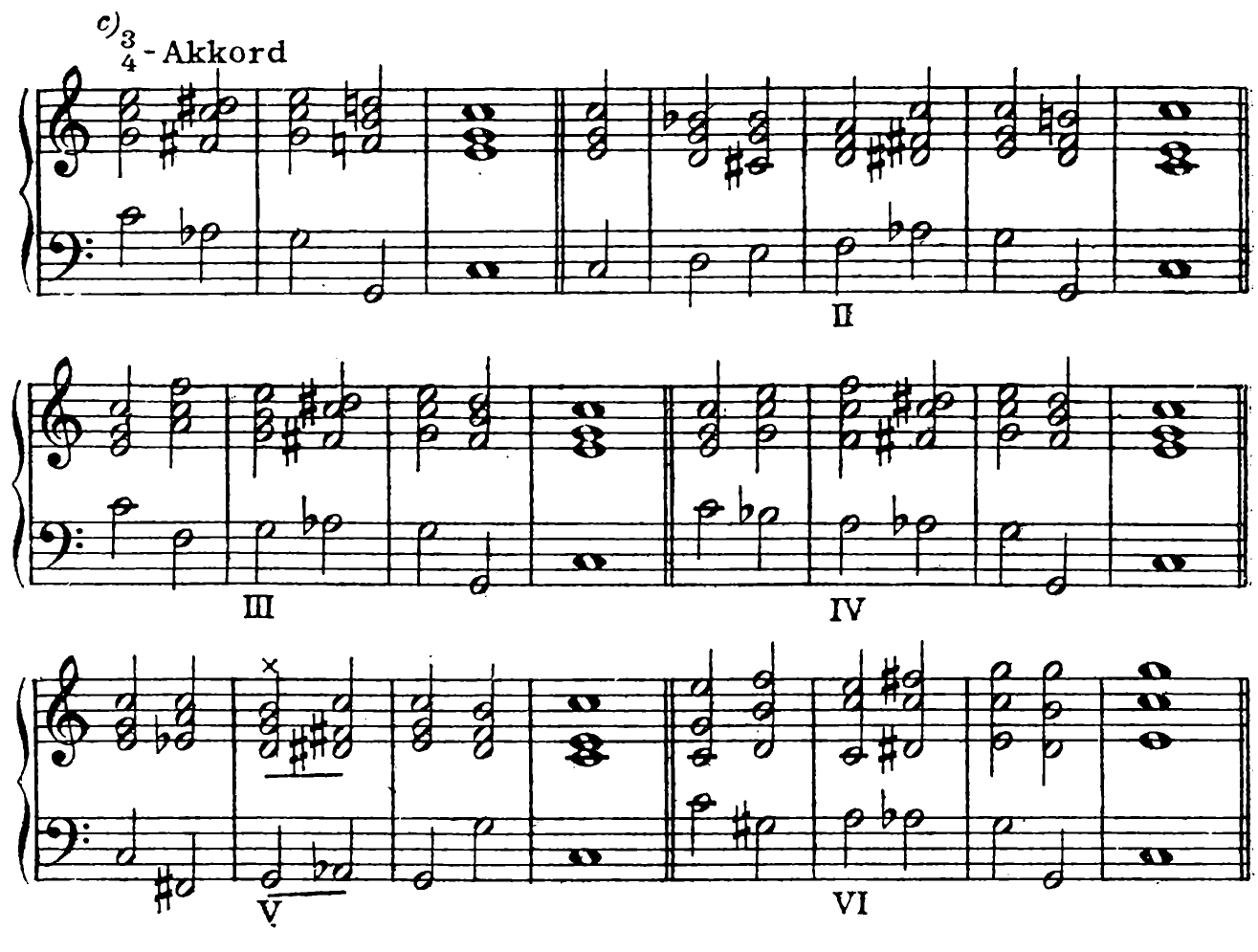
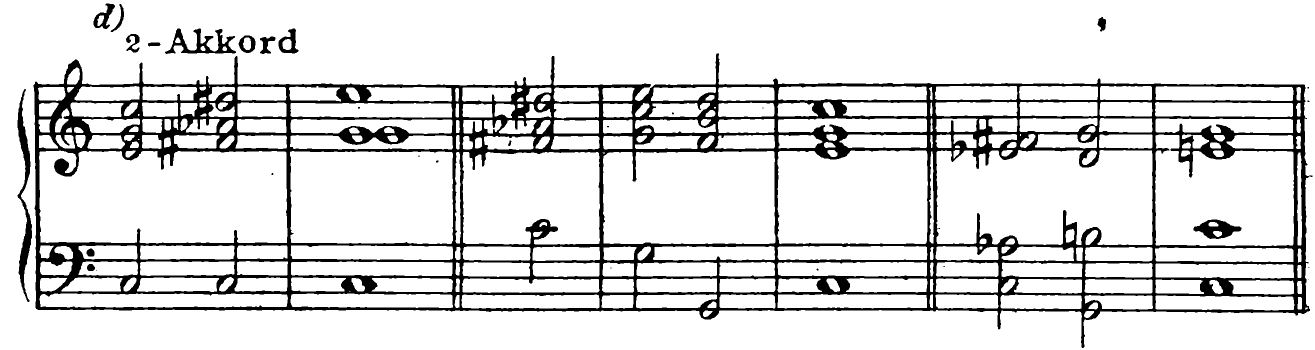
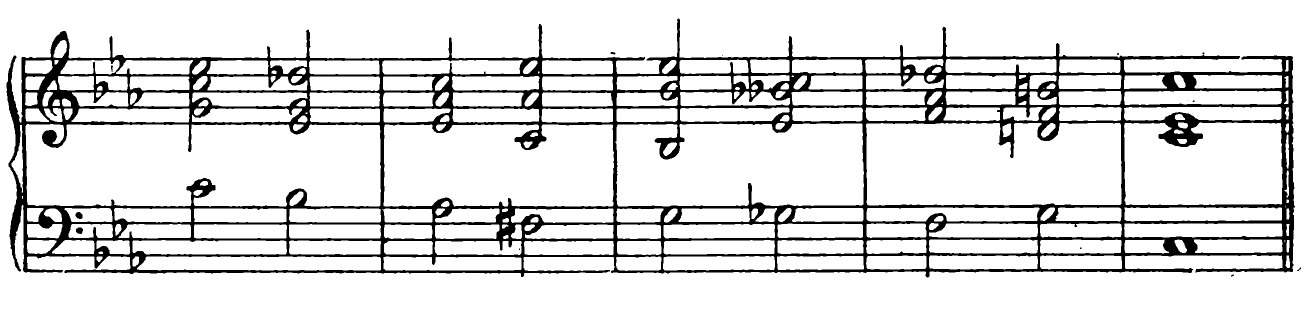
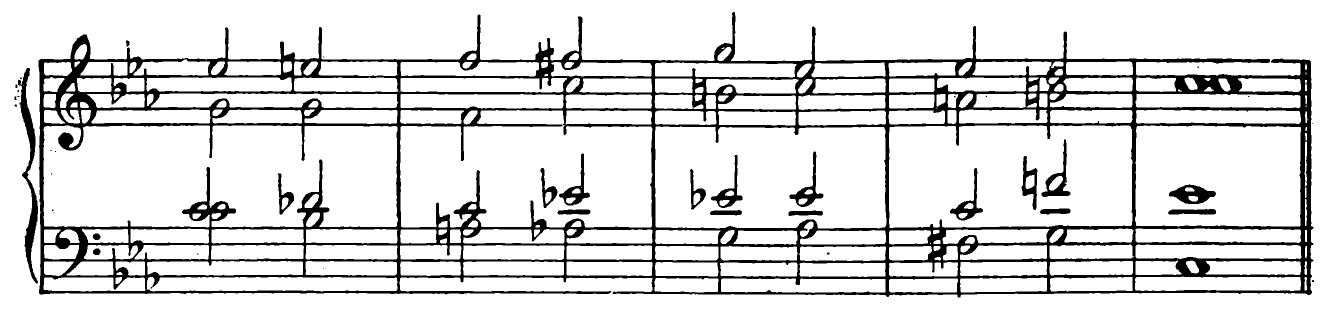
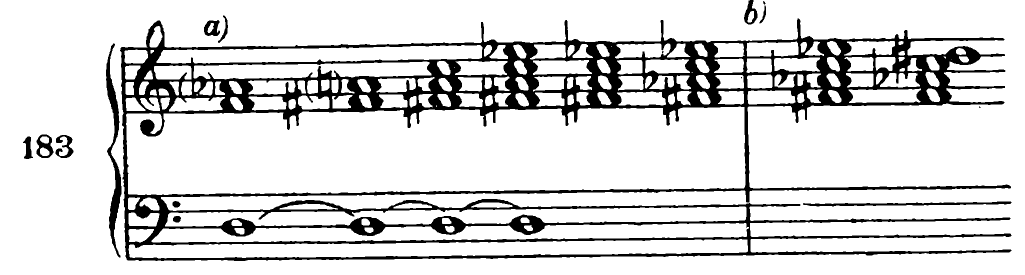
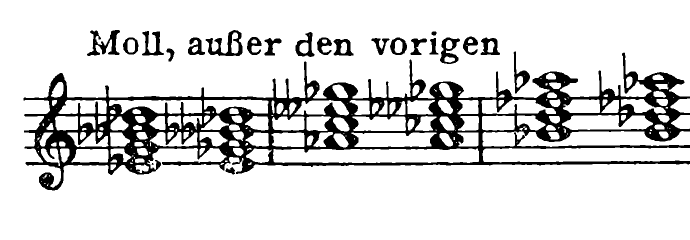
Just as we extended the idea of the dominant to that of the secondary dominant, and artificially constructed diminished triads, seventh chords, and the like, so we proceed here: we make similar, appropriate alterations on the other degrees, following the model of II, and thus obtain the following chords. The pupil can work out the other inversions, four-three and second chords, as well as the augmented sixth chord, independently.
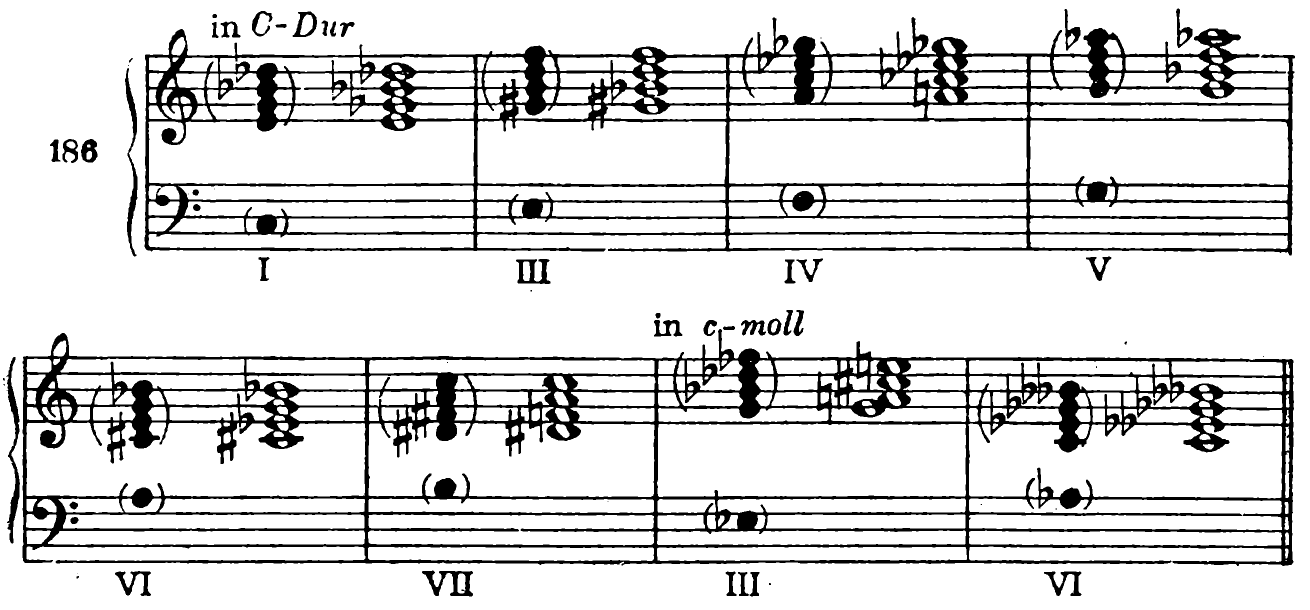
They are introduced either by making use of the relation to the minor subdominant in major or through chromatic steps. There are not very many examples in the literature of six-five, four-three, and second chords derived from the other degrees, though I have seen them in Brahms and Schumann. The examples show that they are usable, even if strong measures are sometimes needed to reestablish the key.
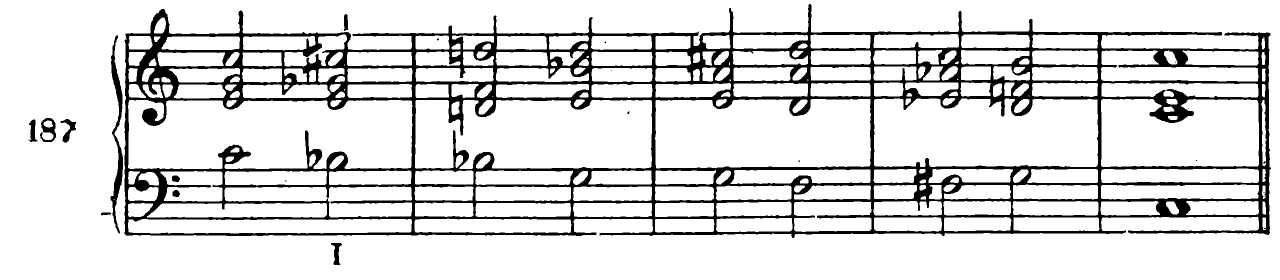
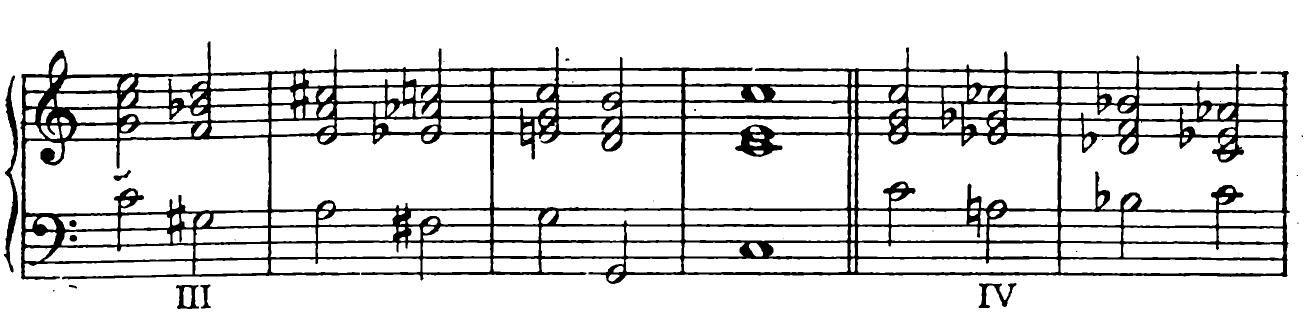
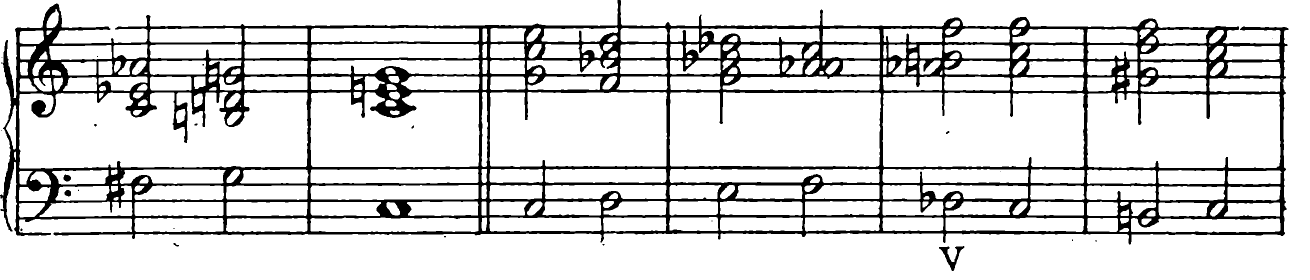
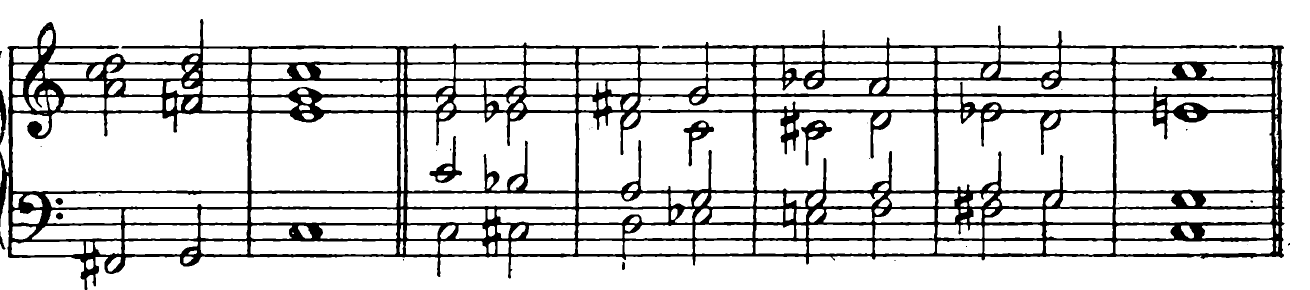
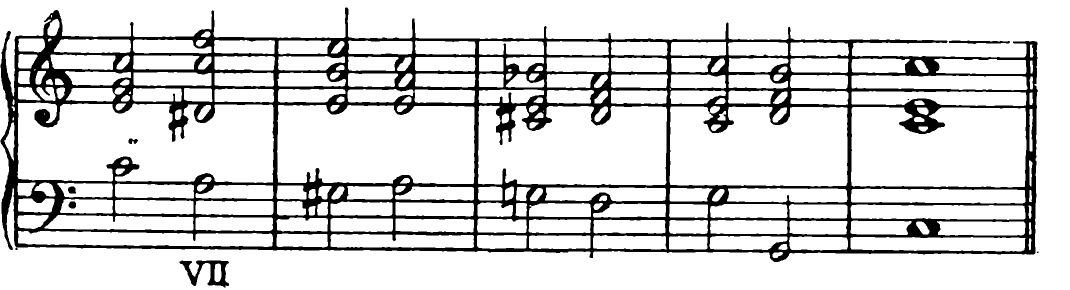
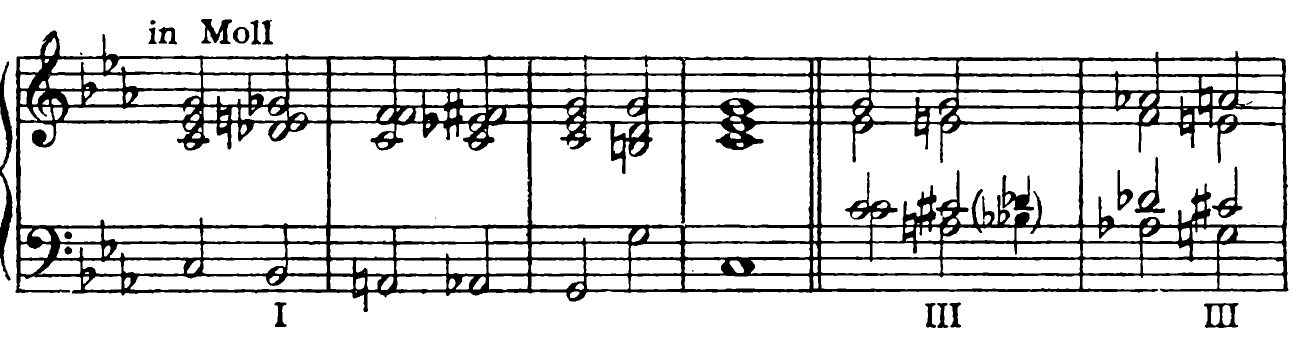
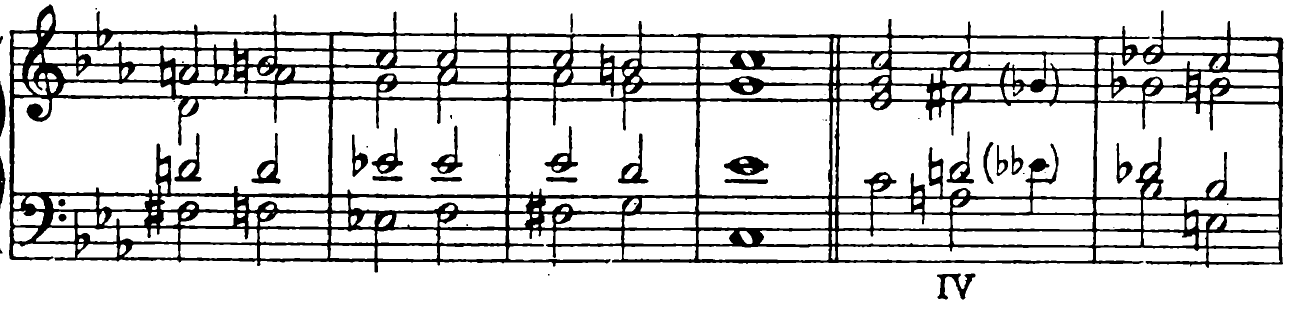
Plate B [for page 307 and following].
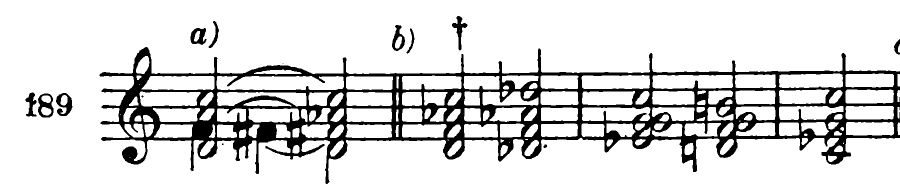



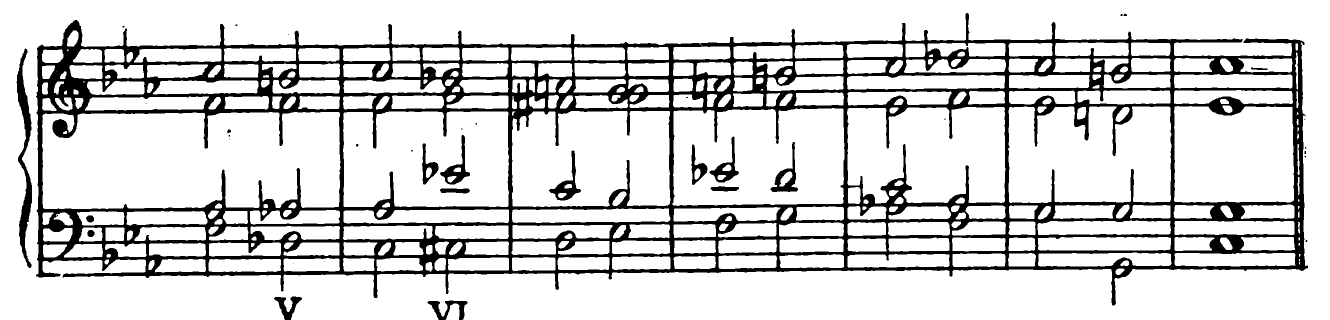
The identical sound of an augmented six-five, four-three, second, or sixth chord and a dominant seventh chord can readily be exploited by treating one—introducing and continuing it—as though it were the other. For example, an augmented six-five chord on any degree is regarded as the seventh chord with which it is identical in sound, and resolved according to the pattern of V–I, V–VI, or V–IV (188a). Or a dominant or secondary-dominant seventh chord is understood as an augmented six-five, four-three, or second chord and resolved accordingly (188b). Combined with the idea of the Neapolitan sixth on secondary degrees, this greatly enriches the key.
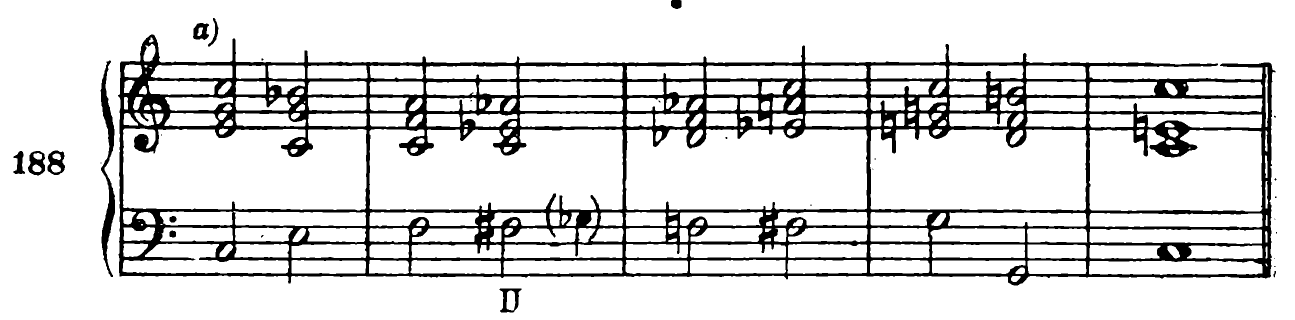
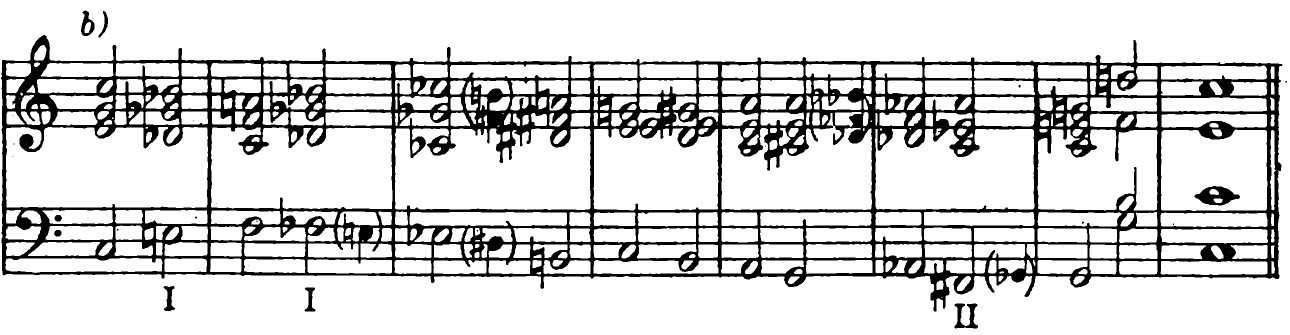
Naturally, chords occur here that can also be understood differently. But since we are not engaged in analysis, that is immaterial to us. Our concern is only with a system that stimulates thought by interpreting as many events as possible in a unified way. It is needless to say that there is little point in racking one’s brains over whether the harmonic meaning requires C-sharp or D-flat, G-sharp or A-flat. One writes whichever is simplest. The fault lies with our imperfect notation, and with nothing else.
Before I begin to suggest ways of connecting these various vagrant chords with one another—suggest, because it is scarcely possible to show everything that can be done here—I wish to discuss two more chords that also belong to the vagrant chords.
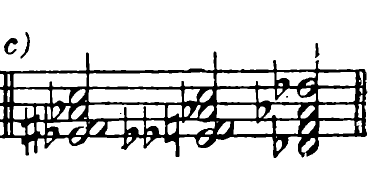
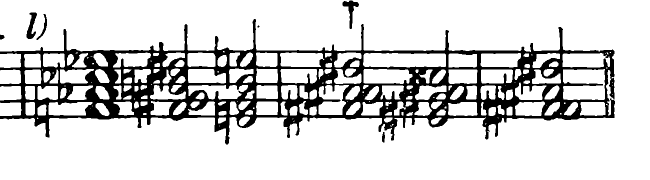
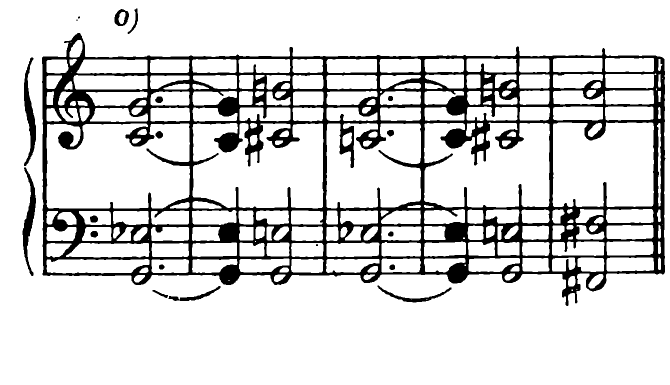
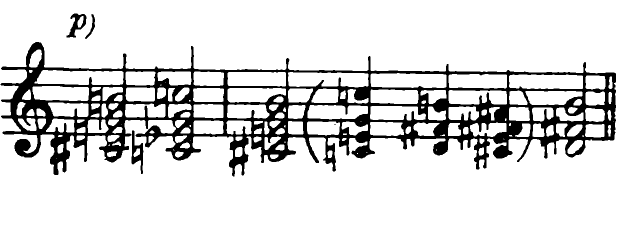
The first (189a) is best derived from degree II in major or minor by raising the third and lowering the fifth. Raising the third creates an ascending leading tone; lowering the fifth creates a descending one. This combines the possibilities of the dominant or secondary dominant with the minor-subdominant relationships. We know the second chord (189b, dagger) from the minor-subdominant relationships. Under that interpretation it is, as it were, II of C minor or VII of E-flat major. But the context revealed by its continuation is new to us. Here one would like to regard its D as E-double-flat. This would be especially necessary if one imagined it arising, for example, from an inversion of the augmented six-five chord (189c). The same resolution also occurs with the first chord, however (189d). This may suggest that the root of these two chords is not D but A-flat (189e and f). That interpretation is apparently supported by the fact that the second chord also resolves to a minor chord on D-flat (189g), as can naturally be done with the first chord too, since F-sharp here always equals G-flat (189h). In that case D would be the lowered fifth, and F, understood as G-double-flat, the lowered seventh. On the other hand, the most common resolutions of these chords, because they are the most immediately suggested, are those in 189i. These allow us to regard them as degree II, with the root progressions II–V, II–III, and II–I. Interpreting A-flat as the root, degree VI of C minor, would give VI–II, an upward fourth, for the connection to D-flat, but VI–I, an upward third, for the connection to C. This is possible, but not convincing. First, it is more consistent to relate this chord, like so many others, to degree II; deriving it from VI would be something new. Introducing that novelty would be impractical for the system of treatment and practical application, even if it would be less harmful to the system of interpretation.
Second, there is this further objection: D in 189i is the root when the chord is understood as degree II; understood as VI, however, it would actually be an inaccurate spelling of E-double-flat, a nondiatonic tone—the lowered fifth above A-flat, whose diatonic spelling would be E-flat. This very same nondiatonic tone would then suddenly become diatonic in the chord of resolution, V! This too is not impossible, but it is complicated, and the other interpretation does not require it. The only connection that might be difficult to explain is that with a D-flat major or minor chord, since we would have to describe it as II connecting with II, with no root progression. But this is nothing new to us. First, we have already encountered cases in which no root progression is to be imagined between successive chords: for example, when the triad of a degree is followed by the seventh chord on that same degree, or by its secondary dominant, secondary dominant seventh, diminished seventh or ninth chord, and so on. Second, we encountered a case very similar to this one when we connected the augmented six-five chord on II with the Neapolitan sixth, also on II. Assuming the same thing here is therefore thoroughly systematic.
This gives us the same advantage we have gained elsewhere through a consistent frame of reference: it suggests making the same alteration on other degrees. We then obtain the chords in 189k, of which the marked ones, as well as one on degree VII, are already familiar from earlier discussions. Some others may be somewhat difficult to introduce, but with our present stock of resources they are no longer very difficult. Above all, transferring the procedure in this way makes clear how thoroughly vagrant these chords are, and how little justification analysis has for assigning them to this or that key.
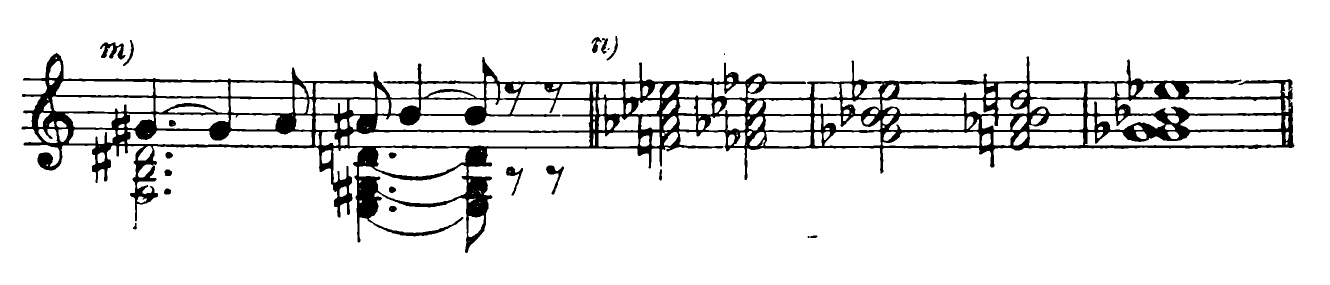
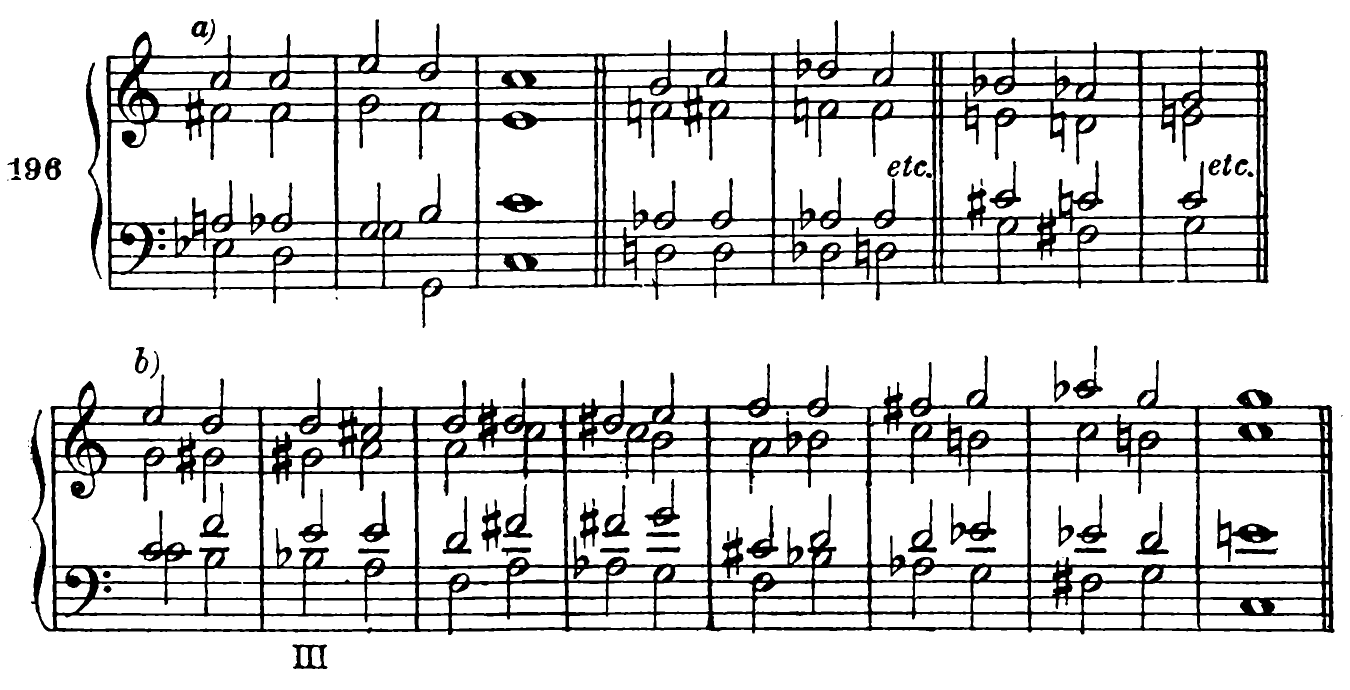
These chords would not have required so much discussion, for they are not particularly complicated. Only their important role in Wagner’s harmony, and the great amount written about them—I do not know the attempts in question, but have only heard of them—compels me to take a position as well. Chord 189b, transposed a minor third upward and enharmonically respelled (189l), is universally known as the so-called Tristan chord. Although it resolves to E by analogy with 189b, which should then have the continuation shown in 189l and thus point toward E-flat minor, Wagner treats it as the dominant of A minor (189m). There has been much dispute over the degree to which it belongs; I hope to contribute best to disentangling the question by offering no new derivation. One might regard G-sharp as an upward suspension resolving to A, making the chord the form shown in 189a; or, equally possible, regard A as a passing tone leading to B through A-sharp. Or one might immediately assume the worst: that it really originates in E-flat minor (189n), if it must originate somewhere, and, being a vagrant chord, is reinterpreted and related to A minor. This seems the most far-reaching view, but is not: A minor and E-flat minor share not only this chord but simpler ones too. For example, VI of E-flat minor is identical with the dominant of the dominant in A minor, the secondary dominant on II; the Neapolitan sixth in A minor is V in E-flat minor; and the Neapolitan sixth of E-flat minor likewise coincides with V of A minor. To someone who has recognized how rich the relationships between even the most distant keys become when vagrant chords create new routes and new means of communication, these alternatives seem immaterial. Naturally, I do not really mean that this chord here has anything to do with E-flat minor. I wanted only to show that even that assumption has justification, and that little is said by showing where the chord originates, since it can originate anywhere. What matters to us is its function, and this emerges when we know its possibilities. And why should these vagrant chords in particular have to be traced back to a key at any cost, when people have readily refrained from establishing such an origin for the diminished seventh chord? I did relate the diminished seventh chord to the key, but not to limit its sphere of action. Rather, I wished to show the pupil its uses systematically, so that by combining possibilities he may find what the ear recognized intuitively long before. Later the pupil will do best to regard all these vagrant chords simply as what they are, without tracing them to a key or degree: homeless phenomena roaming between the territories of keys, incredibly adaptable and dependent; spies who discover weaknesses and use them to cause confusion; deserters for whom abandoning their own personality is an end in itself; troublemakers in every respect, but above all, highly entertaining fellows.
If we refrain from trying to explain the origins of these chords, their effect becomes much clearer. We then understand that such chords need not necessarily appear in the function their derivation would prescribe, since the climate of their homeland has no influence on their character. As will be shown later, the same property can be demonstrated in many other chords where it is not immediately apparent. They flourish in any climate, and it becomes understandable how another form of this chord is resolved in Götterdämmerung as in 189o and led to B minor. This does show that my first derivation, 189b, is supported by another Wagner example, since 189p, the outline of the quotation in 189o, is undoubtedly the function shown in 189b transposed down a semitone. But I do not mean that this establishes its origin, for even in Wagner this chord appears with many other resolutions:

And so on; many more can easily be added. As these examples show, however, the preferred resolutions are to chords whose tones can be reached by chromatic motion, or to other vagrant chords whose formation and connection do not require such an elaborate demonstration through melodic voice leading.
This may serve the pupil as a guide in trying to find resolutions of such vagrant chords independently. Since it is often difficult here to judge the value of a succession by examining the progressions of degrees and connections between roots, melodic considerations may serve instead, as has often been said. In general, the best connections of ordinary chords with vagrant chords, or of vagrant chords with one another, will be those in which the second chord contains, if possible, only tones that either occur in the first or can be recognized as chromatic raisings or lowerings of its tones. In the first attempts, this origin should be expressed in the voice leading: an E-flat in the second chord should actually occur in the voice that had the E in the first chord from which it arose. This is necessary only at first. Later, when the pupil is familiar with the function of these phenomena, he may dispense with explicitly reproducing their origin in the voice leading.
In the following connections of vagrant chords with one another, however, we shall once again keep the key in mind, shaping them so that the key is expressed and we remain conscious of the relationships between degrees.
We shall connect:
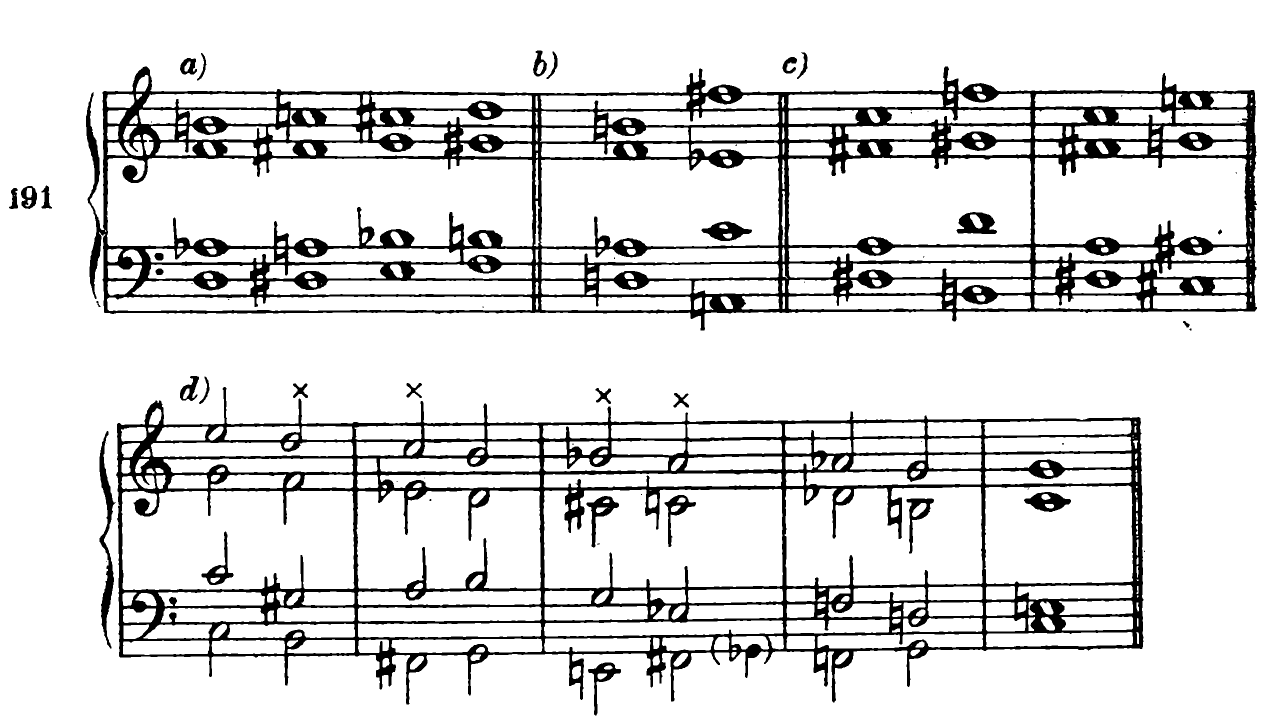
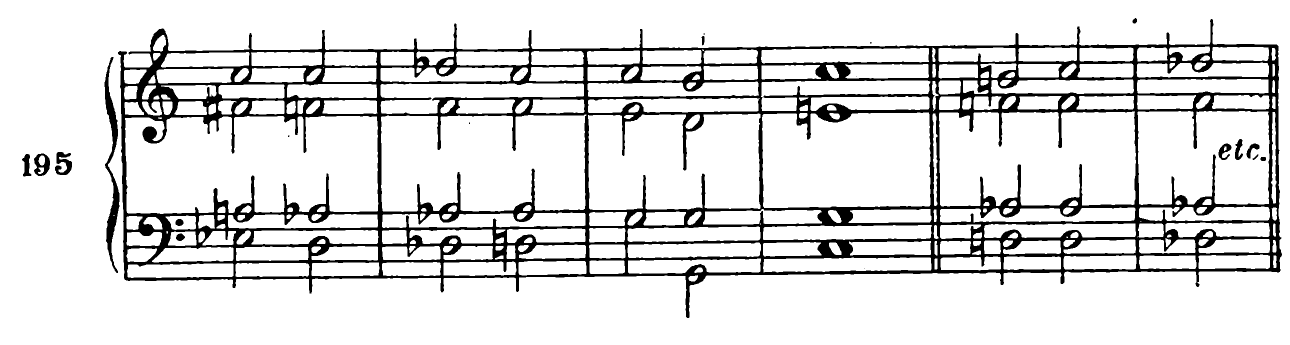
1. Diminished seventh chords with one another (191); then with augmented triads (192), augmented six-five, four-three, and second chords (193), Neapolitan sixths (194), and finally, in 195 and 196, the vagrant chords discussed most recently, on page 307.
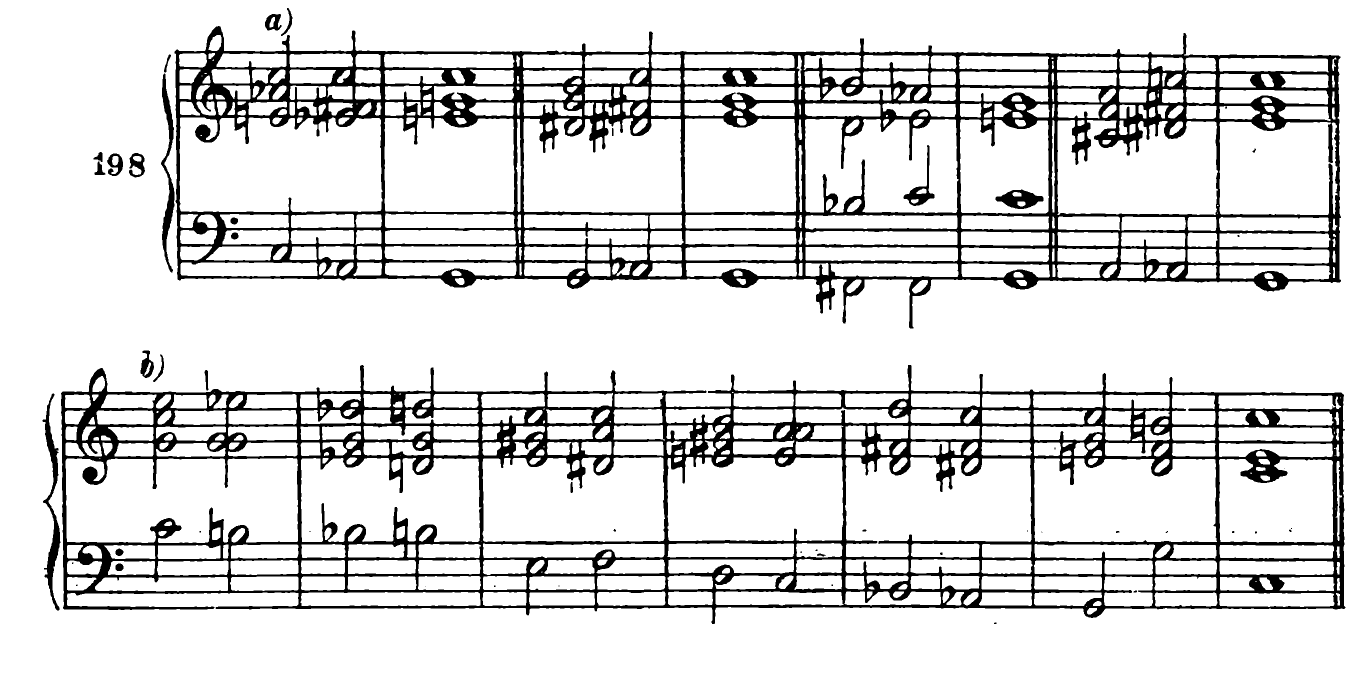
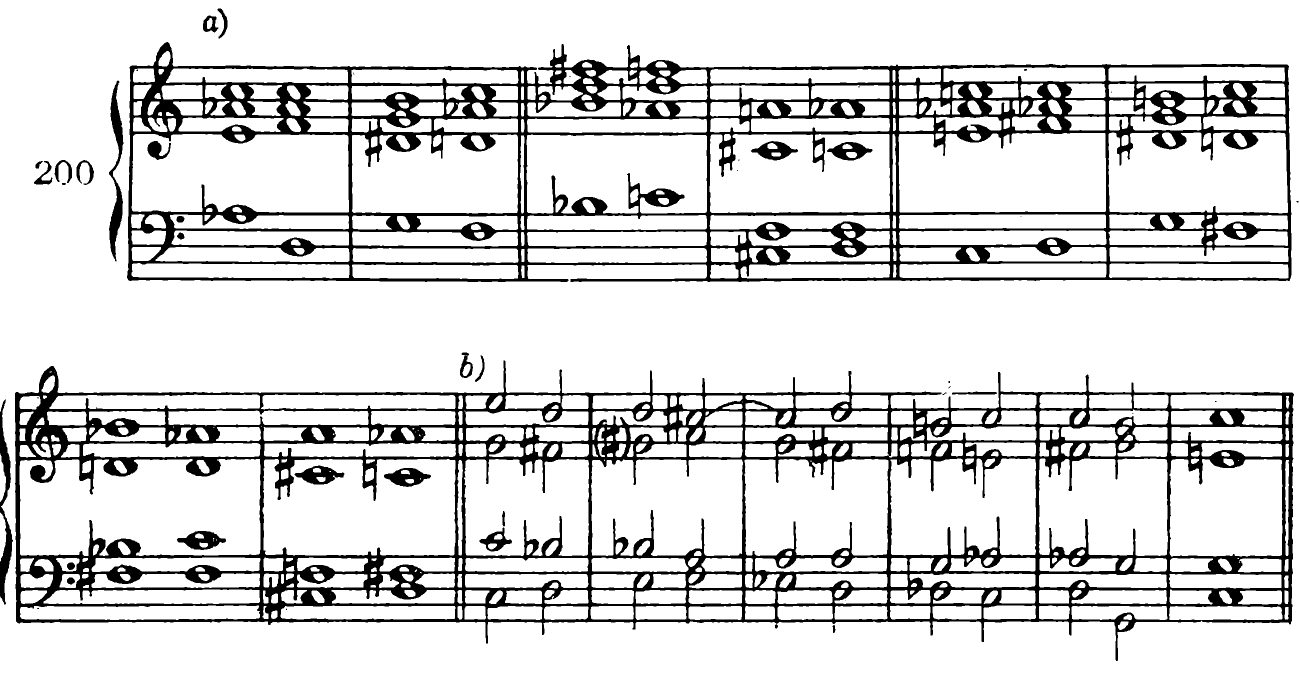
2. Augmented triads with one another (197); then with augmented six-five, four-three, and second chords (198), Neapolitan sixths (199), and the other vagrant chords (200).
3. Augmented six-five, four-three, and second chords with Neapolitan sixths (201) and the other vagrant chords (202).
4. Neapolitan sixths with the vagrant chords just mentioned (203).
5. These vagrant chords with one another (204).
Connecting diminished seventh chords with one another is very simple. Naturally it can be done either by moving all voices chromatically or by letting the voices leap (191b), and at most it creates difficulties of spelling. Sometimes it may be hard to decide whether to write E-flat or D-sharp, G-sharp or A-flat. I recall the following instruction: take guidance more from the key most closely resembled by the passage at that particular moment than from the key signature of the piece, and try to relate the connections through their spelling to that imagined key. But one need not be overly pedantic. I prefer spellings that avoid complicated combinations of double sharps and double flats, and consider the spelling requiring the fewest accidentals the right one. It will be good to give each chord a written appearance that recalls another familiar chord. Otherwise, all melodic steps should be represented so that at least segments of three or four successive tones in a voice can be related to a major, minor, or chromatic scale, and transitions between scales should be represented as they could occur in an exemplary tonal series. This spelling has the advantage of being relatively easy to read, whereas the other does not even fulfil its intended purpose of expressing derivation. Against the excessive use of diminished-seventh successions it must be said: they are powerful, but there is little merit in that power. It is too easily obtained for one to be especially proud of exploiting its effect.
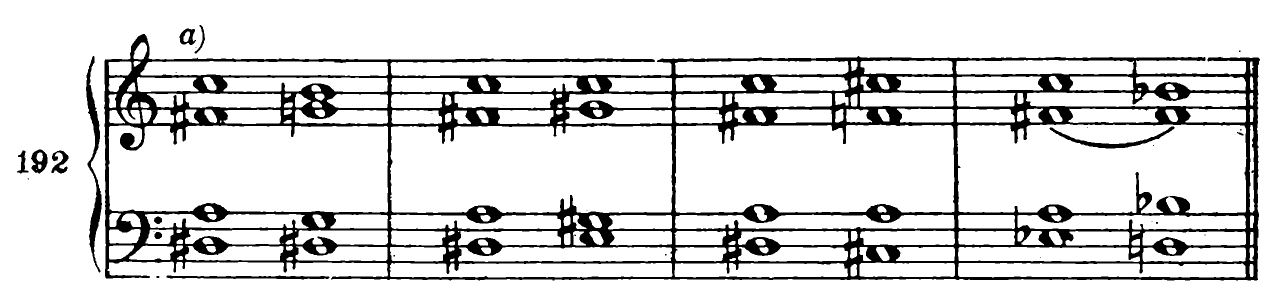
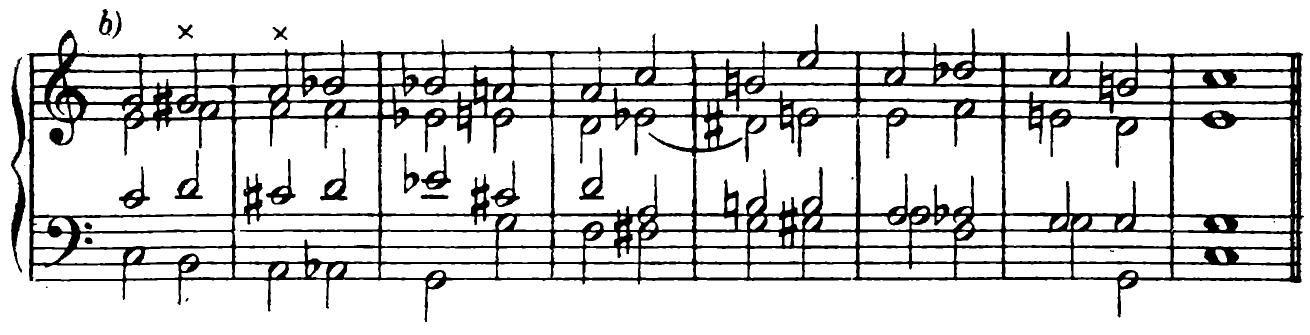
Connections between diminished seventh chords and augmented triads are illustrated with one diminished seventh chord in 192a. A short passage in C major shows an application (192b).
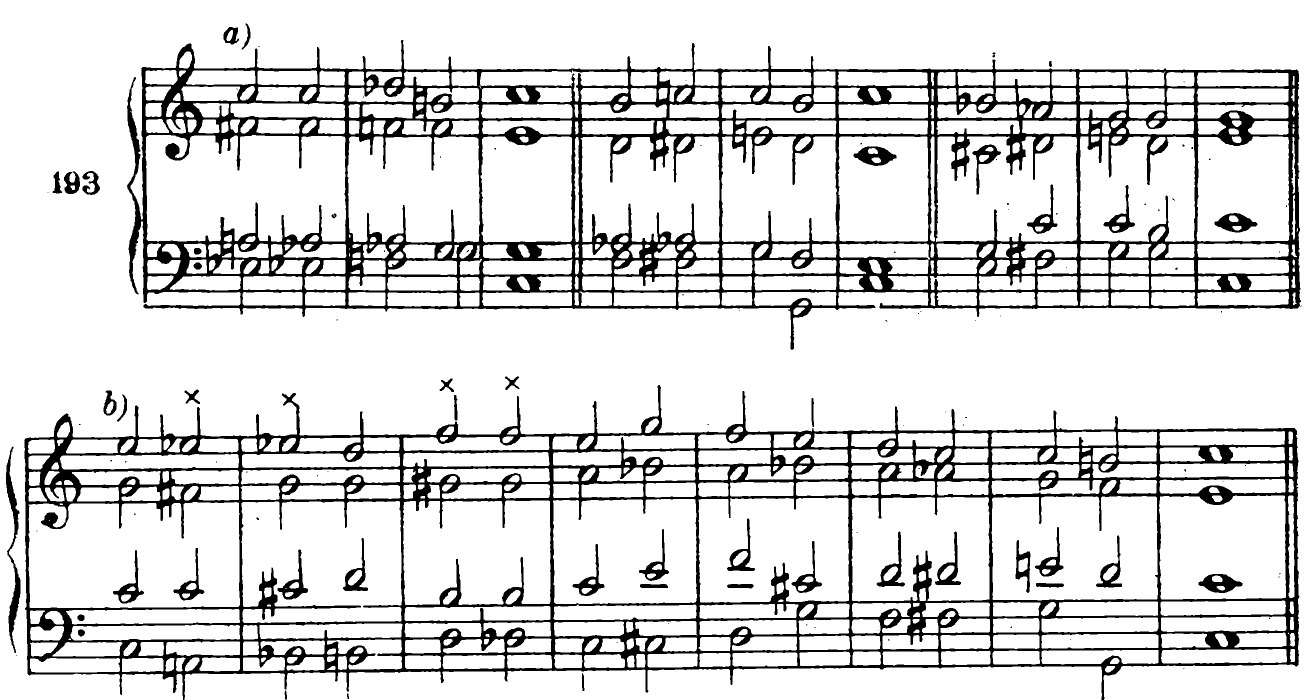
Augmented six-five, four-three, and second chords with diminished seventh chords. Only those derived from degree II are shown here. The pupil can easily try the others independently, following the model of 193b.
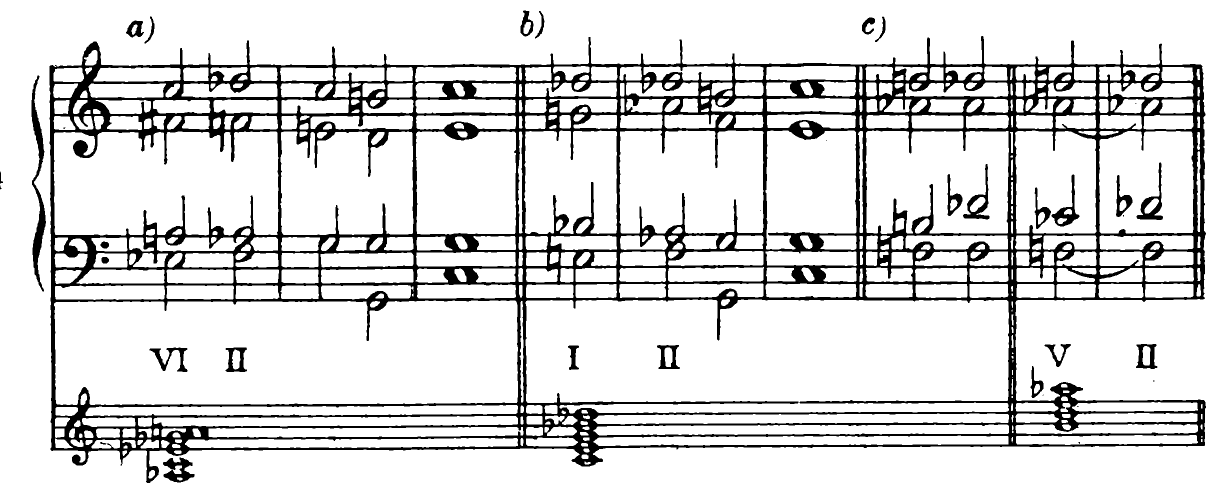
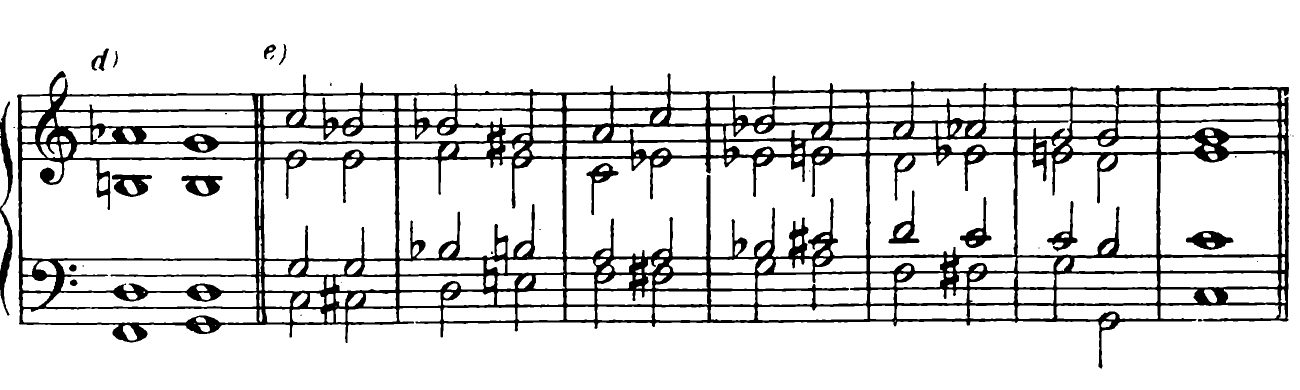
The Neapolitan sixth chord on degree II connects excellently with two diminished seventh chords, at a and b. The chord at a should be regarded as derived from VI, and that at b from I, of C minor through the minor-subdominant relationship, or of C major; this gives good root progressions. The third, however, can only be understood as V, and connecting V with II is scarcely advisable in itself, since it is based on a descending progression. It also has a relatively weak effect because two tones remain common, only one moves chromatically, and the third, if written as it properly should be—B—would have to make an improbable step to D-flat. Thus, although the connection appears worthless in a harmonic sense, this says nothing about its usefulness as an expressive device. The fact that the Rheingold motive in 194d rests on the same root progression may attest to this; see also example 173.
Example 194e uses Neapolitan sixths on other degrees.
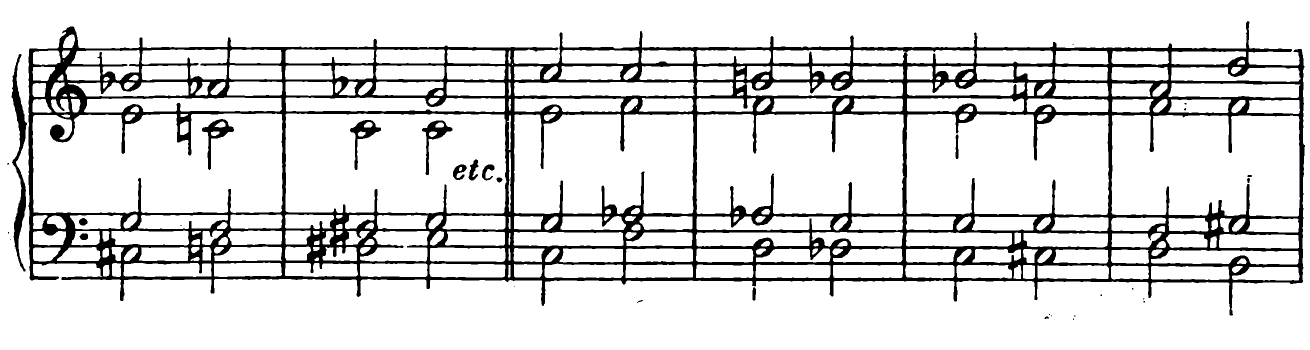
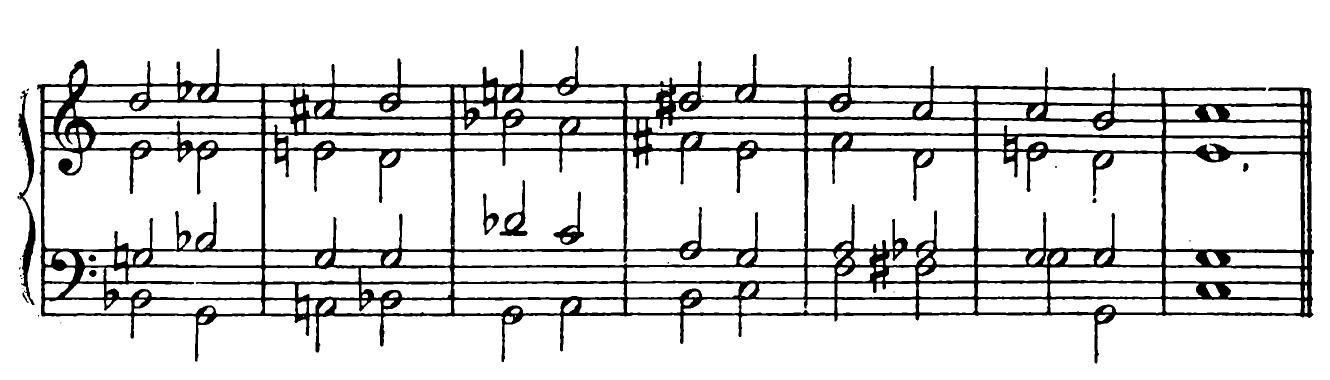
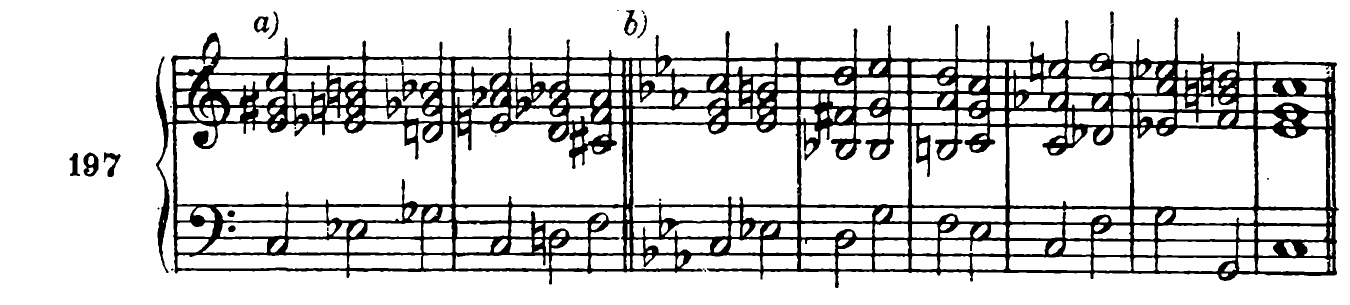
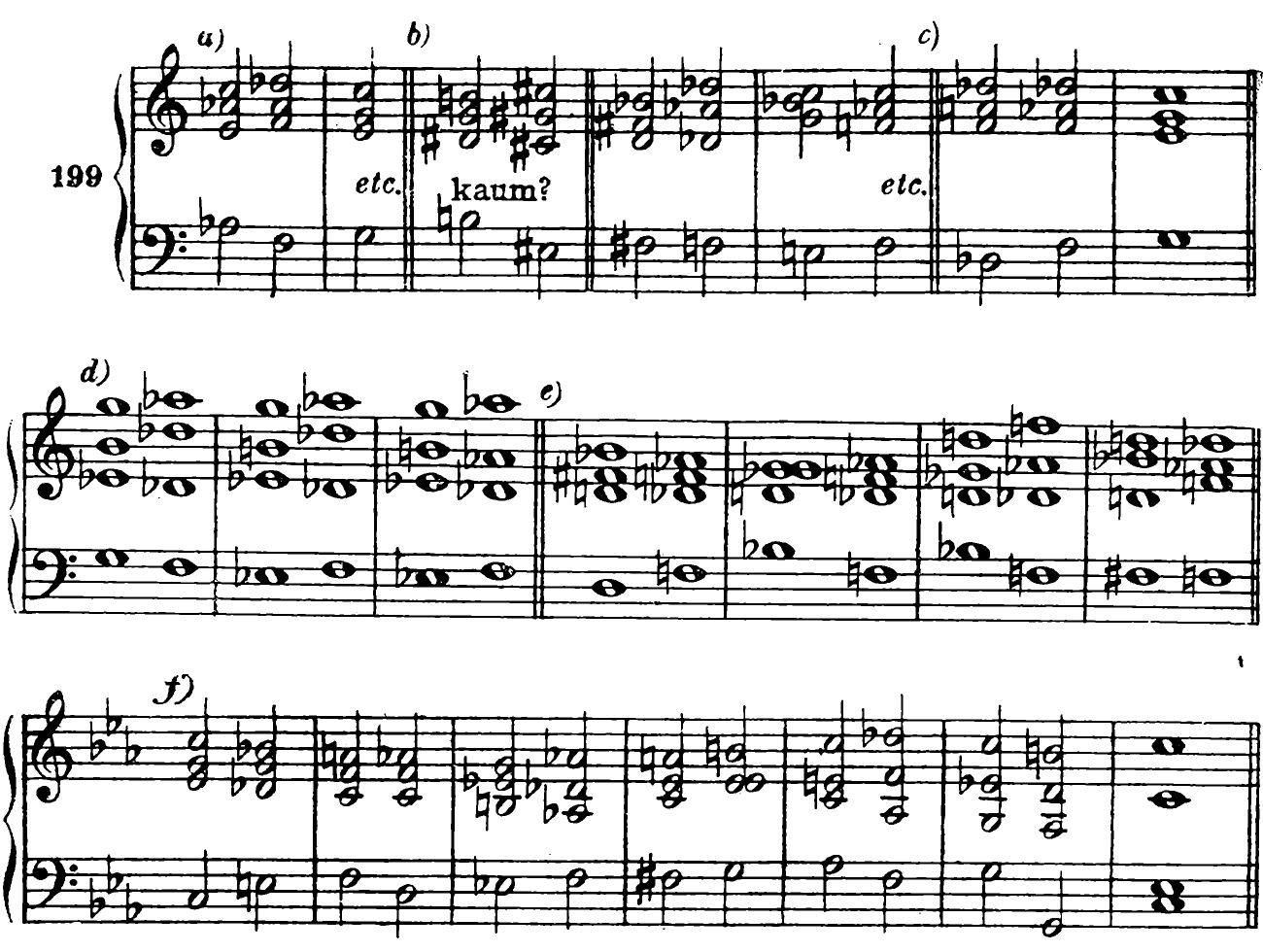
The two augmented triads in 199b present considerable difficulties. Hardly any disposition avoids reinterpretation through enharmonic respelling, or augmented or diminished steps. The pupil will do best to leave such connections aside for the time being.
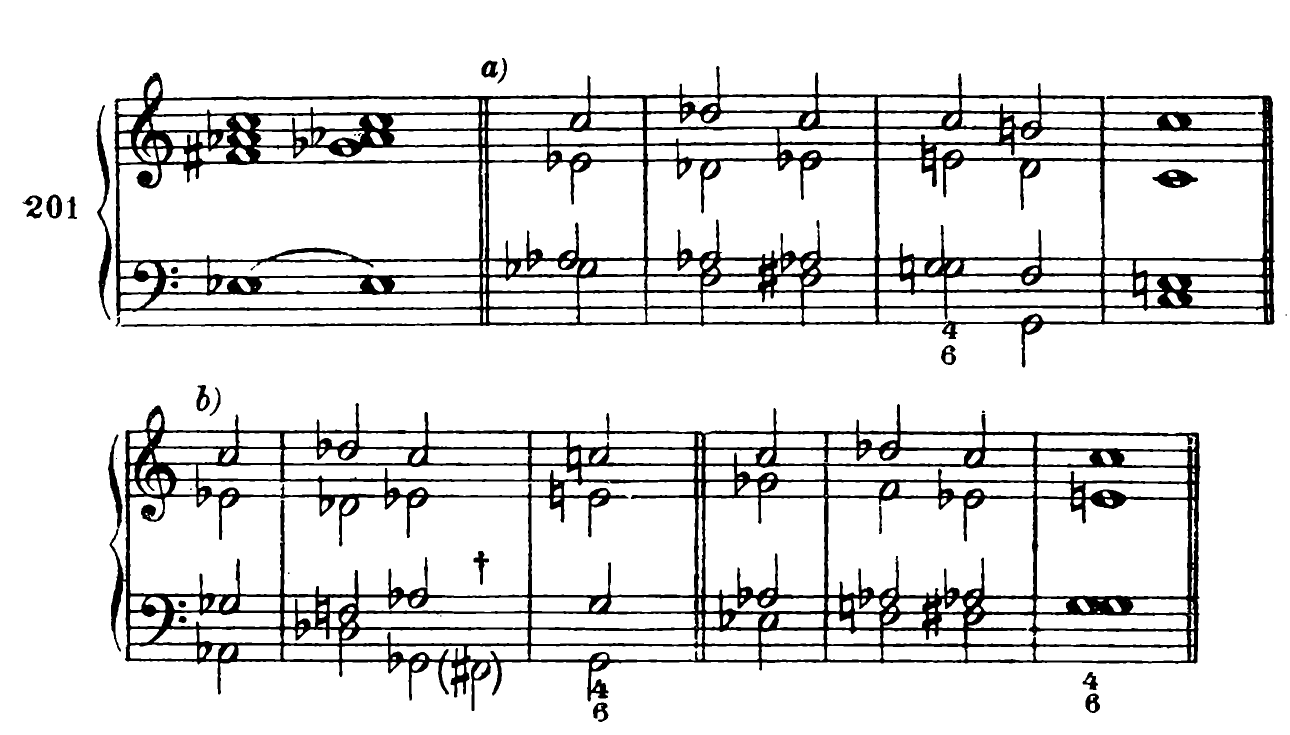
As already mentioned, the connection of augmented six-five, four-three, and second chords with the Neapolitan sixth rests on their sounding identical to the seventh chord and its inversions that could be understood as the dominant of the Neapolitan sixth. In such cases the six-five chord is generally written that way too: in our example, G-flat rather than F-sharp. Repeating it after the Neapolitan sixth, then proceeding to the six-four chord, is especially effective (201a). Such repetition is well suited to reaffirming a key that has become unstable.
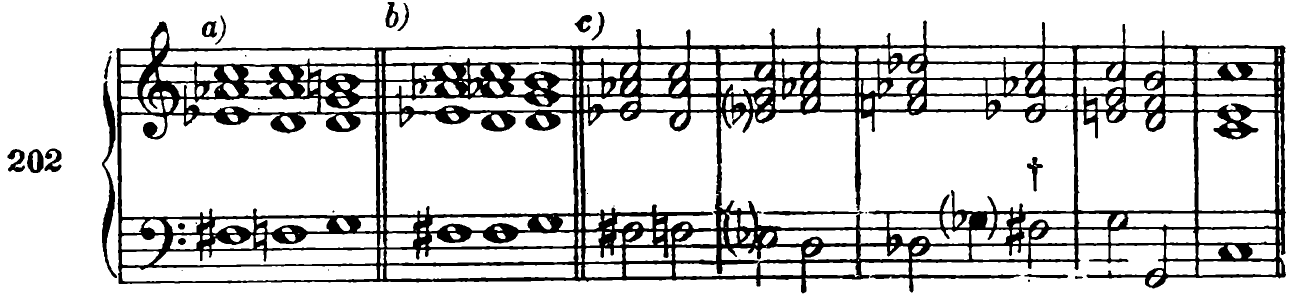
Their connection with the other vagrant chords on degree II also occurs often enough, although the chord in 202a, where F-sharp moves to F, does not exactly favor placing V in root position, with G in the bass. But since the six-four chord need not be the goal, the continuation in 202c is also possible. The bass step D-flat–F-sharp, marked with a dagger here and in 201b, is probably usable only if one thinks G-flat and respells it enharmonically. But one can certainly do that!
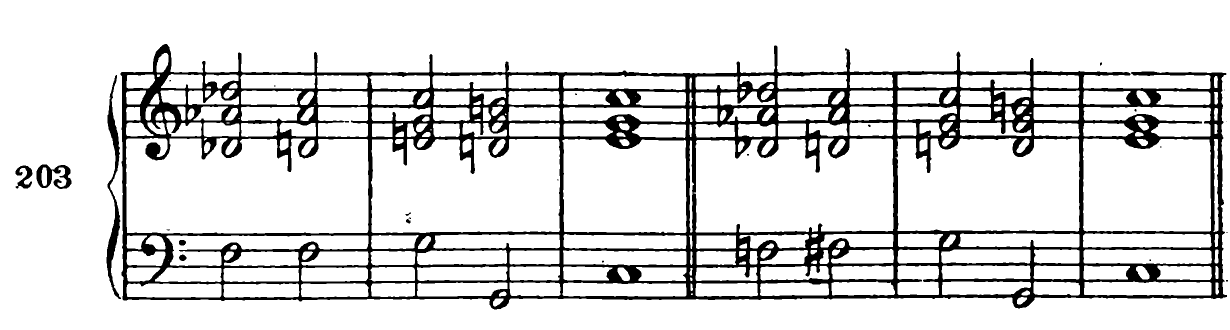
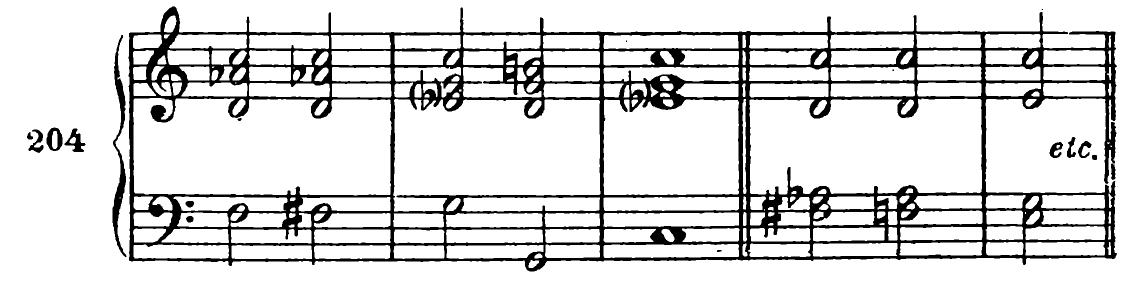
In all these examples, wherever possible, the voices have been led as our earliest instructions required: avoiding augmented and diminished intervals, parallel fifths, and so forth. Where a connection presented difficulties, augmented intervals naturally could not be avoided. And there they are good, for necessity is the strongest command. But when, as here, the relationships between such chords lead back to widely separated keys, it would be pedantry to insist that the voice leading remain within a single major or minor key. A singer wishing to intone such intervals must think enharmonically to make an augmented interval more approachable. The enharmonically respelled tone does not, admittedly, coincide with that of the tempered system, and this creates great difficulties for choral singing today. Naturally, however, it cannot halt the development of our music, for it is self-evident that one wishes to use the same harmonic resources in choral as in instrumental writing. Perhaps little choral music will be written until a means of overcoming the difficulty is found. But since that means must be found, it will be found. Instrumentalists today have scarcely any difficulty intoning such intervals and far more complicated successions. The range of what may reasonably be demanded of them is continually expanding. Naturally, the pupil should by no means exploit these possibilities fully yet. He should still strive to express chromatic voice leading melodically, and to relate the events within a voice to one key for as long as possible, making the transition to another key as cautiously as possible. As has often been said, since his voices are only the necessary connecting parts of a harmonic construction, and their development is not driven and justified by a motive, he should never depart from the simplest presentation unless compelling reasons require it.
To conclude, several further possible resolutions of the diminished seventh chord should be added here.
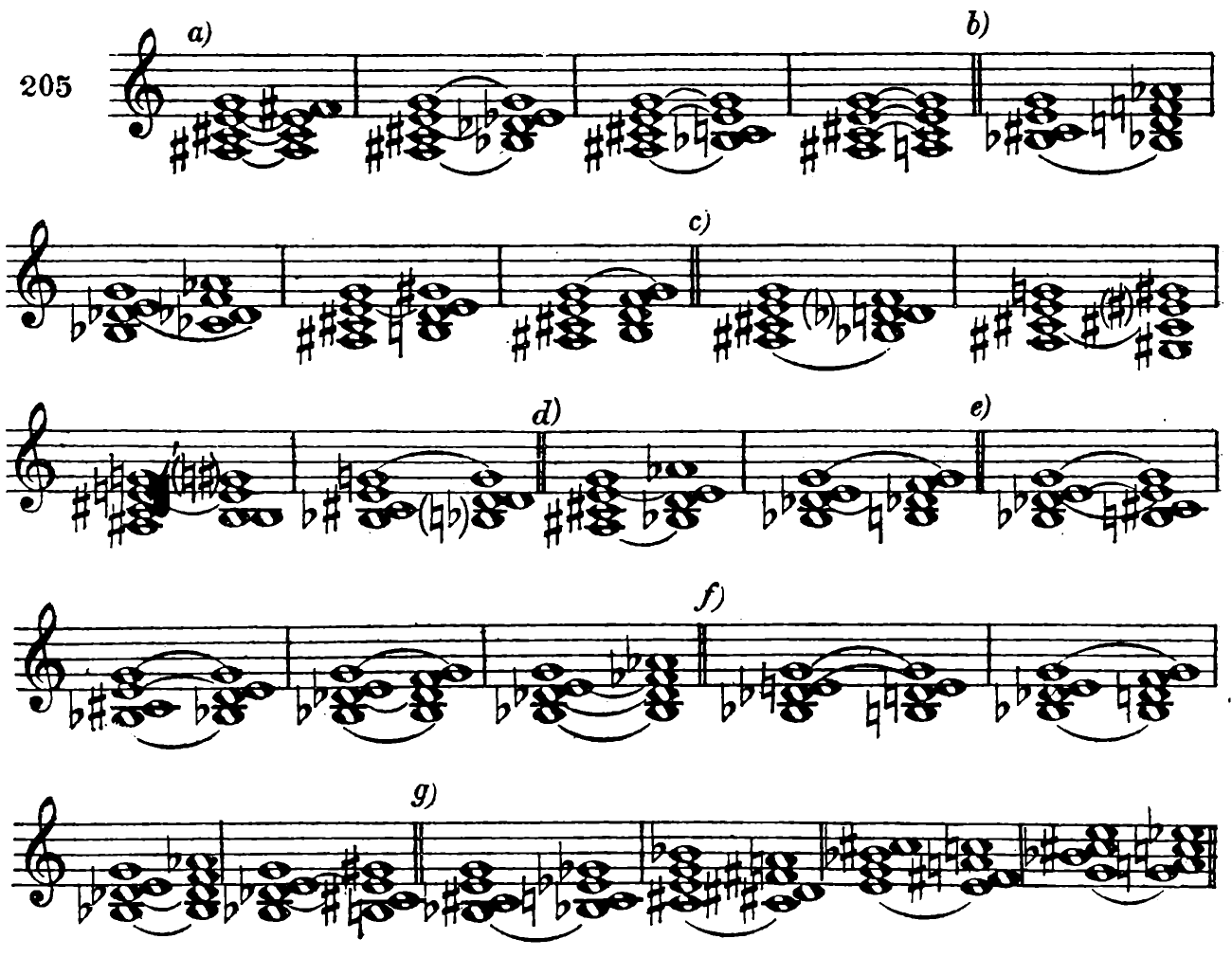
Example 205a shows how a diminished seventh chord can be transformed into four different dominant seventh chords: each time, a different tone falls a semitone and becomes the root—our imagined fundamental! If one tone remains as the root while the other three rise a semitone (205b), four other dominant seventh chords result. Or the same procedure, with a correspondingly different resolution, yields major or minor chords on those degrees (205c). If two nonadjacent tones, a diminished fifth or augmented fourth apart, are held while the other two nonadjacent tones rise a semitone, two forms of the altered chord mentioned on page 307 result (205d). Holding three tones and raising one (205e) produces secondary seventh chords of the same form as VII in major or II in minor. Holding two adjacent tones and raising the other two adjacent tones produces secondary seventh chords like III in major (205f). If three tones fall and one remains, the same chords result as when three remain and one rises, but in different keys (205g): VII in major or II in minor.
I have discussed this type of connection in an addendum for three reasons: first, the underlying root progressions are not invariably good; second, this procedure of altering individual chords does not agree with our usual manner of presentation; and third, these connections generally have only a pseudo-harmonic significance. They usually occur as, so to speak, melodic leading of the harmony, adapting rhythmically to the course of a principal voice. Such procedures are certainly used often in modulation, but generally without awareness of the root progressions, and that makes little sense.