 Playable Books
Arnold Schoenberg · section 50 of 66
Chorale Harmonization
Read and hear this section in the playable edition →

I include these exercises in my book despite having certain objections, because I take a different view of their purpose. First: one does not harmonize; one invents with the harmony. One may then make corrections, but it is not theory that draws attention to faulty places; it is the sense of form. Nor is the improvement found theoretically: sometimes, perhaps, by much trial and error, but usually by a fortunate idea—intuitively, through the sense of form, through imagination. At least that is what my experience tells me, and only someone who “harmonizes” himself, who is therefore unable to invent a melody together with its harmony, could maintain the opposite. Yet it cannot be denied that there are cases in which a theme should appear in a harmonization different from the one in which it first occurred to its composer. And we must admit that, for beginners, an otherwise usable idea sometimes reveals a harmonic weakness at some point, whose correction requires the whole idea to be reharmonized. In neither case, however, does what is really meant by harmonization take place. Neither case consists in adding harmony to a melody given without harmony. Rather, a harmonically articulated melody already exists, its harmony and articulation known to its author, who merely makes changes to it. In the first case, when he does this for purposes of variation, his very task is to make a different use of the harmony contained in it, thus exploiting its particular qualities. In the second case, that of correction, only individual places were poor; the whole was harmonized, and he was aware of this harmony. He probably merely wrote it down incorrectly, or failed to hear its impulses properly when continuing the theme. This failure to hear properly is something I have often observed in pupils. It occurs even among the gifted, but is easily remedied. Yet in correcting the harmony as in varying it, the new form should be invented, not calculated. It is a mistake to believe that art can be calculated, and the aestheticians have an entirely false conception of the “work” of the “thinking” artist: according to them, one would almost have to believe that his entire achievement consists in selecting, with much taste and sound calculation, the most effective of the available possibilities. Artistic creation does take place on a somewhat higher level. In my own work I have all too often found that what was not good in the first conception never became good, even if I corrected it a hundred times. Yet the first conception has usually produced forms of a smoothness that no correction could ever have achieved. I would therefore say: if one discovers a fault in an idea that cannot still be corrected while the original inspiration is active, perhaps it is better to abandon the idea, or else leave it with the fault with which it was born. That fault will still be smaller than those one teaches it by tinkering with it. This is not to say that a pupil should make no corrections, for then the teacher could not correct him either. On the contrary: the pupil should work a great deal with intellect and taste. He is still learning; he is only practicing. He merely wishes to reach the point at which he can one day say something, should he have something to say. The pupil should think; but the artist, the master, creates according to feeling. He no longer needs thinking, for he has reached a higher way of communicating with his need for expression. The pupil should improve his work, but he should not believe that a work becomes better through improvements. Correction can do only one thing for him: it can show him how the work might have been better if this fault had not been there from the beginning. And it may help him another time. Then he can be a little more careful while inventing, and corrections made “in statu nascendi,” while the first warmth of the idea is still present, will scarcely cause harm. But corrections made afterward seldom help.
An objection might be raised here: if I condemn harmonization exercises because the artist does not harmonize but invents the harmony together with the melody, why do I have little passages produced by writing down roots—numerals—and building passages from them? Harmonization is an exercise just as planning roots is, and the only question is what advantage it brings the pupil. To this I reply as follows. First, planning roots at least resembles actual practice in that, insofar as the roots represent harmonies, one is nevertheless thinking in harmonies, even if by a detour through numbers. At first one thinks numbers, but later sounds! Harmonizing, on the other hand, bears almost no resemblance to actual practice. Second, as I have shown above, the pupil must indeed do certain things as exercises that the master does not do; but it does not follow that the pupil should also do something the master must not do! Third, through the preceding exercises we have hopefully reached a stage of ability at which we would no longer wish to do such an exercise, even if it were less bad than planning roots. But it is not.
My harmonization exercises will therefore not aim to teach the pupil how to do something he should not do. Instead, they seek to strengthen his sense of form in a case where his imagination need not yet be involved. He is given a melody; it is not his, so its harmonization can never be as good as the one in which it was invented. Since he is therefore not to blame for the task's partial failure, it matters little that he produces nothing perfect; nor does any misfortune befall the melody he mistreats, for it is certainly not indissolubly bound to a bad harmony. On the contrary. This work resembles the dissection exercises young doctors perform on a corpse: if they cut too deeply, no one is hurt. It does not matter if a chorale harmonization turns out badly. It will not be published. But in such a simple case the pupil can learn to attune his sense of form to the events of a melody and practice regarding it as a whole, preparing him for the time when he must himself invent a melody as a whole together with its harmony.
I shall therefore use harmonization exercises to guard, somewhat more thoroughly than is usual, against the need for corrections that arises from an undeveloped sense of form. I shall, however, refrain from assigning modern melodies as harmonization exercises. The form of the chorale melody is so simple and lies so far behind us that we may perhaps see through it: perhaps we can truly recognize its relationships as precisely as is necessary to obtain similar effects through imitation. Nor is it absolutely necessary here to give instructions that properly belong to the study of form. More modern melodies, even if I meant only those of Mozart or Beethoven, exhibit such a complicated variety of forms that a pupil could not approach them without prior knowledge. Someone with a gifted ear may not find it impossible to obtain good solutions even here. And I have no objection if the pupil makes such attempts on his own. The best procedure is to take a theme from Beethoven, Mozart, or Brahms, or from a work by another master—but it must be a master; anyone else is not good enough!—try to harmonize it, and then compare it with the original. The most important thing is that he recognize that his harmonization is worse than the model and then try to discover why. Another useful exercise might be to harmonize a theme remembered by ear and then compare it with the model. This exercise achieves its purpose even if the pupil has remembered the original harmonization and merely writes it down from memory. For all these exercises are concerned less with actually constructing a harmony—constructing it!—than, if the solution is not to turn out stiff, with skillfully applying what the ear has retained from similar cases, under the control of theoretical awareness. But I entirely refrain from inventing such passages myself and then making the pupil struggle to harmonize them, although I could certainly produce something better than the wretched stuff certain harmony textbook authors have the nerve to include solely because they utterly lack formal discrimination. If I leave the pupil free to do whatever occurs to him, it matters little if the result is not particularly smooth. The principal purpose was practice in independently stringing harmonies together. Any faults lie in his thinking and could be combated there. But if I subject him to the constraint of a given melody, it should be as good as only an inspired master can produce. Otherwise the faults lie not merely in his thinking but also in the imperfect thinking of the person who devised an imperfect melody. Then correction becomes not only difficult, because it is hard to discover whether the fault lies in the harmony or the melody, but also unfair to the pupil, who can hardly overcome his teacher's mistake. For my part, however, I cannot summon inspiration to invent melodies for harmonic exercises. Otherwise I could not do so for my own works—not because the purpose is too lowly, but because it is a purpose. And if the others who impose such passages on the pupil claimed to have been inspired when inventing them, the stiffness and roughness of these products would not allow me a very favorable conclusion about that inspiration. If a pupil writes roughly and incorrectly, it is no disaster, provided he does so out of his own resources. He can always cross it out again. But if the teacher fails in the one thing in which he must never fail—as a model, as Gustav Mahler characterized the essence of the teacher in a single word—then that is a crime. A teacher who expects the pupil to harmonize melodies made by the teacher, which are not good and cannot be good, is not fit to be a model. A pupil who wishes to practice harmonizing more modern melodies should likewise take these from the works of the relevant composers. As I have said, I do not consider this exercise particularly necessary. But anyone who believes in it may do it; and if he does it in this way, it is at least not harmful.
Now to the chorale.
Like every artistic form, the chorale is clearly articulated. Every thought needs articulation as soon as it is expressed: although we conceive a thought all at once, as a whole, we cannot say it all at once, but only gradually. By stringing together its various components, into which we break it down differently from the way we assemble it, we produce a more or less accurate representation of its content. In music, melodic or harmonic successions are regarded as components of a thought. This is correct, however, only as regards what is visible or audible, what the senses can perceive in music; it holds only by analogy for what constitutes the true content of a musical thought. Nevertheless, we may assume that the written notes provide a fitting symbol for the musical thought. Thus, just as every well-built organism's outward appearance accords with its internal arrangement, so that the outward appearance with which it is born cannot be regarded as accidental, the form and articulation revealed in the notes correspond to the inner nature of the thought and its motion, just as the contours and hollows of our bodies are determined by the positions of internal organs.
We may therefore draw conclusions about the essence from the outward form.
In the chorale, articulation is expressed by the holds at the ends of musical phrases, which coincide with the ends of the lines of verse and divide the thought into parts. In such simple artistic forms, the individual parts stand in the simplest relationships of contrast or complement. Such mosaic-like composition allows no more complicated relationships and favors the principle of more or less simple repetition as the element that creates coherence. The motion within a thought, through which alone a thought becomes something living, is produced especially by the contrasts arising from the simple departures inherent in the key. These contrasts are only relatively large, not so large that they cannot easily be bound together. What binds them is the uniformity of rhythmic motion, their uncomplicated nature, their simplicity, and above all the key. What separates them, what divides into parts, is really something negative: the almost total absence of motivic life in development and connection. Because of this lack of motivic premises, which fails to bind the parts more firmly, the unbound parts confront one another without any particular obligation; perhaps they stand beside one another more than they stand opposed. Naturally, beginnings of motivic activity are not entirely absent, for the simple rhythmic principle of almost uninterrupted equal motion in half notes or quarter notes is itself a motive to a certain extent, or at least an equivalent, though very primitive, formal principle. Naturally, still more connectedness can be discovered in it, but the modest demands of the whole leave the motive—rhythmic and melodic, with at most the rhythmic aspect, almost never the melodic, providing connection—in so ambiguous a state that in melody one can recognize relationships almost only through contrasts. But contrasts too are relationships. And if the melody rises in one line of the chorale and falls in the next, this is a contrast that connects: the fall compensates for the tension produced by the rise. “Question and answer” is a happily chosen symbol for these events. Given the principal direction of motion, which is always extremely clear in simple artistic forms, it is self-evident that the harmony continuously follows the same path as the melody. It is self-evident that the aim must be to follow the motion of the content exactly, to support it, at most to anticipate it helpfully. Counteraction, obstruction, reversal, like all psychologically more elevated artistic devices, are largely excluded from straightforward, popular, primitive forms. Since we are in the unnatural situation of reconstructing by calculation the harmony that ought to have been born with a given melody, exact observation of the melody's particular qualities is indispensable. Ultimately one must rely on feeling here too, and these exercises will succeed best when, after becoming familiar with many chorales harmonized by masters and working out many himself, the pupil no longer makes the setting by calculation but in a single conception, by ear. Even then, however, foresight into coming events, obtained through calculation, will sometimes be useful.
As already stated, the endings at the ends of the lines of verse are characteristic of chorales.* The relationship of contrast is clearly expressed in them: contrast, but also coherence; those contrasts that are necessary in a key, those contrasts through which the key is expressed. With a slight exaggeration, whose extent I shall explain in a moment, we may understand the chorale, like any larger composition, as a cadence of greater or lesser size and richness. In the present case its smallest components would not be all the chords that occur, but the chords forming the partial closes at the ends of the lines. Set beside one another, these form a cadence. Here lies the exaggeration: these chords would first have to be put in order to make an effective cadence. Although such a cadence may then seem less rich than the events through which its constituent degrees are brought about in the piece, there is nothing surprising in the plan being simple and its realization more complex. Once one has accepted the simplicity of such a plan, one sees that even the simplest cadences are relevant here—that is, those with the fewest degrees—so that perhaps even a cadence consisting of degree I alone might suffice. But this is improbable, as I explained in discussing cadences, for the key itself can hardly be expressed with any compelling force unless its contrasts produce that motion, that contest for supremacy, in which the tonic will remain victorious. It is therefore clear—and this was the purpose of the comparison—that the same degrees are used to compose this imagined cadence, extracted from the whole, even if possibly in another order. Above all I, then V and IV: the tonic, dominant, and subdominant regions. The regions, and thus also what belongs to them: III, VI, and II.
* The pupil should take the melodies from a collection containing chorales harmonized by masters. He will have to exclude many because they are in church modes with which he does not know how to work. The final chord can serve as a sign for distinguishing the keys, though not an infallible one. If it agrees with the key signature in that it represents the corresponding major or minor tonic, the chorale can usually be treated as major or minor. Some, however, which may otherwise be regarded as major or minor, begin and end in a contradictory way. This is usually because the setting suppresses the church mode, though this need not result from ignorance of style or lack of skill. If the pupil chooses such chorales, they will cause him some difficulty.
The comparison also contains a slight inaccuracy in that, in a cadence, especially a short and simple one, scarcely any degree except I would be repeated, whereas in this imagined cadence the repetition of V or VI, or possibly others as well, is not the obvious course but is by no means excluded.
What is essential and new for the pupil here is that he should develop individual degrees of the key through cadences virtually as keys in their own right. This presents no difficulty, for it resembles the intermediate and transitional keys in composite modulations, where episodes in a foreign key likewise occur, completely suppressing the character of the starting key while bringing out the particular features of the episodic key by familiar means. The close on the relevant degree can occur—and generally will—as though that degree were a key. For example, if one has to make such a close on degree III of C major, the cadence should proceed as though it were establishing a modulation to E minor, and that modulation would have to be prepared in what precedes it.
With a chorale melody before him, the pupil should examine the ends of the lines, recognizable by the holds (𝄐), to see to which degree the closing note can be referred. We assume that, in general, each half note receives a new harmony. Naturally, two or even more chords could be set against a half note. But we shall generally avoid this, doing it only where it serves a particular purpose.
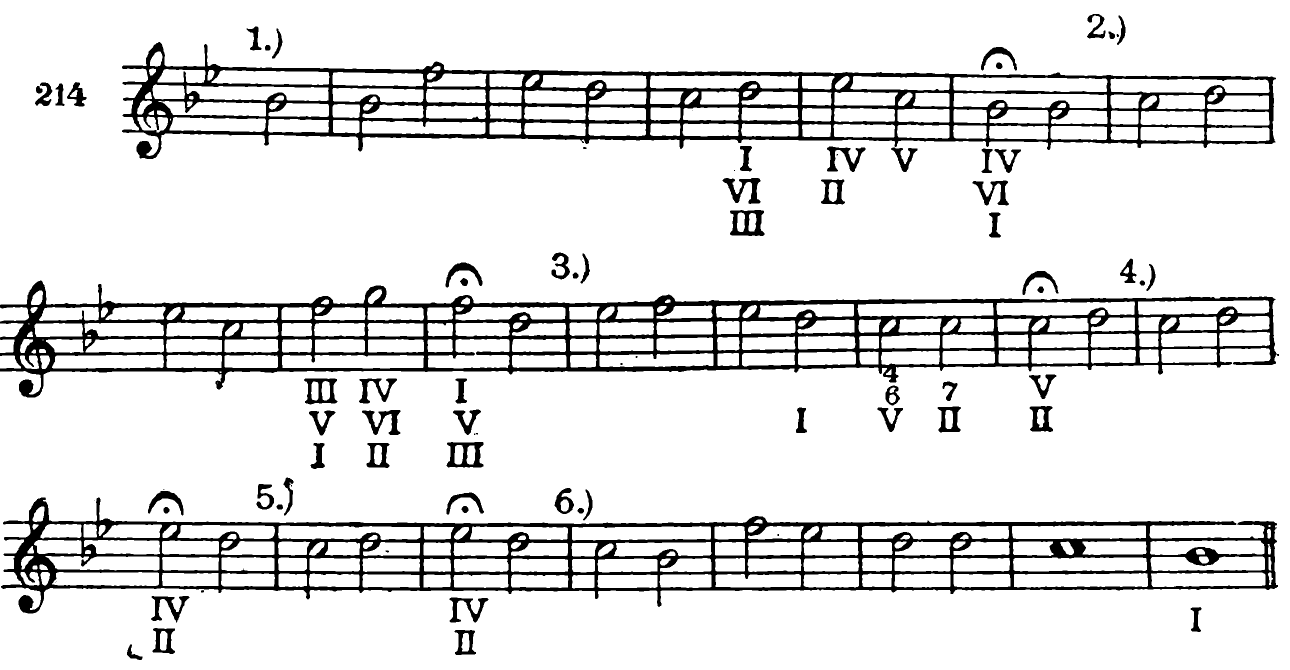
The B-flat of the first close may belong to degree I, VI, or IV; the F of the second to I, V, or III; the C of the third to V or II—VII will probably be excluded here; the E-flat of the fourth to IV or II, and likewise that of the fifth. But the close of the entire chorale, of the sixth line, must naturally and unconditionally be I. The following consideration decides which degree should be preferred. Above all, the key must be expressed. As we know, the tonic does this most clearly, followed by the dominant and subdominant. The pupil will therefore try, if possible, to close the first line with the tonic. If that is impossible, V or IV comes into consideration, and only then III, VI, or II. For the ends of the other lines, he may choose those degrees that form a good contrast with the first, if the melody permits. If I was used there, then V, IV, III, VI, or II here. But the pupil need not invariably avoid repeating a degree, especially I, for sometimes the melody directly aims at such a repetition. This is quite apart from cases where individual sections are repeated exactly or with only a slight variant. Where possible, the pupil will seek variation in such cases through reharmonization. Where repeating a degree would be poor, a deceptive cadence might help; this will be discussed later. But this need will scarcely arise often. The closing note alone does not suffice to decide which cadence to choose. One must also examine the preceding note, and often one or two notes before that. Since some lines contain little more than six to eight melody notes, one might almost say that the work should proceed from the closing note, from the cadence, backward toward the beginning. But this is only partly true, for the beginning must also be taken into account, both in itself and especially in its relationship to the preceding close. This relationship should be as though the hold had caused no interruption, as though the harmony continued uninterrupted across it. The two chords sought must therefore stand in a relationship of continuation, and the first chord of the new line cannot be chosen without regard to the last chord of the old one. The pupil must first judge whether the two or three melody notes immediately before the closing note permit those degrees that make a cadence to the chosen degree possible; for a cadence it must be. Even if it is only an internal close, not a definitive ending, it is nevertheless a close, and the harmony should trace it. For the present, we know no means of doing this other than the cadence.*
* The pupil will be inclined to use everything he has learned so far in chorales. At first glance one would have to say that this is not good, because attaching complicated harmony to such a simple melody would violate its style. Theoretically, this seems correct. But if one looks at Bach's chorale preludes, in which he too allows his voices to combine into complicated harmonies above such simple melodies, one may surely say that it does not violate the style, for otherwise Bach would not have done it. Thus the theory is false, for living art is right. Or else stylistic fidelity is not an essential requirement of an artistic effect. In other words, it is quite possible to present a simple melody through harmonies other than those corresponding to its style. In this sense, Reger's chorale settings or Richard Strauss's folksong arrangements may be entirely beyond reproach. Nevertheless, in his attempts the pupil should not go beyond simple harmonies or draw on more distant key relationships. Of the vagrant chords, he should at most occasionally use the diminished seventh chord, and then without enharmonic reinterpretation, as a ninth chord above a degree of the key. Secondary dominants may be used, since they also occur in the church modes. For later exercises I have no objection if the pupil attempts a solution with richer means as well.
We first examine the first line. The degree numerals beneath the last three melody notes show that a cadence to I is quite possible. For C one can choose V, for E-flat II or IV, and for D I, VI, or III. From these the following cadences can be assembled: I–IV–V–I, VI–IV–V–I, and even III–IV–V–I, though with some caution, because III and IV—a progression resembling a deceptive cadence—have no such direct relationship. Moreover, if the deceptive-cadence progression, the “superstrong” progression, is to be used in accordance with its character, it must have sufficient reason for its “superstrong” action. It produces a turn, and this applies here to the deceptive cadence too. One should therefore first see whether the situation requires such a turn, whether the deceptive cadence is a necessary solution, as in this situation: in danger of losing coherence by going straight ahead, one regains the center line by turning sharply in the other direction.
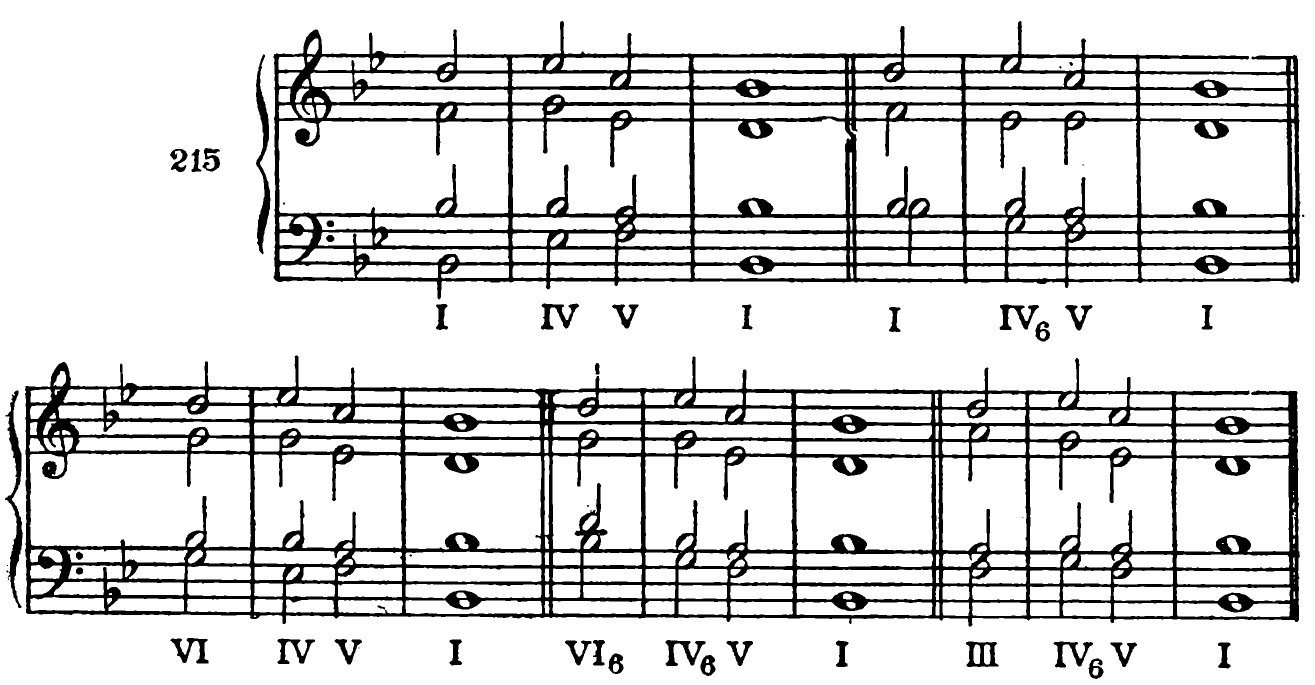
Or I–II–V–I, VI–II–V–I, III–II–V–I.
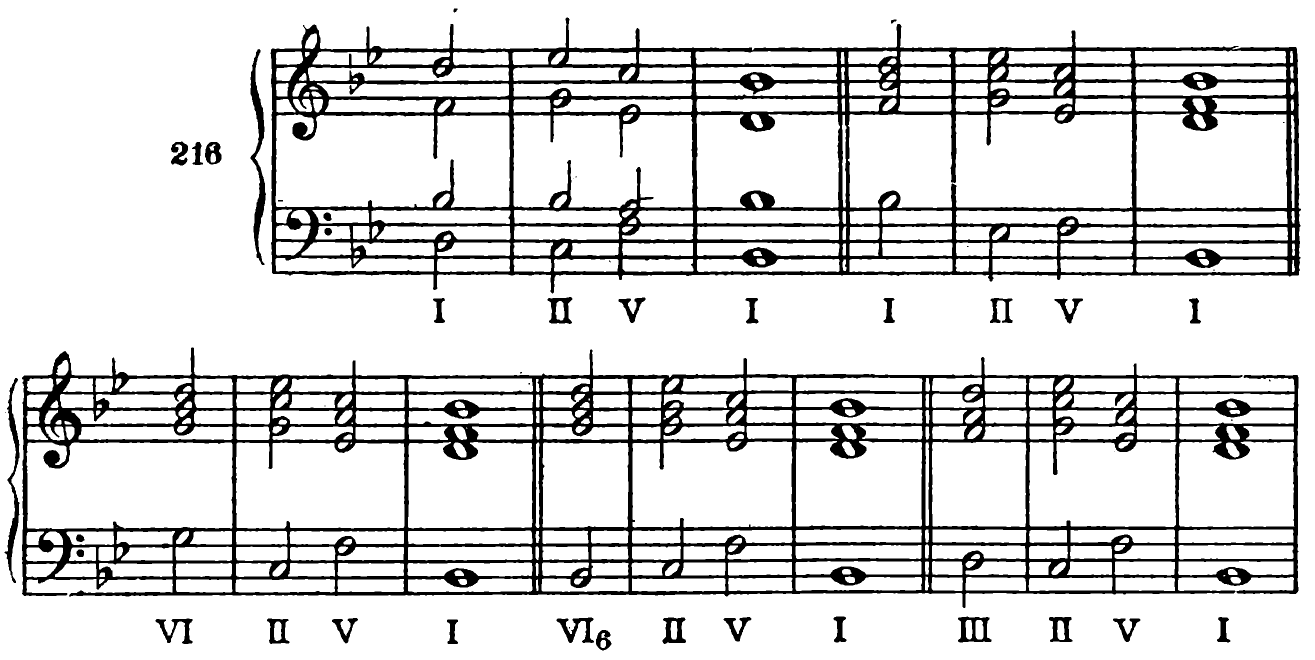
All these cadences are usable; and since the cadence to I works so well and in so many ways, we may reasonably assume that it is the one appropriate to this melody. Nevertheless, a cadence to VI would also be possible (217).
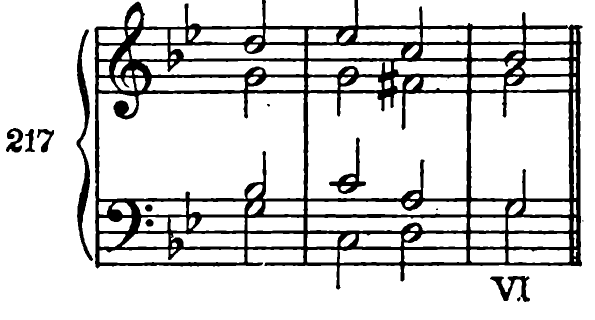
A cadence to IV is highly improbable, since it cannot be carried out without invoking subdominant relationships. But it would also be inadvisable (218) because the passage could otherwise too easily be taken for E-flat major; whenever possible, the key should be expressed quite clearly through degree I.
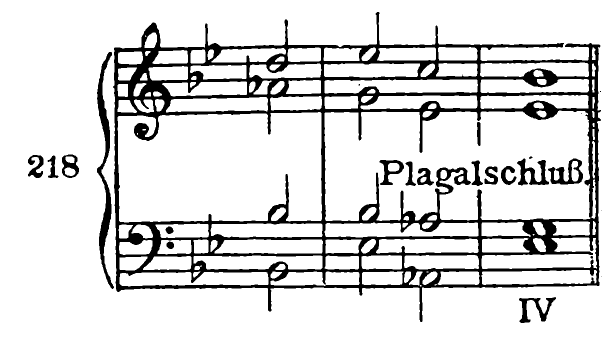
Even VI, which is possible, should be used only if necessary—for example, if the same line were repeated, perhaps in place of the third. In chorales, the root or octave, or the fifth of a chord, is generally more likely to be in the melody than the third. There are historical reasons for this: the third was discovered only later, initially admitted more sparingly, and perhaps completely avoided in exposed places for a long time afterward. Even if the pupil gives preference to the root or fifth, however, he need not therefore avoid the third. Bach offers many cases in which the closing note is the third of the chord.
If the pupil now examines the ends of the following lines in the same way, he will find, among others, the possibilities below. For the second line:
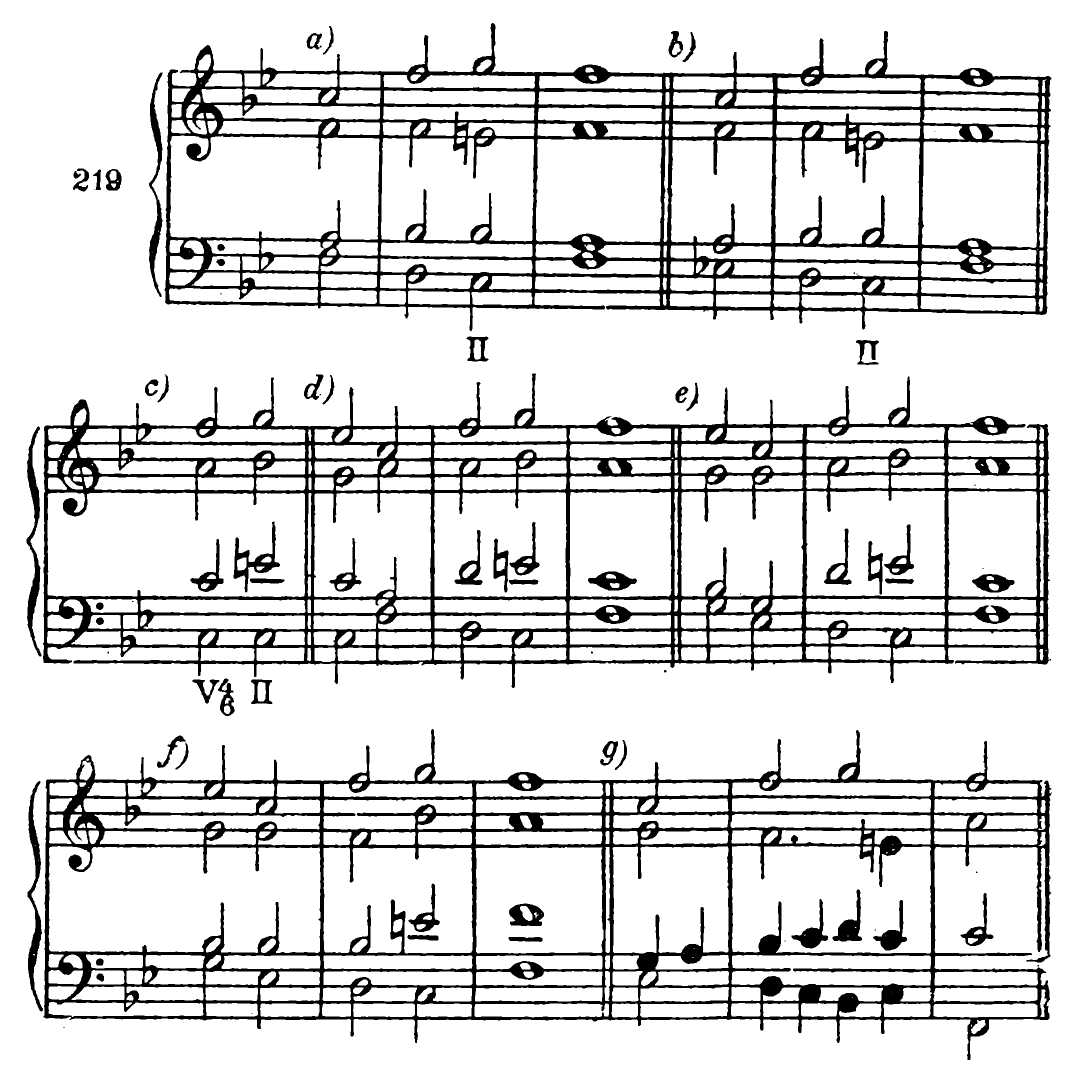
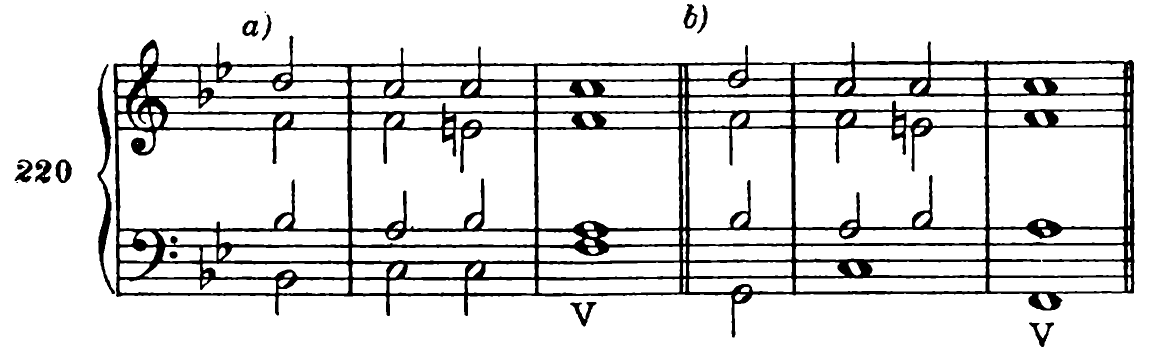
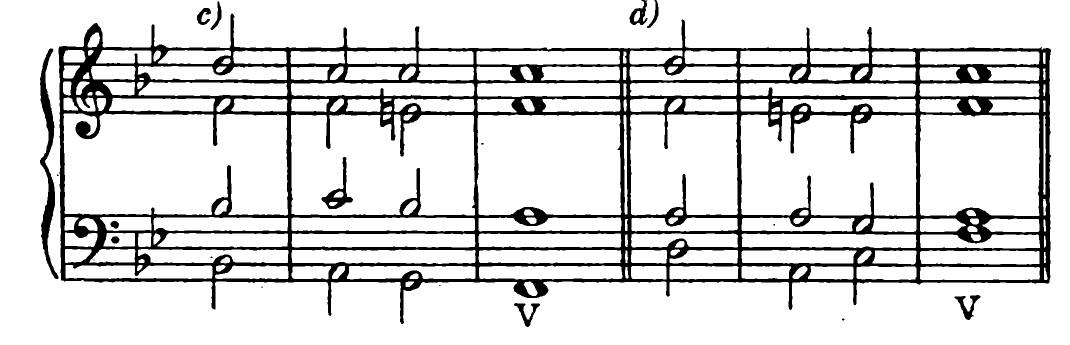
Degree II naturally appears here as a secondary dominant of V. Why the preceding chord cannot be the six-four chord of V (219c) is clear when one considers that the preceding C in the melody does not permit a chord that connects well with V. For the same reason, the close will not turn toward III, although means could more readily be found here. The “unresolved” E-flat before the C—it does not go to D!—also creates difficulties for the turn toward V. Since the melody leaps away from E-flat, so that it has not been “disposed of” before entering the region that permits E-natural, one should nevertheless try to “resolve” it in another voice, preferably the bass, by leading it to D. It will therefore be good if the chord on the melody's C still contains E-flat, as in 219b, e, and f. But then so little time remains for the turn that the cadence may easily be insufficiently strong. In any case, if E-flat still occurs in the chord beneath the melody's C, the six-four chord of V cannot stand beneath the F, since the E-flat would then remain unresolved. One could, however, cadence on I; but we have already turned there in the preceding phrase, and moreover this would use a plagal cadence, as in 218, a type not yet encountered in our earlier cadences and to be discussed later. The pupil will not easily find other harmonies for this close at this rate of motion. In Bach's St. Matthew Passion, from which this chorale is taken, simplified by omitting neighboring and passing notes, this line is harmonized as in 219g. By placing two chords against each half note here, Bach can achieve a clearer cadence containing more degrees. The pupil too may occasionally use quarter notes, but exclusively for this purpose: when their use makes a richer harmonization and clearer cadence possible, especially when a sufficiently strong cadence could not be achieved without them. We write chorale melodies in half notes, Bach writes them in quarter notes; here I have transferred the quotation into our notation. But only for this purpose! The pupil should entirely refrain from the familiar “embellishment” with neighboring and passing notes. At our present stage we cannot regard these as a harmonic event. Only a later examination will show in what sense they nevertheless are. Example 220 shows types of close for the third phrase. Little else is possible here. Forms a, b, e, f, and g, and perhaps also c, will probably be relatively favorable. Form d is not entirely impossible. But it will sound somewhat harsh because of the poorly prepared E-natural, which acts quite provocatively in the chord above A, since it is entrusted to so indecisive a chord as this one—as though “there were nothing to it.” The plagal-cadence form at g is good in itself, but questionable with regard to the key. This becomes especially clear if one imagines it in conjunction with the harmonization of the first line in 218.
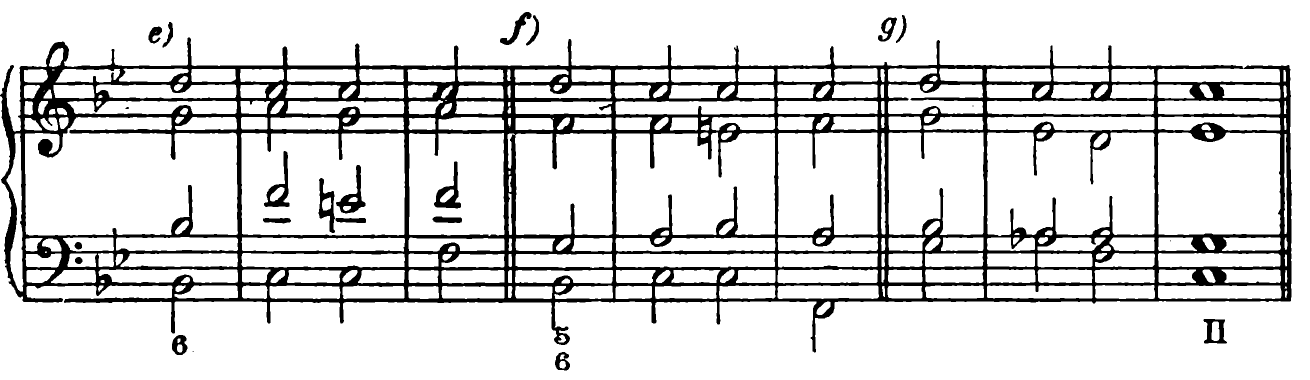
The fourth and fifth phrases present an interesting case (221): in our simplification both have the same melody notes, whereas Bach creates a variation through ornamental notes. Here it will be necessary to harmonize the two parts differently, aiming to make the repetition an intensification at the same time. II or IV comes into consideration as the degree for the closing note. This is therefore a pronounced turn toward the subdominant region.
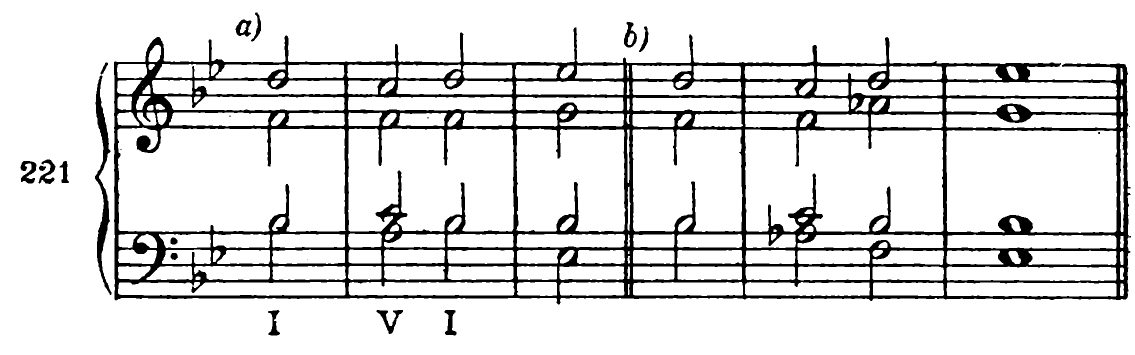
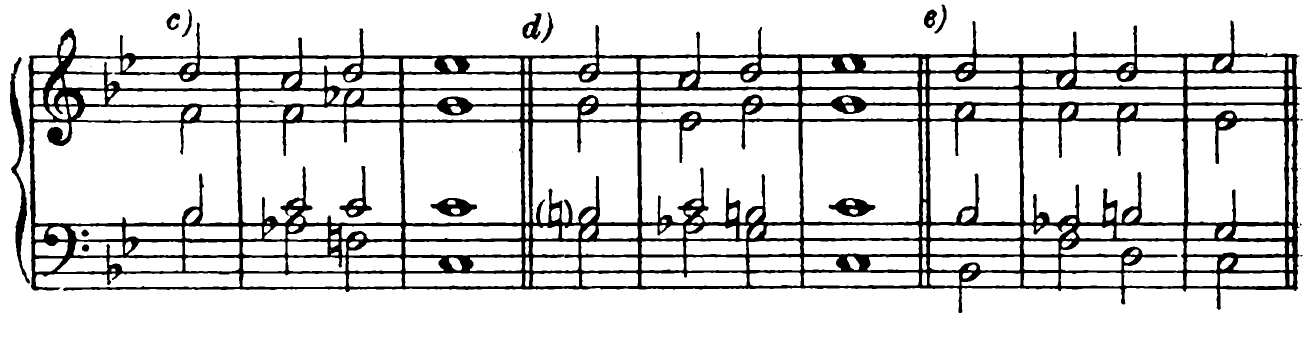
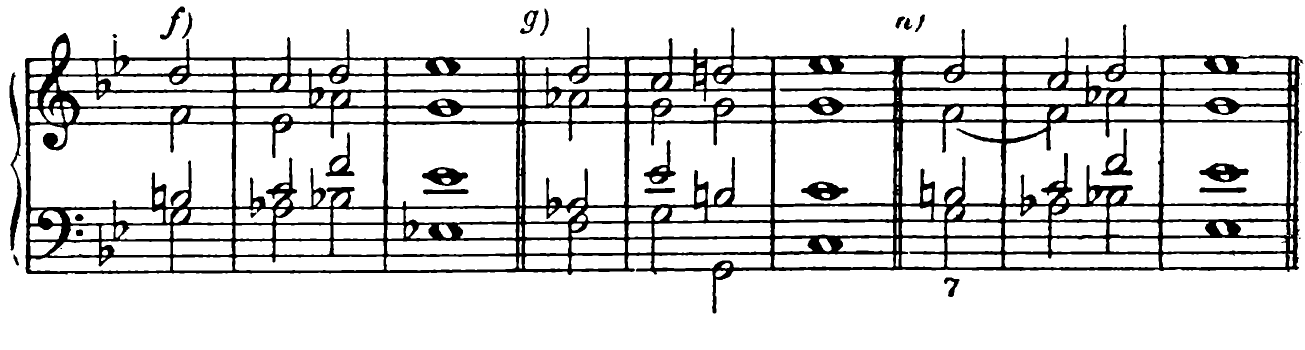
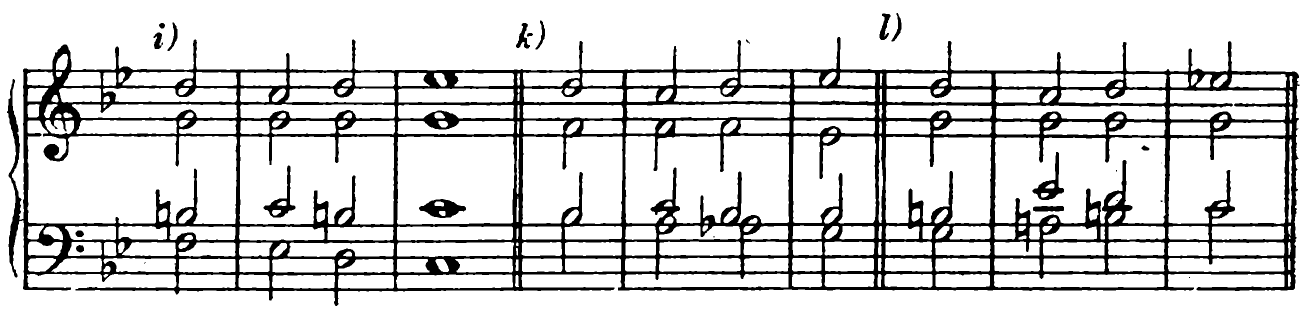
Example 221 presents a number of possible harmonizations; in 222, pairs are joined into a succession in various ways.
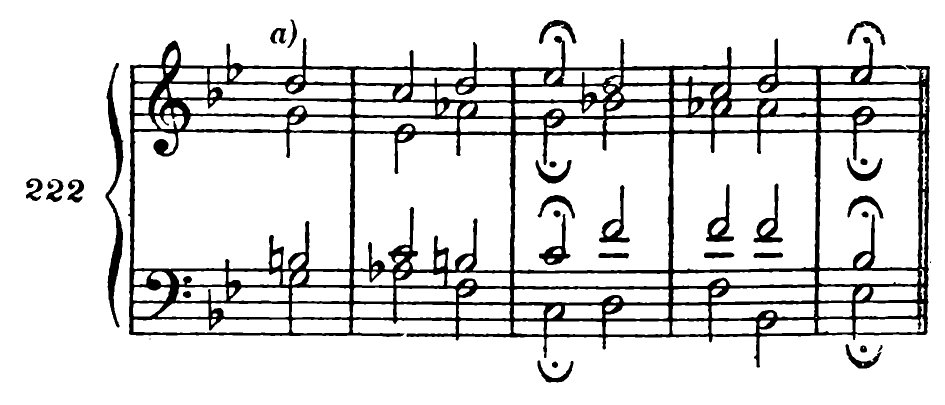
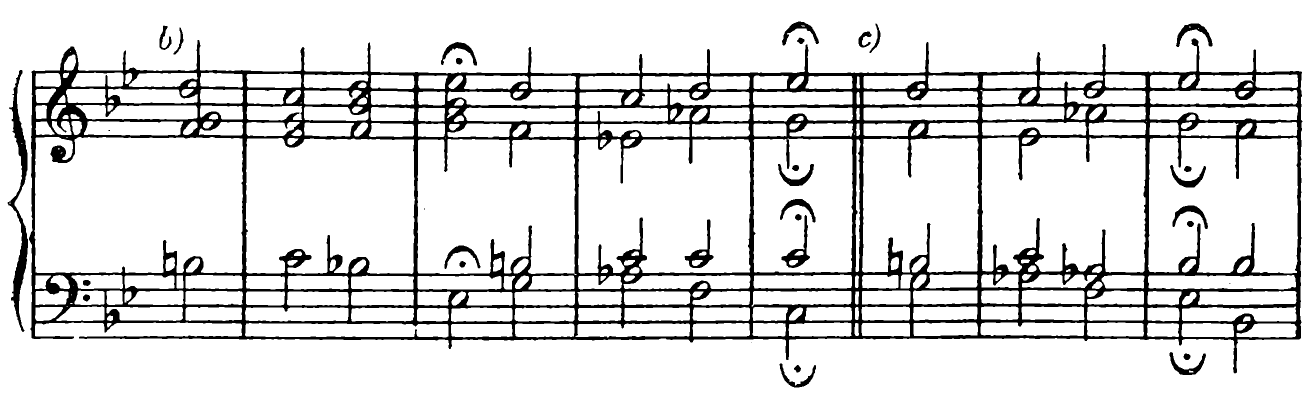
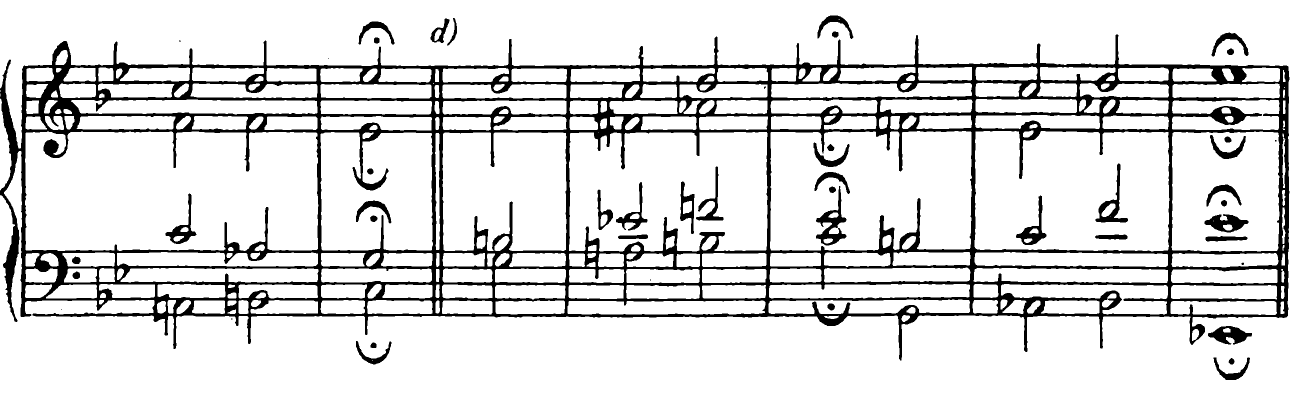
The simplest form is surely 221a, which the pupil need not avoid at all costs. The other forms accommodate the subdominant region by preparing, in various ways, now the ascending leading tone B-natural, now the descending leading tone A-flat. Example 221i would be somewhat too simple, since it gives only II and its dominant, a secondary dominant. This tonic–dominant harmonization is generally uncommon in chorales. But where it is occasionally unavoidable, the pupil should prefer this simplicity to something more complicated that may sound unnatural: the chorale may have been conceived with so simple a harmony, and any other would be inappropriate. That is not the case here, however; here there are enough suitable and rich harmonizations. Nor is 221k something the pupil should do often. It occurs in Bach, but rarely overall, and then never out of necessity, as it might with the pupil, but for an effect that the pupil's resources cannot yet seek. For the succession of these two forms, the decisive question is whether it is more favorable to close first on E-flat and then on C, or conversely. Bach gives this form:
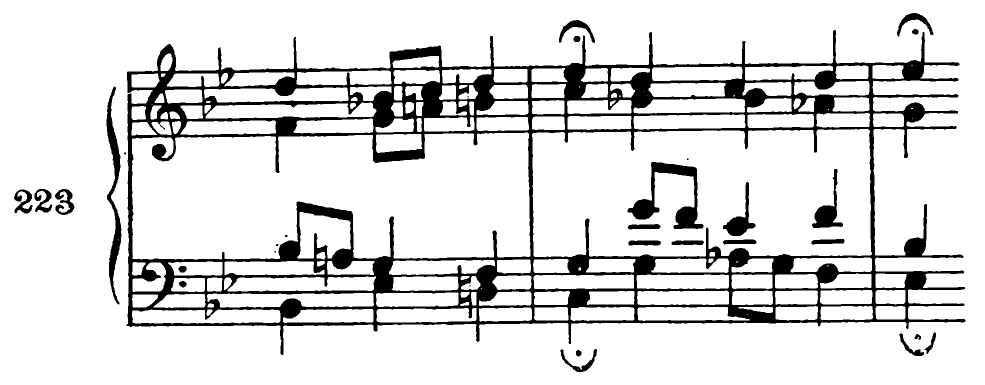
First degree II, then IV. Yet the reverse can generally be done with considerable effect, and the judgment then depends on the surroundings. In general, it is certainly better to place II after IV, since one then reaches I through V. This accords with our understanding of strong root progressions, which can in this way be transferred from chord succession to phrase succession. Yet it is not unconditionally stronger. For there is a very compelling effect in the arrangement II followed by IV: the less perfect minor chord, II, is followed by the perfect major chord, the “provisional” followed, so to speak, by the “decisive.” After IV, Bach's harmonization no longer uses either IV or II—only at the very end does he bring II back, then as a secondary dominant, where it almost belongs to the dominant region. Instead, he approaches I with a clear preference for VI and the chords related to it. Perhaps one cannot categorically say that this ending is the necessary consequence of the order II–IV, but the tendency is nevertheless striking.
Example 224 also shows a few possible harmonizations for the last line. There are not many here; the ending is too unambiguous.
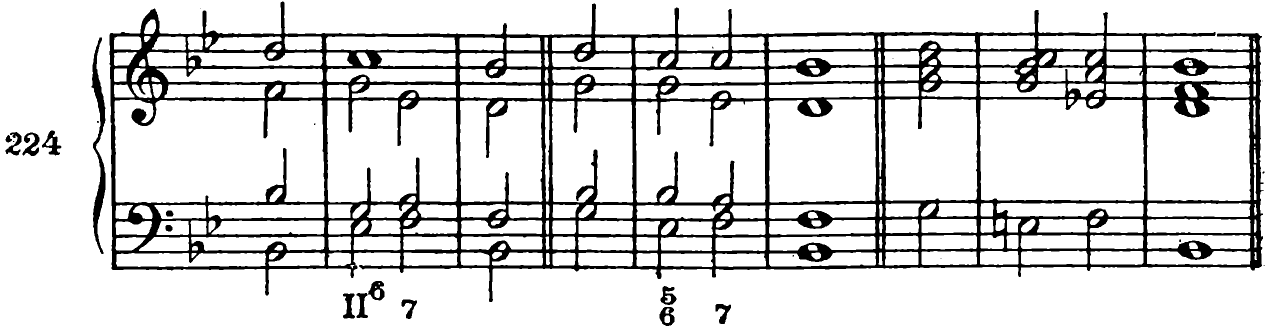
Some chorales, and occasionally individual lines as well, begin without an upbeat on the strong part of the measure and close “femininely,” that is, on the second beat. Usually the same note then occurs on beat two as on beat one. In such cases the close must in any event be completed on the first beat, with the same chord repeated on the second. One may then suspend one or more voices on beat one and resolve them on beat two to obtain some movement. If the note on beat one differs from that on beat two, one must first determine whether both belong to the same chord—for example, if they form a third—to the closing chord, which is thereby given to a certain extent. The motion then merely changes the position while the harmony remains the same. The rare case in which this interpretation does not apply is somewhat more difficult. I then recommend lengthening the last two notes into whole notes. The first whole note usually provides an opportunity for a cadence.
Once the pupil has worked through the closes—if more practiced, preferably without writing them down, merely retaining them in memory so that some invention still remains—he must decide on the closing degrees, taking the following into account. 1. The final close must unconditionally lead to the tonic. 2. The first, or at least the second, line should if possible also lead into the tonic; one of them may go to V. If there is absolutely no other way, both could go to V or both to I, but the key would then have to be very clear and sufficient variety present: different soprano and bass positions, close instead of open position, a different course of harmony, and so on. 3. III or VI generally comes into consideration more for internal sections; IV most often toward the end, and likewise II, because the rise from the subdominant to the dominant region then has a very strong effect. But other arrangements also occur often. 4. Stated harshly and exaggeratedly, one might demand that, apart from the necessary repetition of I at the beginning and end, no degree should repeat. As stated, this is exaggerated and almost never practicable, but it should be sought as far as possible. 5. Since the preceding aim is difficult to attain, one should seek to separate closes on the same degree by intervening cadences elsewhere. This too, like everything in artistic laws, is greatly exaggerated. The opposite may also be good here, and repetition may act as reinforcement. 6. Most important, however, is to harmonize every phrase without forcing the melody. This is a matter of feeling, hence of talent. Nevertheless, we do know some things that can help—for instance, observing such particular features of a melody as I demonstrated in discussing the second line, where the E-flat must first be disposed of before E-natural can appear.
Once the closes of the lines have been determined, their beginnings are chosen. Above all, this choice depends on the beginning standing in a good relationship to the preceding close. As stated earlier, this should, if possible, proceed as though no hold were present. The beginning should also prepare the degree on which the line closes. It does this best by bringing its very first chords at least into the vicinity of the key corresponding to the treatment of the chosen closing degree as a key. Preparation of this kind will almost always be good, but will not always be possible. If it is impossible, preparation may also occur gradually over the course of a line, even when the closes of the lines are far apart. But a sudden turn in the middle can often have a very strong effect as well.
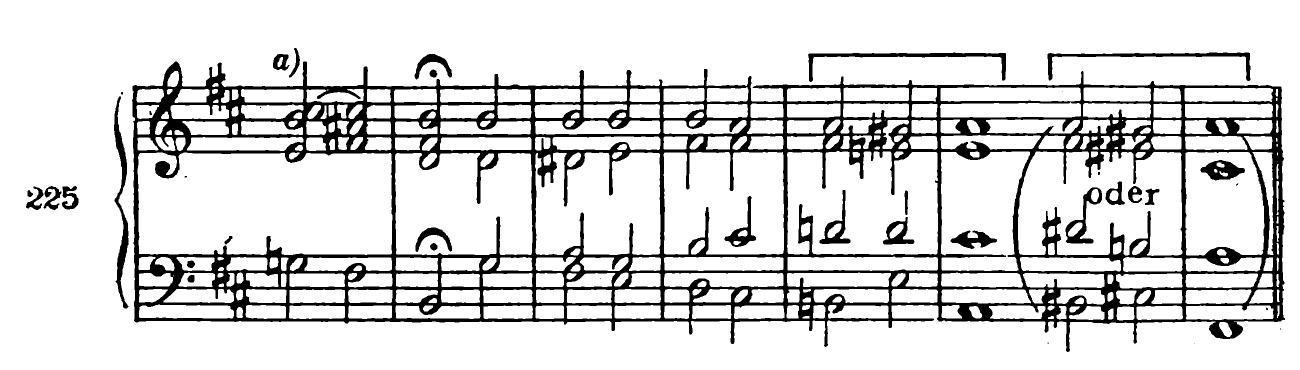
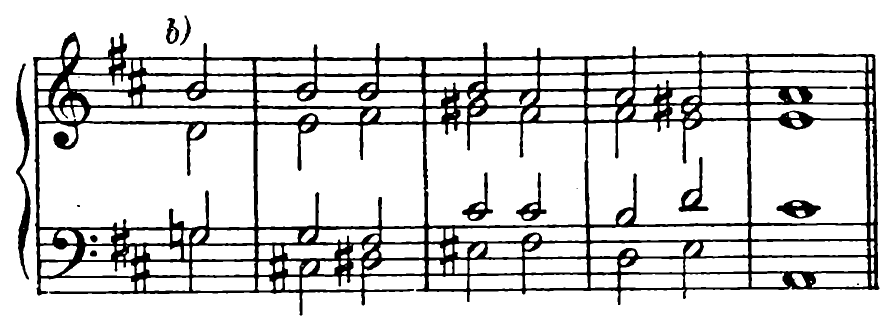
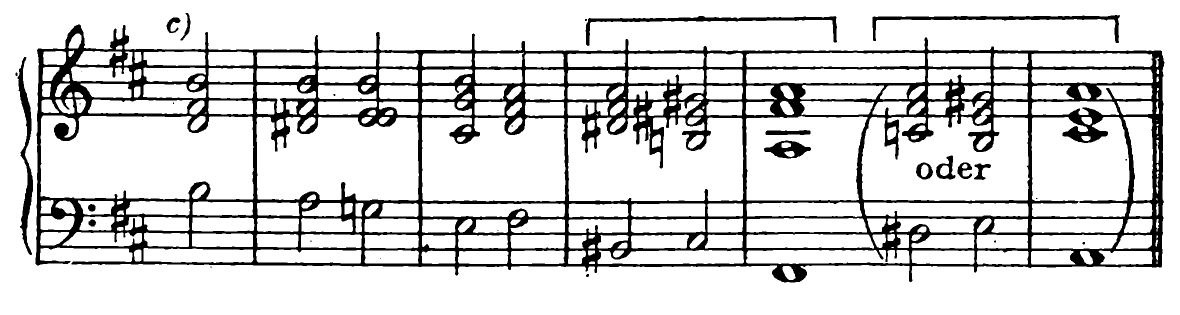
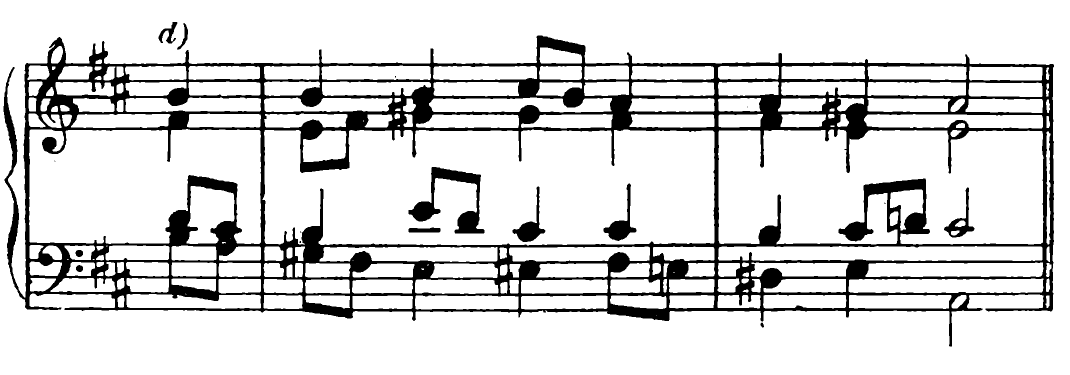
For example, in another chorale from the St. Matthew Passion, “Was mein Gott will …,” which is in B minor, Bach (225d), after the close on B, I of B minor, uses the upbeat turn to bring E, the dominant of the closing chord A. Examples 225a, b, and c take their time with this, tending almost toward the subdominant region of the closing tone A, or respectively F-sharp, toward E minor, D major, and B minor. Yet a and b do mediate gradually, while c brings the decision about with a more sudden turn. In general, preference should be given to the method that indicates its intention with the very first step, as Bach does here. Often enough, however, he himself uses a more sudden step. For example, the fourth line of the chorale “Ich bin’s, ich sollte büßen” from the St. Matthew Passion, which is in A-flat major, could quite well accommodate a turn to the dominant, as in 226b.
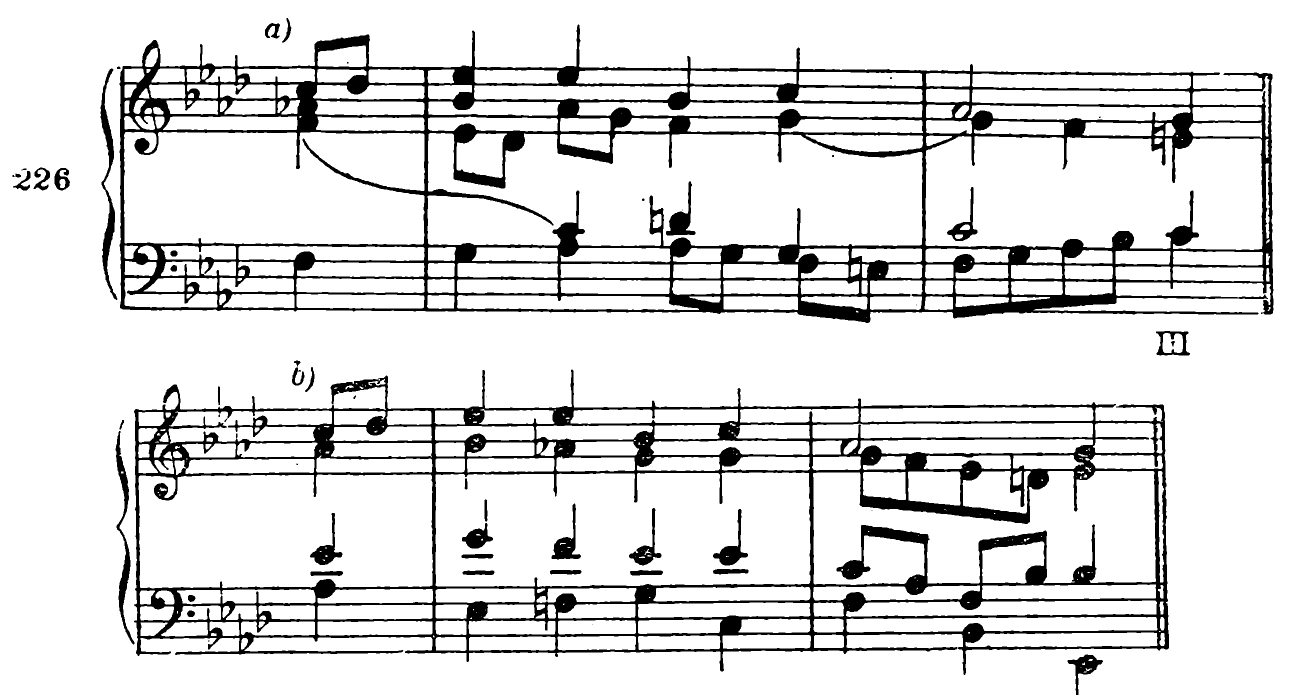
But despite the E-flat actually standing in the way of this undertaking, Bach chooses a close on III as a major chord, virtually the dominant of the relative minor, and brings it about with a rather surprising turn. A comparison of the two forms will show how much more interesting Bach's is, although I could have found something better for my own. This is still clearer when both are placed in context within the chorale. One then sees that different degrees were chosen for the third and fourth closes in this chorale precisely because these two lines merely repeat the first two. These are the reasons that lead a good constructor to write harsh turns. Variation is one of the most important requirements of this style.
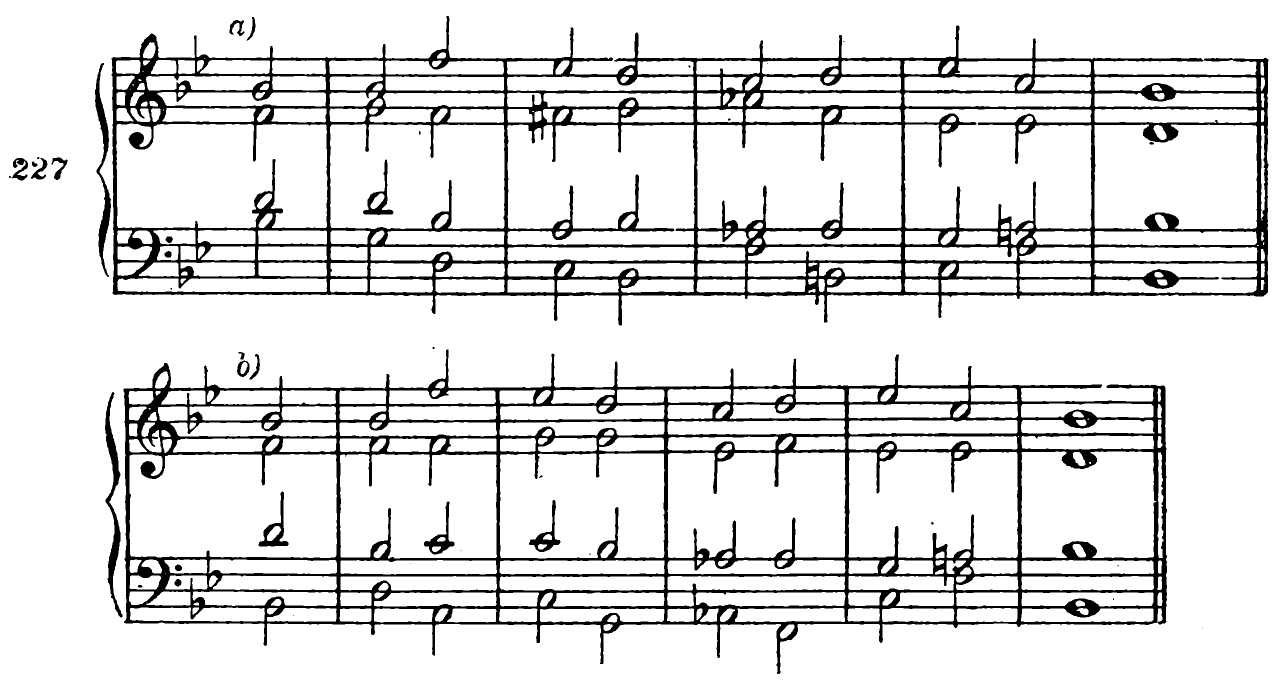
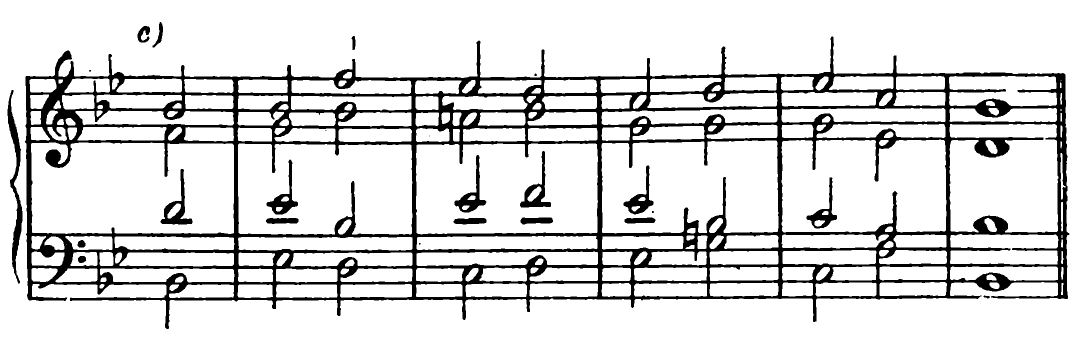
Example 227 attempts to harmonize the first line. This melody is not particularly easy to set: it is fairly long but does not offer a great many degrees, as the pupil can easily verify by writing the degrees beneath it and selecting the good possibilities for connection. In particular, because E-flat and C occur twice in the melody, it will not be easy to avoid repeating II or IV, together with their accessories. Solution 227b is perhaps relatively the best, although it is rather modest, and repeating the bass note F toward the end of the line is not very fortunate. The solution Bach found is wonderful (228). Admittedly, it would scarcely be possible without passing and neighboring notes, which are therefore not ornamental here but structural: not accidents, not foreign to the harmony, but necessities, chords. In general, the pupil will have to pay particular attention to avoiding repeated chords. Especially what I called “accessories” above—the dominant or secondary dominant accompanying a degree, or its substitute, a diminished triad acting as a quasi-VII—will readily try to slip in. As stated, avoiding this is not always possible, and a good result is therefore not easily attained. Mendelssohn's chorale harmonizations show this best: how difficult even a master often finds it to inhabit a style that is not his own. Brahms usually succeeds better, having attained outstanding mastery of stylistic imitation in general. Nevertheless, the differences between a chorale harmonization by Bach and one by Brahms remain quite striking. For this reason I avoid including a model example of my own making and instead give Bach's entire chorale (228). To be sure, I could produce a setting of a quality the pupil will not be able to achieve for some time. But I am not presumptuous enough to present it as a model, as an example to follow, although I do have some regard for my abilities.
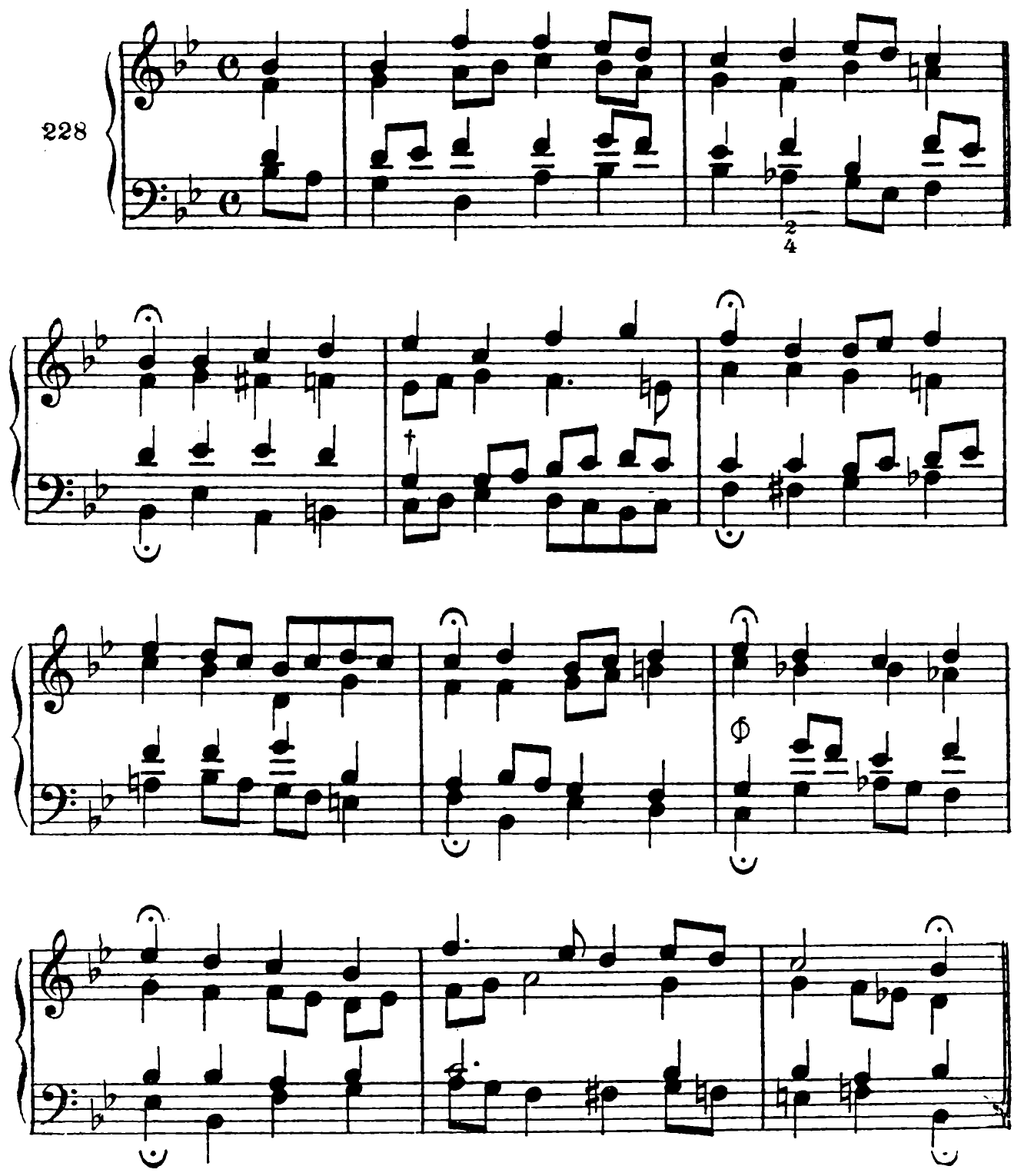
If the pupil notices things here that do not agree with my instructions and their justifications, he may take comfort: art will never be exactly like the laws of art. Art is broad; the laws of art are narrow. Nevertheless, I believe I have framed the instructions broadly enough to leave room for actual events. If, for example, at the circle-and-line sign the distance between alto and tenor, an eleventh, is greater than our instructions allowed, the justification for that instruction spoke of an “average” euphony. This surely implies that there are spacings above and below it of such a kind that the octave distance nevertheless remains the average euphony. Or if at the dagger the alto does not first resolve its E-flat, I said “it will be good,” not “it must ….” And besides, as was also pointed out, the E-flat resolves in the bass.
The pupil should practice chorale harmonization in as many cases as possible. Above all, I recommend setting every chorale in at least two or three different ways. Naturally he should strive for the greatest possible smoothness. He will not, or will scarcely, attain it. The value of the exercise therefore lies only in working through the material: it is a gymnastic exercise that strengthens specific muscles. As with any such training, the goal worth seeking is not the beautiful execution of the individual exercise, but the cultivation of certain abilities.